
Free Flight: Old-Timers
Clarence Haught
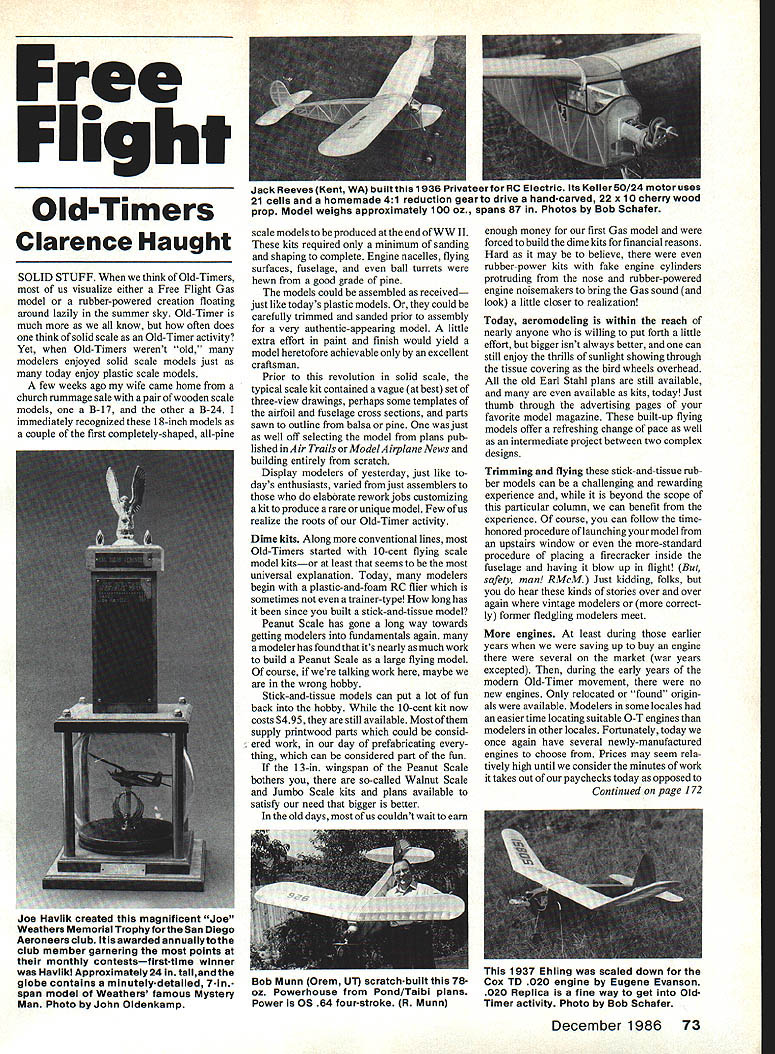
SOLID STUFF. When we think of Old-Timers, most of us visualize either a Free Flight gas model or a rubber-powered creation floating around lazily in the summer sky. Old-Timer is much more, as we all know, but how often does one think of solid scale as an Old-Timer activity?
Yet, when Old-Timers weren't "old," many modelers enjoyed solid scale models just as many today enjoy plastic scale models.
A few weeks ago my wife came home from a church rummage sale with a pair of wooden scale models, one a B-17 and the other a B-24. I immediately recognized these 18-inch models as a couple of the first completely-shaped, all-pine scale models to be produced at the end of WWII.
These kits required only a minimum of sanding and shaping to complete. Engine nacelles, flying surfaces, fuselage, and even ball turrets were hewn from a good grade of pine.
The models could be assembled as received — just like today's plastic models. Or they could be carefully trimmed and sanded prior to assembly for a very authentic-appearing model. A little extra effort in paint and finish would surely yield a model heretofore achievable only by an excellent craftsman.
Prior to the revolution in solid scale, the typical scale kit contained a vague (at best) set of three-view drawings, perhaps some templates of the airfoil and fuselage cross sections, and parts sawn to outline from balsa or pine. One was just as well off selecting the model from plans published in Air Trails or Model Airplane News and building entirely from scratch.
Display modelers of yesterday, just like today's enthusiasts, varied from mere assemblers to those who do elaborate rework jobs customizing a kit to produce a rare or unique model. Few of us realize the roots of our Old-Timer activity.
Dime kits
Along more conventional lines, Old-Timers started with 10-cent flying scale model kits — or at least that seems to be the most universal explanation. Today, many modelers begin with a plastic-and-foam RC flier which is sometimes not even a trainer-type! How long has it been since you built a stick-and-tissue model?
Peanut Scale has gone a long way toward getting modelers back into fundamentals again. Many modelers have found that it's nearly as much work to build a Peanut Scale as a large flying model. Of course, if we're talking work here, maybe we are in the wrong hobby.
Stick-and-tissue models can put a lot of fun back into the hobby. While the 10-cent kit now costs $4.95, they are still available. Most of them supply plywood parts which, in our day of prefabricating everything, can be considered part of the fun.
If the 13-inch wingspan of the Peanut Scale bothers you, there are so-called Walnut Scale and Jumbo Scale kits and plans available to satisfy our need that bigger is better.
In the old days, most of us couldn't wait to earn enough money for our first gas model and were forced to build the dime kits for financial reasons. Hard as it may be to believe, there were even rubber-power kits with fake engine cylinders protruding from the nose and rubber-powered engine noisemakers to bring the gas sound (and look) a little closer to realization!
Today, aeromodeling is within the reach of nearly anyone willing to put forth a little effort, but bigger isn't always better, and one can still enjoy the thrills of sunlight showing through the tissue covering as the bird wheels overhead.
All the old Earl Stahl plans are still available, and many are even available as kits today! Just thumb through the advertising pages of your favorite model magazine. These built-up flying models offer a refreshing change of pace as well as an intermediate project between two complex designs.
Trimming and flying these stick-and-tissue rubber models can be a challenging and rewarding experience and, while it is beyond the scope of this particular column, we can benefit from the experience. Of course, you can follow the time-honored procedure of launching your model from an upstairs window or the more-standard procedure of placing a firecracker inside the fuselage and having it blow up in flight! (But, safety, man! R. McM.) Just kidding, folks, but you do hear these kinds of stories over and over again where vintage modelers—or, more correctly, former fledgling modelers—meet.
More engines
At least during those earlier years when we were saving up to buy an engine there were several on the market (war years excepted). Then, during the early years of the modern Old-Timer movement, there were no new engines. Only relocated or "found" originals were available. Modelers in some locales had an easier time locating suitable O-T engines than modelers in other locales. Fortunately, today we once again have several newly manufactured engines to choose from.
I just received a mailing from John Targos, 3229 Dianora Dr., Palos Verdes, CA 90274, who distributes the line of engines from Dunham Engineering of England. In the category of spark ignitions, Dunham produces the popular Orwick series of engines. These engines originally appeared shortly after WWII and were sought after as powerful units. Dunham, through John, offers the Orwick in the following sizes:
- .29 cu. in.
- .32 cu. in.
- .64 cu. in.
- .73 cu. in.
Prices run from $150 to $210 U.S.
In addition to the Orwicks, they also offer:
- Mechanair 5.9 cc
- Viking 5.3 cc
Diesel engines are also getting more use in Old-Timer activity. Dunham produces:
- Elflyn 2.49 cc
- Valkyrie 5.3 cc
- Orwick .29
- Oliver Battleaxe
Diesel engines normally require much more breaking-in than we are accustomed to with modern glow engines, but they offer quick-start/launch techniques for thermal flying and are a great change of pace.
Clarence Haught 3226 Honeysuckle Dr. Coeur d'Alene, ID 83814
Transcribed from original scans by AI. Minor OCR errors may remain.

