
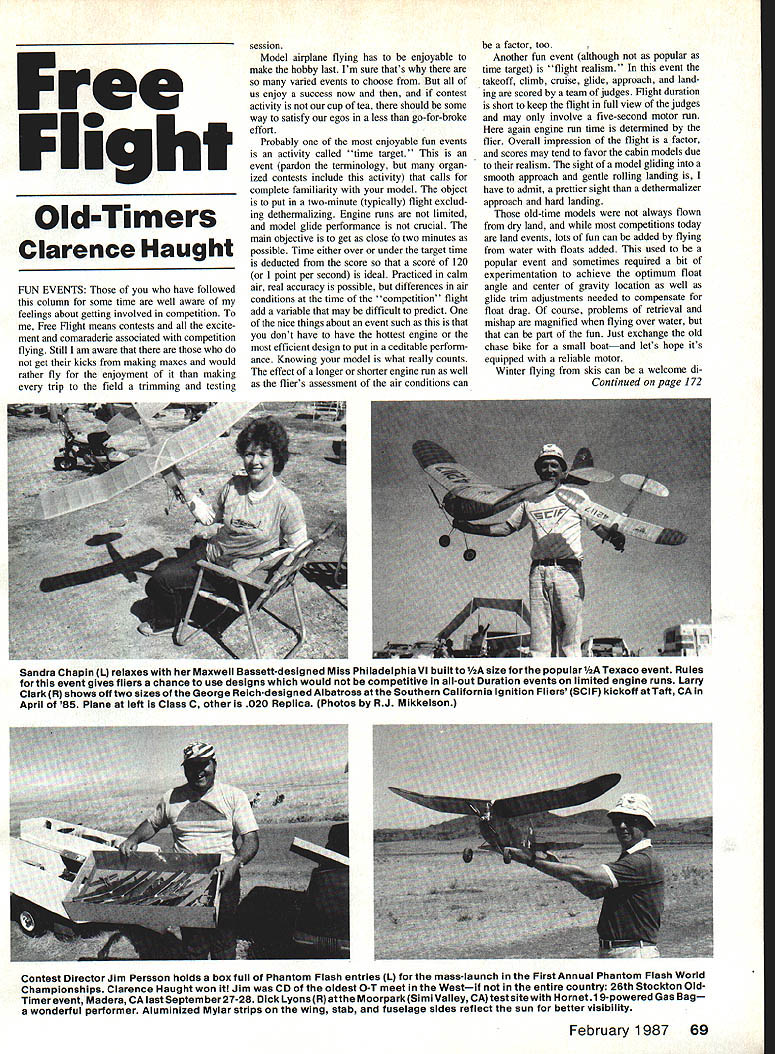
Free Flight: Old-Timers
Clarence Haught
Fun Events
Those of you who have followed this column for some time are well aware of my feelings about getting involved in competition. To me, Free Flight means contests, excitement and camaraderie associated with competition flying. Still, I am aware that there are those who do not get their kicks from making maxes and would rather fly for the enjoyment of it than make every trip to the field a trimming and testing session.
Model airplane flying has to be enjoyable to make the hobby last. I'm sure that's why there are so many varied events to choose from. But all of us enjoy a success now and then, and if contest activity is not our cup of tea, there should be some way to satisfy our egos in a less-than-go-for-broke effort.
Time Target
Probably one of the most enjoyable fun events is an activity called "time target." This event (pardon the terminology) is included in many organized contests and calls for complete familiarity with your model. The object is to put in a two-minute (typically) flight excluding dethermalizing. Engine runs are not limited, and model glide performance is not crucial. The main objective is to get as close to two minutes as possible. Time either over or under the target time is deducted from the score so that a score of 120 (or 1 point per second) is ideal.
Practiced in calm air, real accuracy is possible, but differences in air conditions at the time of the "competition" flight add a variable that may be difficult to predict. One of the nice things about an event such as this is that you don't have to have the hottest engine or the most efficient design to put in a creditable performance. Knowing your model is what really counts. The effect of a longer or shorter engine run as well as the flier's assessment of the air conditions can be a factor, too.
Flight Realism
Another fun event (although not as popular as time target) is "flight realism." In this event the takeoff, climb, cruise, glide, approach and landing are scored by a team of judges. Flight duration is short to keep the flight in full view of the judges and may only involve a five-second motor run. Here again engine run time is determined by the flier. Overall impression of the flight is a factor, and scores may tend to favor cabin models due to their realism. The sight of a model gliding into a smooth approach and gentle rolling landing is, I have to admit, a prettier sight than a dethermalizer approach and hard landing.
Water (Float) Flying
Those old-time models were not always flown from dry land, and while most competitions today are land events, lots of fun can be added by flying from water with floats added. This used to be a popular event and sometimes required a bit of experimentation to achieve the optimum float angle, center of gravity location and other trim adjustments needed to compensate for float drag. Of course, problems of retrieval and mishap are magnified flying over water, but that can be part of the fun. Just exchange the old chase bike for a small boat—and let's hope it's equipped with a reliable motor.
Winter Ski Flying
Winter flying from skis can be a welcome diversion. Skis can be fabricated from building shoe stock, and a good pair of skis can be made in fairly short order. Skis do not require the trim adjustments of floats and permit more conventional chase systems. I personally find model engines a bit cantankerous in cold weather, so I leave all this winter fun up to my friends. But if you enjoy getting out in the winter, ski flying can provide the incentive.
Mass-Launch and Other Fun Activities
There are other fun-type activities which can be added to sport or contest flying, and given the ingenuity of most Free Flighters, I'm sure that many more can be thought up. Most other modeling interests have them. For example:
- Mass-launch events: lots of fun and present interesting problems of safe retrieval.
- Launch, "last-one-down-wins" events in Scale modeling.
- Le Mans starts in RC racing.
The possibilities are there. Perhaps the best thing about these fun events is that they keep old models and old timers involved in the hobby without the pressure of serious competition. After all, Free Flight is supposed to be fun — and these events are designed to make it more so.
Safety
I would suggest, however, that events that try to beat the clock with engine starts, takeoffs, or retrievals should be closely evaluated for their safety factors. Hurrying to do anything around a spinning propeller is not a good idea. Play it safe and put in procedures that are compatible with safe operating practices. A trip to the emergency room can spoil your whole day.
Newsletters
It seems that all Free Flighters enjoy reading about their counterparts in other areas and keeping track of local events through newsletters. I am fortunate enough to receive a handful of newsletters every month, and they never go unread.
I recently received a form of newsletter, the Okie Free Flier, from its editor and publisher, Bill Baker, 1902 Peer Pl., Norman, OK 73072. What makes the Okie Free Flier different? It is an independent newsletter published in the interest of Free Flight news from across the country. So far 16 issues have been printed. Some material is contributed, some is original by Bill, and some is borrowed from other newsletters. For example, issue 16 features an article first published in the Bat Sheet, the official newsletter of the Stratobats of the Seattle area. Also included are contest announcements, building tips, classified ads, and a few cartoons. Just the thing for keeping informed about the world of Free Flight. Cost is a buck an issue with no restriction on subscription length. It comes out eight times per year.
Clarence Haught 3226 Honeysuckle Dr. Coeur d'Alene, ID 83814
Transcribed from original scans by AI. Minor OCR errors may remain.

