
Free Flight: Old-Timers
Clarence Haught
Back in the Thirties modelers often competed for a particular perpetual trophy. One such trophy was the Moffett Memorial Trophy, named after Admiral Moffett, who died when the U.S. airship Akron plunged into the Atlantic in April 1933. In 1936 Vernon Gray won the Moffett Trophy when his model was proxy-flown to 44 minutes, 14 seconds by Bert Pond at Detroit, MI.
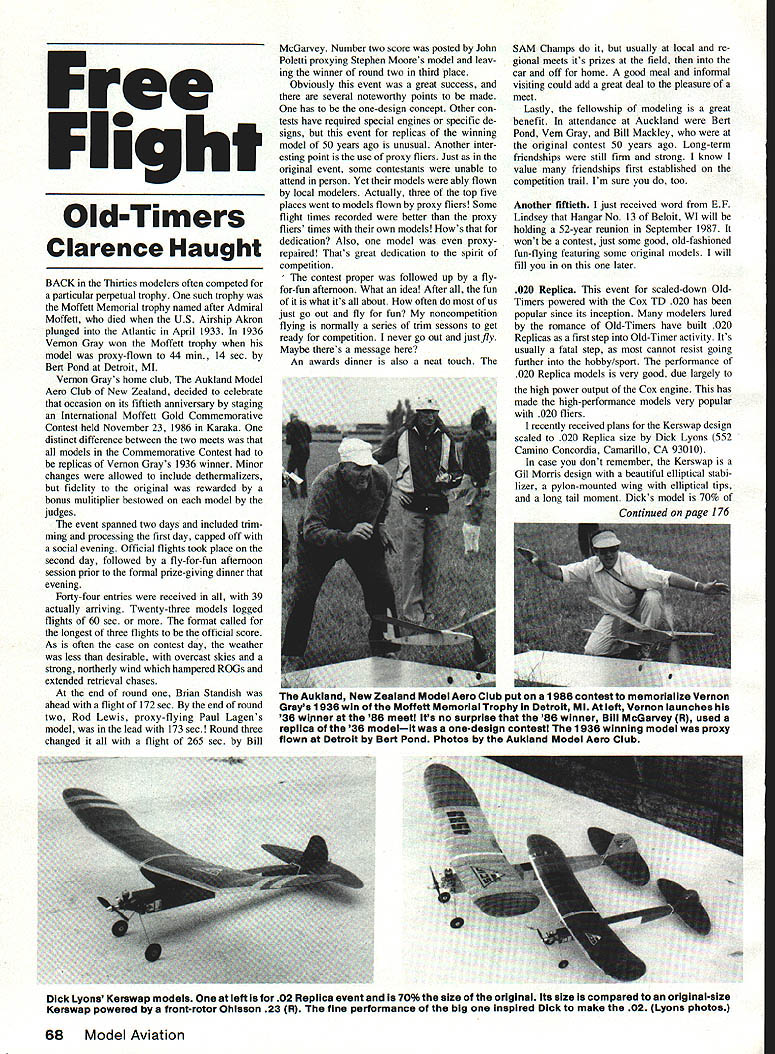
Vernon Gray's home club, the Auckland Model Aero Club of New Zealand, decided to celebrate that occasion on its fiftieth anniversary by staging an International Moffett Gold Commemorative Contest held 23 November 1986 in Karaka. One distinct difference between the two meets was that all models in the Commemorative Contest had to be replicas of Vernon Gray's 1936 winner. Minor changes were allowed to include dethermalizers, but fidelity to the original was rewarded by a bonus multiplier bestowed on each model by the judges.
The event spanned two days and included trimming and processing on the first day, capped off with a social evening. Official flights took place on the second day, followed by a fly-for-fun afternoon session prior to the formal prize-giving dinner that evening.
Forty-four entries were received in all, with 39 actually arriving. Twenty-three models logged flights of 60 seconds or more. The format called for the longest of three flights to be the official score. As is often the case on contest day, the weather was less than desirable, with overcast skies and a strong northerly wind which hampered ROGs and extended retrieval chases.
At the end of round one, Brian Standish was ahead with a flight of 172 seconds. By the end of round two, Rod Lewis, proxy-flying Paul Lagen's model, was in the lead with 173 seconds. Round three changed it all with a flight of 265 seconds by Bill McGarvey. Second place was posted by John Poletti proxying Stephen Moore's model, leaving the winner of round two in third place.
This event was a great success, and there are several noteworthy points to be made. One is the one-design concept. Other contests have required special engines or specific designs, but this event for replicas of the winning model of 50 years ago is unusual. Another interesting point is the use of proxy fliers. Just as in the original event, some contestants were unable to attend in person, yet their models were ably flown by local modelers. Actually, three of the top five places went to models flown by proxy fliers. Some flight times recorded were better than the proxy fliers' times with their own models — how's that for dedication? One model was even proxy-repaired. That's great dedication to the spirit of competition.
The contest proper was followed by a fly-for-fun afternoon. What an idea! After all, the fun of it is what it's all about. How often do most of us just go out and fly for fun? My noncompetition flying is normally a series of trim sessions to get ready for competition. I never go out and just fly. Maybe there's a message here.
An awards dinner is also a neat touch. The SAM Champs do it, but usually at local and regional meets it's prizes at the field, then into the car and off for home. A good meal and informal visiting could add a great deal to the pleasure of a meet.
Lastly, the fellowship of modeling is a great benefit. In attendance at Auckland were Bert Pond, Vern Gray, and Bill Mackley, who were at the original contest 50 years ago. Long-term friendships were still firm and strong. I know I value many friendships first established on the competition trail. I'm sure you do, too.
Another fiftieth: I just received word from E.F. Lindsey that Hangar No. 13 of Beloit, WI, will be holding a 52-year reunion in September 1987. It won't be a contest, just some good old-fashioned fun-flying featuring some original models. I will fill you in on this one later.
.020 Replica
.020 Replica is an event for scaled-down Old-Timers powered with the Cox TD .020 and has been popular since its inception. Many modelers, lured by the romance of Old-Timers, have built .020 Replicas as a first step into Old-Timer activity. It's usually a fatal step; one cannot resist going further in the hobby/sport. Performance of .020 Replica models is very good due largely to the high power output the Cox engine provides, which has made high-performance models very popular with .020 fliers.
I recently received plans for the Kerswap design scaled to .020 Replica size from Dick Lyons (552 Camino Concordia, Camarillo, CA 93010). In case you don't remember, the Kerswap is a Gil Morris design with a beautiful elliptical stabilizer, a pylon-mounted wing with elliptical tips, and a long tail moment. Dick's model is 70% of the original in size (the original Kerswap being powered by a front-rotor Ohlsson .23 R). The fine performance of the big one inspired Dick to make the .020 version. He says it is the equal of the Stratostreak, which dominates many .020 meets. The Kerswap won the SCAMPS annual last November with six maxes! Many modelers asked Dick for plans, so he has them made available for five dollars. The plans come with a sheet of construction and trim notes.
Clarence Haught 3226 Honeysuckle Dr. Coeur d'Alene, ID 83814
Transcribed from original scans by AI. Minor OCR errors may remain.

