
Free Flight: Old-Timers
Clarence Haught
Operating an ignition engine
Many newcomers to Old-Timer activity have considerable experience with glow engines, but most have never operated an ignition engine. Running one can be half the fun, but there are a few new things to learn and some challenges to be met. You know of the presence of ignition points and a spark plug and that a coil, condenser, and batteries are needed, but there are a few fine points to be dealt with.
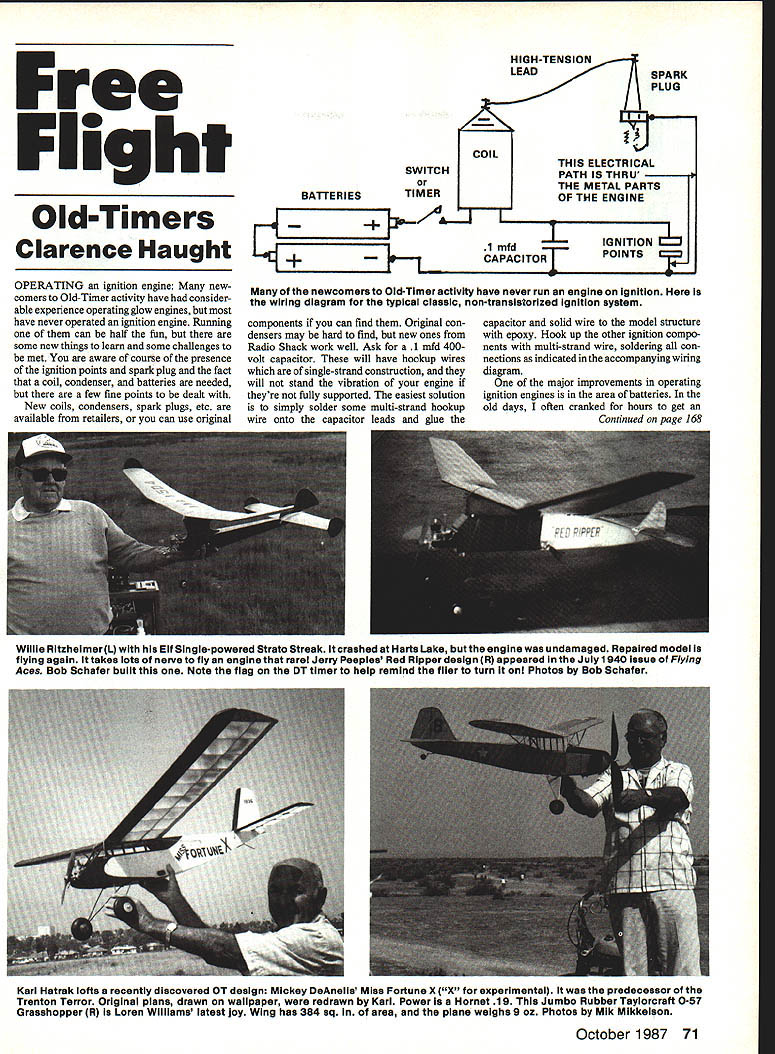
New coils, condensers, spark plugs, etc., are available from retailers, or you can use original components if you can find them. Original condensers may be hard to find, but new ones from Radio Shack work well. Ask for a 0.1 µF, 400-volt capacitor. These will have hookup wires of single-strand construction and will not stand the vibration of your engine unless they are fully supported. The easiest solution is to solder some multi-strand hookup wire onto the capacitor leads and glue the capacitor solidly to the model structure with epoxy. Hook up the other ignition components with multi-strand wire, soldering all connections as indicated in the wiring diagram.
Batteries
One of the major improvements in operating ignition engines is batteries. In the old days I often cranked for hours to get an engine started on booster batteries—only to have it quit when switched over to the flight batteries. Today, on my larger models I use alkaline C or D batteries for the flight pack and start the engine without booster batteries. For bench-running, I still prefer boosters made from two 1.5-volt dry cells in series to provide the required three volts. I do use boosters on small models equipped with AA flight batteries.
Polarity of the ignition system is optional, but care must be used when using booster batteries, since reversing their polarity will ruin the flight pack.
Propellers and performance
Ignition engines run slower than their glow counterparts and generally require a propeller with a larger diameter and lower pitch. As a rule of thumb, I usually use:
- 9" diameter prop on small engines up to .19 cu. in. displacement
- 10" on small Class B (.19 to .25 cu. in.)
- 11" on .29s
- 14" on .60s
Pitch in the neighborhood of 4" to 6". I like to use the largest propeller that will still allow the engine to attain its original rated RPM.
Fuel and lubrication
Fuel for the ignition engine must be mixed. Although ignition engines will run on alcohol fuel, SAM competition rules require a gasoline/methanol mix. The originally recommended formula was three or four parts white gasoline to one part SAE-70 motor oil (motorcycle oil).
White gasoline is no longer available at service stations, but unleaded auto gas is a good substitute. SAE-70 oil is now scarce; I use aviation SAE-60 (uncorrected) from the local airport and mix it three-to-one with unleaded gasoline. It seems to work fine. Some suppliers offer premixed fuel and other lubricating additives; availability varies.
Electric starters
Before attempting to start an ignition engine, note that older engines were not designed for electric starters. Electric starters place a reverse thrust load on the crankshaft and may push it back into the crankcase far enough to cock and score the piston or damage the bearings. Use an electric starter with care; whenever possible, start these engines by hand or with a starter designed to bear on the prop hub rather than the crankshaft.
Ignition timing and starting procedure
Ignition occurs when the points open — not when they close (i.e., just after the piston has started downward). After the engine is running, advance the spark timing by moving the timer arm against the direction of propeller rotation until maximum RPM is obtained.
To start the engine:
- Open the needle valve three or four turns.
- Choke the engine by turning the propeller while holding a finger over the air intake to draw fuel into the engine.
- Retard the spark and energize the ignition system.
- Crank the engine until it starts.
- Adjust the needle valve and spark advance alternately until the engine runs properly.
Troubleshooting
If the engine fails to start:
- Remove the high-tension (spark plug) lead from the spark plug and hold its end near the engine (about 1/4 inch) while turning the prop and watching for the high-voltage spark. Do not touch the bare end of the high-tension lead or any engine part with your body while cranking.
- If there is no spark, try advancing the ignition timer a bit (you may have retarded it too far). Check that the points are clean, dry, and set to about 0.012 inch clearance. Oil on the points will create an insulating film and prevent sparking.
- Other causes of no spark: poor electrical connections, bad batteries, or broken hookup wires.
If you have spark but the engine doesn't fire:
- Check for a fouled spark plug. Remove the plug, hook the high-tension lead to its normal spot, and hold the metal base of the plug against the engine while rotating the prop with the ignition on. You should see a good, hot spark jump between the electrodes. An oil-fouled plug won't work, and plugs can have internal failures. Carry a spare spark plug to the flying field.
If the ignition system checks out, experiment with the needle valve setting and prime the engine with a few drops of fuel in the exhaust port. If all else fails, screw a glow plug into the engine and connect a 1.5-volt battery to it while you start the engine. The engine will run on the glow plug as long as the battery is connected; this allows you to get the fuel regulated without the hassle of the ignition system and is a good way to isolate fuel problems from ignition problems.
Practice
Run your ignition engine many times until you are thoroughly acquainted with its operation before you install it in your airplane and head for the flying field.
Catalogs
I recently received a neat catalog from Old-Timer Model Supply, P.O. Box 7334, Van Nuys, CA 91409. OTMS is operated by Ken Sykora, a longtime enthusiast of Old-Timer modeling. Many have read his articles in the SCIF newsletter Flightplug (he signs them "King Sugar"). Ken offers many hard-to-locate items, mainly in the rubber-power field, including an extensive inventory of rubber-model plans: Stahl, Struhl, Lindberg, Comet, Megow, Scenic, etc.
New tools
I also received a sample of a new sanding block called Grate-Shapes. They come with grit bonded to the surfaces and are sold in many shapes, including flats, grooves (for making V-shaped edges), radii suitable for leading edges and other curved model parts, and round bars. They work well. The manufacturer is Bell Rock Industries, 6846 Hwy. 179 — Suite 108, Sedona, AZ 86336.
Clarence Haught 3226 Honeysuckle Dr. Coeur d'Alene, ID 83814
Transcribed from original scans by AI. Minor OCR errors may remain.

