
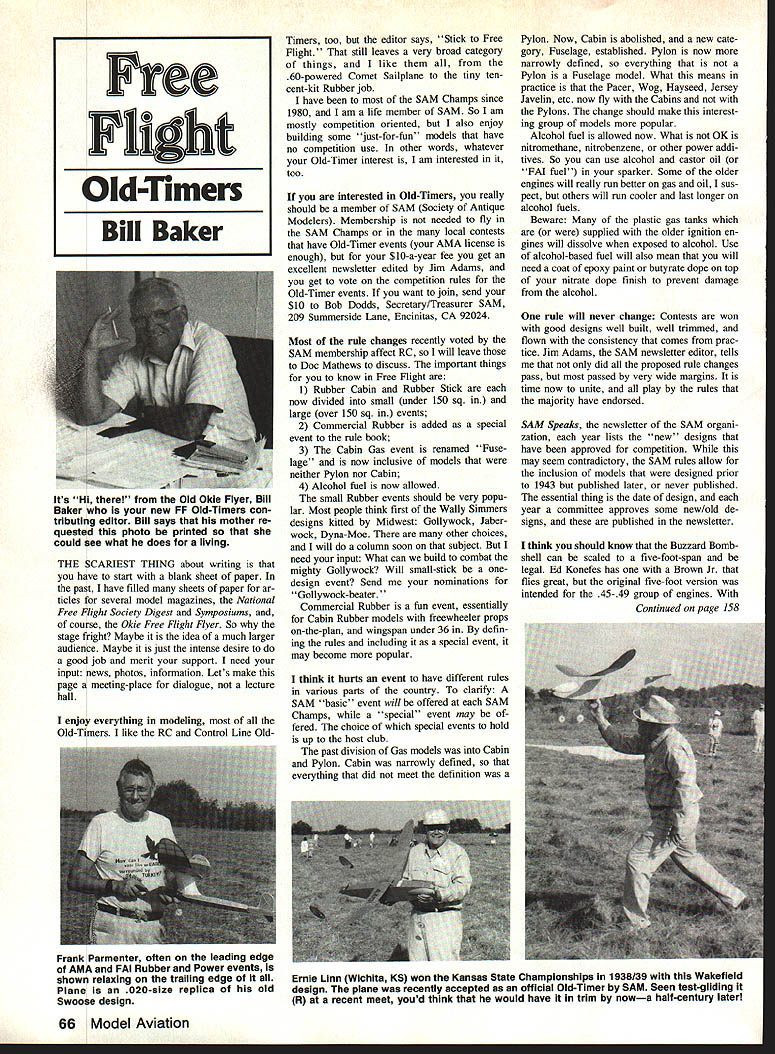
Free Flight: Old-Timers
Bill Baker
THE SCARIEST THING about writing is that you have to start with a blank sheet of paper. In the past I have filled sheets of paper for articles for several model magazines, the National Free Flight Society Digest and Symposiums, and, of course, the Okie Free Flight Flyer. So why the stage fright? Maybe it's the idea of a much larger audience. Maybe it is the intense desire to do a good job and merit your support. I need your input: news, photos, information. Let's make this page a meeting-place for dialogue, not a lecture.
I enjoy everything in modeling, most of all the Old-Timers. I like the RC and Control-Line Old-Timers, too, but the editor says, "Stick to Free Flight." That still leaves a very broad category of things, and I like them all, from the 60-powered Comet sailplane to the tiny ten-cent-kit rubber job.
I have been to most of the SAM Champs since 1980, and I am a life member of SAM. So I am mostly competition-oriented, but I also enjoy building some "just-for-fun" models that have no competition use. In other words, whatever your Old-Timer interest is, I am interested in it, too.
If you are interested in Old-Timers, you really should be a member of SAM (Society of Antique Modelers). Membership is not needed to fly in the SAM Champs or in the many local contests that have Old-Timer events (your AMA license is enough), but for your $10-a-year fee you get an excellent newsletter edited by Jim Adams, and you get to vote on the competition rules for the Old-Timer events. If you want to join, send your $10 to Bob Dodds, Secretary/Treasurer SAM, 209 Summerside Lane, Encinitas, CA 92024.
Recent rule changes and important items
Most of the rule changes recently voted by the SAM membership affect RC, so I will leave those to Doc Mathews to discuss. The important things for you to know in Free Flight are:
- Rubber Cabin and Rubber Stick are each now divided into small (under 150 sq. in.) and large (over 150 sq. in.) events.
- Commercial Rubber is added as a special event to the rule book.
- The Cabin Gas event is renamed "Fuselage" and is now inclusive of models that were neither Pylon nor Cabin.
- Alcohol fuel is now allowed.
The small Rubber events should be very popular. Most people think first of the Wally Simmers designs kitted by Midwest: Gollywock, Jaberwock, Dyna-Moe. There are many other choices, and I will do a column soon on that subject. But I need your input: What can we build to combat the mighty Gollywock? Will small-stick be a one-design event? Send me your nominations for "Gollywock-beater."
Commercial Rubber is a fun event, essentially for Cabin Rubber models with freewheeler props on-the-plan, and wingspan under 36 in. By defining the rules and including it as a special event, it may become more popular.
I think it hurts an event to have different rules in various parts of the country. To clarify: a SAM "basic" event will be offered at each SAM Champs, while a "special" event may be of the host club's choice.
The past division of gas models was into Cabin and Pylon. Now, Cabin is abolished and a new category, Fuselage, established. Pylon is now more narrowly defined, so everything that did not meet the definition is a Fuselage model. What this means in practice is that the Pacer, Wog, Hayseed, Jersey Javelin, etc., now fly with the Cabins and not with the Pylons. The change should make this interesting group of models more popular.
Alcohol fuel is allowed now. What is not OK is nitromethane, nitrobenzene, or other power additives. So you can use alcohol and castor oil (or "FAI fuel") in your sparker. Some of the older engines will really run better on gas and oil, I suspect, but others will run cooler and last longer on alcohol fuels.
Beware: many of the plastic gas tanks that were supplied with older ignition engines will dissolve when exposed to alcohol. Use of alcohol-based fuel will also mean that you need to coat with epoxy paint or butyrate dope over your nitrate-dope finish to prevent damage from the alcohol.
One rule will never change: contests are won with good designs, well built, well trimmed, and flown with the consistency that comes from practice. Jim Adams, the SAM newsletter editor, tells me that not only did all the proposed rule changes pass, but most passed by very wide margins. It is time now to unite, and all play by the rules that the majority have endorsed.
SAM Speaks, the newsletter of SAM, each year lists the "new" designs that have been approved for competition. While this may seem contradictory, the SAM rules allow inclusion of models designed prior to 1943 but published later or never published. The essential thing is the date of design, and each year a committee approves some new/old designs and these are published in the newsletter.
I think you should know that the Buzzard Bombshell can be scaled to a five-foot span and be legal. Ed Konefes has one with a Brown Jr. that flies great, but the original five-foot version was intended for the .45–.49 group of engines.
Consequences
Don Larsen, a California free flier, learned this the hard way on one of his .020 gas-powered wings. The model had a spoiler DT with the hinge line at 25% chord. After launch, it climbed out beautifully, transitioned well, and was gliding nicely until the dethermalizer popped. When the spoiler came out it caused a large nose-down moment, and the model executed a square outside figure-seven and dove vertically into the ground. Needless to say, Don has moved the spoiler back on his latest models.
Don is one of the better flying-wing builders in the hobby and is always a serious threat at the annual Northrop Flying Wing Contest.
On my own tailless P-30s I have gotten extreme. I let the fuse burn through the wing hold-down rubber bands and separate the wing from the fuselage. The wing and fuselage are attached by a string. The wing tips snap-free and the fuselage hangs beneath it on the way down. This type of DT works on all lightweight models, and it also produces some amusing expressions of shock from spectators who don't know that it is deliberate and think they are witnessing a disaster in progress.
Sometimes the thermal gods are hungry, and even a pop-off wing will not keep them from eating your model. I learned this one day when trimming one of my P-30s. When the DT actuated, the wing and fuselage separated properly but, unfortunately, the DT fuse had not only burned through the rubber bands, it had also burned the string holding the wing and fuselage together! The fuselage came down rapidly, and the wing continued to climb in the thermal, tumbling end-over-end. It eventually was lost from sight. How often do you get half of an out-of-sight (OOS)?
At Taft, to quote Martyn Cowley, the thermals play for keeps. This year I had the experience of watching a P-30 with a pop-off wing go OOS overhead on a clear day AFTER the wing had come off and the fuselage was hanging beneath it on the string. This always seems to happen right after you drop a flight badly enough to put your heart out of the money in the contest. At least I got the model back.
One of the great charms of Taft is that there are so many modelers out chasing that things very rarely stay lost.
Another dethermalizer approach for flying wings is to pivot a large chunk of the wing around an axis near the trailing edge. This makes a big hole in the wing and causes air to flow over the movable piece, holding the back end of the model down and forcing it to stall. The model comes down flat, just like a conventional model on DT. The only disadvantage of the system is that the large hole in the wing is a structural weak spot, and you must be careful to make the structure around it strong enough to carry the loads.
Taft and the San Diego Orbiteers
The San Diego Orbiteers Club held its annual contest over the Labor Day weekend at Taft. They put on a great contest, and a good time was had by all. In addition to the standard AMA events, the Orbiteers added some new and fun classes of competition.
One of these was Night P-30. Free Flight becomes a truly eerie experience when all you can see is a little green chem-lamp light circling silently overhead.
A second fun event for the terminally hypersensitive was Minuteman. The goal here is to put up the maximum number of one-minute flights possible in a half-hour period. Contestants could use any AMA-legal model or any model which was legal in any unofficial event being flown at the contest. Those of us who were too lazy to fly were treated to a mass launch of every kind of model imaginable when the starters all went off.
The winner was a 10-year-old Junior flying a Pee Wee-30 model. Unfortunately, the prize was a magnum of champagne, which he was too young to legally drink. The situation was compounded when the champagne bottle had been sitting in the Taft sun for everyone to lust after; it exploded when the hot bottle contacted the cold ice in the bucket. At last report, the contest director was going to provide a replacement award more appropriate for a 10-year-old.
The Orbiteers' Annual was my first chance to fly Pee Wee-30. There is no doubt in my mind that the Orbiteers, who originated P-30, have done it again, and I expect Pee Wee-30 to become extremely popular. The models are easy to build and fly, and the event is a heck of a lot of fun.
Barnaby Wainfan 2503 Hardwick St. Lakewood, CA 90712
New and recently approved designs
The release of Herb Wahl's excellent Bunch Tiger replica may make this a popular choice.
Another recently approved scale design is a 52-inch version of the Stinson Reliant. Plans for this one show an "A" and a "B" version, too, with a .23 to .25 engine. You can get a full-size printed plan of the design from Bob Lahr (45 South Withrow Ave., Indianapolis, IN 46201) for $4.85 postpaid.
If you ask, I can include a list of other Old-Timer and Nostalgia plans — names as well as a list of full-size plans of Old-Timer hand-launched gliders, which include the Hank Cole glider (but it will cost you another $1.25 postpaid). In my opinion, the latter will become a favorite design of the OT HLG fliers once it becomes more widely known.
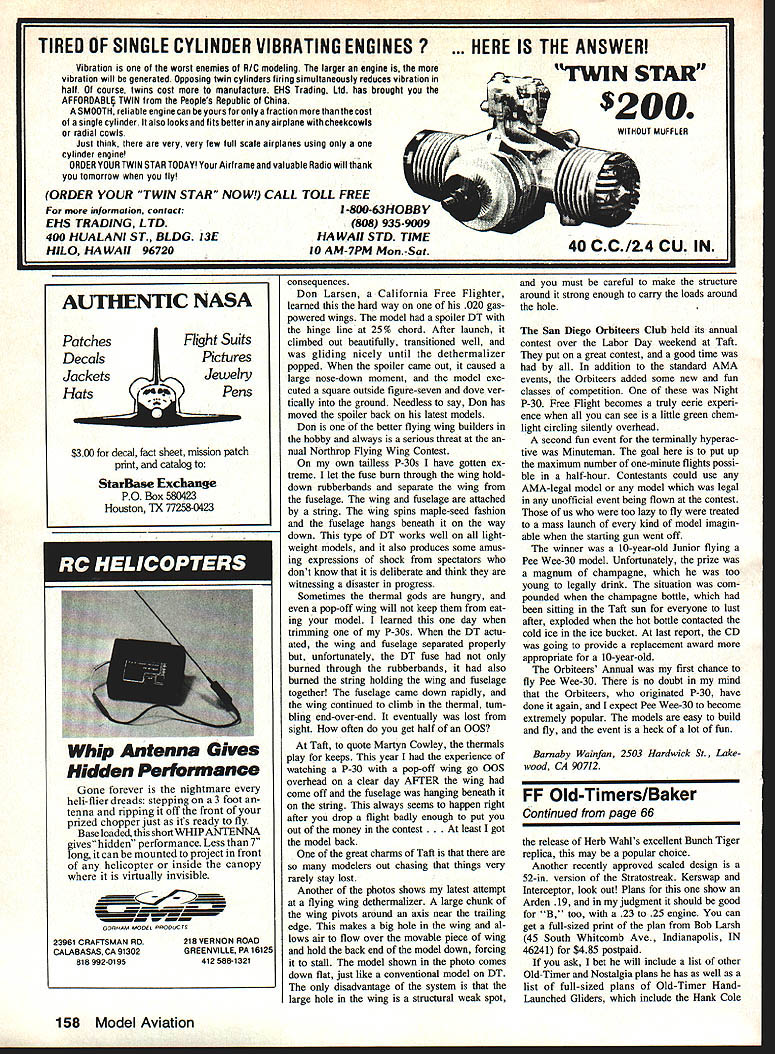
Old-Timer Wakefield is increasingly popular. The ships can be flown in "large Cabin Rubber" under the new rules, and there are, more and more frequently, special events for them. A "new" design you might want to consider is Ernie Linn's Kansas State Champion Wakefield. Two versions are shown — 1938 (freewheeler) and 1939 (folder). You can get the full-size plan from Ernie for $4.50. The address is 3505 East Mt. Vernon, Wichita, KS 67218.
Upcoming events and my schedule
The 1988 SAM Champs will be the week of July 18 at Lawrenceville, IL. There will be a MECA Grand National. Flying will start July 19, with the traditional bean feed that evening, and the awards banquet will be Friday evening, July 22.
I am writing this in late September for an October 1 deadline, and you will read it in December (in your January issue). In the meantime, I will go to the Mid-America FF Champs October 17–18 at Lawrenceville, check out the site for you, and report in my next column, which should be the March issue (which you will get in February and which I will write in November for a December 1 deadline... Pay attention, there may be a quiz).
Future columns and requests
Future columns will include a rundown on what is now available in replica engines and parts, glow-to-ignition conversions, and sources of other items needed by the Old-Timer flier. I need your help to locate the cottage industries involved. Please send all information, news, photos, queries, etc. to me at the address below.
William L. Baker P.O. Box 249 Norman, OK 73070-0249
Transcribed from original scans by AI. Minor OCR errors may remain.

