
Free Flight: Old-Timers
Clarence Haught
KEEPING TRIM: The flying season is officially here. Time to get those old birds out for a check of the trim or do the initial trimming on a brand-new ship. Even if your model has several successful seasons on it, winter storage may take its toll in the form of unwanted warps, sticky timers or congealed oil in the fuel system. Better to check it out before the big contest than to spend the day troubleshooting or retrimming.
Trimming the old-timer is a little different than checking out the typical AMA power ship. Start by locating the center of gravity or balance point. Many old-timer plans do not indicate the C.G. Generally speaking, cabin ships balance at 1/3 of the chord back from the leading edge. Pylon models should balance at 1/2 chord.
Next check the model for warps. Any unwanted warps can be removed by twisting in the opposite direction while holding the surface over steam from a pan of boiling water. Eliminate any tail surface warps. Wing tips should be washed out slightly (trailing edge higher than leading edge) so that tips will not stall before main panels and induce spins. About 3/32 inch is O.K.
If you plan your glide turn to be the same as the power turn the inboard wing panel, in the direction of turn, should be washed slightly (trailing edge lower than the leading edge)—1/8 inch is average. This effective added incidence will assist the slower flying inboard wing during the climbing turn and this same added incidence will create enough drag to help induce a gliding turn in the same direction.
If you wish to glide in the opposite direction of the power pattern, then you would be better advised to keep the main panels flat and climb against opposite rudder tab to hold the inboard wing up and glide with the rudder as was typical in the "old days." I personally feel models transition better if all turns are in the same direction. Stabilizer tilt widely used for turn trim on modern models is seldom effective on old-timers due to the small area compared to the wing and the frequent use of non-lifting stabilizer airfoils.
The basic rule for power turn is pylon Right, cabin left. Some cabin ships will climb to the right just as well, but I would recommend left to be on the safe side. Power turn is usually induced by engine side-thrust. While on the subject of thrust adjustments most old-timers need down-thrust, but it is rarely called out on the plan. About 2 degrees is a good starting point.
We should now be ready for the flight tests. Hand glide your ship into the wind and check for diving or stalling tendencies. Correct by changing incidence in either the wing or stab. I prefer to make all adjustments to the stabilizer because changing wing incidence effectively changes the thrust line. Also, turning tendencies should be observed. Due to the limited duration of a hand glide, only slight turn should be apparent.
Begin the power tests with a 5-second engine run. A shorter run will not tell you enough and a longer one may prove disastrous if trim is far off. The engine should be adjusted for a reasonable amount of thrust. Extremely low power won't really tell you anything and could lead to a stall. As soon as possible increase power to normal as many models behave considerably different as power increases so trimming done at low power will have to be redone anyhow.
Gradually lengthen engine run while observing flight pattern. Adjust climb pattern with thrust and/or incidence adjustments. Make only one adjustment at a time. Don't worry too much about glide trim as long as it's safe at this stage. Once the power pattern is good you can correct glide speed with small shifts in the center of gravity by the addition of a ballast.
Glide turn can also be induced by adding a short (approximately 6 in.) piece of 1/4 x 1 tapered trailing edge stock to the bottom trailing edge of the inboard wing (trim edge forward). Some modelers prefer a hinged drag flap for this purpose, but my experience with them is nil so I'll not misdirect you on that score.
Transition from power to glide is influenced by power turn. If you are having trouble with transitions, try a tighter power turn. This will reduce the effective incidence, and you may have to increase it to maintain climb angle. Looping tendencies can be corrected by down-thrust or more power turn. Think out each problem as you observe it. If things aren't going too well, pack up and go home where you can devote unpressured thought to the problem. Never rush flight trimming procedures.
Fuel Tests: My mail indicates many of you are testing various fuels for improved service life and better power. Phil Mahony of Lime Rock, CT has been experimenting with Castrol R-40. Phil claims less heat with this oil. He uses Amoco high-test and no-lead gasoline. Phil didn't indicate his mixing ratio, but 3 to 1 would be a good start.
Mark Fechner out Salt Lake way has run some interesting tests using an O&R 19 side-port engine and an Y & O 10-4 prop using various oils and combustibles, but always comparing back to good old SAE 70 oil. The accompanying chart shows the results of Mark's tests. Mark is an accomplished engine conversion specialist. We plan to obtain one of Mark's Klondyke engines for test in a future column. For a list of parts, services, and engines write him at 4456 W. 3145 S., Salt Lake City, UT 84120.
Incidentally, Mark has available excellent reproduction Super Cyclone manuals. A very interesting bit out of the past.
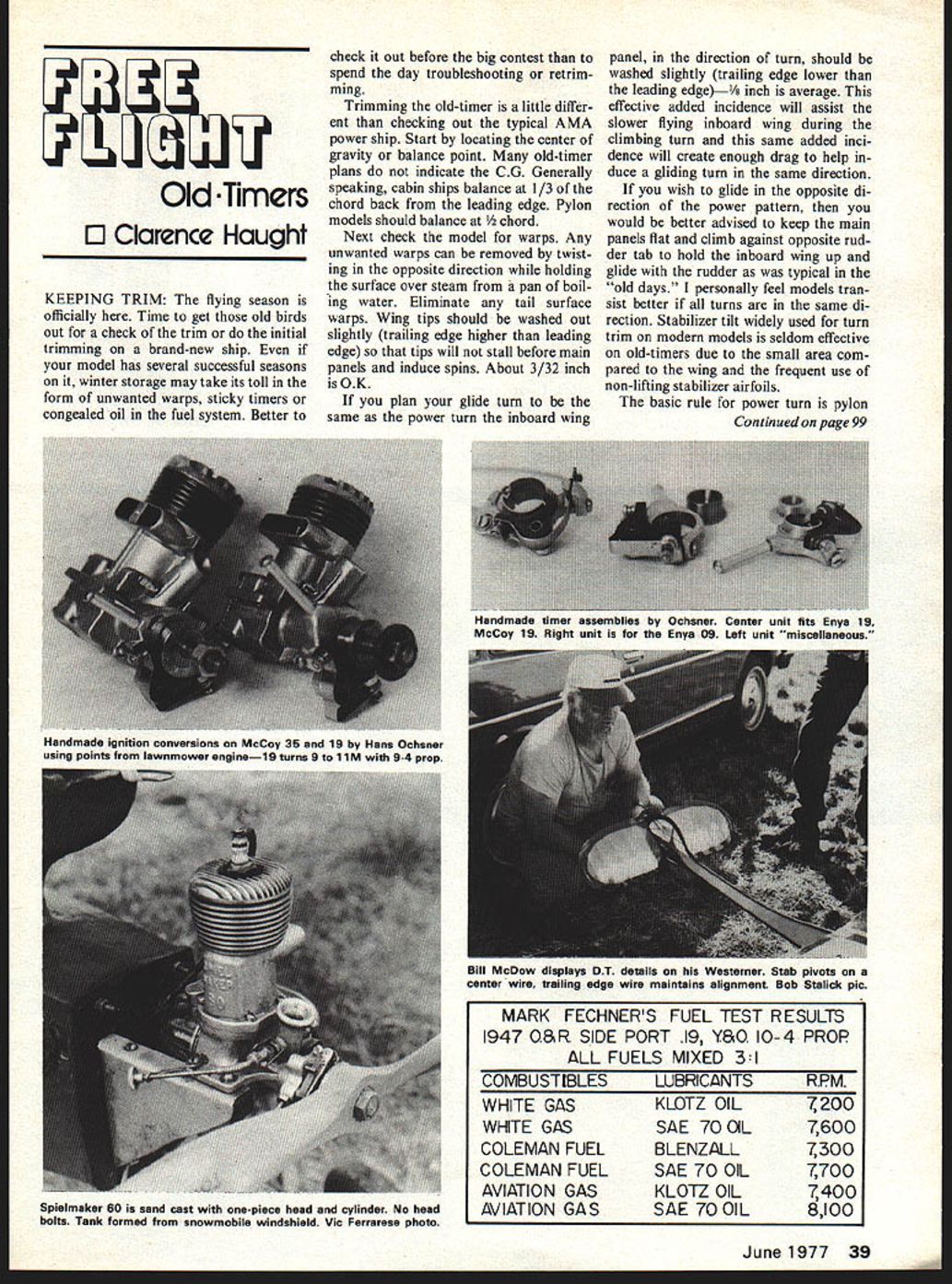
Engines: My mail also indicates considerable interest in engine conversion work. Hans Ochsner of Detroit has been working with McCoy and Enya engines and converting them using only hand tools. Hans utilizes readily available chainsaw and lawnmower point assemblies, and reworks them for model use. The engines so far converted have good power and handling qualities. Hans is a competition flier, and has flown a Brooklyn Dodger on the Enya 19 conversion. Hans also has been running some interesting comparisons of engine dimensions and combustion chamber volumes. Write him at 19195 McCormick, Detroit, MI 48224.
Clarence Haught, Route 5, Box 16, Coeur d'Alene, ID 83814.
Transcribed from original scans by AI. Minor OCR errors may remain.

