
Free Flight: Old-Timers
Bill Baker
1902 Peter Pan Norman, OK 73072
The 1939 Wakefield finals
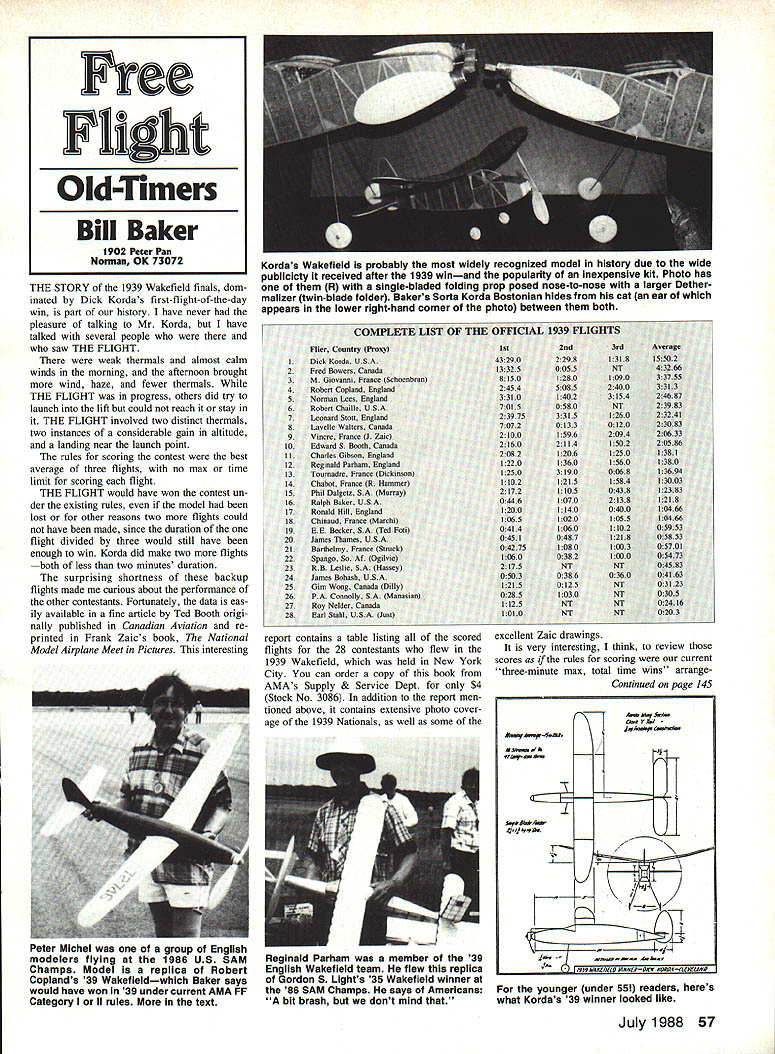
The story of the 1939 Wakefield finals, dominated by Dick Korda's first-flight-of-the-day win, is part of our history. I have never had the pleasure of talking to Mr. Korda, but I have talked with several people who were there and who saw the flight.
There were weak thermals and almost calm winds in the morning; the afternoon brought more wind, haze, and fewer thermals. While the flight was in progress, others tried to launch into the lift but could not reach it or stay in it. The flight involved two distinct thermals, two instances of a considerable gain in altitude, and a landing near the launch point.
The rules for scoring the contest were the best average of three flights, with no maximum or time limit for scoring each flight. The flight would have won the contest under those rules even if the model had been lost or, for other reasons, two more flights could not have been made—since the duration of the one flight divided by three would still have been enough to win. Korda did make two more flights, both of less than two minutes' duration.
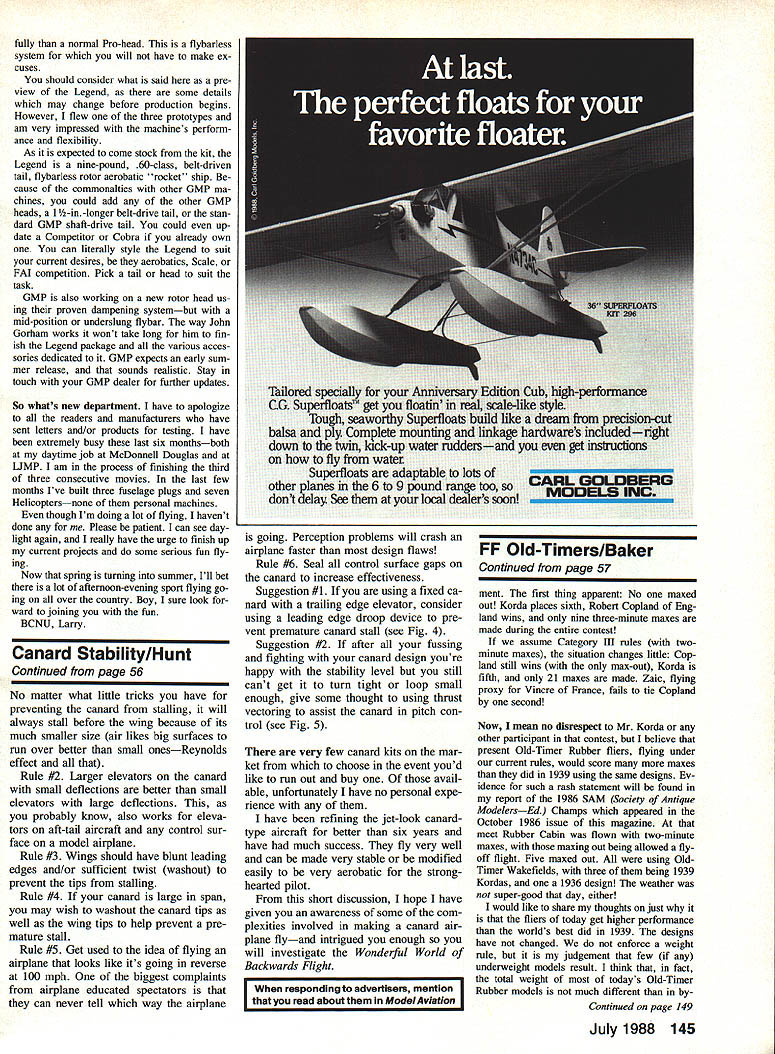
The surprising shortness of these backup flights made me curious about the performance of the other contestants. Fortunately, the data is easily available in a fine article by Ted Booth, originally published in Canadian Aviation and reprinted in Frank Zaic's book The National Model Airplane Meet in Pictures. That report contains a table listing all of the scored flights for the 28 contestants who flew in the 1939 Wakefield, which was held in New York City. You can order a copy of Zaic's book from AMA's Supply & Service Dept. (Stock No. 3086).
Re-scoring with modern criteria
At a glance, the first thing apparent: no one maxed out. Re-scoring the 1939 results using our current "three-minute max, total time wins" criteria changes the placings: Korda drops to sixth, Robert Copland of England wins, and only nine three-minute maxes are recorded during the entire contest.
If we assume Category III rules (two-minute maxes), the situation changes little: Copland still wins (with the only max-out), Korda is third, and only 21 maxes are made. Zaic, flying for the Centre of France, loses to Copland by one second.
I mean no disrespect to Mr. Korda or any other participant in that contest, but I believe that present Old-Timer rubber fliers, flying by our current rules, would score many more maxes than they did in 1939 using the same designs. Evidence for that can be found in my report on the 1986 SAM (Society of Antique Modelers) Champs (October 1986 issue), where Rubber Cabin was flown with two-minute maxes and many designs achieved those maxes.
Why modern fliers do better
I want to share thoughts on why today's fliers get higher performance than the world's best did in 1939, even when flying the same designs:
- Designs themselves have not changed significantly.
- We do not enforce a weight rule, but modern rubber and improved motor-preparation methods make a substantial difference.
- More careful trimming, better prop and airframe handling, and an improved understanding of glide and climb characteristics all contribute to better results with vintage designs when flown by contemporary competitors.
We are no longer in the old days; structures today tend to be heavier while rubber weight is reduced. The old practice was to build very light structures and bring the model up to the required weight with rubber. That produced some terrifying hunks of rubber held by very flimsy structures.
So why didn't the old heavy-rubber models achieve higher average flight times? The answer is: we use less rubber, but we use it well.
Several fliers from that era commented that their winders would not wind the big motors fully without binding, and since they did not use winding tubes, they seldom really attempted to pack in maximum winds (and the models were likely not trimmed for that much power anyway). The long, heavy motors led to inertia problems in pitch trim. Frequent problems with the center of gravity being shifted aft—due to gobs of knots collecting in the rear end—spoiled the glide. (As a side note: a dropped bread-and-jelly sandwich always seems to land jelly-side down—one of Baker's rules derived from Parkinson's Law.)
Modern advantages:
- Winders with good bearings and gears permit winding to maximum turns with ease.
- Blast tubes and torque meters encourage winding to maximum.
- Better rubber is available, and serious competitors test and reserve the best rubber for official flights.
- Fliers are more aware of thermal picking and how to exploit thermals.
- Models today are usually in better trim because they last longer (few are lost due to the short max and universal use of dethermalizers). Flying for a string of maxes encourages stronger, better-built models that stay in trim.
Chester Lance once told me he built "13 or 14" of his popular 1940 National Stick Winner airplanes in one year (since one was lost in every contest). I have a version of this model that I have flown since 1979; it has won many contests, including the SAM Champs twice (1980 and 1986), and is finally getting into good trim.
The same principle applies to gas models. An out-of-sight flight is not needed to win—and should never happen without a dethermalizer failure (except in Oklahoma, where whole houses and towns go flying out of sight from time to time).
Building Old-Timers today: strength without excess weight
The art of building the Old-Timer today is making it stronger than the original without going too heavy. Terry Rimer's three rules for free flight apply: "Keep it light, don't let it get heavy, and it shouldn't weigh much."
Major areas likely to need strengthening:
- Spars
- Leading edges
- Longerons
- Landing gear
- Motor mounts
Tileston, an expert at creating light-but-strong structures, points out that trailing edges are usually too heavy: "They go through the fence last, anyway."
I welcome your input; I don't know it all. You can expect future columns to go into more detail about structural changes, trim schemes, and how to pick a design to build. For now, you know why some changes from the original plans may be desirable.
Advice for gas models
One immediate suggestion for gas models: never use beam mounts. For good trim you must be able to make small thrust-line adjustments easily—so make the engine mounts bolt to the firewall. If you can't adjust the thrust line, the model will be limited in the amount of power it can handle: you'll have too much rudder deflection at high power and still not enough turn in the glide, for example.
Corrections and notes
I have made a couple of errors in past columns: the Micro Model Engineering catalog is $5 now, and the price of the 52-in.-span, SAM-legal-for-FF version of the Strato Streak is $5.85 postpaid from Bob Larsh, 45 S. Whitcomb Ave., Indianapolis, IN 46241.
Thermals. Viva Dos Equis!
Transcribed from original scans by AI. Minor OCR errors may remain.

