
Free Flight: Old-Timers
Bill Baker 1902 Peter Pan Norman, OK 73072
Preface: Philosophical Comments
Before we get to nuts, bolts, and gluing sticks, I want to let loose some philosophical comments.
I often think of an incident from 1960 when I was holding Bob Wilder's Wakefield while he practiced winding to absolute maximum turns prior to our going to try to get him on the U.S. Wakefield team. Sixteen strands of rubber is a lot, and to get all the power possible the expert stretches the rubber almost to the breaking point throughout the entire winding procedure. We both were grunting and straining, trying to concentrate on the number of turns and just the right feel for tension to pull. This was before Bob made his now‑famous torque meters that make this job so much easier. He would pull so hard I could feel my heels cut into the grass at the Wichita "Beech Field." A boy of about ten was watching our labors with amazement. After a flight, as we prepared to do it again, the boy said, "Hey! I have an .049 Baby Bee I'll sell you guys for three bucks that will fly that thing without all that work."
For years I told that story almost as an "Aggie" joke, since the boy was so obviously ignorant of the very existence of the Wakefield event—let alone its terrible importance (importance to us at the time, that is). Now I see it a bit differently: the kid was right!
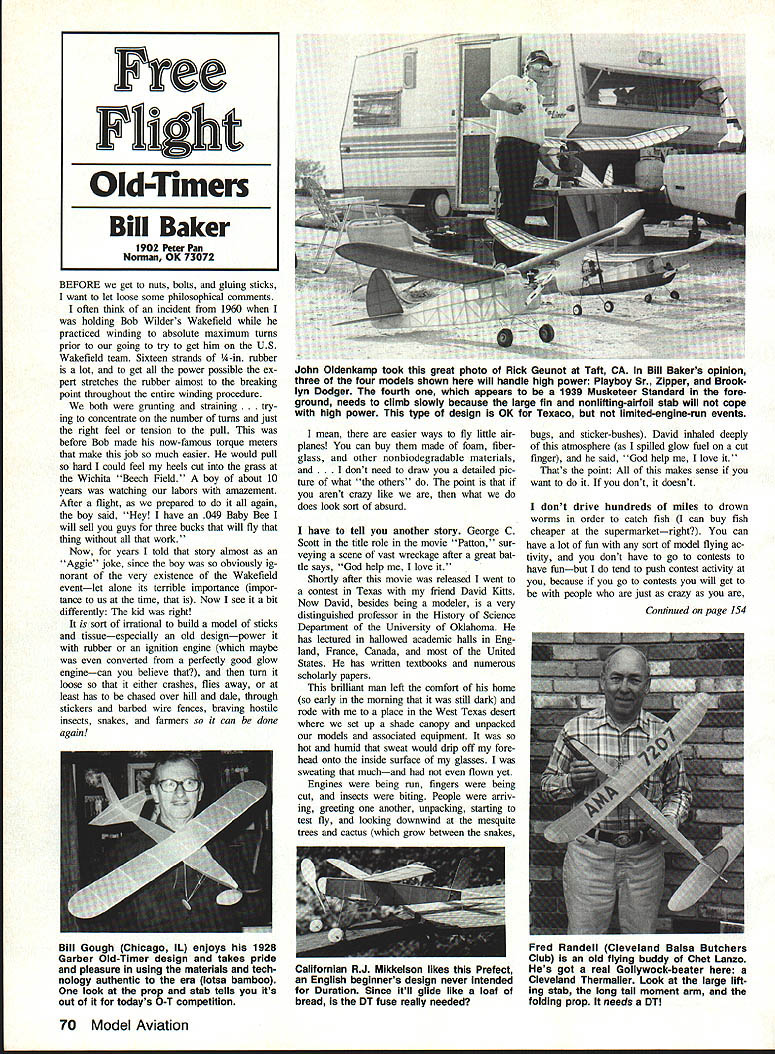
It is sort of irrational to build a model of sticks and tissue—especially an old design—power it with rubber or an ignition engine (which maybe was even converted from a perfectly good glow engine—can you believe that?), and then turn it loose so that it either crashes, flies away, or at least has to be chased over hill and dale, through stickers and barbed-wire fences, braving hostile insects, snakes, and farmers so it can be done again.
I mean, there are easier ways to fly little airplanes! You can buy them made of foam, fiberglass, and other nonbiodegradable materials, and I don't need to draw you a detailed picture of what "the others" do. The point is that if you aren't crazy like we are, then what we do does look sort of absurd.
"God help me, I love it"
I have to tell you another story. George C. Scott, in the title role of the movie Patton, surveying a scene of vast wreckage after a great battle, says, "God help me, I love it."
Shortly after the movie was released I went to a contest in Texas with my friend David Kitts. David, besides being a modeler, is a very distinguished professor in the History of Science Department at the University of Oklahoma. He has lectured in hallowed academic halls in England, France, Canada, and across the United States, and has written textbooks and numerous scholarly papers.
This brilliant man left the comfort of his home (so early in the morning that it was still dark) and rode with me to a place in the West Texas desert where we set up a shade canopy and unpacked our models and associated equipment. It was so hot and humid that sweat would drip off my forehead onto the inside surface of my glasses; I was sweating that much—and had not even flown yet.
Engines were being run, fingers were getting cut, and insects were biting. People were arriving, greeting one another, unpacking, starting to test fly, and looking downwind at the mesquite trees and cactus (which grow between the snakes, bugs, and sticker-bushes). David inhaled deeply of this atmosphere (as I spilled glow fuel on a cut finger), and he said, "God help me, I love it." That's the point: All of this makes sense if you want to do it. If you don't, it doesn't.
You don't drive hundreds of miles to drown worms in order to catch fish (you can buy fish cheaper at the supermarket). You can have a lot of fun with model flying activity and not go to contests, but I tend to push contest activity because, as you go to contests you will get to be with people who are just as crazy as you are.
Publications and Foreign Coverage
One useful bit of information I tracked down was on turbulators. That turned up in the Italian model magazine Modellistica in an article about Anselmo Zen’s Rara Avis Wakefields. By the way, Andrujkov uses a 4 mm turbulator at 42% chord. The best information on CG location (55–60%) was in this column a few years back, in a review of a British FAI system.
Wings of the Featherland is a most interesting publication; no ads, and all in Russian, of course. The magazine covers everything from skydiving to aviation history. Free Flight coverage includes both detailed plans of state-of-the-art FAI models and a beginner’s column done cartoon-style. I even spotted a Wakefield motor test.
Many general modeling magazines around the world include an occasional Free Flight item. But there are a few publications that cover Free Flight exclusively:
- NFFS Digest (U.S.)
- Free Flight News (British monthly newsletter). A typical issue includes several three-views, a technical article or two, contest results, and a roundup of available supplies. Contact: Ian Kaynes, 7 Ashley Road, Farnborough, Hants GU14 7EZ, England.
- Vol Libre (French bi-monthly, now in its eleventh year). Editor André Schandel puts a lot of work into this publication; last year he was honored with a special NFFS award. A typical 60-page issue will include several three-views in each of the main FAI categories, as well as coverage of Coupe, P-30, or A-1. For fun, he includes a Peanut or two each issue. One of the regular contributors is 1937 Wakefield champ Emmanuel Fillon, who has evidently retired and jumped into Peanut with a vengeance. Indoor (F1D and beginner models) is also covered.
Although Vol Libre is written in French, there are English and German translations of a few articles in each issue. The three-views are easy to understand, no matter the language, as long as you are familiar with the metric system. A French–English dictionary will help with the rough spots.
Part of the fun of reading foreign magazines (even Aeromodeller) is "translating" them into American English. For example, in the Danish magazine Modelflyve Nyt, there is this delightful account of the Power flyoff at the 1987 Scandinavian International:
"Thomas Koster vant F1C-konkurrencen i ved trilde fly-off runde at handskaste sin model til en flyvning på 2 sekunder. Nummer to, Lothar Doring, hadde nemlig ikke nogen model at flyve med i runden."
Very loosely translated (by someone who knows absolutely no Danish), this says:
"In the last fly-off round, Lothar Doring didn't have a model left, so Thomas Koster hand-glided his Power model for a two-second flight to take first place."
Whether you call it "friflygning" like the Danes, "vol libre" like the French, or "freeflight" like the Germans, Free Flight is a great sport, and there is great comfort in that.
Building for Reasons Beyond Competition
I sometimes make models for which there is no competitive use. Somehow it is nice not to be concerned with competitiveness and to make something because I like its looks, have some nostalgic association with it, or for some other reason that has nothing to do with a rational choice based on performance potential.
Having said that, my next several columns will concentrate on selecting designs for performance potential and on the structural modifications needed to make them last long enough to reach that potential (see my previous column—July 1988).
If you want to build a Miss Philadelphia, a Quaker, or a Red Zephyr, and power it with a Super Cyclone .60, let me know so I can get out a couple of the commoner three-views. The old cabin ships, with small, non-lifting stabs, large fins, and short tail-moment arms all looked something like an airplane, and all will fly most pleasantly on moderate power. Add a half-throttle for power if you want to get way up on a short engine run; if you want maximum height, look for a ship with:
- a longer tail moment arm
- shorter nose
- large stab with a lifting airfoil
- small fin
- lots of dihedral
The Buzzard Bombshell does not have a lifting stab, but it has everything else. With reasonable limits it will handle a good .60 (Super Cyclone, Oliver, or Brown), and instead of looping or spiraling during the last shots, you will get a pleasant, high-phi glide.
Old-Timer Design Notes
The late Old‑Timer era (circa 1940–41) was a period of accelerated development; in general the higher-performance models were developed then, and very few designs from earlier years can match them.
- The Interceptor, Strato Streak, and Kerswap came out after fuselage cross-section rules had been dropped, so they have lower drag in addition to pylons, long tail moments, large lifting stabs, and small fins.
- The Theo-Radical, designed by Schoenbrun and published in Model Craftsman in April 1941, is astonishingly modern in appearance, with fine proportions. It may have been overlooked because the magazine was not as widely available as Model Airplane News and Air Trails were; it looks like a Playboy-batcher if there is one.
Another design factor to look for, in addition to proportions, is weight. Simple structures tend to give low weight:
- The Strato Streak, especially in its .020 Replica form, is a winner because of excellent proportions and a simple, four-stringer fuselage that is light.
- The Kerswap is also a four-stringer box.
- The Playboy has an eight-stringer box, but only four of them need to be of the hard wood. On the other hand, there is more cross-section—and therefore more drag—to the Playboy than to the Kerswap.
How about the American Ace? It is pretty and is the "B" version of the New Ruler. This ship was never as successful as the New Ruler, maybe because of the poor balsa that came in so many of the Berkeley kits. Even so, it is a good ship; there is a lot of structure in the fuselage, so it has to be heavier than a Playboy Jr. and will very likely be tail-heavy, thereby needing a lot of lead ballast up front.
Do you get the idea I am driving at? There is a lot of difference in what you will build, predicated on why you are building it in the first place.
Rubber Models
For rubber-powered models the key features to look for are:
- light structures
- large lifting-airfoil stabs
- large-diameter folding props (at least 25% of the wingspan)
- plenty of dihedral
Some very pretty models do not meet these criteria—the Scientific Zephyr, for example. Of course, you can always cut off the nose and stick on a Baby Bee.
Closing
If you want plans, three-views, or advice on picking an old-timer for competition or for fun, drop me a line. My next columns will get more technical and cover specific modifications to improve longevity and performance.
Transcribed from original scans by AI. Minor OCR errors may remain.

