
Free Flight: Old-Timers
By Bill Baker 1902 Peter Pan Norman, OK 73072
Jim Bohash and the U.S. Standard Wakefield
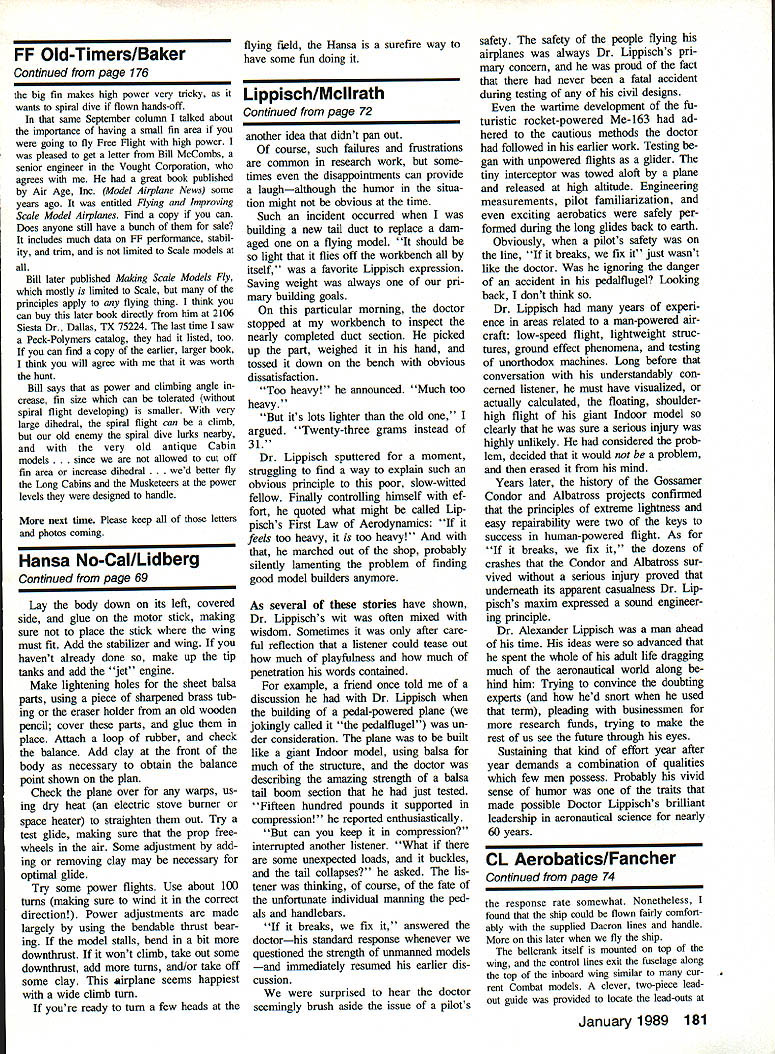
A couple of the photos this month show an interesting 1938/39 Wakefield—with a folding prop—which has never heretofore been published. It is the design of Jim Bohash, who called it the U.S. Standard Wakefield. It not only got him on the 1938 and 1939 U.S. Wakefield teams, but won many contests in the U.S. and Canada.
Jim tells me that the 1938 Wakefield contest, held at Paris, France, was quite an adventure. Frank Zaic was the team manager and guide, "so we were always lost." Zaic was "broke, as usual," Jim says, and the French customs seized 300 of his Yearbooks—which he had brought along to sell in order to have enough money for his return fare! Jim recalls that Frank "turned on his usual charm," got the books from customs in time to sell enough to make it home—but then there was the problem of visas (Not the credit cards! RMcM), which the hotel had somehow "lost." There was, at that time, a strong black market in stolen visas—war clouds were forming on the horizon, and people were trying to get out of Europe.
Model Airplane News had a feature on the 1938 and '39 Wakefield finals in its November 1939 issue, and said, "It is our sincere hope that world conditions will not prevent the fraternity of model builders from getting together again next year at the Wakefield contest which will be held in this country."
I got a kick out of learning from Bohash that Cahill's winning flight in 1938 was made with a Band-Aid on the propeller. It seems the blade was damaged, and they could not get the glue to set hard, so Jim put a Band-Aid on it.
Jim Bohash, like so many, started modeling after the Lindbergh flight. He flew indoor until he attended the 1936 Wakefield finals where he met Copland, Judge, and Gordon Light—which turned him into a Wakefield flier.
Jim's performance at the 1939 Wakefield meet was quite a disappointment, and as one might guess, was due to having to use a new, untested model instead of his "good one," which had been flattened by cattle after landing in the stockyards on a test flight. His workshop was burglarized and vandalized, and there was barely time to build a new one.
The design is an excellent one, however, and I think it should be competitive for flying in both today's Old-Timer Cabin Rubber events (large and small) and, of course, the OT Wakefield events. The plan was never published, but it was approved for SAM competition in 1983. The plan is available for $5 from Jim Bohash:
- Jim Bohash, 20721 Millard St., Taylor, MI 48180
The 1938 version had the wing on the fuselage, but in 1939 he experimented with a pylon wing mount—so you get your choice. This ship looks very good. I hope lots of you build it.
Jim still treasures the memories and friendships that modeling provided him, and he marvels that while the Great Depression was still on, a "poor kid from West Detroit" could be sent to France to fly models. Could it happen today? I sort of doubt it. Jim is retired now after a successful career in engineering, a bit of gold prospecting, and some songwriting. He did his share for the U.S. Army Air Corps in WWII, and he flew Wakefields up until about 1950. He never got around to publishing his design, but I think it will not be forgotten once today's SAM fliers see the plans.
50th Anniversary of the 1939 Wakefield Championships
I hear from my California correspondents that the 50th anniversary of the 1939 Wakefield Championships will be celebrated at the Taft Free Flight Champs (not the SAM Champs, as announced earlier) on the Memorial Day weekend in 1989. It will feature genuine imported British fliers—and maybe some fliers from other countries such as Canada and Texas—flying 1939 Wakefields. It should be fun. I hope someone builds a Bohash U.S. Standard and this time gets it in trim—and keeps it away from the stockyards!
Compressed-Air Motors at the 1988 SAM Champs
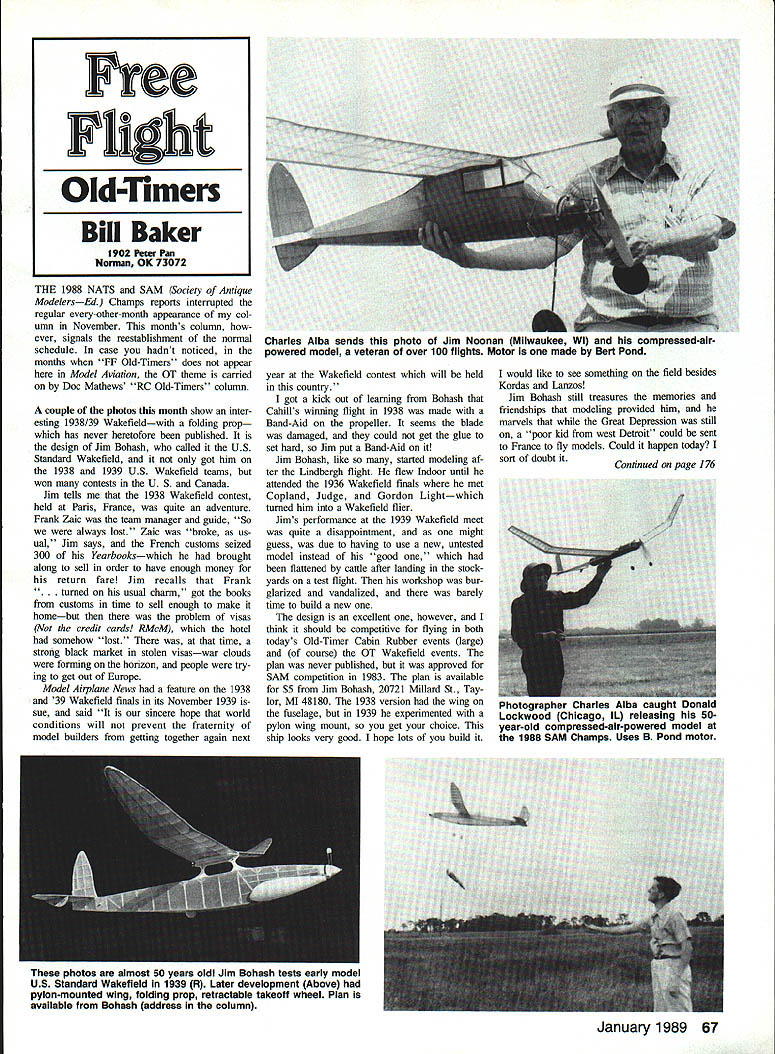
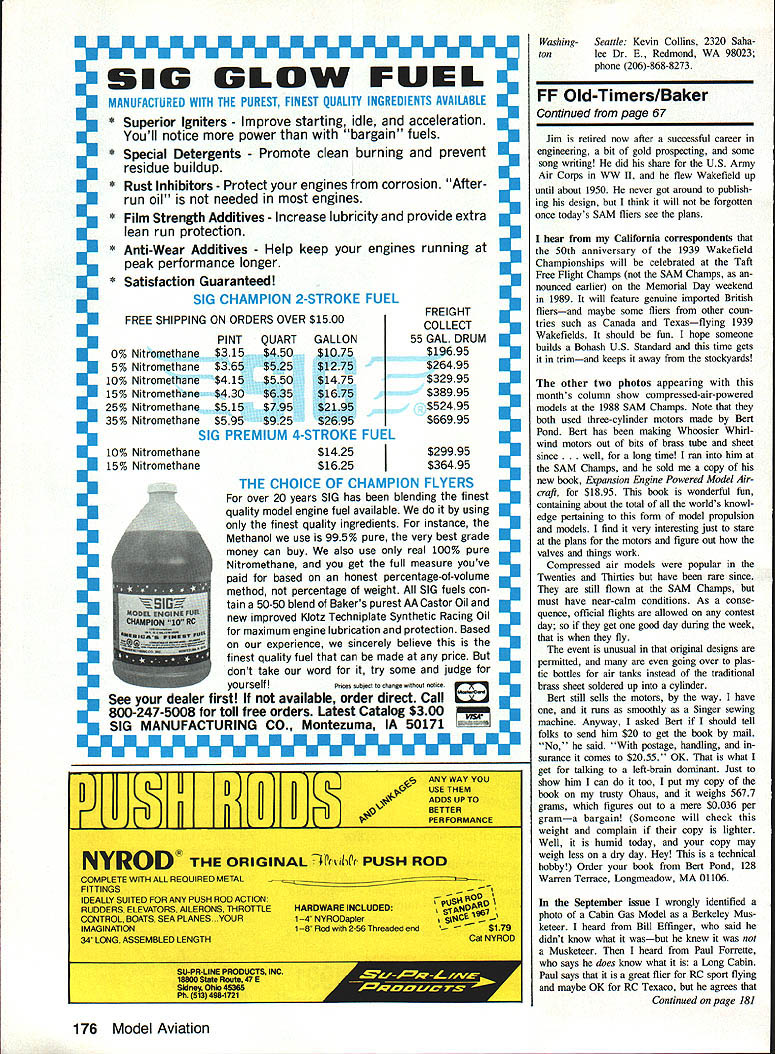
The other two photos appearing with this month's column show compressed-air-powered models at the 1988 SAM Champs. Note that they both used three-cylinder motors made by Bert Pond. Bert has been making Whoosher Whirlwind motors out of bits of brass tube and sheet for a long time! I ran into him at the SAM Champs, and he sold me a copy of his new book, Expansion Engine Powered Model Aircraft, for $18.95. This book is wonderful fun, containing about the total of all the world's knowledge pertaining to this form of model propulsion and motors. I find it very interesting just to stare at the photos of motors and engines and figure out how the valves and things work.
Compressed-air motors were popular in the Twenties and Thirties but have been rare since. They are still flown at the SAM Champs, but they need near-calm conditions. As a consequence, official flights are allowed on any contest day; so if they get one good day during the week, that's it when they fly.
The event is unusual in that original designs are permitted, and many are being revived. People are using new bottles for air tanks instead of the traditional brass sheet soldered up into a cylinder.
Bert still sells the motors, by the way. I have one, and it runs as smoothly as a Singer sewing machine. I asked him how to buy the book, and he told me the price with postage, handling, and insurance comes to $20.55. To prove a point, I put my copy on my trusty Ohaus, and it weighs 567.7 grams, which figures out to a mere $0.036 per gram—a bargain! (Someone will check this and complain if they find it lighter.) Well, it is humorous, but I hope many will use the book as an aid in their work. Order your book from:
- Bert Pond, 128 Warren Terrace, Longmeadow, MA 01106
Corrections and Identifications
In the September issue I wrongly identified a photo of a Cabin Gas Model as a Berkeley Musketeer. I heard from Bill Effinger, who said he didn't know what it was—but that it was not a Musketeer. Then I heard from Paul Forrette, who says he does know what it is: a Long Cabin. Paul says that it is a great flier for RC sport flying and may be OK for RC Texaco, too.
Fin Size and High-Power Free Flight
"The big fin makes high power trickery, as it wants to spiral dive if flown hands-off."
In that same September column I talked about the importance of having a small fin area if you were going to fly Free Flight with high power. I was pleased to get a letter from Bill McCombs, a senior engineer in the Vought Corporation, who agrees with me. He had a great book published by Air Age, Inc. (Model Airplane News) some years ago. It was entitled Flying and Improving Scale Model Airplanes. Find a copy if you can. Does anyone still have a bunch of them for sale? It includes much data on FF performance, stability, and trim, and is not limited to Scale models at all.
Bill later published Making Scale Models Fly, which mostly is limited to Scale, but many of the principles apply to any flying thing. I think you can buy this latter book directly from him at:
- Bill McCombs, 2106 Siesta Dr., Dallas, TX 75224
Bill says that when power and climbing angle increase, the fin size which can be tolerated (without spiral flight developing) is smaller. With very large dihedral, the spiral flight can be a climb, but our old enemy the spiral dive lurks nearby, and with the very old antique Cabin models—since we are not allowed to cut off fin area or increase dihedral—we'd better fly the Long Cabins and the Musketeers at the power levels they were designed to handle.
More next time. Please keep all those letters and photos coming.
Transcribed from original scans by AI. Minor OCR errors may remain.

