
Free Flight: Old-Timers
Author
Bill Baker 1902 Peter Pan Norman, OK 73072
Cardboard jigs and Ed Lidgard
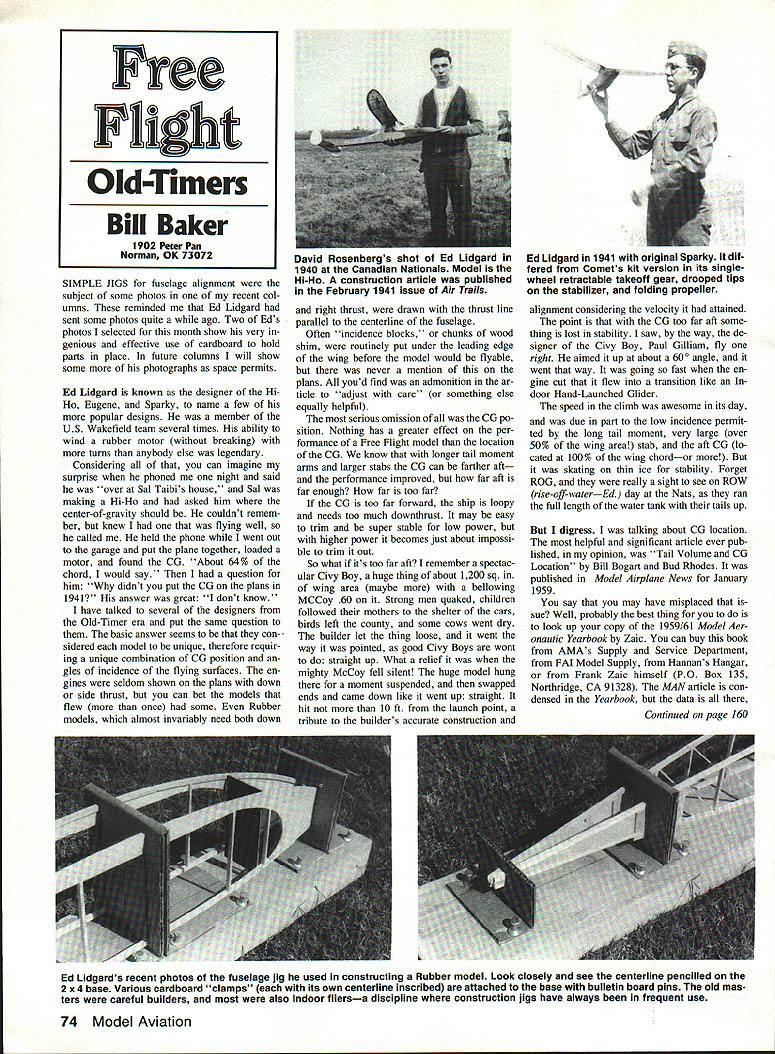
Simple jigs for fuselage alignment were the subject of some photos in one of my recent columns. These reminded me that Ed Lidgard had sent some photos quite a while ago. Two of Ed's photos I selected for this month's show his very ingenious and effective use of cardboard to hold parts in place. In future columns I will show some more of his photographs as space permits.
Ed Lidgard is known as the designer of several popular models, including:
- Hi-Ho
- Eugene
- Sparky
He was a member of the U.S. Wakefield team several times. His ability to wind a rubber motor (without breaking) with more turns than anybody else was legendary.
Considering all of that, you can imagine my surprise when he phoned me one night and said he was "over at Sal Taibi's house," and Sal was making a Hi-Ho and had asked him where the center-of-gravity should be. He couldn't remember, but he knew he had one that was flying well, so he called me. He held the phone while I went out to the garage and put the plane together, loaded a motor, and found the CG. "About 64% chord," I told him. He said, "Why didn't you put the CG on the plans in 1941?" His answer was great: "I don't know."
Center of gravity and old plans
I have talked to several of the designers from the Old-Timer era and put the same question to them. The basic answer seems to be that they considered each model to be unique; therefore requiring a unique combination of CG position and angles of incidence of the flying surfaces. The engines were seldom shown on the plans with down or side thrust, but you can bet the models that flew (more than once) had some. Even rubber models, which almost invariably need both down and right thrust, had the drawn thrust line parallel to the centerline of the fuselage.
Often "incidence blocks," or chunks of wood which were routinely put under the leading edge of the wing before the model would be flyable, were shown in a view or mentioned on the plans. All you'd find was an admonition in the article to "adjust with care" (or something close enough to help).
The most serious omission of all was the CG position. Nothing has greater effect on the performance of a Free Flight model than the location of the CG. We know that with longer tail moment arms and larger stabs the CG can be farther aft—and the performance improved—how far aft is far enough? How far is too far?
If the CG is too far forward, the ship is loopy and needs too much downthrust. It may be easy to trim it out. If the CG is too far aft, stability can be seriously compromised. I remember a spectacular Civy Boy, a huge thing of about 1,200 sq. in. wing area (maybe more), with a bellowing McCoy .60 on it. Strong men quaked, children were led from the shelter, and the cows went dry. The builder let the thing loose, and it went the way it was pointed, as good Civy Boys are prone to do—straight up. What a relief it was when the mighty McCoy fell silent! The huge model hung there for a moment suspended, and then swapped ends and came down like it went up; straight. It hit not more than 10 ft. from the launch point, a tribute to the builder's accurate construction and alignment considering the velocity it had attained.
The point is that with the CG too far aft something is lost in stability. I saw the designer of the Civy Boy, Paul Gilliam, fly one right. He aimed it up at about a 60° angle, and it went that way. It was going so fast when the engine cut out that it flew into a transition like an in-door hand-launched glider.
The speed in the climb was awesome in its day, due in part to the low incidence permitted and the very large tail moment—over 50% wing area; stab aft, CG located almost at 100% wing chord—or skating on thin-ice stability. Forget ROG; it was really a sight to see ROW (rise-off-water). But I digress. I was talking about CG location.
Useful references
The most helpful and significant article ever published, in my opinion, was "Tail Volume and CG Location" by Bill Bogart and Bud Rhodes. It was published in Model Airplane News for January 1959.
If you have misplaced that issue, the best thing to do is to look up your copy of the 1959/61 Model Aeronautic Yearbook by Zaic. You can buy this book from:
- AMA's Supply and Service Department
- FAI Model Supply
- Hannan's Hangar
- Frank Zaic (P.O. Box 135, Northridge, CA 91328)
The MAN article is condensed in the Yearbook, but the data is all there, including the all-important graph.
The models used to illustrate the graph are mostly designs from the Fifties or Nostalgia era, but the same laws of physics applied in 1940 and earlier. I think rubber models may best be flown just a bit more in the stable direction by 5%–10% than the gas models shown. Anyway, once you understand this article and how to do the simple calculations needed to find your model's location on the graph, you can establish a safe CG position. It remains, perhaps, to find the optimum CG by field trials (and errors), but this method does work.
The article helps one understand why that scale model with a tiny stab must have the CG forward of the 30%-of-wing-chord location to fly successfully, and how the Civy Boy could fly with the CG on (or even aft of) the wing's trailing edge.
Sal Taibi's method for finding optimum CG
Returning to the Hi-Ho story, Sal later told me that the CG position I gave him was helpful, and the model flew well. Ed Lidgard wrote me later telling me how impressed he was with Sal's technique for finding the optimum CG. Sal puts a small bolt in the tail and adds or subtracts washers to it to make small CG changes. He moves the CG aft and retrims the model until the performance gets worse instead of better, and then moves the CG forward again until the performance suffers. The point just between these two extremes is the best position.
Most of us are satisfied with whatever CG we have if the model is flyable (which is why Sal beats us most of the time).
RC considerations
For the RC folk: the large pitch-trim change you experience between power On and power Off can be reduced by moving the CG aft—but too far aft gives you a model which is overly sensitive to elevator movement. It will pay to optimize the CG location, not only for the ease of trimming with less pitch trim change, but because the glide will improve.
You may want the CG a bit ahead of the position for Free Flight, as you will get somewhat better control response, but too far forward will hurt the glide by increasing drag due to the up trim the model has to have, whether you realize it or not, to counter the nose-heavy condition.
Requests and announcements
I am looking for two Hand-Launched Glider plans. One was a design used by Ray Matthews (of FUBAR fame) called the FUGAN, and the other a kit by Testor's in the late Forties. It had one other name than "Contest Hand-Launched Glider" (or something like that). It was somewhat similar to the current Campbell's Thermal Pidget HLG. I'll appreciate leads and/or copies of plans. I'll make same available to all if they're obtained.
Speaking of Campbell's Custom Kits, he has a new catalog out, so send him a couple of bucks and get yours. It lists many modern, Old-Timer, and Nostalgia era kits, and is a good source of Free Flight supplies, timers, winding wires, rubber, etc. If you have problems with the business, manufacture kits and do business with them. The address is: Campbell's Custom Kits P.O. Box 5996 Lake Worth, FL 33466-5996
Recent additions to Campbell's line which would be of interest to Old-Timer fliers include:
- Stahl's Gypsy — a rubber cabin ship similar to the better-known Korda Wakefield
- A SAM-legal Hand-Launched Glider called the Vartamjan
- Various kits formerly made by Fresno and Easy Built, including a 1939 Canadian Wakefield and a Scientific Miss World's Fair
I attended a club meeting of SAM 56 (Wichita, KS) and gave a little slide show from the photos I took at the 1988 SAM Champs. It was a well-received presentation. I would be willing to try to put something similar together for other clubs if the transportation and other costs can be arranged. Is there a SAM chapter in Tahiti?
Transcribed from original scans by AI. Minor OCR errors may remain.

