
Free Flight: Old-Timers
By Bill Baker 1902 Peter Pan Norman, OK 73072
COME ON—make my day! It makes my day when I hear from you. I love to get something in the mail other than bills and advertisements. I will make an effort to answer questions that are accompanied by a SASE (a postcard will often do). Anyway, this month's column is the happy result of some recent mail.
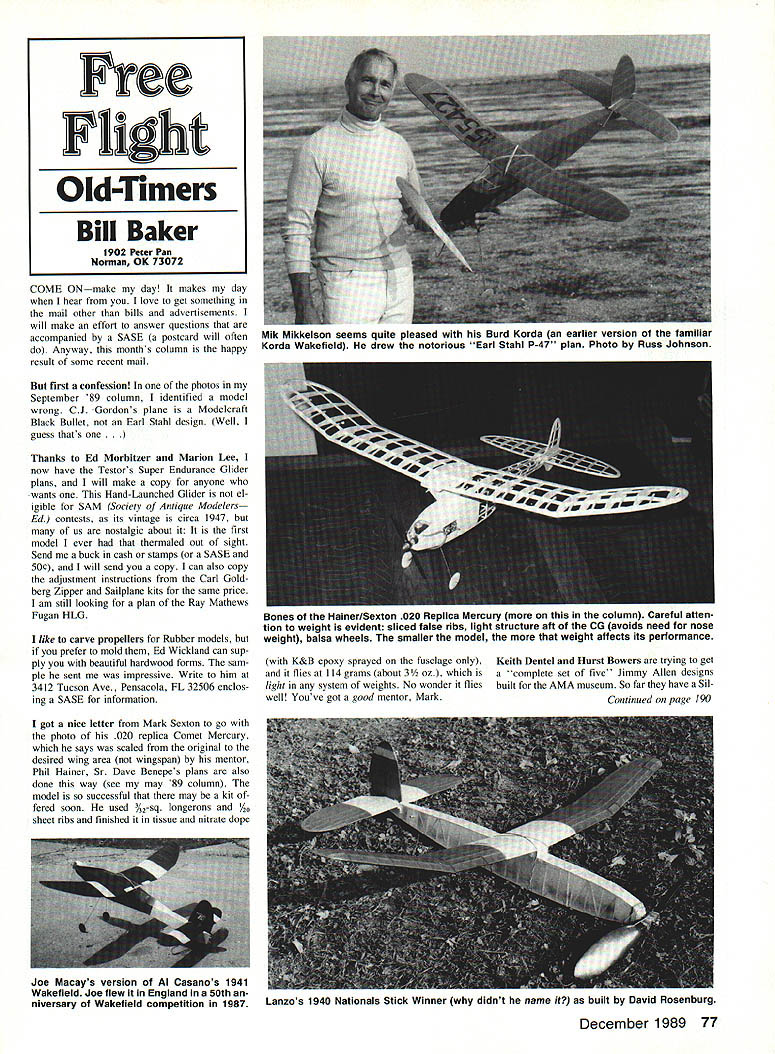
But first a confession: in one of the photos in my September '89 column, I identified a model wrong. C. J. Gordon's plane is a Modelcraft Black Bullet, not an Earl Stahl design. (Well, I guess that's one . . .)
Plans and offers
- Thanks to Ed Morbitzer and Marion Lee, I now have the Testor's Super Endurance Glider plans, and I will make a copy for anyone who wants one. This hand-launched glider (HLG) is not eligible for SAM (Society of Antique Modelers) contests, as its vintage is circa 1947, but many of us are nostalgic about it; it is the first model I ever had that thermaled out of sight. Send me a buck in cash or stamps (or a SASE and 50¢), and I will send you a copy.
- I can also copy the adjustment instructions from the Carl Goldberg Zipper and Sailplane kits for the same price.
- I am still looking for a plan of the Ray Mathews Fugan HLG.
I like to carve propellers for rubber models, but if you prefer to mold them, Ed Wickland can supply you with beautiful hardwood forms. The sample he sent me was impressive. Write him at 3412 Tucson Ave., Pensacola, FL 32506 enclosing a SASE for information.
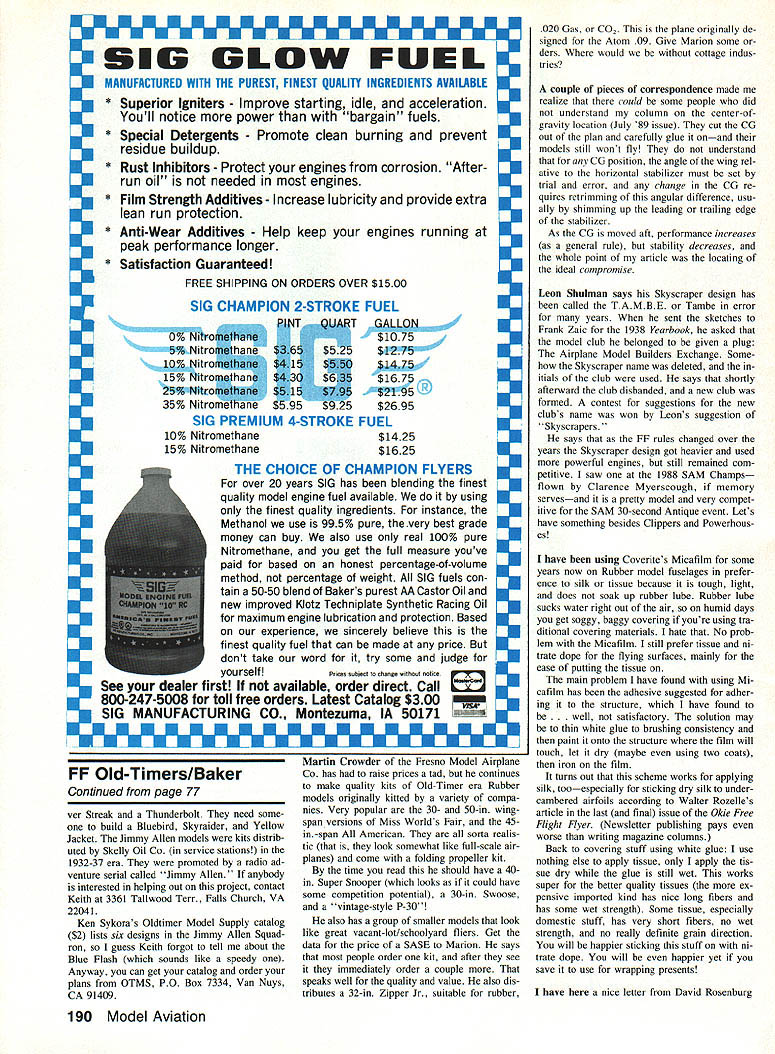
I got a nice letter from Mark Sexton to go with the photo of his .020 replica Comet Mercury, which he says was scaled from the original to the desired wing area (not wingspan) by his mentor, Phil Hainer, Sr. Dave Benepe's plans are also done this way (see my May '89 column). The model is so successful that there may be a kit offered soon. He used 3/32-inch square longerons and 1/32-inch sheet ribs and finished it in tissue and nitrate dope (with K&B epoxy sprayed on the fuselage only) and it flies at 114 grams (about 3½ oz.), which is light in any system of weights. No wonder it flies well! You've got a good mentor, Mark.
Jimmy Allen projects
Keith Dentel and Hurst Bowers are trying to get a complete set of five "Jimmy Allen" designs built for the AMA museum. So far they have a Silver Streak, Thunderbolt, Bluebird, Skyraider and Yellow Jacket. Jimmy Allen models and kits were distributed by Skelly Oil Co. service stations in the 1932–37 era and promoted by a radio adventure serial called "Jimmy Allen." Anybody interested in helping out on the project should contact Keith at 3361 Tallwood Terr., Falls Church, VA 22041.
Ken Sykora's Oldtimer Model Supply catalog ($2) lists six designs in the Jimmy Allen Squadron; I guess Keith forgot to tell about the Blue Flash — sounds like a speedy one. You can get the catalog or order plans from OTMS, P.O. Box 7334, Van Nuys, CA 91409.
Kits and cottage industry
Martin Crowder of the Fresno Model Airplane Co. has had to raise prices a tad, but he continues to make quality kits of Old-Timer era rubber models originally kitted by a variety of companies. Very popular are the 30- and 50-inch winders versions of Miss World's Fair, and the 45-inch span All American. They are all sorta realistic (that is, they look somewhat like full-scale airplanes) and come with a folding propeller kit. By the time you read this he should have a 40-inch Super Snooper (which looks as if it could have some competition potential), a 30-inch Swoose, and a "vintage-style" P-30!
He also has a group of smaller models that look like great vacant-lot/schoolyard flyers. Get the data for the price of a SASE to Marion. He says that most people order one kit, and after they see it they immediately order a couple more. That speaks well for the quality and value. He also distributes a 32-inch Zipper Jr., suitable for rubber, .020 gas, or CO2. This is the plane originally designed for the Atom .09. Give Marion some orders. Where would we be without cottage industries?
Center-of-gravity and trimming
A couple of pieces of correspondence made me realize that there could be some people who did not understand my column on the center-of-gravity location (July '89 issue). They cut the CG out of the plan and carefully glue it on—and their models still won't fly! They do not understand that for any CG position, the angle of the wing relative to the horizontal stabilizer must be set by trial and error, and any change in the CG requires re-trimming of this angular difference, usually by shimming up the leading or trailing edge of the stabilizer.
As the CG is moved aft, performance increases (as a general rule), but stability decreases, and the whole point of my article was the locating of the ideal compromise.
Skyscraper history
Leon Schulman says his Skyscraper design has been called the T.A.M.B.E. or "Tambe" in error for many years. When he sent the sketches to Frank Zaic for the 1938 Yearbook, he asked that the model club belonging be given a plug: the Airplane Model Builders Association. Needless to say, Leon was pleased with the results, and the initials of the club were used. He says that it disappeared with the club disbanded, and a new club was formed. A contest for suggestions for the new club's name was won by Leon's suggestion of "Skyscrapers."
He says that as the free-flight rules changed over the years the Skyscraper design got heavier and used more powerful engines, but still remained competitive. I saw one at the 1988 SAM Championships in Frederic (Denmark), if memory serves—and it is a pretty model and very competitive for the SAM 30-second Antique event. It has something besides Clippers and Powerhouse models.
Coverite's Micalfilm
I have been using Coverite's Micalfilm for some years now on rubber model fuselages instead of silk. It is tough, light, and does not soak up rubber lube. Rubber lube tends to keep the silk damp and increases wing weight. Coverite claims their product is much lighter per square inch than silk. It does take some practice to apply because it tends to wrinkle. Use a little warm iron (not hot) and it smooths.
The main problem I have found with using Micalfilm is that it can be brittle when thin. The solution may be to brush on a 50–50 mixture of dope and lacquer thinner, then iron on the film. It is also possible to wrap fuselages with the film first and then brush on dope to the film. I have found that the film gives a nice finish when doped.
Transcribed from original scans by AI. Minor OCR errors may remain.

