
Free Flight: Old-Timers
Bill Baker
1902 Peter Pan Norman, OK 73072
REMEMBER the movie "Back to the Future"? We're going Back to the Past here. My column in the April issue stimulated many of you to write of your own happy memories of towline gliders—even of two-line gliders (that latter sort was an inside joke; see the April column).
Joe Wagner: Two-Line Towline Gliders
Joe Wagner says he flew two-line style in 1940–41 and even set a record that was disallowed under an interpretation of the 1941 AMA rule book concerning the use of an "inextensible line." I think Joe got a bad call, but arguing with umpires and contest directors paid about as well in 1941 as it does now.
Some notes from Joe:
- He often mounted the bellcrank and linkage external to the fuselage so he could access it for adjustments; this made retrieval from trees a real mess.
- He never had really consistent luck with pre-autorudder techniques. Offset tow hooks were particularly troublesome: helpful when low, but past about 45° they tended to accentuate rudder turning action.
- He had better luck with Henry Struck's "golf stick," especially after adding weight to its "nose" to optimize the dynamic effect.
- On his two-line jobs he slanted the bellcrank axis about 50° aft so he could maintain control through the tow, working the rudder with cables.
- The upper ends of the dual towlines were tied together with a short slack length of string; the pull-off streamer was attached to that so both lines would fall free more or less simultaneously.
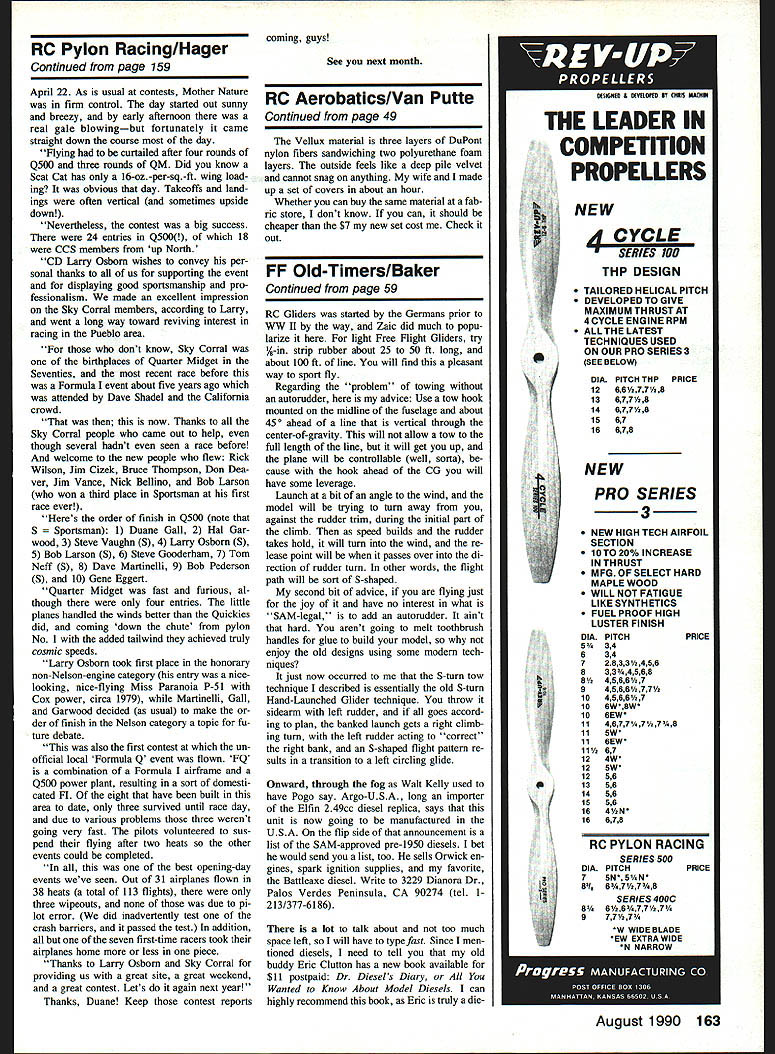
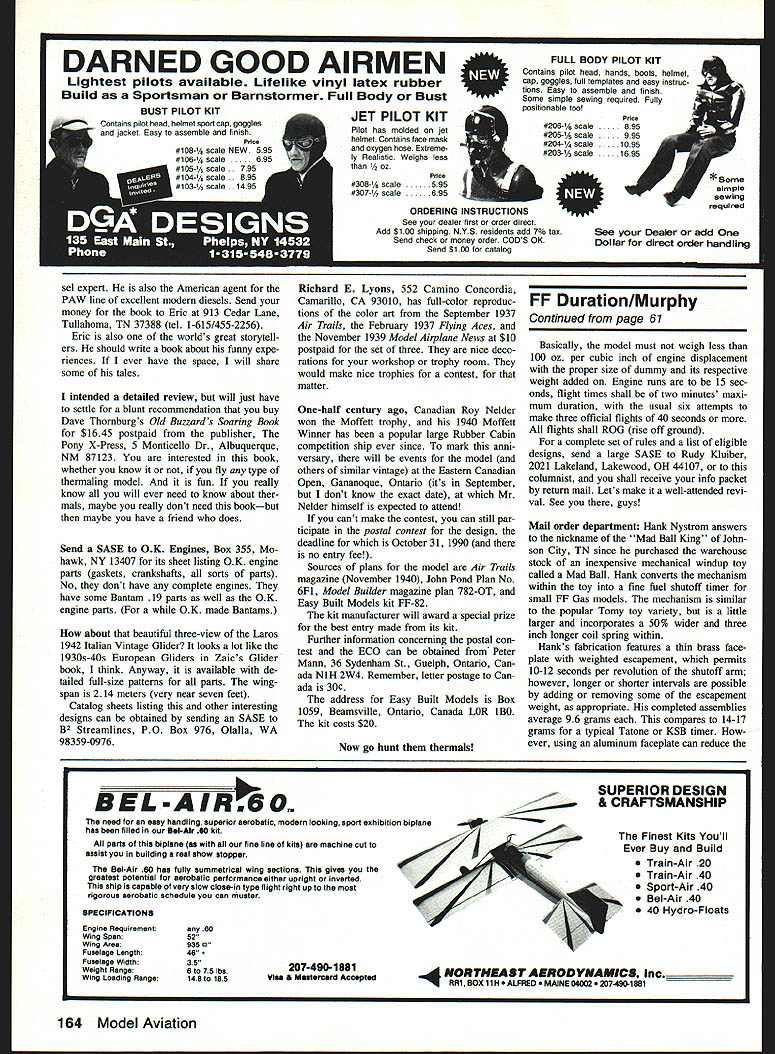
Joe designed many models for Veco Company kits. Remembered flight examples include:
- Dakota biplane
- Sioux
- Comanche
- Taylor Cub
He has detailed plans for these at $5.50 each postpaid. Mail orders: P.O. Box 15, New Wilmington, PA 16142.
What I appreciated about his designs was that needed adjustments (thrust-line offsets, etc.) were designed into the structure. Too many plans assume the engine points straight ahead, which can doom the novice builder.
Plans and Old-Timer Gliders
My "One Saturday Morning" piece in the June issue stirred interest in old hand-launched glider designs. Prime sources for plans are Zaic's books and old magazines, but Bob Larsh has made things easy for the novice by drawing many plans full size.
- Get his list and a sample plan for $1.25. Most plans are $0.50 each.
- He also has Old-Timer Gas and Nostalgia plans; ask for those lists too.
Popular Larsh plans currently:
- 1952 prototype Texan — 61 in. wingspan, 480 sq. in. area. Price: $6.25 postpaid. Note: only the prototype version is "nostalgia legal."
- Strato-streak — 52 in. span, 359 sq. in., for .19 engines. Price: $6.50 postpaid.
Bob Larsh address: 45 South Whitcomb Ave., Indianapolis, IN 46241.
Before leaving towline gliders, note J.K. Quarman's nine-page article "Towline Glider Stability" in the 1957–58 Frank Zaic Yearbook. It covers design factors, their interrelationships, helpful footwork, and design changes for tow problems (hand-tow, high-start, electric-winch launches, and RC planes). Much of the information traces to pre-WWII research on kite stability (applications included lifting radio antennas at sea where a tall mast was infeasible).
The high-start launch popular today was started by the Germans prior to WWII, and Zaic did much to popularize it here.
For light free-flight gliders, try 1/2-in. strip rubber about 25–50 ft long and about 100 ft of line — a pleasant way to sport fly.
Towline Technique and Design Tips
Regarding towing without an autorudder, here is practical advice:
- Use a tow hook mounted on the midline of the fuselage and positioned about 45° ahead of a vertical line through the center of gravity. This won't allow a tow the full length of the line, but it will get you up and provide some control because the hook ahead of the CG gives leverage.
- Launch at a slight angle to the wind. Initially the model will try to turn away from you (against rudder trim) during climb. As speed builds and the rudder becomes effective, it will turn into the wind. Release when it passes into the downwind portion of the turn. The resulting flight path is roughly S-shaped.
- If you're flying for fun and don't care about "SAM-legal" rules, add an autorudder — it's not hard and will make many old designs more enjoyable to fly.
The S-turn tow technique described is essentially the old S-turn hand-launched glider technique: a banked launch with a touch of left rudder can produce a right climbing turn, with the rudder correcting the bank and producing an S-shaped transition into a left circling glide.
Engines, Books and Other Resources
- Argo-U.S.A., long an importer of the Elfin .24–.4 cc diesel replica, reports this motor will be manufactured in the U.S.A. They also published a list of SAM-approved pre-1950 diesels. For diesel inquiries, you may write to Battleaxe Diesels: 3299 Diana Dr., Palos Verdes Peninsula, CA 90274. Tel: (213) 377-6186.
- Eric Clutton has a new book: Dr. Diesel's Diary, or All You Wanted to Know About Model Diesels — $11 postpaid. Eric is a diesel expert and the American agent for the Palm line of modern diesels. Order from: Eric Clutton, 913 Cedar Lane, Tullahoma, TN 37388. Tel: (615) 455-2256. Eric is also a great storyteller.
- Dave Thornburg's Old Buzzard's Soaring Book — strongly recommended for anyone flying thermal gliders. Price: $16.45 postpaid from the publisher: The Pony X-Press, 5 Monticello Dr., Albuquerque, NM 87123.
- O.K. Engines — send an SASE to Box 355, Mohawk, NY 13407 for a parts listing (gaskets, crankshafts, etc.). They do not have complete engines but list O.K. parts and some Bantam .19 parts (O.K. made Bantams for a while).
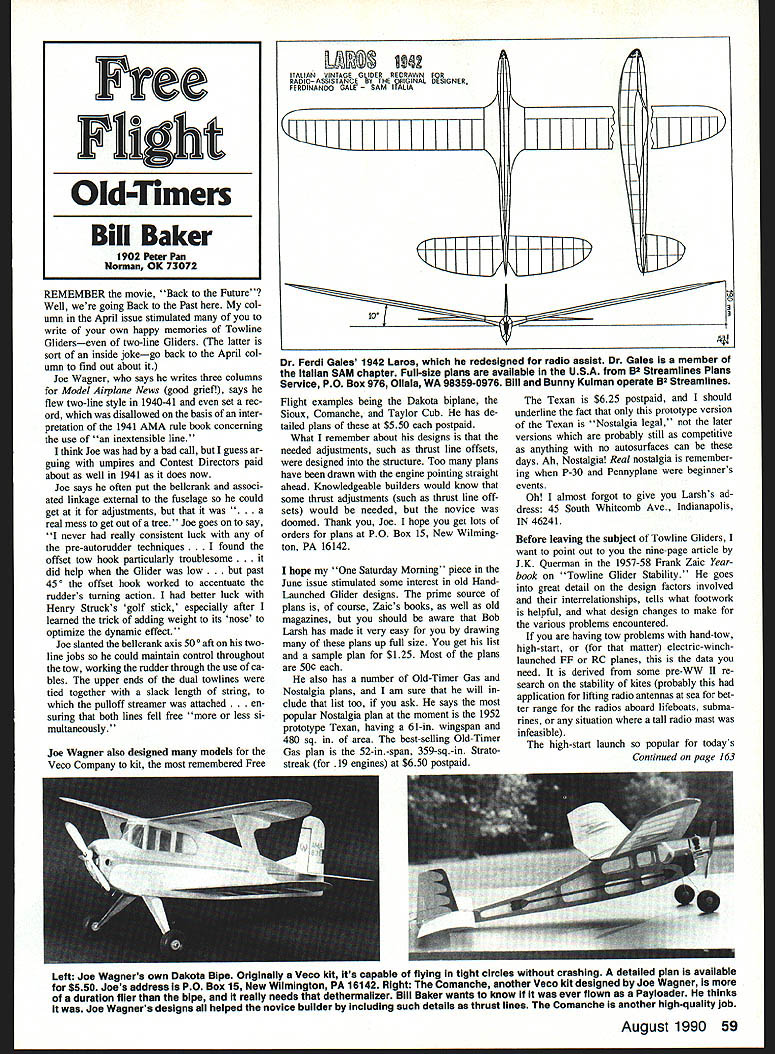
- Laros 1942 Italian vintage glider — a beautiful three-view is available with full-size patterns for all parts. Wingspan: 2.14 meters (very near seven feet). For catalog sheets send an SASE to B2 Streamlines, P.O. Box 976, Olalla, WA 98359-0976.
Closing
There is a lot to cover in old designs, diesels, and towing techniques, and not enough space here. Hunt those thermals — and enjoy revisiting the past with a few practical modern fixes.
Transcribed from original scans by AI. Minor OCR errors may remain.

