
Free Flight: Old-Timers
Bill Baker 1902 Peter Pan Norman, OK 73072
Trips to England
I have been granted extra space this month to show photos from R. J. "Mik" Mikkelson's trip to England in 1985. Mik has been a major source of photos for this column and was the co-conspirator and draftsman for the Earl Stahl P-47 caper (see my column for September '89 if you don't know about that one).
1985 was the first of several trips to England by Mik and some of his flying buddies from SCIF (Southern California Ignition Flyers) and SCAMPS (Southern California Antique Model Plane Society), along with some East Coast folk such as Bert Pond and Danny Sheelds. The California contingent included such well-known names as:
- Sal Taibi
- Jim Adams
- Ken Sykora
- Andy Faykun
- Wade Wiley
- Al Richardson
Some of the group stayed in England for weeks, attending several contests and fun-flys, visiting aviation museums, and generally having a memorable time. Since then, Mik and others have returned several times, and some English fliers have traveled here to visit the "colonies." They were at the SAM Champs I reported on in 1986, and in 1989 they attended the United States Free Flight Champs at Taft, where they reenacted the 1939 Wakefield Championships with American fliers by holding a contest for the Wakefield models of that year.
Differences in approach: U.S. vs. Britain
The single greatest difference between Old-Timer Free Flight activity in the United States and England is attitude toward competition.
- In the U.S. we tend to be very competition-oriented. Events are divided into many classes (size, pylon vs. fuselage, etc.), flown for duration with short maxes, and trophies awarded to third place. A class event often becomes dominated by one or a few designs because contestants select models with the best chance to win.
- The British are much less trophy-driven. They are likely to search out obscure or unconventional designs that haven't been flown to death. They seem especially fond of biplanes, canards, tailless and other unorthodox craft. The emphasis is more on getting Old-Timers into the air and enjoying the spectacle.
Old Warden, mass launches, and Vintage Day
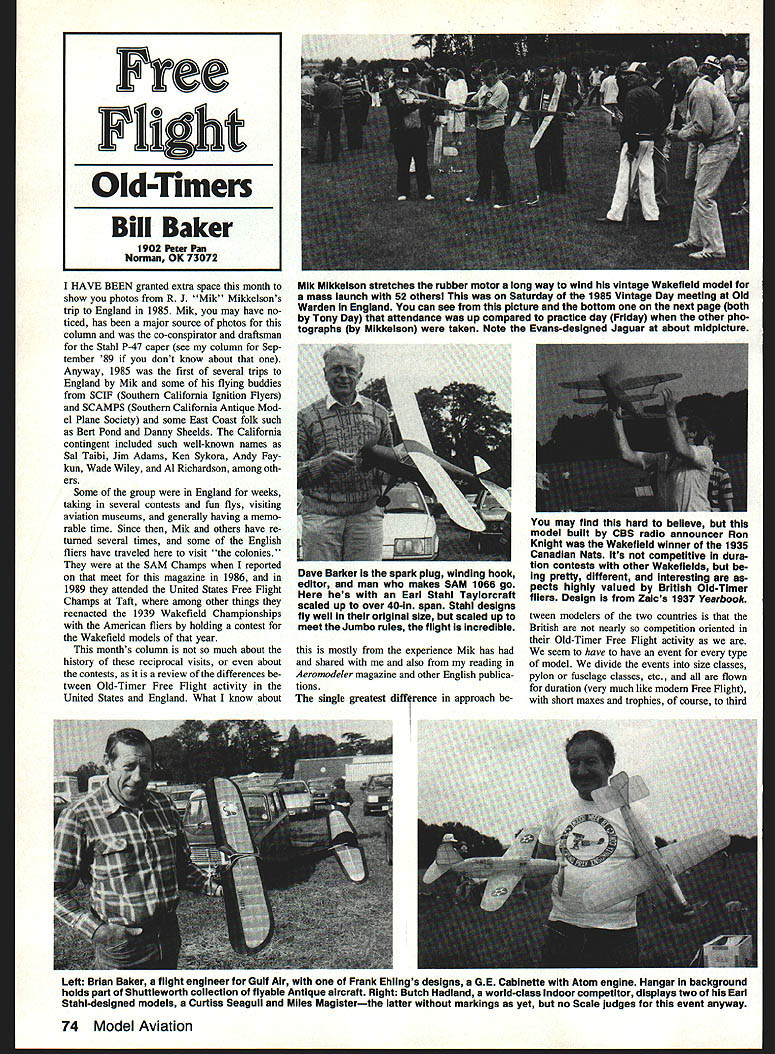
At Old Warden in 1985, the only contests on Vintage Day were mass-launch events — twin pushers (which they call A-Frames) and Wakefields — each drawing about 50 entrants. Winners were decided by the judges' opinion of which model was highest after 45 seconds. The mass launches are spectacular; Mik was so excited he forgot to watch his own model and lost. His takeaway: participate in the spectacle and enjoy it.
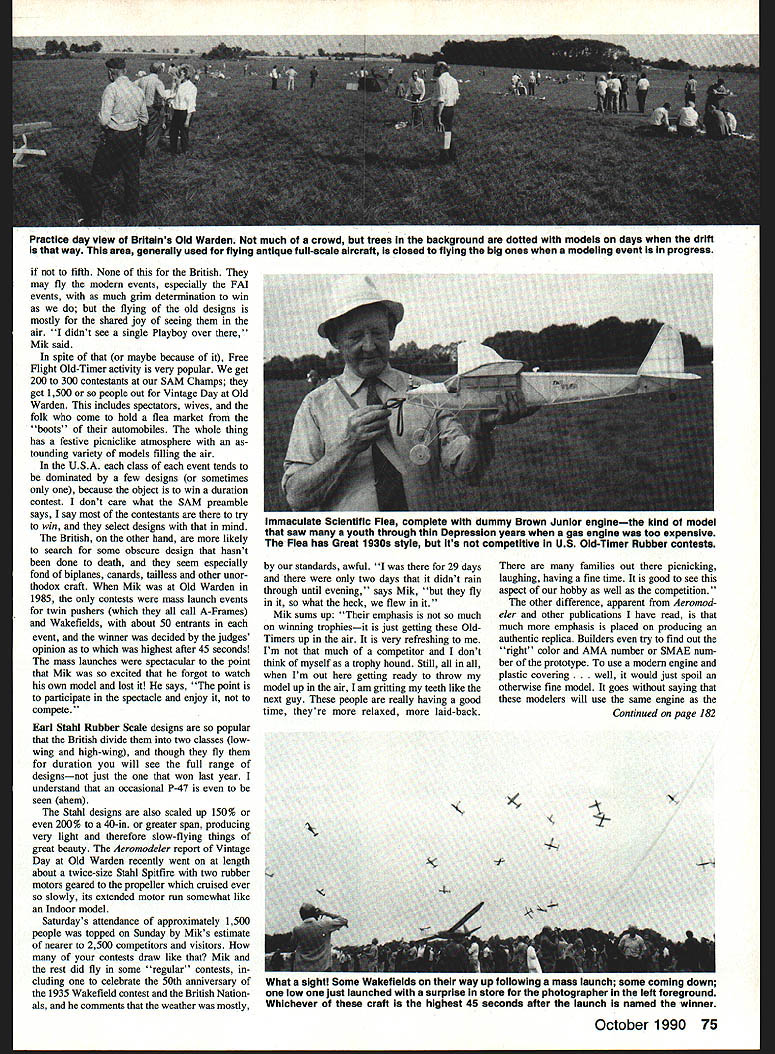
Vintage Day at Old Warden is immensely popular and picnic-like in atmosphere. It draws a wide mix of spectators, families, and vendors who sell from the boots of their cars. Mik estimated about 1,500 people on Saturday and nearer 2,500 competitors and visitors on Sunday. Compare that to typical U.S. meets — how many of yours draw like that?
Despite often poor weather — Mik said he was there for 29 days and there were only two days without rain until evening — they fly in it. "They fly in it, so what the heck, we flew in it," he told me.
Earl Stahl designs and scale practice
Earl Stahl rubber-scale designs are very popular in Britain. The British even divide Stahl models into two classes (low-wing and high-wing). Although they fly them for duration, you'll see the full range of designs rather than just the one that won last year. Some Stahl designs are scaled up 150% or even 200% to 40-inch span or greater, producing very light, slow-flying aircraft of great beauty. An Aeromodeller report of Vintage Day described a twice-size Stahl Spitfire with two rubber motors geared to the propeller, cruising so slowly that its extended motor run was almost like an indoor model.
Authenticity and restoration
Another notable difference is the British emphasis on producing authentic replicas. Builders try to find the "right" color schemes and correct SMAE or prototype numbers. Using a modern engine or plastic covering is often frowned upon because it would "spoil" an otherwise fine model. Some modelers will use the same engine type as the prototype, but many will not — the point is variety and faithful appearance.
I know Americans who also pursue authenticity. For example, I visited Jim Clem's workshop (Doctor "Country-Boy" Clem, not Speed-and-Indoor Clem) where he was working on a Zipper using the original plan. Because his first Zipper had had a Denny-mite, he hoped to use one again — not just any Denny-mite but the same model with the same type of tank. He had the "right" wheels but was having trouble finding the exact motor mount. I suggested a Hayes nylon; Jim wouldn't consider it. If he ever flies the Zipper it will be to see, hear and smell it like it was in 1939. That's the payoff — after all, Jim has enough trophies.
A cautionary note on disputes
Sometimes we allow our disputes over rules and categories of model planes to get out of hand. I once saw a newspaper item about six people killed in New Guinea in a dispute over how to prepare a pig for a feast — a grim reminder that petty disputes can escalate. I recall a small quarrel with a few Tiger Burner devotees; they tore each other apart trying to establish dominance over a limited territory. Their five gallons were that important!
Mik's summary and closing thoughts
Mik sums up the British approach well: "Their emphasis is not so much on winning trophies — it is just getting these Old-Timers up in the air. It is very refreshing to me. I'm not that much of a competitor and I don't think of myself as a trophy hound. Still, all in all, when I'm out here getting ready to throw my model up in the air, I am gritting my teeth like the next guy. These people are really having a good time; they're more relaxed, more laid-back."
There are many families out there picnicking, laughing, and having a fine time. It's good to see this lighter, more social aspect of our hobby alongside the competitive side.
Transcribed from original scans by AI. Minor OCR errors may remain.

