
Free Flight: Old-Timers
Bill Baker 1902 Peter Pan Norman, OK 73072
It's been a while. Activity in England, Nationals coverage and letting Doc have a turn have kept this column away from these pages. I have a lot of information I want to fit into this space, and I want to thank those who wrote expressing concern over my health — I'm doing fine, mean as ever.
One more thing before I get into model topics: the young fellow on the AMA staff who shares my name is not me. Judging from my mail some folks think we're the same. Some thought the photo or caption on page 100 of the October issue of Model Aviation was reversed; the caption and photo are correct — the young fella is Bill Baker and the older man is Geoff Styles. Neither of them is me. The other Bill Baker is young, cheerful and energetic; I am old, grumpy, heavy with warts and battle scars — easy to tell apart. I hope this ends the confusion.
Propeller drag and P/D ratios
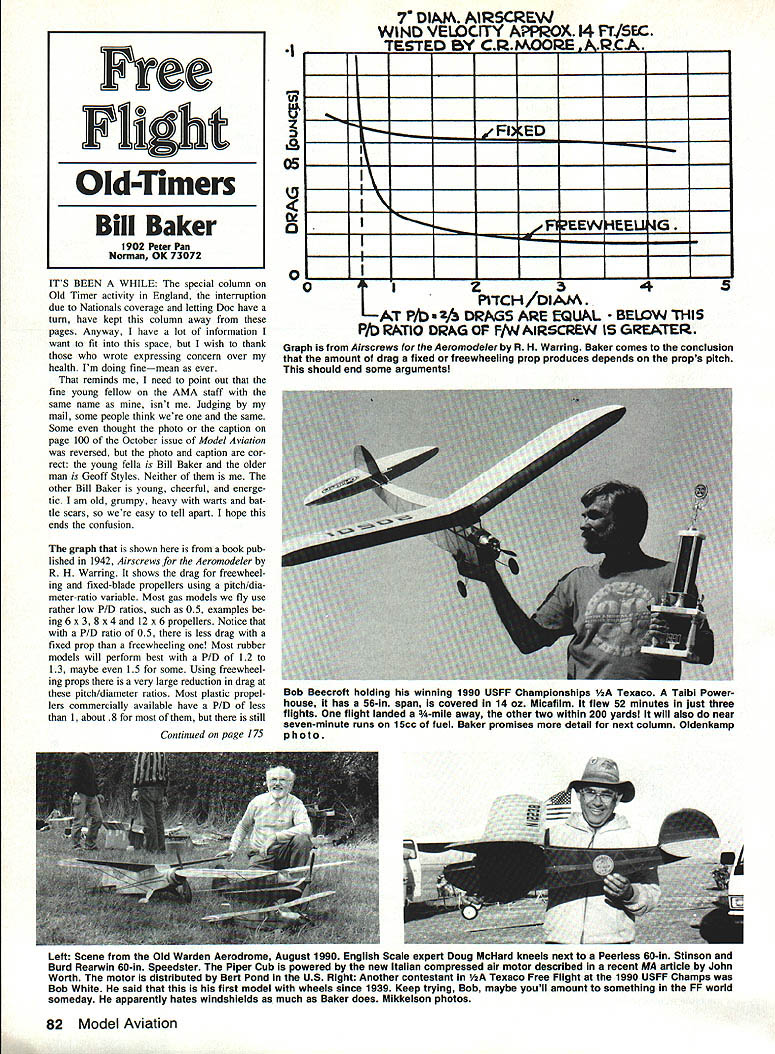
The graph shown here comes from the 1942 book Airscrews for the Aeromodeller by R. H. Warring. It compares drag for freewheeling (folding) and fixed-blade propellers as a function of pitch/diameter (P/D) ratio.
- Most gas models use rather low P/D ratios (about 0.5). Examples: 6×3, 8×4, 12×6 props. At a P/D of 0.5 there is less drag with a fixed prop than with a freewheeling one.
- Most rubber models perform best with P/D in the 1.2–1.3 range, and some up to 1.5. At those higher P/D ratios freewheeling props give a very large reduction in drag.
- Most commercially available plastic props have P/D below 1 (about 0.8 for many), but even so there can be a worthwhile drag reduction with freewheeling.
My OFB George Beaver and I have been flying Goldberg Electras this past year with 8×4 props. The difference between a fixed and a folding prop is appreciable; if no brake is used to keep the prop from freewheeling the increased drag is very noticeable. Some Old-Timer rubber models with freewheelers tend toward very high pitches and gain little in drag reduction; they’ll also be harder to trim, especially in turbulent air. My advice: stick to about 1.25–1.3 P/D — for example a 20‑in diameter with a 26‑in pitch.
Torsion-bar landing gear
I’ve been meaning to write about the joy of torsion bars for landing gear. I delayed because I was reluctant to try to draw examples, then saw Paul McIlrath’s torsion-bar landing-gear drawings in Bill Warner’s column (September MA). Check those out — they’re worth careful study.
I had a very fine-flying Stahl Rearwin from the Flyline kit ruined by its rigid landing gear. Heavier gas models can be a real pain when gear bends out of shape on routine landings, or — if too rigid — transfers destructive shock to the fuselage structure.
I built a Stahl Skyfarer (tricycle gear) some years ago with torsion-bar nose and main gear. Torsion bars can save weight and greatly improve durability. The first torsion bars I remember were the main gear on the Goldberg Senior Falcon and the wing-mounted gear on the Top-Flite Taurus — both showed that surprisingly little plywood bracing was needed to handle loads. Look at some of the gas-powered Old-Timer RC plans by Doc Matthews in MA; Doc often adds torsion-bar-type gear to improve durability without changing appearance.
For models like the Powerhouse or the Quaker with two- or three-wire landing-gear struts I recommend making the main strut a torsion bar and letting the other struts be “dummies,” free to move in a hole or slot in the fuselage. Dummies can even be aluminum tubing to save weight. On my Skyfarer the .045" wire passed through .062" ID aluminum tubing; the tubing was glued to the horizontal structural crosspiece, and the vertical wire was bound with thread and glued to the fuselage uprights. Almost no added weight, yet the gear never needed re-bending, never tore out and never damaged the fuselage. (For several years now it has been at the top of a huge tree — the only real disadvantage of such gear.)
Newsletters, clubs and stamps
I get several newsletters that are very helpful for this column, and I like to give recognition and thanks. Two I consistently find helpful are:
- Vegas Freeflighter — editor: Phil McCrory, 532 College Drive #212, Henderson, NV 89015
- Aero News (San Diego) — editor: Jim Altback, 16634 Diaz Drive, San Diego, CA 92128
Club newsletters reflect club activity (contest results, who built what, who crashed what, show-and-tell, etc.), but these two contain a lot of original material and reprints of articles and plans from old magazines. The editors will often send a sample copy for a dollar or two; I think you’ll want to subscribe after seeing one. As a former newsletter editor I can tell you that stamps are as welcome as cash, maybe more so.
For club correspondence you might consider a rubber stamp of your club logo. Bill Polk makes them:
- Bill Polk, 3413 Fremont N.E., Albuquerque, NM 87109
Stamps from him typically cost around $1. He can make them from a photo or drawing and also offers a catalog ($2) of ready-made airplane stamps (mostly WWI, Golden Age or earlier subjects). He does some buying and selling of used models and kits; I traded some kits I’d lost interest in for a couple of models.
Thanks and closing
I appreciate the photos and data individuals send me. Just because I don’t use something right away doesn’t mean I won’t — I simply can’t send a thank-you letter to everyone, though your material is much appreciated.
- Bill Baker, 1902 Peter Pan, Norman, OK 73072
Transcribed from original scans by AI. Minor OCR errors may remain.

