
Free Flight: Old-Timers
By Bill Baker
1902 Peter Pan, Norman, OK 73072
Reprint credit
Our reprint from Old Buzzard's Soaring Book is courtesy of David Tijeras, Pony X Press.
On "stalking the invisible thermal" — Dave Thornburg's River of Air concept
Dave Thornburg's Old Buzzard's Soaring Book has much to teach us about "stalking the invisible thermal" and "The River of Air." The river-of-air concept is useful because it reminds us that, as we stand on the ground, the air moves by and over us like a river. Thermals have not only volume but motion, and the motion of thermals affects the local motion of the airstream (wind). There are more than three spatial dimensions to consider — time (the velocity of the river) is effectively a fourth.
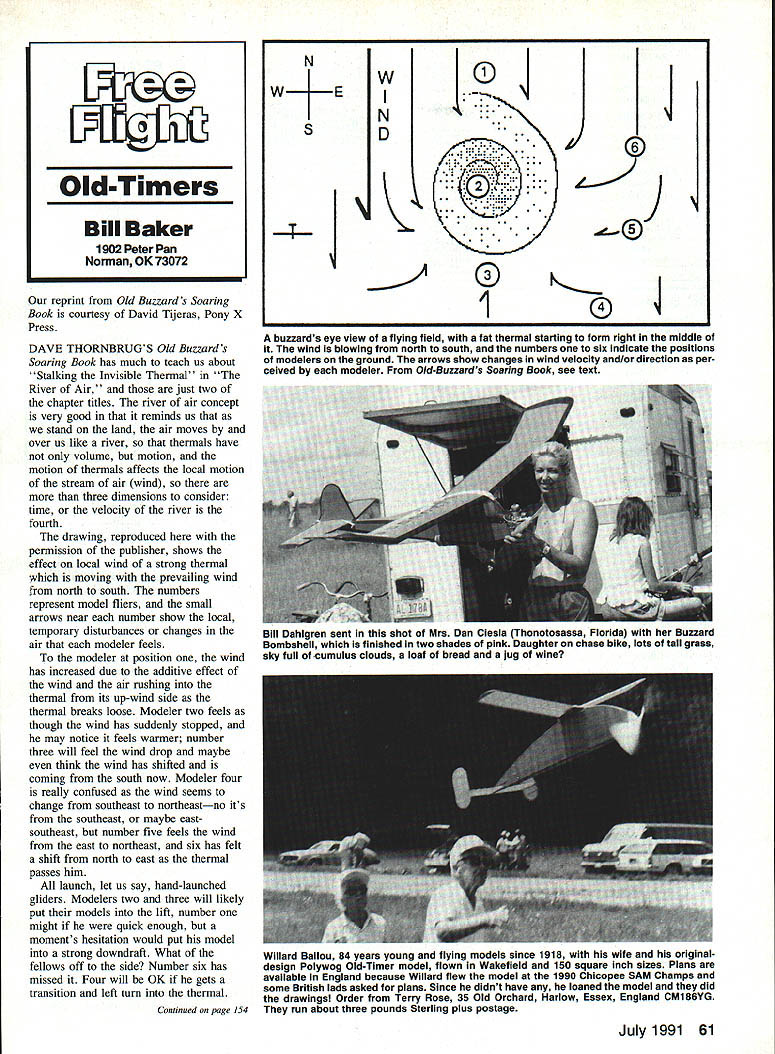
The drawing reproduced with permission from the publisher shows the effect on local wind of a strong thermal moving with the prevailing wind from north to south. The numbered positions represent model fliers; the small arrows near each number show the local, temporary disturbances or changes in the air that each modeler feels.
- Modeler 1: Feels the wind has increased due to the additive effect of the wind and the air rushing into the thermal from its up-wind side as the thermal breaks loose.
- Modeler 2: Feels as though the wind has suddenly stopped and may notice it feels warmer.
- Modeler 3: Feels the wind drop and may even think the wind has shifted and is coming from the south.
- Modeler 4: Is confused — the wind seems to change (southeast, then northeast, maybe east-southeast).
- Modeler 5: Feels the wind from the east to northeast.
- Modeler 6: Feels a shift from north to east as the thermal passes.
What that means for launching hand-launched gliders
- Modelers 2 and 3 will likely put their models into the lift.
- Modeler 1 might catch it if quick, but a moment's hesitation could put his model into a strong downdraft.
- Modelers 4, 5, and 6 (off to the side) may miss it; 6 often has missed it entirely. If 4 gets a transition and a left turn into the thermal, he'll be OK.
From position 3, releasing into an oncoming thermal can still miss: the model may climb strongly, make a lovely transition, and then the glide circle takes it out of the side of the thermal. This commonly happens when the climb and glide turns are in different directions. The model will seek the thermal center in a spiral climb, but during a transition to a turn in the opposite direction the thermal can be lost and the model slowly flies out.
Launch strategy
- On windy days: watch for a drop in velocity (what modeler 3 perceives). That lull is a good time to launch.
- On light-wind days: modeler 1's moment is better — he has waited for the thermal or lull to pass and, as the first puff or return of wind comes, he launches knowing a large thermal is likely.
- Modelers 4–6 know there's lift around because of the wind shift (which is always toward the thermal). If they get high launches and the thermal is large they may be lucky, but consider crosswind or even downwind launches when appropriate.
- Mostly: wait for a drop in the wind on windy days; wait until you feel some wind on calm days; or better yet, wait until birds, other models, weed seeds, etc., are going up — then there's no doubt the thermal is there.
The late Al Bissonette was a great "airpicker," and he mostly did it by looking upwind and watching the trees and grass move.
Where to get Thornburg's book
You can buy Thornburg's Old Buzzard's Soaring Book from Pony X Press:
- Pony X Press, 5 Monticello Drive, Albuquerque, NM 87123
- Price: $16.95 postpaid
- Phone: 505-299-8749
That'll save you the agony of spelling Albuquerque, and you won't have to worry about how much the postage is to New Mexico.
SAM rule and a cautionary anecdote
Old flying buddy Walter Rozelle points out there is some irony in having too much thermal knowledge. The official SAM (Society of Antique Modelers) rule book (Section VI, Rule 8) states:
"Thermal detection devices such as thermal sniffers, electronic thermal detectors, bubble machines and mylar ribbons shall not be used to assist the contestant in determining the optimum time of launch of his model."
Walt jokes that maybe this is to give the females a competitive edge. He suggests remembering the '60s pop song in which, when a streaker was loose in the supermarket, the husband yelled, "Don't look, Ethyl" — but it was too late. In like fashion, perhaps the timer can yell "don't look" at just the right time and we can launch. Walt concludes, "SAM continues to send scouting parties ahead to burn the bridges." The practical takeaway: feel the wind, understand the changes, and use your eyes to see the effect of the wind on whatever is still legal to use as an indicator.
Old-Timer Model Supply and other contacts
- Old Timer Model Supply (new catalog): $2.00. OTMS, P.O. Box 7334, Van Nuys, CA 91409.
- Gene Hempel (custom engine work, chrome plating, special Cox .049–.051 parts): 301 North Yale Drive, Garland, TX 75042. Tel: (214) 272-5210.
- Dave Haught (plans for rubber and CO2 scale models; new book "Building with Kids" — 20+ plans and ideas for teaching youngsters model building): $20 ppd. Send SASE for list or order to Haught Graphics, Rt. 1, Box 978, Munising, MI 49862.
- Edward Schlosser (plans for the old Best-by-Test Model Company rubber model and lowline glider kits, plus hardware: thrust washers, tension springs, 14" machine-carved balsa propellers, etc.): P.O. Box 412, Ridgefield, NJ 07657-1418. Send SASE for catalog sheets and old-catalog drawings.
Popular models noted:
- Altimeter and Stratomoter (doing well in SAM small cabin and stick events).
- Larger 44 in. span Enduro (stick) and Sensatherm (cabin) — light, structurally simple, and well designed for duration flying.
Brief news, notes, and Old-Timer items
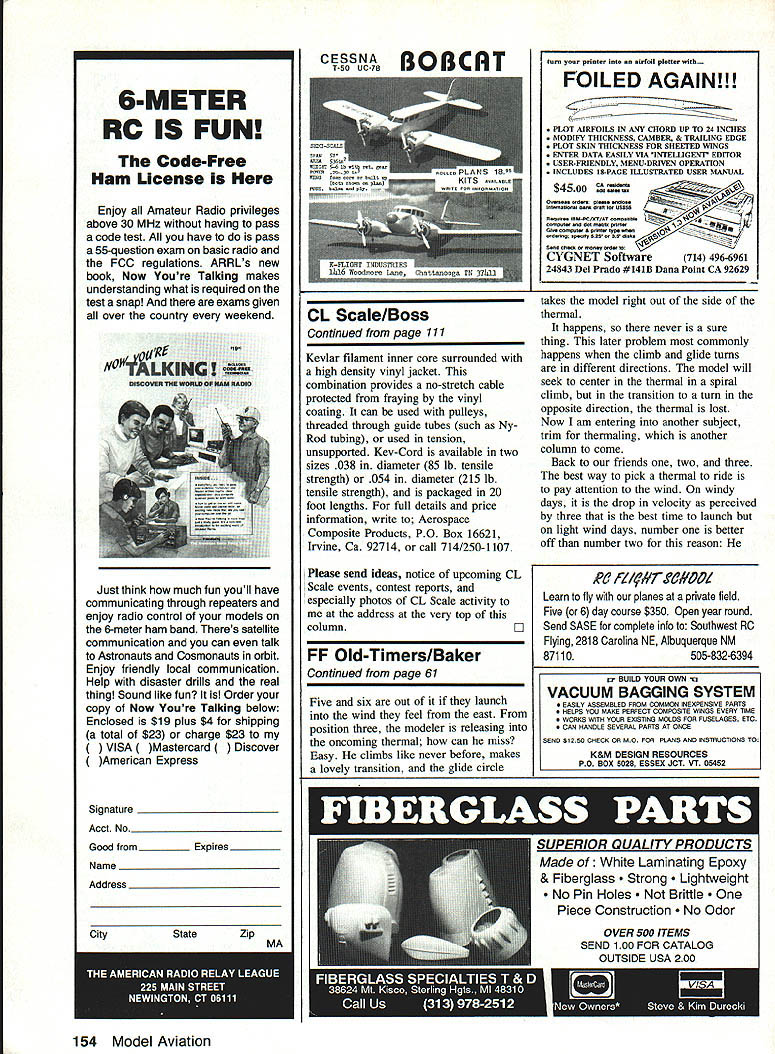
- Dahlgren sent a photo: Mrs. Dan Clesla of Thonotosassa, Florida — Buzzard Bombshell finished in two shades of pink; sky full of cumulus.
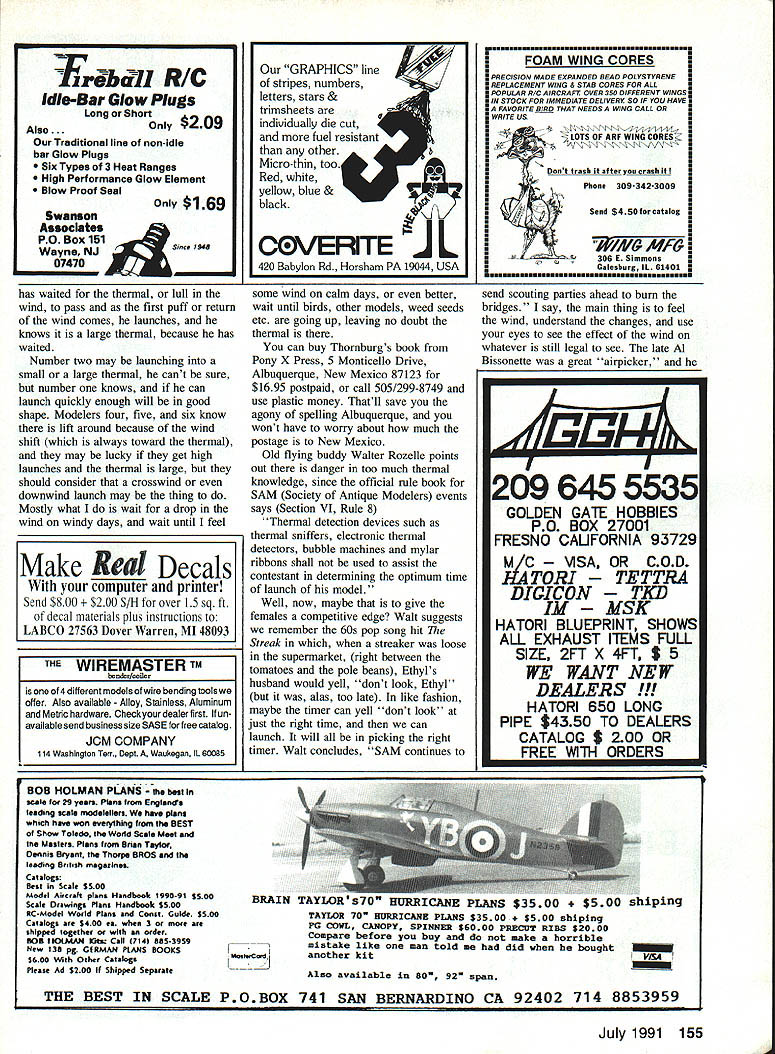
- Willard Bailou, 84, has been flying models since 1918. He flew an original Polywog Old-Timer (Wakefield, 150 sq in). At the 1990 Chicopee SAM Champs some British modelers asked for plans; since Willard had none, he loaned the model and made drawings. To order plans in England: Terry Rose, 35 Old Orchard, Harlow, Essex CM18 6YG — about £3 plus postage.
Transcribed from original scans by AI. Minor OCR errors may remain.

