

Free Flight: Old-Timers
Clarence Haught
SPECIAL AWARDS: All of us enjoy recognition for our efforts, be it in special competitions or in our everyday lives. More and more contests are featuring special awards as an added attraction or interest builder.
The '77 SAM Champs in Las Vegas included special awards in Electric Power, Twin Pusher Rubber, and Hightime by a DeLong .30. Such awards are usually "special" in that they differ from the standard awards in the form of sculptures or prized merchandise, and are coveted by their recipients.
Special awards, if properly publicized in advance, can be an effective tool in encouraging the use of uncommon design types or less powerful engines than the ones constantly showing up in the winners' circle. For example, a special award for Hightime in Antique using a parasol wing or Hightime in B cabin with an Ohlsson 23. I know of three modelers willing to sponsor such special awards at the next SAM Champs. How about it old-timers? Maybe we can bring out some new and interesting ships and airplane-engine combinations.
Rules We Live by: Now is the time to take pen in hand and submit that favorite rules change proposal to SAM.
I've been struggling for weeks to come up with a proposal to redefine the Antique category. My goal is to get the Clippers and Powerhouses out of the Antique class. True enough, I own a Clipper powered by a Madewell .49, but this design can hold its own with any Cabin Ship.
Take a look at a few contest reports from across the country, and see how many times Clippers and Powerhouses come up winners in Antique, and often the same ships lead in Cabin. Antique should be for the classic old parasols or some of the beautiful, but low performance, streamlined beauties in the Zaic yearbooks, or designs from the pages of Flying Aces.
The only question is how can it be done. Eliminating Cabin Ships from Antique isn't the answer because of all those elegant but low (by Clipper standards) performance Cabin ships like Miss Philly, Red Zephyrs, Quakers, or Weathers Westerners. I fear that if we don't do something soon, Antique will become a one- or two-design event. Old-Time Free Flight was revived for fun not trophy hunting, but we all like to win and to do that we eventually gravitate to the known performers. How about a little help out there?
Send your rules change proposal to: Gene Wallock, Free Flight Rules Coordinator, 220 Le Roy Avenue, Arcadia, CA 91006. If you have an idea you want to try on our readers send it to me. My address appears at the end of this column.
New Items of Interest: I recently received an interesting accessory from PAS-M-CO, 25260 153rd Southwest, Kent, WA 98031. Known as the "Crash Guard Switch," this novel component was designed to interrupt electrical current in electric-powered models anytime the model assumed the "ready to crash" attitude. Installed in series with the power source in longitudinal and/or lateral axis positions a mercury contact breaks connection and shuts the power in the event of unusual attitudes. The designers were quick to realize that the Crash Guard Switch would serve equally well in old-time ignition systems.
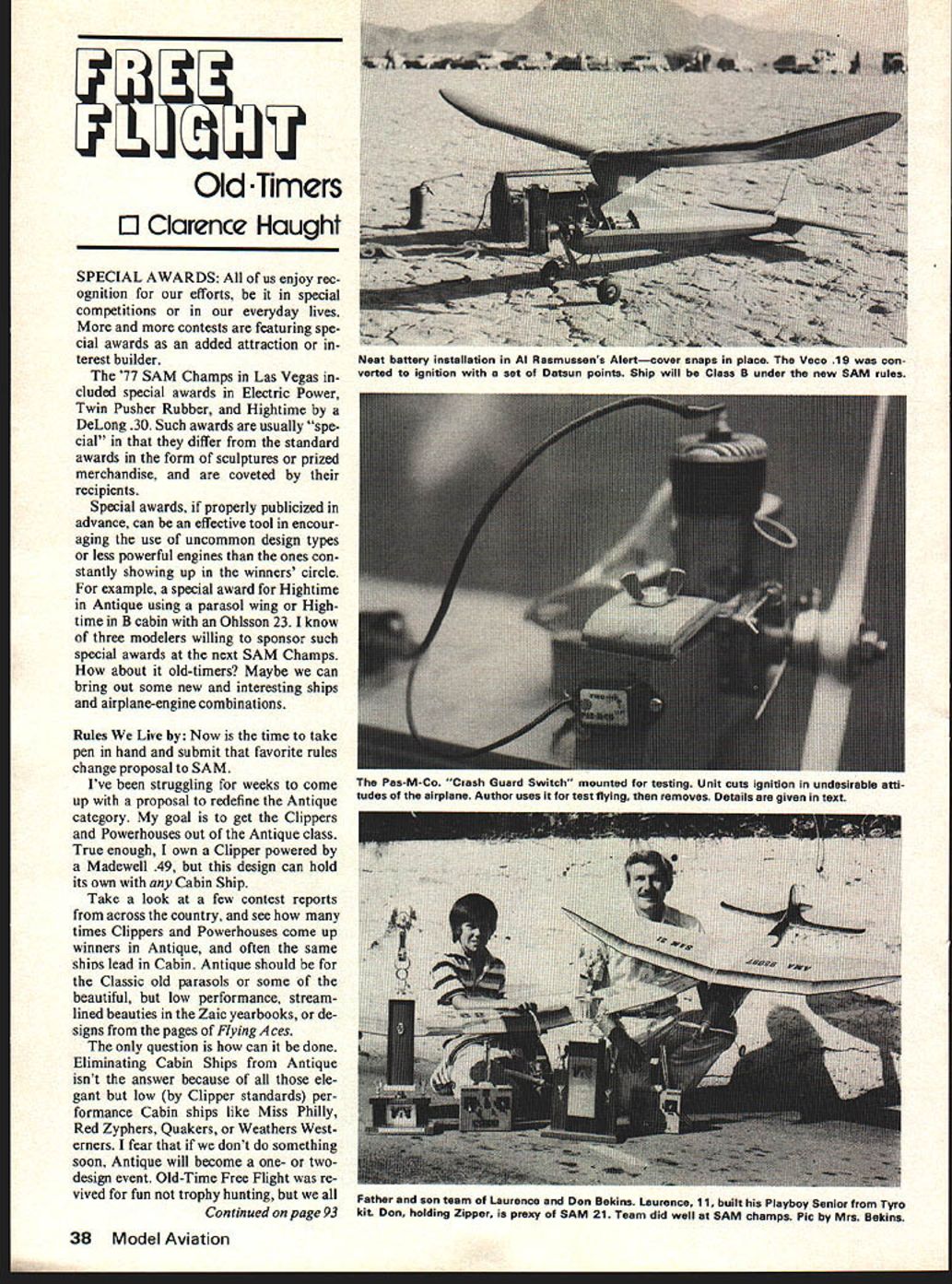
As indicated in the accompanying photo, I installed a sample on my test stand. The mounting angle selected governs the attitude of the cut-out function. I experienced no difficulty in starting the engine, but I must confess I was apprehensive about the effects of inertia and deceleration in the case of ambitious hand launch. The cut-out stopped the engine immediately when the "nose" was pointed down even during simulated forward motion. I was unable to effect failure of any kind by "wringing out" my test stand.
I did not install the unit in any of my ships as I was unwilling to put the model in "crash eminent" attitude under power. I have knowledge of one old-time modeler with a Crash Guard Switch installed in a Playboy Senior, and although he has had no trouble, he also has not had need for the switch to function. My only criticism of the unit is in the single-strand copper terminals or connectors which may be subject to vibration failures. This should be effectively alleviated by adequately securing the connecting wires to the aircraft structure with epoxy glue. The Crash Guard switch has the potential of saving many new models. I intend to install one on my next ship during the initial trimming procedure then remove it when the ship is safely flying.
Another new item to cross my bench is a product known as "Super RPM" produced by Lube Specialties, Inc., 1152 West Ninth St., Upland, CA 91786. As stated by Lube Specialties, "Super RPM consists of a neutral carrier and twenty percent dispersion of teflon beadlets. It was originally formulated for the aerospace industry, and has only recently become available for general use."
After reading the instruction sheet I fired up my old O&R 60 FRV on a 12-6 prop using a 4-1 fuel mixture of gasoline and SAE-70 oil. The tach showed 7500 rpm. I then allowed the engine to cool and squirted 3-4 drops of Super RPM directly in the exhaust port as directed, and flipped the engine over to coat the cylinder and piston. Two drops per ounce were added to the fuel mixture and the engine restarted and tacked at 7800 rpm or an increase of 300 rpm.
It would take extensive testing to determine if any undesirable long range characteristics were to develop, but it certainly appears to do what Jean Andrews claims it will do. Should help the old engines get up there with the conversions! Incidentally, this product conducts electricity and will not short out your points!
Clarence Haught, Rt. 5, Box 16, Coeur d'Alene, ID 83814.
Transcribed from original scans by AI. Minor OCR errors may remain.

