
Free Flight: Old-Timers
Bill Baker
1902 Peter Pan Norman, OK 73072
My column in the July issue included the address of the Best By Test Model Company where you can write for plans and some rubber-model hardware. Since then I have heard from Edward Schlosser, the designer/owner of the company, and I think what he has to say is interesting. Over to you, Ed.
Edward Schlosser (Best By Test Model Company)
While I was a sophomore in high school in the '30s, I started Best By Test Model Company with rubber flying models of my own design. That earned me more than enough money to attend a university where I earned a Ph.D. I then joined the chemical industry where I am still active.
The two wood saws used in the model company made plenty of balsa sawdust, and one day I got the idea of using the dust to an advantage. We filled up large paper bags with the stuff and took them over to the Bendix Golf Course, Teterboro, New Jersey (the same spot Dick Korda hit 43 minutes 29 seconds to win the Wakefield Cup from England). When the ground temperature was sufficiently warm to generate thermals, we would run criss-cross over the area, tossing handfuls of balsa dust into the air. Sure enough, if a thermal current was forming, the suspended dust would start circling and rising into the air. Depending on the upward velocity of the dust cloud a modeler could determine a launching spot. The Bergen County A.S.M.A.E.—a group of about 200 fliers—used this technique until WWII.
I was in Germany on a business trip last fall and took some time to visit the famous Industrial Museum in Munich. The building is huge—the aviation wing alone exhibits a full-size Lufthansa 747 on the first floor—and the aviation wing consists of six floors, each having full-sized planes on display. But on the top floor in glass cases are model airplanes from all over the world. To my surprise, there hung an "Altimeter"—my design of 1938. In the same case was a model of Walter Good's first radio-control plane... sorry, no photos allowed. Upon returning to the U.S.A., my curiosity got the best of me. Somewhere I had saved model items all these years. Sure enough, in one of our warehouses was the stuff all neatly boxed. I started building again, and soon the word got around, hence to your column.
In addition to the old plans and rubber-model hardware mentioned, Ed has metal covering material 0.001 inch thick, which looks like aluminum but is another alloy, and might be just what you need for a metal-covered scale model, or for metal skins for a modern FAI or AMA duration model. Check with Ed at:
- P.O. Box 412, Ridgefield, NJ 07657
Thermals and Rotation
Speaking of thermals, some people still think thermals all rotate, and that they do so all in the same direction depending on which hemisphere you are in. All these years I have believed what I was told about the Coriolis force. Now I've got new information.
Check out the June 1988 issue of Soaring, the official publication of the Soaring Society of America, for an article entitled "Do Thermals Rotate?" It reports results of an 18-month study by a sailplane club in which they dropped newspapers in thermals and watched. Their conclusion is that some thermals rotate right, some left. The article says the findings are in agreement "with other findings that tornadoes and waterspouts rotate in both directions." So do birds. O.F.B. Walter Rozelle counts soaring birds turning right and turning left, and after several years of counting a lot of birds, he reports that the ratio is about 50/50.
Sal Taibi and the Brooklyn Dodger
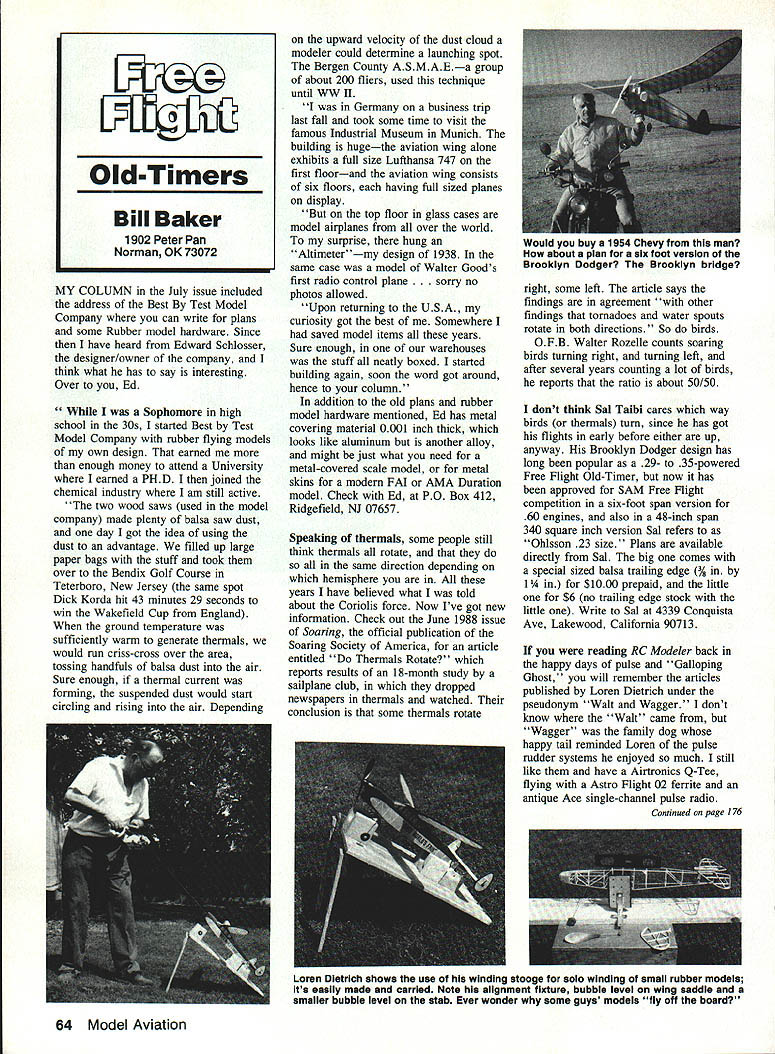
I don't think Sal Taibi cares which way birds (or thermals) turn, since he has got his flights in early before either are up, anyway. His Brooklyn Dodger design has long been popular as a .29–.35-powered Free Flight Old-Timer, but now it has been approved for SAM Free Flight competition in a six-foot-span version for .60 engines, and also in a 48-inch-span, 340-square-inch version. Sal refers to an "Ohlsson 23 size." Plans are available directly from Sal.
- Six-foot version (special sized balsa trailing edge 3/8 in.): $14.00 prepaid
- 48-inch version (no trailing edge stock included): $6.00
Write to Sal at: 4339 Conquista Ave., Lakewood, CA 90713.
Loren Dietrich — "Walt and Wagger"
If you were reading RC Modeler back in the happy days of pulse and "Galloping Ghost," you will remember the articles published by Loren Dietrich under the pseudonym "Walt and Wagger." I don't know where the "Walt" came from, but "Wagger" was the family dog whose happy tail reminded Loren of the pulse rudder systems he enjoyed so much. I still like them and have an Airtronics Q-Tee, flying with an Astro Flight 02 ferrite and an antique Ace single-channel pulse radio.
Loren is retired now, and like so many others I hear from, is going back to his modeling roots. He writes:
I certainly am enjoying AMA's Model Aviation magazine after a 10-year layoff from modeling. I'm now retired and have had time to recapture the special moments of my youth in the 1930s. I've built eight of my old rubber-powered loves and have them all nicely adjusted and hanging up while they await their monthly flights. Early on I found the need for an easily carried winding stooge as well as a building and alignment fixture. I'm cheap but handy, and so are they.
About the winding stooge platform (see photo):
- The two legs are hinged and swing flat against the board after use and are held with Velcro.
- A U-shaped bracket on the rear accepts the tail skid, and a nail passes through the bracket and skid.
- A large nail goes through the rear of the board and into the ground to resist the pull of the winder.
- A couple of hardware-store clips hold the winders, and the handle makes it easy to carry.
- You can use the stooge solo—no assistant needed—an important feature for us small-town folk.
About the alignment fixture:
- Little rubber-powered models are hard to hold while attaching landing gear, preparing wing and tail platforms, and such.
- A 1 x 4 pine board, two straps, and two angles from the hardware store make adjustable 90° uprights.
- A couple of Masonite pads, hot-glued to the uprights, and voila! An alignment fixture.
As a young boy in the wilds of Montana who built Ace Whitman dime-store models, the discovery of a local mailman who built immaculate Earl Stahl flying scale was my deliverance. That name in Model Airplane News meant more to me than I suspect Auntie Em did to Dorothy. When I retired, I decided to re-create all my old loves.
They now hang in the shaded rafters of my new shop and take turns flying at the college green every week. Always, as I enter the shop, nostalgia whispers their names—Falcon, Albatross, Air Rider, Miss World's Fair, Moth, Victory, Curtiss Robin...
Transcribed from original scans by AI. Minor OCR errors may remain.

