
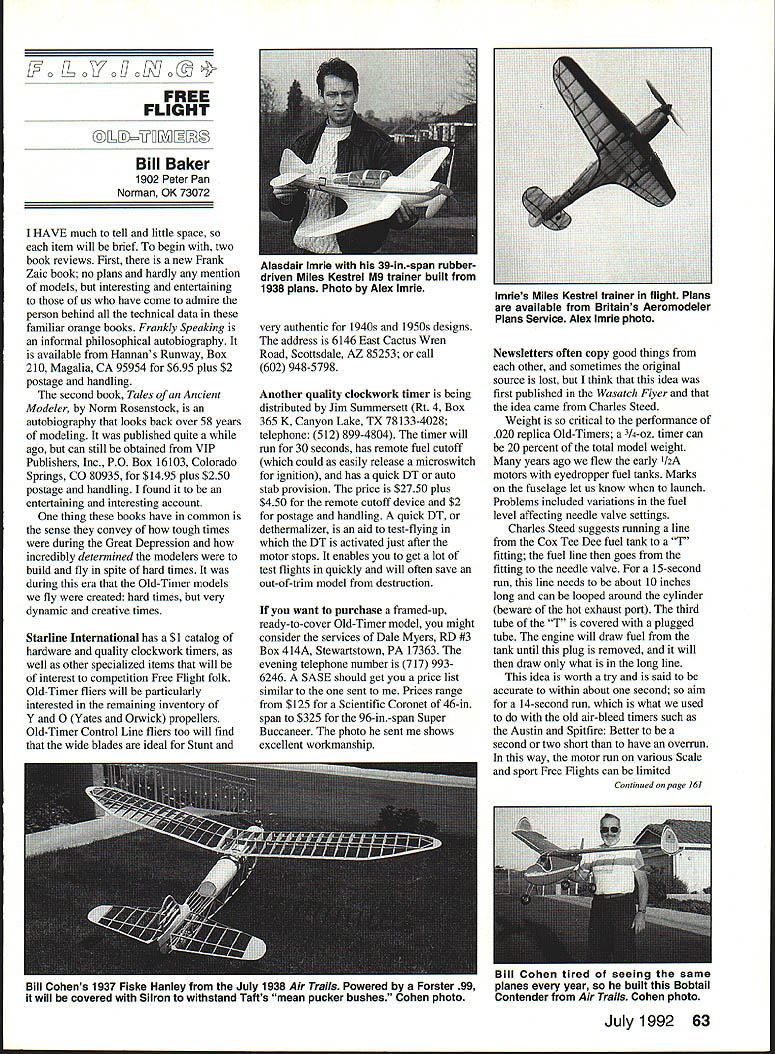
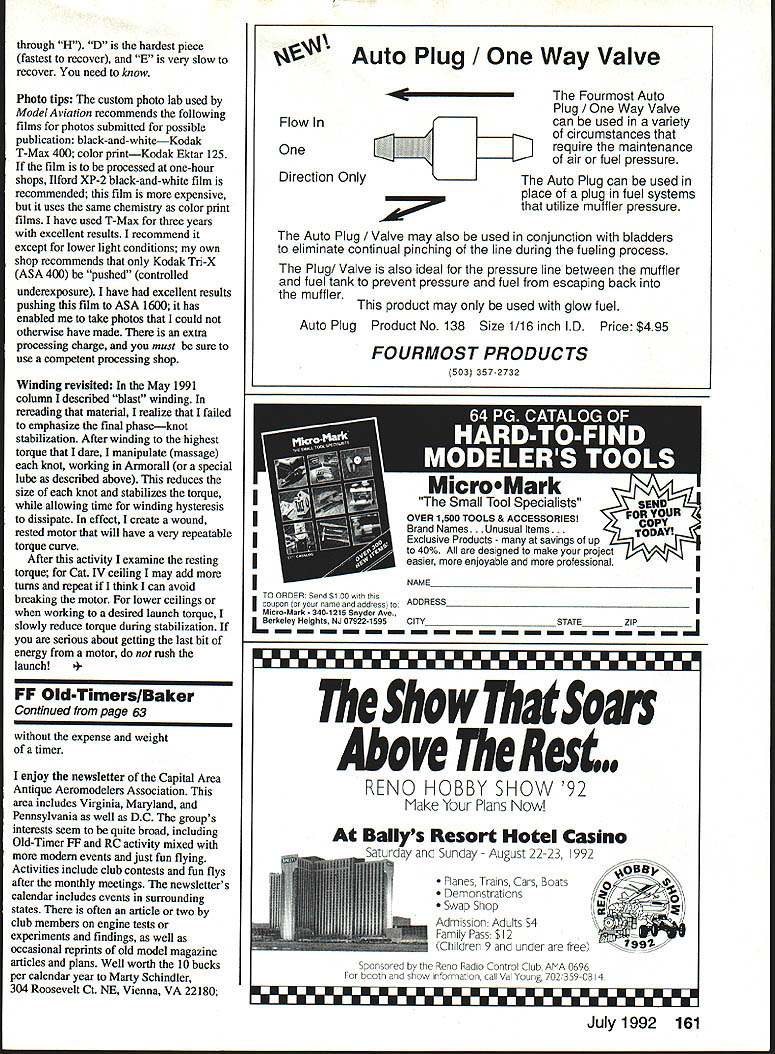
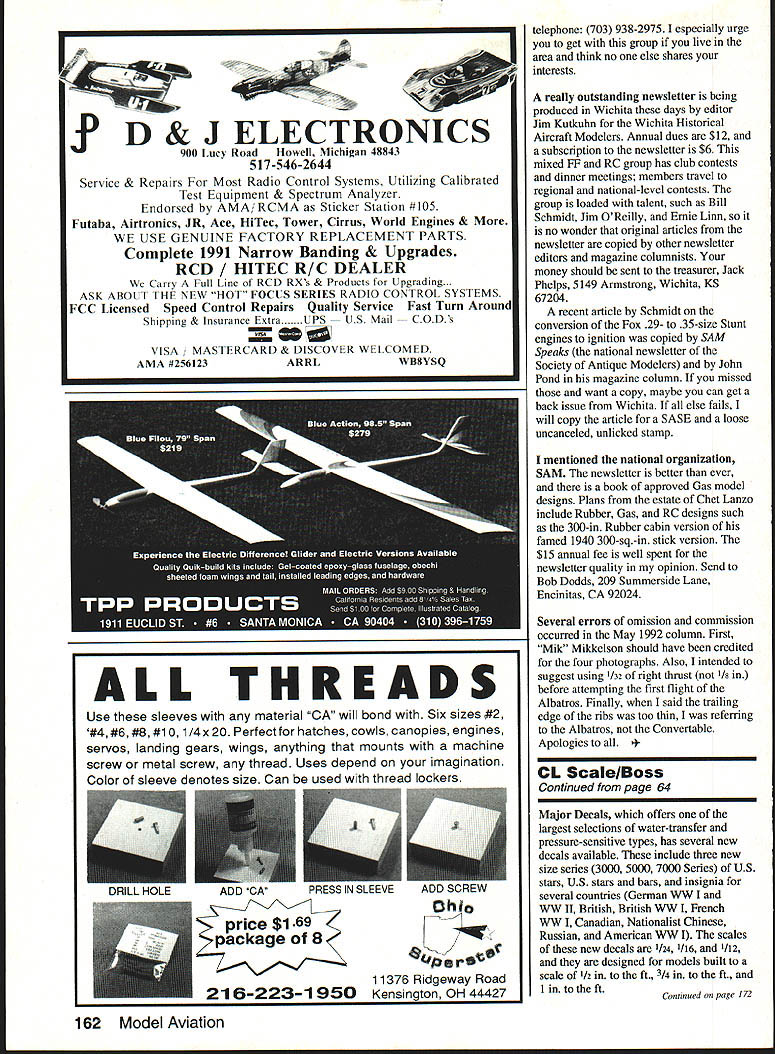
Free Flight: Old-Timers
Bill Baker 1902 Peter Pan Norman, OK 73072
Book reviews
I have much to tell and little space, so each item will be brief.
- Frankly Speaking, Frank Zaic — No new plans and hardly any mention of models, but interesting and entertaining to those who admire the person behind the technical data in the familiar orange books. An informal philosophical autobiography. Available from Hannan's Runway, Box 210, Magalia, CA 95954 for $6.95 plus $2 postage and handling.
- Tales of an Ancient Modeler, Norm Rosenstock — An autobiography looking back over 58 years of modeling. Published some time ago, but still obtainable from VIP Publishers, Inc., P.O. Box 16103, Colorado Springs, CO 80935, for $14.95 plus $2.50 postage and handling. Entertaining and interesting.
Both books convey how tough times were during the Great Depression and how determined modelers were to build and fly despite hard times. It was during this era that the Old-Timer models we fly were created: hard times, but very dynamic and creative times.
Hardware and timers
- Starline International — $1 catalog of hardware and quality clockwork timers, plus other items of interest to competition Free Flight folk. Old-Timer fliers will be particularly interested in the remaining inventory of Y & O (Yates and Orwick) propellers. Old-Timer Control Line fliers will find the wide blades ideal for Stunt and very authentic for 1940s and 1950s designs. Address: 6146 East Cactus Wren Road, Scottsdale, AZ 85253; telephone (602) 948-5798.
- Quality clockwork timer from Jim Summersett — Rt. 4, Box 365S, Canyon Lake, TX 78133-4028; telephone (512) 899-4804. The timer runs for 30 seconds, has a remote fuel cutoff (which could as easily release a microswitch for ignition), and has a quick DT (auto-stab) provision. Price: $27.50 plus $4.50 for the remote cutoff device and $2 postage and handling.
A quick DT, or dethermalizer, is an aid to test-flying in which the DT is activated just after the motor stops. It enables many quick test flights and will often save an out-of-trim model from destruction.
Ready-to-cover Old-Timers
If you want a framed-up, ready-to-cover Old-Timer model, consider Dale Myers, RD #3 Box 414A, Stewartstown, PA 17363. Evening telephone: (717) 993-6246. A SASE should get you a price list similar to the one sent to me. Prices range from $125 for a Scientific Coronet (46 in. span) to $325 for the 96-in. span Super Buccaneer. The photo I saw shows excellent workmanship.
Fuel-tank/run-timing tips
Weight is critical to the performance of .020 replica Old-Timers; a 3/4-oz. timer can be 20 percent of the total model weight. Many years ago we flew early 1/2A motors with eyedropper fuel tanks. Marks on the fuselage let us know when to launch, but problems included variations in fuel level affecting needle-valve settings.
Charles Steed suggests running the Cox Tee Dee fuel-tank fitting: the fuel line goes from the tank to the fitting and the needle valve. A 15-second run line needs to be about 10 inches long and can be looped around the cylinder (beware of the hot exhaust port). If a third tube or "T" fitting is plugged or covered, the engine will draw fuel from the tank until that plug is removed; once removed it will draw only what is in the long line. The idea is worth a try and is said to be accurate within about a second. Aim for a 14-second run with the old air-bleed timers such as the Austin Spitfire. Better to be a second or two short than to have an overrun. In this way the motor run on various Scale and Sport Free Flights can be limited without the expense and weight of a timer.
Note on recovery: through "H." "D" is the hardest piece (fastest to recover), and "E" is very slow to recover. You need to know.
Photo tips
The custom photo lab used by Model Aviation recommends the following films for photos submitted for possible publication:
- Black-and-white: Kodak T-MAX 400.
- Color print: Kodak Ektar 125.
If the film is to be processed at one-hour shops, Ilford XP-2 black-and-white film is recommended; this film is more expensive but uses the same chemistry as color print films.
I have used T-MAX for three years with excellent results. I recommend it except for lower-light conditions; my own shop recommends that only Kodak Tri-X (ASA 400) be "pushed" (controlled underexposure). I have had excellent results pushing Tri-X to ASA 1600; it enabled me to take photos I could not otherwise have made. There is an extra processing charge, and you must be sure to use a competent processing shop.
Winding revisited
In the May 1991 column I described "blast" winding. In rereading that material, I realize I failed to emphasize the final phase—knot stabilization. After winding to the highest torque that I dare, I manipulate (massage) each knot, working in Armor All (or a special lube as described above). This reduces the size of each knot and stabilizes the torque while allowing time for winding hysteresis to dissipate. In effect, I create a wound, rested motor that will have a very repeatable torque curve.
After this activity I examine the resting torque; for Cat. IV ceiling I may add more turns and repeat if I think I can avoid breaking the motor. For lower ceilings or when working to a desired launch torque, I slowly reduce torque during stabilization. If you are serious about getting the last bit of energy from a motor, do not rush the launch!
Newsletters and clubs
- Capital Area Antique Aeromodelers Association — I enjoy their newsletter. The area includes Virginia, Maryland, and Pennsylvania as well as D.C. The group's interests are broad, including Old-Timer FF and RC activity mixed with more modern events and just fun flying. Activities include club contests and fun flys after the monthly meetings. The newsletter calendar includes events in surrounding states and often features articles by members on engine tests, experiments, and occasional reprints of old model magazine articles and plans. Well worth $10 per calendar year to: Marty Schindler, 304 Roosevelt Ct. NE, Vienna, VA 22180.
- Wichita Historical Aircraft Modelers — Outstanding newsletter produced by Jim Kutkuhn. Annual dues are $12; a subscription to the newsletter is $6. This mixed FF and RC group has club contests and dinner meetings; members travel to regional and national contests. The group includes talent such as Bill Schmidt, Jim O'Reilly, and Ernie Linn, and original articles from the newsletter are often copied by other editors and columnists. Send money to treasurer Jack Phelps, 5149 Armstrong, Wichita, KS 67204.
A recent article by Bill Schmidt on converting Fox .29- to .35-size Stunt engines to ignition was copied by SAM Speaks (the national newsletter of the Society of Antique Modelers) and by John Pond in his magazine column. If you missed those and want a copy, try getting a back issue from Wichita. If all else fails, I will copy the article for a SASE and a loose uncanceled, unlicked stamp.
I mentioned the national organization, SAM. The newsletter is better than ever, and there is a book of approved Gas model designs. Plans from the estate of Chet Lanzo include Rubber, Gas, and RC designs such as the 300-in. rubber cabin version of his famed 1940 300-sq.-in. stick version. The $15 annual fee is well spent for the newsletter quality. Send to Bob Dodds, 709 Summerside Lane, Encinitas, CA 92024.
Corrections
Several errors of omission and commission occurred in the May 1992 column:
- "Mik" Mikkelsen should have been credited for the four photographs.
- I intended to suggest using 1/32 inch of right thrust (not 1/8 in.) before attempting the first flight of the Albatros.
- When I said the trailing edge of the ribs was too thin, I was referring to the Albatros, not the Convertable.
Apologies to all.
Transcribed from original scans by AI. Minor OCR errors may remain.

