
Free Flight: Old-Timers
Bill Baker 1902 Peter Pan Norman, OK 73072
I've been building model planes for more than half a century. I need only a few marks on paper—or the bench—to build a model. I try to discipline myself to read building instructions when they are provided, but it's hard. Like a jazz musician, I tend to improvise around a basic melody rather than follow the dots.
Newcomers are having success with today's better R/C kits because these kits include detailed step-by-step instructions, similar to those in the Heathkit electronic kits I used to make. When confronted with most Free Flight kits, newcomers are baffled: "Where are the instructions?"
Since production numbers are low, the cost of most kits would be very high if the kitmaker were to provide instructions suitable for newcomers. Most experienced builders wouldn't need—or wouldn't follow—step-by-step instructions, anyway.
Instructional books and recommended starter models
One solution is a separate, model-specific book, such as Building the Flying Aces Moth by Bill Warner (Tab Books, Blue Ridge Summit, PA 17294-0850). In 80 pages of text with many photos and clear drawings, the book covers exactly what is needed for the first-time builder of a stick-and-tissue rubber model—in this case, the Flying Aces Moth.
I recommend the Peck-Polymers kit for the Moth as a first Old-Timer rubber model, or the plane can be scratch-built from plans available from Ken Sykora's Oldtimer Model Supply, P.O. Box 7334, Van Nuys, CA 91409 (1992 catalog just out—$2). The instructions in the book take you from opening the box all the way to detailed flight-trim instructions. The rest of the 110-page book includes a chapter on building the Lacey M-10 peanut-scale model, a listing of model suppliers and publications, and a glossary of terms.
The big point: a book on how to build a specific model can be applied to other models of similar structure. If you understand how to build one model, you're likely to need far fewer instructions for the next.
Similar books from the same publisher/author cover the Peck-Polymers ROG and the Peck-Polymers Sky Bunny (a larger ROG). Unlike the original Peck ROG, the Sky Bunny has an airfoiled wing covered top and bottom; it glides surprisingly well.
A short history note: ROG means "rise off ground." In the early days, a model that could both fly and take off under its own power was considered remarkable. The term ROG generally referred to a simple rubber-powered model with a single-stick fuselage.
Flying Aces was a popular magazine in the 1930s. Staff-written construction articles included the Flying Aces Moth in the August 1937 issue (designer: Mr. Spatz). In John Pond's plans catalog I count 38 Flying Aces designs, including the Flying Aces Biplane and Flying Aces Navy Pursuit, many by Mr. Unrath.
Recommended tools and winders
- For large rubber models (16 strands of 1/4-in. rubber or similar), use a winder with a ratio in the ballpark of 4:1, such as Bob Wilder's or John Morrill's designs.
- For smaller models—Flying Aces Moth, Peck-Polymers Convertible, or any rubber model up to about 30 in. span—you can use a higher ratio, such as the 10:1 Scawelinder from Rees Industries, 600 Walnut Creek Dr., Goldsboro, NC 27534. It has quality gears and bearings; it is not cheap, but no cheap winder will have adequate bearings and gears. The Rees winder is $39.95 plus $3 shipping and handling.
- Cheaper, all-plastic winders are available but will handle only a few strands of rubber—fine for peanut models or small ROGs, and maybe barely enough for the Flying Aces Moth.
- These days, hand drills from the hardware store are likely to have plastic gears and lack full power under load. Electric drills are inexpensive; there is little market for quality hand drills that cost more than electric ones.
The Morrill winder (called the Sidewinder) is listed in the Oldtimer Model Supply catalog and the F.A.I. Model Supply catalog (P.O. Box 3957, Torrance, CA 90510). The F.A.I. catalog is $1.50.
F.A.I. Model Supply is the prime source for rubber strip these days and carries a surprising number of kits for Old-Timer rubber models. Bob Wilder's winders are first class; for information send an SASE to 2010 Boston, Irving, TX 75061.
Suppliers, catalogs, and drawings
I think the Oldtimer Model Supply catalog is worth the price just for the lovely drawings by Otto Kuhni. The catalog includes plans and scratchbuilder supplies, especially helpful for the rubber-model flier.
For plans and supplies:
- Ken Sykora's Oldtimer Model Supply, P.O. Box 7334, Van Nuys, CA 91409 (1992 catalog $2).
- F.A.I. Model Supply, P.O. Box 3957, Torrance, CA 90510 (catalog $1.50).
- Bob Wilder info: send SASE to 2010 Boston, Irving, TX 75061.
Clubs, newsletters, and plans for sale
In my column in the July issue I mentioned the improved SAM Speaks newsletter and gave the correct address to write to if you want to join SAM and get the newsletter. You will also get a rule book and a list of all approved Gas model designs for SAM competition. (I think someone is working on a similar list for Rubber models.)
A list of plans for sale is available from Jim Adams: write to Jim Adams, 2538 North Spurgeon, Santa Ana, CA 92706. Of special interest are the plans donated to SAM from the estate of Chester Lance. They include:
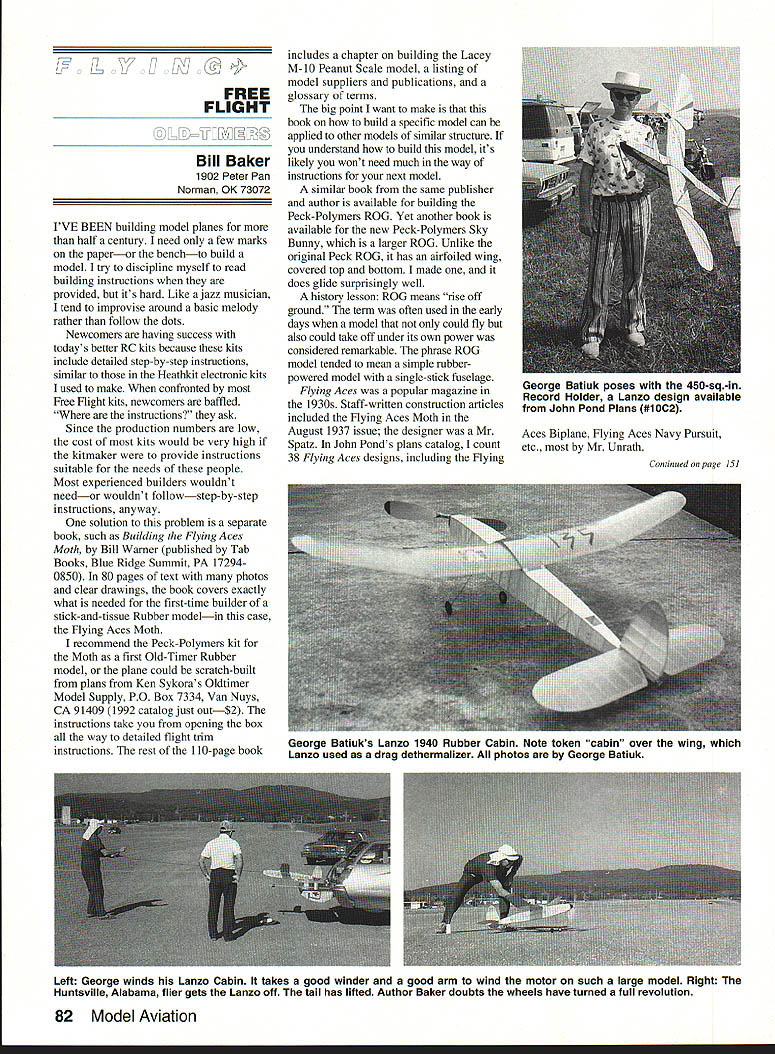
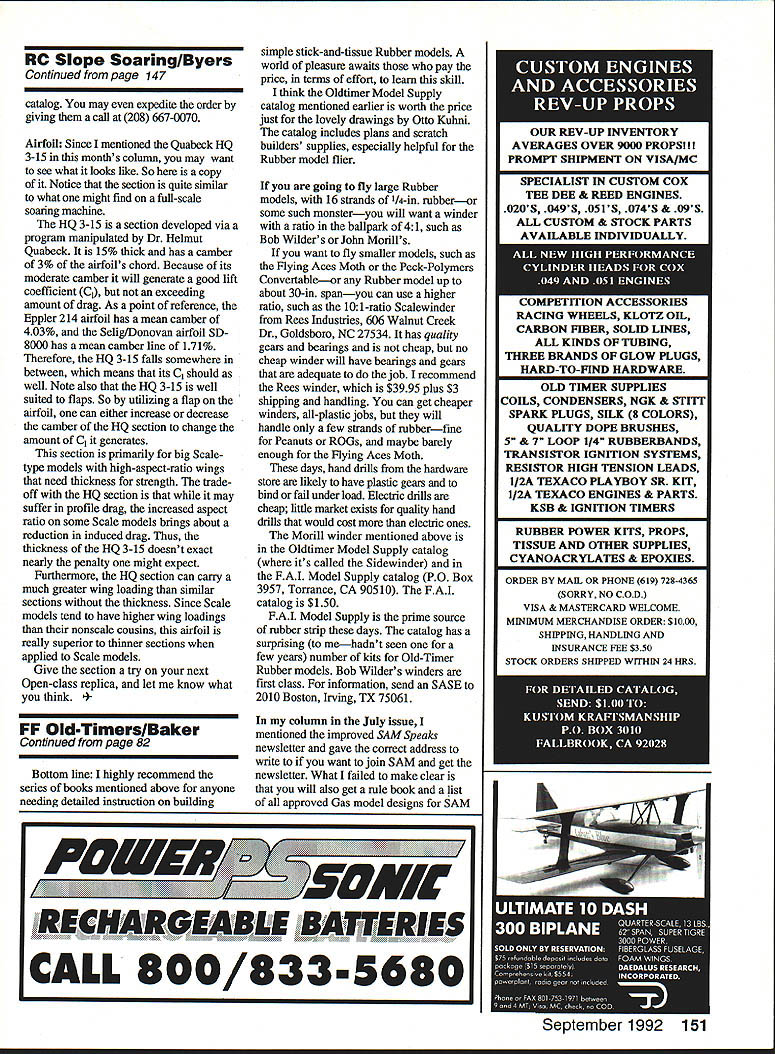
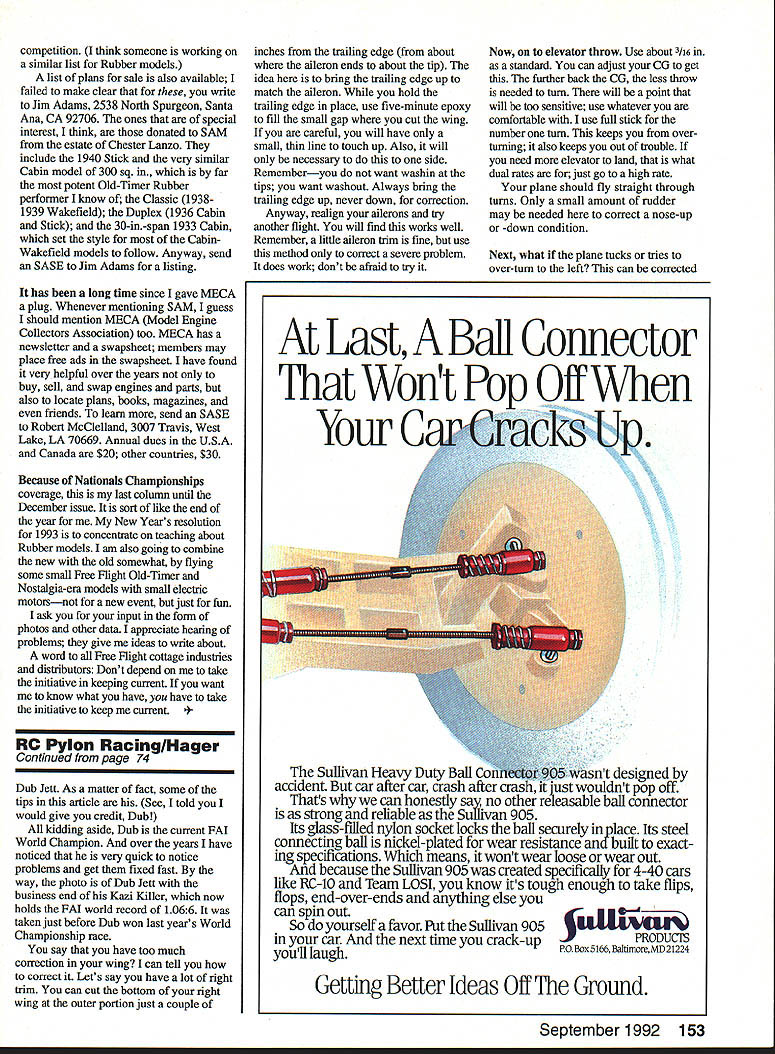
- 1940 Stick and the very similar Cabin model of 300 sq. in. (by far the most potent Old-Timer rubber performer I know),
- The Classic (1938–1939 Wakefield),
- The Duplex (1936 Cabin and Stick),
- The 30-in.-span 1933 Cabin, which set the style for many Cabin–Wakefield models to follow.
MECA (Model Engine Collectors Association) also deserves a plug. MECA has a newsletter and a swapsheet; members may place free ads in the swapsheet. I've found MECA very helpful over the years for buying, selling, and swapping engines and parts, locating plans and books, and even finding friends. To learn more, send an SASE to Robert McClelland, 3007 Travis, West Lake, LA 70669. Annual dues: U.S.A. and Canada $20; other countries $30.
Personal plans and requests
Because of Nationals Championships coverage, this is my last column until the December issue. It feels like the end of the year for me. My New Year's resolution for 1993 is to concentrate on teaching about rubber models. I also plan to combine the new with the old somewhat—flying some small Free Flight Old-Timer and Nostalgia-era models with small electric motors, not for a new event but just for fun.
I welcome your input in the form of photos and other data. Send me problems and questions; they give me ideas to write about.
A word to all Free Flight cottage industries and distributors: don't depend on me to take the initiative in keeping current. If you want me to know what you have, you have to take the initiative and keep me informed.
Flight-trim basics
- Elevator throw: use about 3/16 in. as a standard. You can adjust your center of gravity (CG) to obtain this. The further back the CG, the less elevator is needed to turn. There will be a point when it becomes too sensitive; use whatever you are comfortable with.
- I use full stick for the number-one turn. This keeps you from over-turning and helps avoid trouble. If you need more elevator to land, use higher rudder rates; your plane should fly straight through turns. Only a small amount of rudder may be needed to correct a nose-up or nose-down condition.
- If the plane tucks or tries to over-turn to the left, check and correct control settings and trim. Typical corrective steps include:
- Reduce left rudder or add a small amount of right rudder.
- Add a touch of right thrust (or reduce left thrust) at the motor peg.
- Move the CG slightly forward if needed.
- Check wing and tail alignment for warps or twists.
Bottom line: I highly recommend the series of books and the suppliers mentioned above for anyone needing detailed instruction on building simple stick-and-tissue rubber models. A world of pleasure awaits those who pay the price, in terms of effort, to learn this skill.
Transcribed from original scans by AI. Minor OCR errors may remain.

