
Free Flight: Old-Timers
Bill Baker, 1902 Peter Pan, Norman, OK 73072
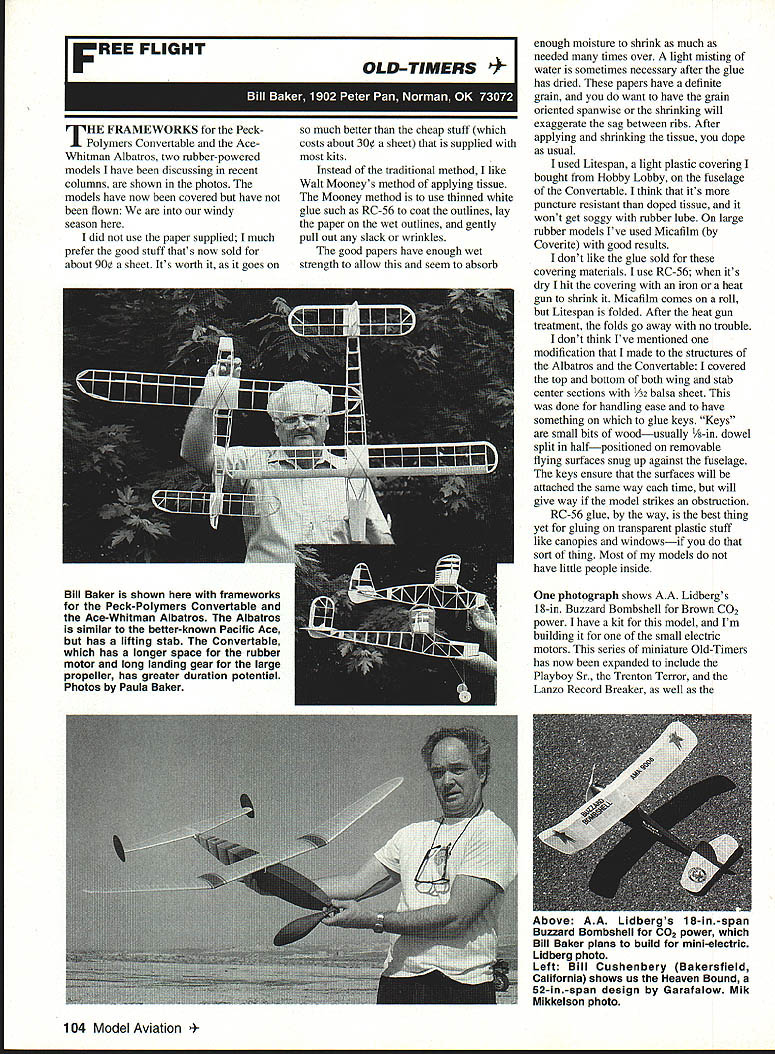
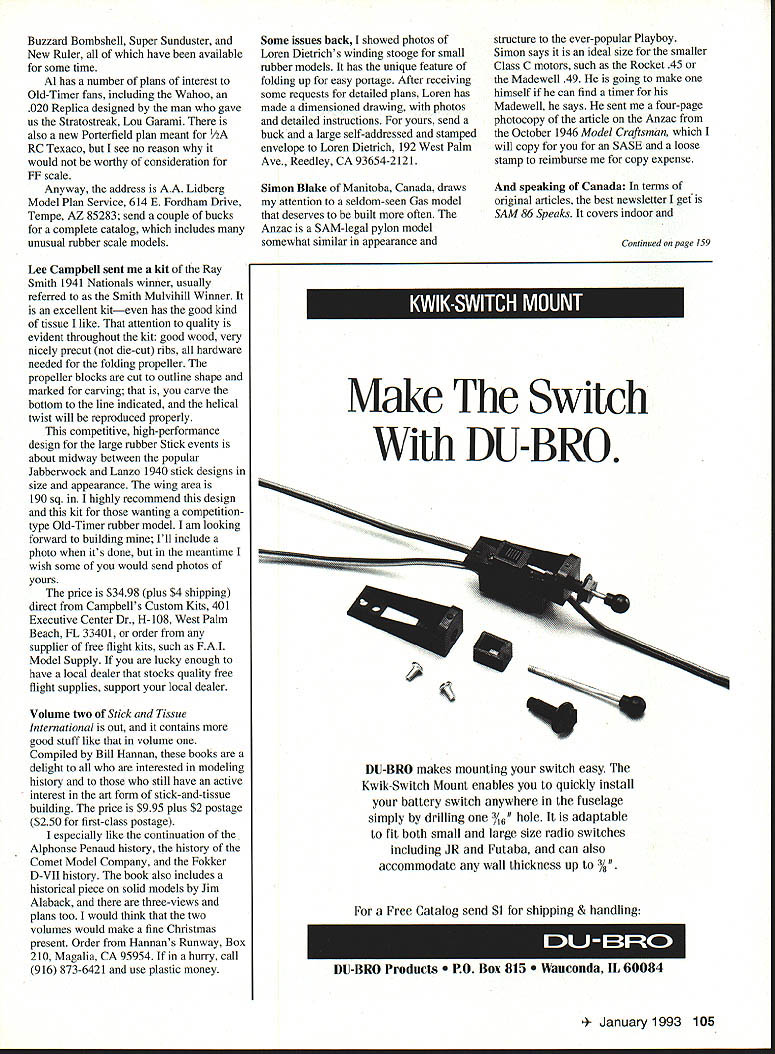
The frameworks for the Peck-Polymers Convertable and the Ace-Whitman Albatros, two rubber-powered models I have been discussing in recent columns, are shown in the photos. The models have now been covered but have not been flown; we are into our windy season here.
I did not use the paper supplied; I much prefer the good stuff that's now sold for about 90¢ a sheet. It's worth it, as it goes on so much better than the cheap stuff (which costs about 30¢ a sheet) that is supplied with most kits.
Covering and adhesives
Instead of the traditional method, I like Walt Mooney's method of applying tissue. The Mooney method is to use thinned white glue such as RC-56 to coat the outlines, lay the paper on the wet outlines, and gently pull out any slack or wrinkles. The good papers have enough wet strength to allow this and seem to absorb enough moisture to shrink as much as needed many times over. A light misting of water is sometimes necessary after the glue has dried. These papers have a definite grain, and you do want to have the grain oriented spanwise or the shrinking will exaggerate the sag between ribs. After applying shrinking tissue, dope as usual.
I used Litespan, a light plastic covering I bought from Hobby Lobby, on the fuselage of the Convertable. I think it's more puncture resistant than doped tissue, and it won't get soggy with rubber lube. On large rubber models I've used Micafilm (by Coverite) with good results.
I don't like the glue sold for these covering materials. I use RC-56; when it's dry I hit the covering with an iron or a heat gun to shrink it. Micafilm comes on a roll, but Litespan is folded. After the heat gun treatment, the folds go away with no trouble.
Modifications and keys
I covered the top and bottom of both wing and stab center sections with 1/32" balsa sheet. This was done for handling ease and to have something on which to glue keys.
Keys are small bits of wood—usually 1/8" dowel split in half—positioned on removable flying surfaces to snug up against the fuselage. The keys ensure that the surfaces will be attached the same way each time, but will give way if the model strikes an obstruction.
RC-56 glue, by the way, is the best thing yet for gluing on transparent plastic stuff like canopies and windows—if you do that sort of thing. Most of my models do not have little people inside.
Kits and models
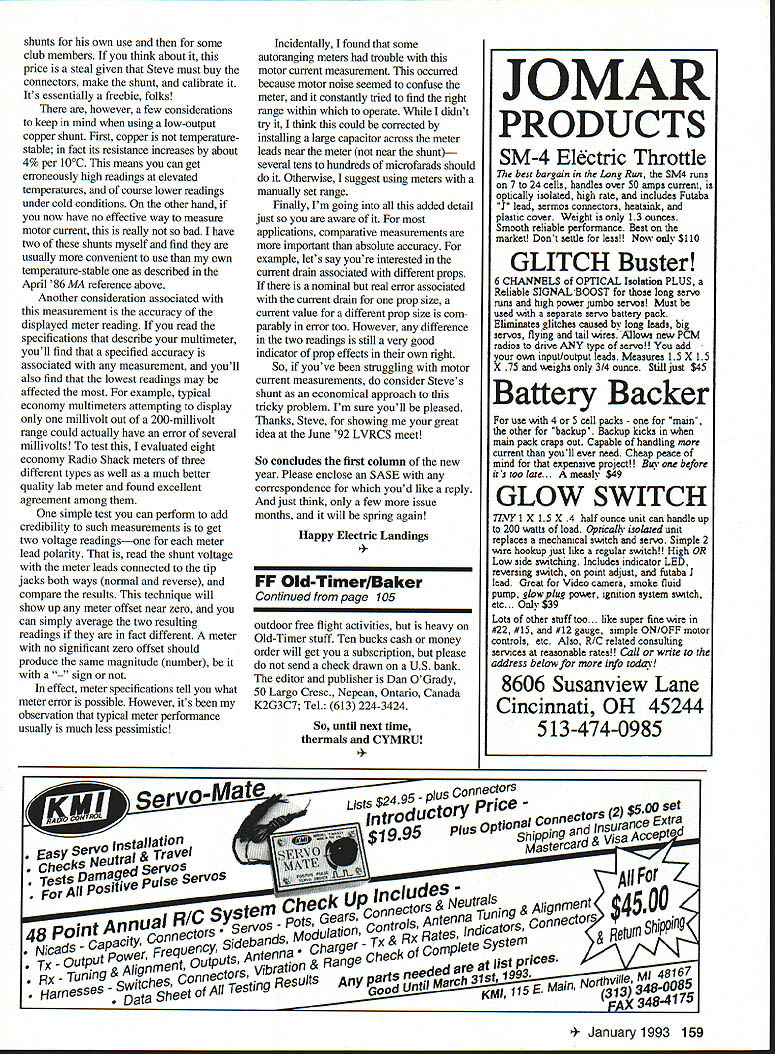
One photograph shows A. A. Lidberg's 18-in. Buzzard Bombshell for Brown CO2 power. I have a kit for this model, and I'm building it for one of the small electric motors. This series of miniature Old-Timers has now been expanded to include:
- Playboy Sr.
- Trenton Terror
- Lanzo Record Breaker
- Wahoo .020 replica (designed many years ago)
A. A. Lidberg Model Plan Service, 614 E. Fordham Drive, Tempe, AZ 85283. Send a couple bucks for a complete catalog; it includes unusual rubber-scale models.
Some issues back we showed photos of Loren Dietrich's winding stooge for small rubber models. It has the unique feature of folding up for easy portage. After receiving some requests for detailed plans, Loren has made dimensioned drawings and photos with detailed instructions. Yours for a buck and a large self-addressed stamped envelope:
- Loren Dietrich, 192 West Palm Ave., Reedley, CA 93654-2121
Simon Blake, Manitoba, Canada, draws attention to a seldom-seen gas model that deserves to be built often—the Anzac. The Anzac is a SAM-legal pylon model somewhat similar in appearance and structure to the ever-popular Playboy. Simon says it's the ideal size for smaller Class C motors such as the Rocket .45 and the Madewell .49. Madewell says he sent a four-page photocopy of the October 1946 Model Craftsman article on the Anzac and will copy it for SASE plus a loose stamp to reimburse copy expense.
Lee Campbell sent me a kit of the Ray Smith 1941 Nationals winner, usually referred to as the Smith Mulvihill Winner. It is an excellent kit—even has the good kind of tissue I like. That attention to quality is evident throughout the kit: good wood, very nicely precut (not die-cut) ribs, and all hardware needed for the folding propeller. The propeller blocks are cut to outline shape and marked for carving; that is, you carve the bottom to the line indicated, and the helical twist will be reproduced properly.
This competitive, high-performance design for the large rubber Stick events is about midway between the popular Jabberwock and Lanzo 1940-stick designs in size and appearance. The wing area is 190 sq. in. I highly recommend this design and this kit for those wanting a competition-type Old-Timer rubber model. I am looking forward to building mine; I'll include a photo when it's done, but in the meantime I wish some of you would send photos of yours.
The price is $34.98 (plus $4 shipping) direct from Campbell's Custom Kits:
- Campbell's Custom Kits, 401 Executive Center Dr., H-108, West Palm Beach, FL 33401
You may also order from any supplier of free flight kits, such as F.A.I. Model Supply. If you are lucky enough to have a local dealer that stocks quality free flight supplies, support your local dealer.
Publications and references
Volume Two of Stick and Tissue International is out, and it contains more good stuff like that in Volume One. Compiled by Bill Hannan, these books are a delight to all who are interested in modeling history and to those who still have an active interest in the art form of stick-and-tissue building. The price is $9.95 plus $2 postage ($2.50 for first-class postage).
I especially like the continuation of the Alphonse Penaud history, the history of the Comet Model Company, and the Fokker D-VII history. The book also includes a historical piece on solid models by Jim Alaback, and there are three-views and plans too. I would think that the two volumes would make a fine Christmas present. Order from:
- Hannan's Runway, Box 210, Magalia, CA 95954. If in a hurry, call (916) 873-6421 and use plastic money.
Continued from page 105
[The publication mentioned is] heavy on Old-Timer stuff and covers outdoor free flight activities. Ten bucks cash or money order will get you a subscription, but please do not send a check drawn on a U.S. bank.
The editor and publisher is Dan O'Grady:
- Dan O'Grady, 50 Largo Cres., Nepean, Ontario, Canada K2G 3C7; Tel.: (613) 224-3424
So, until next time, thermals and CYMRU!
Transcribed from original scans by AI. Minor OCR errors may remain.

