
FREE FLIGHT: OLD-TIMERS
By Bill Baker
1902 Peter Pan, Norman, OK 73072
Propeller sizing (rubber-powered Old-Timers)
- Wing area 100–150 sq in: prop diameter about 12–15 in.
- Wing area 150–200 sq in: prop diameter about 15–17 in.
- Wing area 200–300 sq in: prop diameter about 17–20 in.
- Aim for a pitch/diameter ratio of about 1.2:1 to 1.3:1 for most sport/duration/scale outdoor models.
Note: Modern Mulvihills and Wakes may use larger diameters (my Conscientious Objector Mulvihill used a prop nearly half the wingspan).
Laying out the propeller block
- Decide diameter and pitch. Multiply diameter by the pitch/diameter ratio to get pitch.
- Example: diameter = 15 in. Pitch = 15 × 1.25 = 18.75 → call it 19.
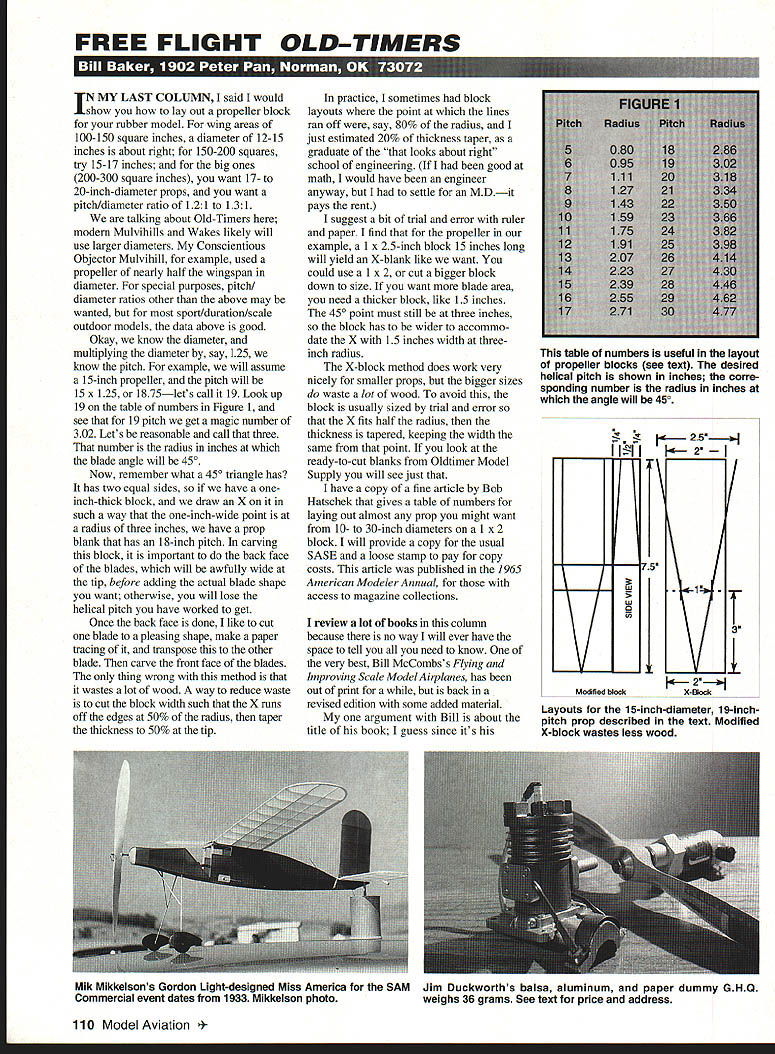
- Look up the pitch (19) on the layout table (see Figure 1). For 19 pitch the table gives a number of 3.02—reasonably call that 3. That is the radius in inches at which the blade angle will be 45°.
- Use a one-inch-thick block and draw an X so that the one-inch-wide point is at a radius of 3 in. A 45° triangle has two equal sides, so this X layout yields the correct helical pitch (an 18–19 inch pitch in this example).
- Carve the back face of the blades first (the back face will be quite wide at the tip). If you carve the front face or the final blade shape first you risk losing the helical pitch you worked to get.
- After cutting the back face, carve one blade to a pleasing shape, make a paper tracing, transpose that tracing to the other blade, then finish the front faces.
Reducing waste and alternative block methods
- The simple X-block method wastes a lot of wood on larger props. To reduce waste:
- Size the block so the X runs off the edges at about 50% of the radius, then taper the thickness to about 50% at the tip while keeping the width constant from that point outward.
- In practice you can run the X off at other percentages (I’ve used points that run off at ~80% of radius and estimated ~20% thickness taper). A bit of trial and error with ruler and paper works well.
- Typical practical block sizes:
- For the example 15 in prop: a 1 × 2.5 in block, 15 in long, will produce a usable X-blank.
- You could use a 1 × 2 in block or cut a larger block down.
- If you want more blade area, use a thicker block (e.g., 1.5 in). The 45° point must still be at the calculated radius (3 in in the example), so increase block width to accommodate the X at that radius.
Old-Timer Model Supply and other blank suppliers size their ready-to-cut blanks so the X fits about half the radius and the thickness is tapered—this is a common factory approach.
Further reference and articles
- Bob Hatschek wrote a useful article with tables for laying out almost any prop from 10– to 30-inch diameters on a 1 × 2 block. I can provide a copy for a usual SASE and a loose stamp to cover copying costs. That article was published in the 1965 American Modeler Annual.
- I review many books because a column can't cover everything. Recommended:
- Bill McComb, Flying and Improving Scale Model Airplanes — revised edition now available. Price $14.95; updates for earlier editions $3.95. Order from: Aircraft Data, P.O. Box 763576, Dallas, TX 75224. Includes an excellent chapter on propellers and an appendix on propeller block layout. See also Bill’s article “Vertical Tail Size for Models,” Model Aviation, March–April 1992.
- Bill Hannan, Models & Musings — simple, fun stick-and-tissue rubber-powered designs. Available from Hannan’s Runway, P.O. Box 210, Magalia, CA 95954. Tel. 916-873-6421. Also available from Peck-Polymers and other distributors. The new edition combines designs from the earlier two editions.
Plans, items, and miscellaneous sales
- Price is $6 for certain fine-looking plans suitable for CO2, rubber, and mini-electric.
- Available for $1.50: a 1947 MAN plan for a twin-boom pusher for tiny CO2 motors by Howard McEntee; a 12-inch-span Megow Fleet Trainer for $1.50. Enclose postage—refunds for extra postage are likely—or send an SASE to get the complete list and postage data.
- WWII plans are drawn to 3/4 in–to–the-foot scale, run about 20–22 in span, show a K&B .020 for power, and include printed wood patterns.
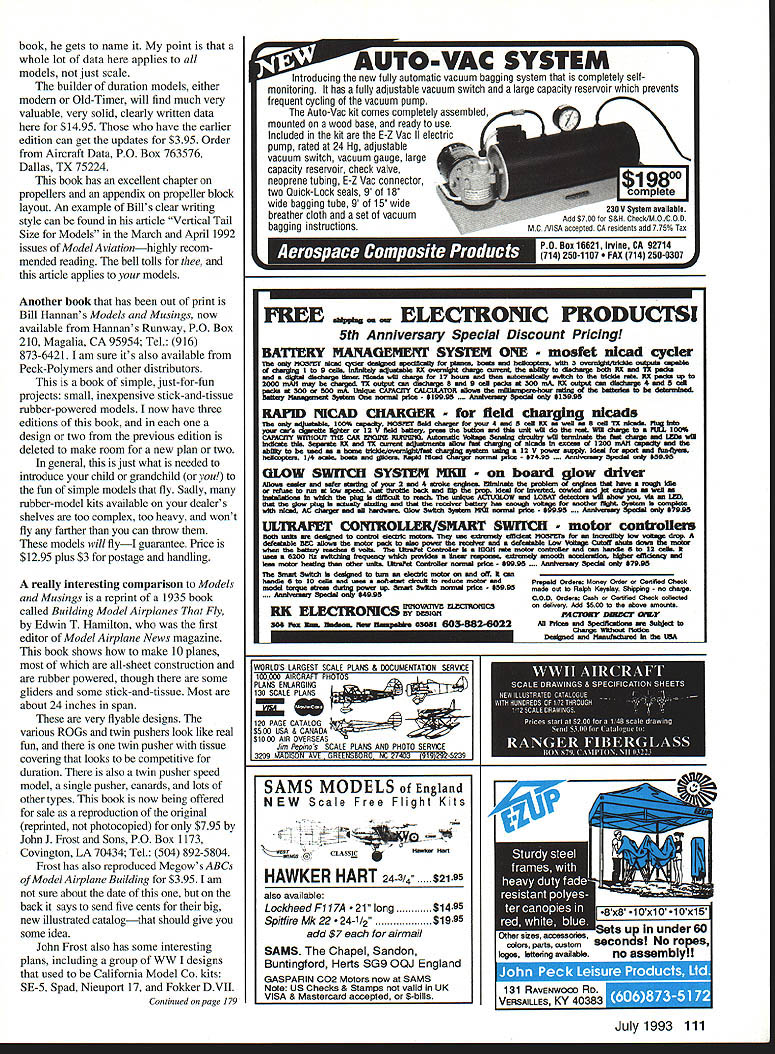
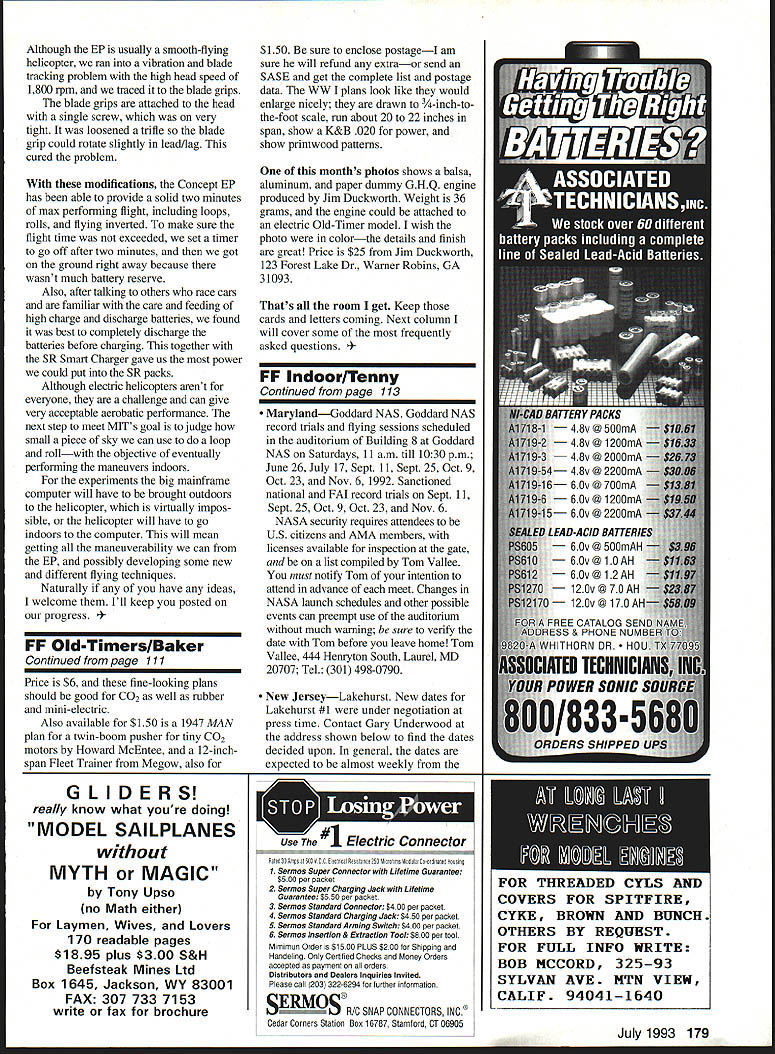
- Photo note: A balsa, aluminum, and paper dummy G.H.Q. engine produced by Jim Duckworth weighs 36 g and could be attached to an electric Old-Timer model. Price $25 from Jim Duckworth, 123 Forest Lake Dr., Warner Robins, GA 31093.
Closing
Keep those cards and letters coming. Next column I will cover some of the most frequently asked questions.
Transcribed from original scans by AI. Minor OCR errors may remain.

