
FREE FLIGHT OLD-TIMERS
Bill Baker, 1902 Peter Pan, Norman, OK 73072
THE MOST FREQUENTLY ASKED questions I receive have been the "Where can I get..." types. That's why I plug the cottage industries. Then there are the how-to questions, which is why I plug various books.
During the past year I have been trying to provide some basic information about rubber power; the questions I've received show that a lot of people need this really basic information. They would be well advised to read Rubber Powered Model Airplanes by Don Ross. The second edition is $13.95 from Zenith; the toll-free number is (800) 826-6600. Many booksellers have it, or you might try Peck-Polymers, Hannan's, etc.
Even the guy who flew rubber models as a youth, is now retired, and wants to fly again (a very frequent scenario, by the way) is puzzled by the changes that have taken place in the way rubber models are flown. You can do everything "like wuz," but everyone else is using modern techniques and doing much better than in the old days.
The present-day flier of Old-Timer designs is likely to use a winding tube and hook, as well as a stooge to hold the model by an aluminum tube that has replaced a dowel or wire hook. The propeller is removed during the winding process, which keeps it out of the line of fire should a blown motor fly in that direction. It also eliminates strain on the prop hinges if the propeller is turned while the rubber is wound.
High-quality winders and torque meters allow winding to the "last turn minus one" so that all of the motor's available energy is obtained. In the old days it was too risky to do that. Models with dethermalizers often last for years, so they get into really fine trim, but need to be well made so as not to die of hangar rash. (I have broken more models than I care to think about just trying to get in and out of doors.)
Basics
I use an old 2 x 4 with holes drilled for dowels, spaced for the motors I use. If the distance from the rear peg to the front hook is 30 inches, I usually space the dowels about 34 inches apart. The rubber strip is placed around the dowel under no tension, but without much slack. I tie one tight overhand knot, using saliva for lubricant. Then I put a square knot on top of that and trim the excess, leaving about 1/2-inch ends. I use small rubber bands (like I might use for dethermalizer bands) around each end of the motor to keep the loops together.
Before the motor is used, I like to break it in by attaching one end to something I really trust will hold in place, then I stretch the motor as far as it feels like it will go. When it quits stretching, that's it. I hold at this point for a couple of minutes.
If the rubber came packed in talcum powder, it should be washed off with water. I like the lubricant F.A.I. Model Supply sells (P.O. Box 3957, Torrance, California 90510; Tel (310) 830-8939; catalog $1.50). I think it is the basic soap-and-glycerine formula. In the past I tried using certain shampoos, but they dry out too fast. Glycerine is hygroscopic—that means it retains moisture.
For motors of only a few (two to eight) strands, I think lubricants such as Armor All are okay; they are very popular with scale fliers because of the absence of splatter. However, I found that on big motors, like 28 strands and up, I had a lot of one- or two-strand breaks, so I went back to soap and glycerine. The most important thing is to use some lubricant; otherwise you will break a lot of motors, have poor power, and have very short motor life. So lube the motor, and put a bottle of rubbing alcohol in your field box. It works fine for getting the soap off your hands after you lube the motor.
I like 1/8-inch rubber for most purposes. If you use 1/4-inch, it's fine until you get into a situation where 12 strands are too few and 14 are too many. Unless you are one of those people who can hear the sound of one hand clapping, you won't be able to use 13 strands, so use 26 strands of 1/4-inch. Once I had a Coupe that flew best on 14 strands of 3/32, which I cut from 7/64 because six strands were too short and eight didn't have enough torque.
Braiding and slack control
People are confused by the term braiding in regard to rubber motors. This is not braiding like pigtails on little girls; what it amounts to is shortening a very long motor (lots of turns, not so much torque, if you remember previous lessons) so it doesn't flop around after unwound, mess up the center of gravity (CG), and spoil the glide. Peanut-butter-and-jelly sandwiches hit the floor jelly-side down, and rubber collects aft of the CG, causing stalls. When two things can happen, the worst of the two is most likely—and at the worst possible time—like going third max.
Peck-Polymers' Dietrich Convertible has very clear instructions on braiding. First, Peck explains how to make a 12-strand 3/16, 22-1/2-inch motor that will have little slack; then they tell how to make up a 35-inch motor and braid it down to 22 inches.
- Lay out six loops 35 inches long.
- Braid the motor.
- Hook the end over a well-anchored smooth projection.
- Put 100 clockwise turns on the rubber.
- Fold the motor over, keeping it stretched.
- Remove the winding hook and attach the hook end of the motor to the same projection as the other end.
- Place the winder at the middle of the motor (where it is folded) and wind another 100 clockwise turns while gradually letting the motor shorten to 22-1/2 inches.
- Holding the 22-1/2-inch length, finish as required for your model.
Gradually unwind the motor. As it unwinds, it will braid itself to the proper length.
Winding technique
Most inexperienced winders do not stretch the rubber far enough when winding. They will not get in the maximum possible turns. My old buddy George Perryman stretches the bejesus out of the rubber and winds so tight you can see the lube come squeezing out. Pull until it feels as if no more elasticity is left, then give in a few inches and wind.
After a few winds, pull again; if there is no elasticity, give up another few inches. That way you will get all the turns possible. If you do not stretch the rubber you might break it at partial winds, as the rubber will get overstressed at some local spot instead of an evenly distributed stretch.
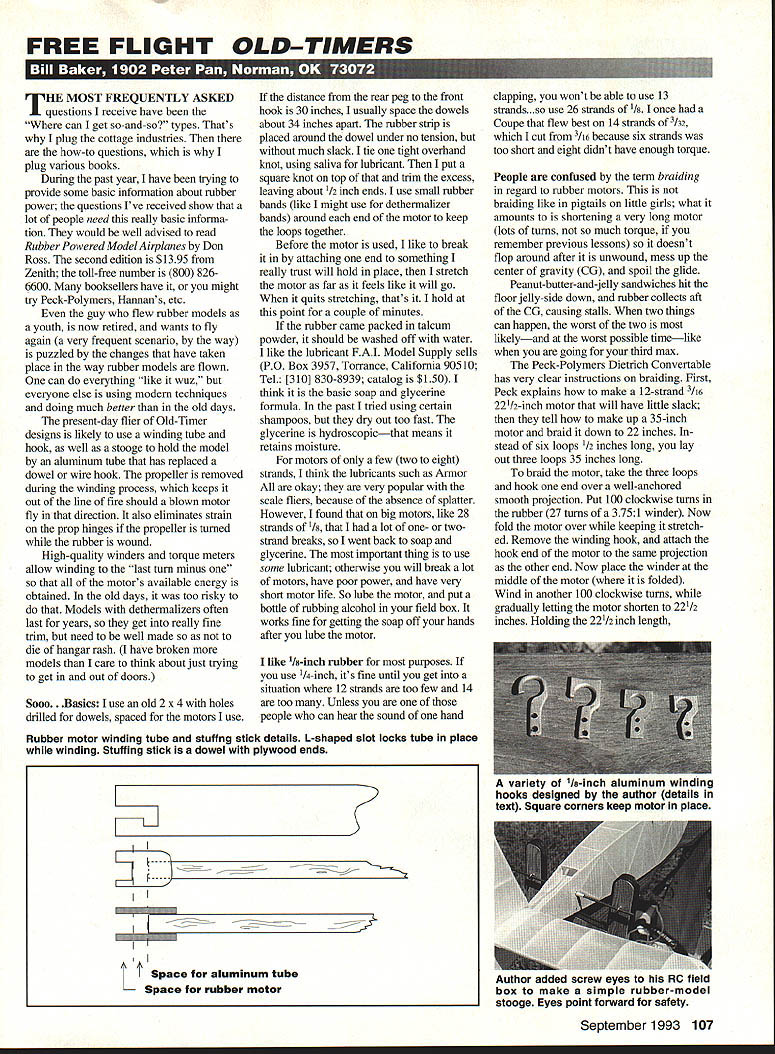
I will describe the tools of the trade—a stuffing stick, winding tube, retrieval hook, winding hook, winder, and stooge. These things are used so that the tube—sometimes called a blast tube—is in the model during winding, so that a shattered motor won't make for a shattered model. Very seldom do I break a motor, but it is the confidence of having the tube there that allows the motor to be fully wound, without fear of a blown motor's destructive force.
The L-shaped slot in the end of the winding tube will twist-lock onto the aluminum rear motor-holding tube, so the tube will stay in the fuselage when the motor is stretched. Tubes may be made of paper, plastic, PVC pipe, or, for smaller models, model rocket tubes.
Stuffing sticks are dowels with plywood ends. I had an aluminum rod I used for years, because I kept stepping on the wooden ones!
I use 1/8-inch aluminum winding hooks. The rubber centers itself at the narrow spot, and it won't climb the square corners. This can happen with the one round-cornered hook shown in some photos. Commercial Crockett hooks are highly recommended.
Note the two holes in each hook. The end hook is for the prop shaft; the other is for a hand-held piece of wire to be inserted, to control the wound motor while the transfer from winder to prop is made.
Winding sequence
- Insert the motor with the stuffing stick.
- Place the tube over the retrieval hook, hook onto the winding hook (which is on the motor), and slide the tube over the motor and into the model.
- Remove the retrieval hook.
- Attach winder and wind.
- Transfer winding hook to retrieval hook, remove tube, attach propeller, remove model from stooge, and fly.
My column appears every other month, but because of the special NATS issue and the strange way Model Aviation counts every other, it will be the January issue before we meet again. Keep on cranking!
Transcribed from original scans by AI. Minor OCR errors may remain.

