
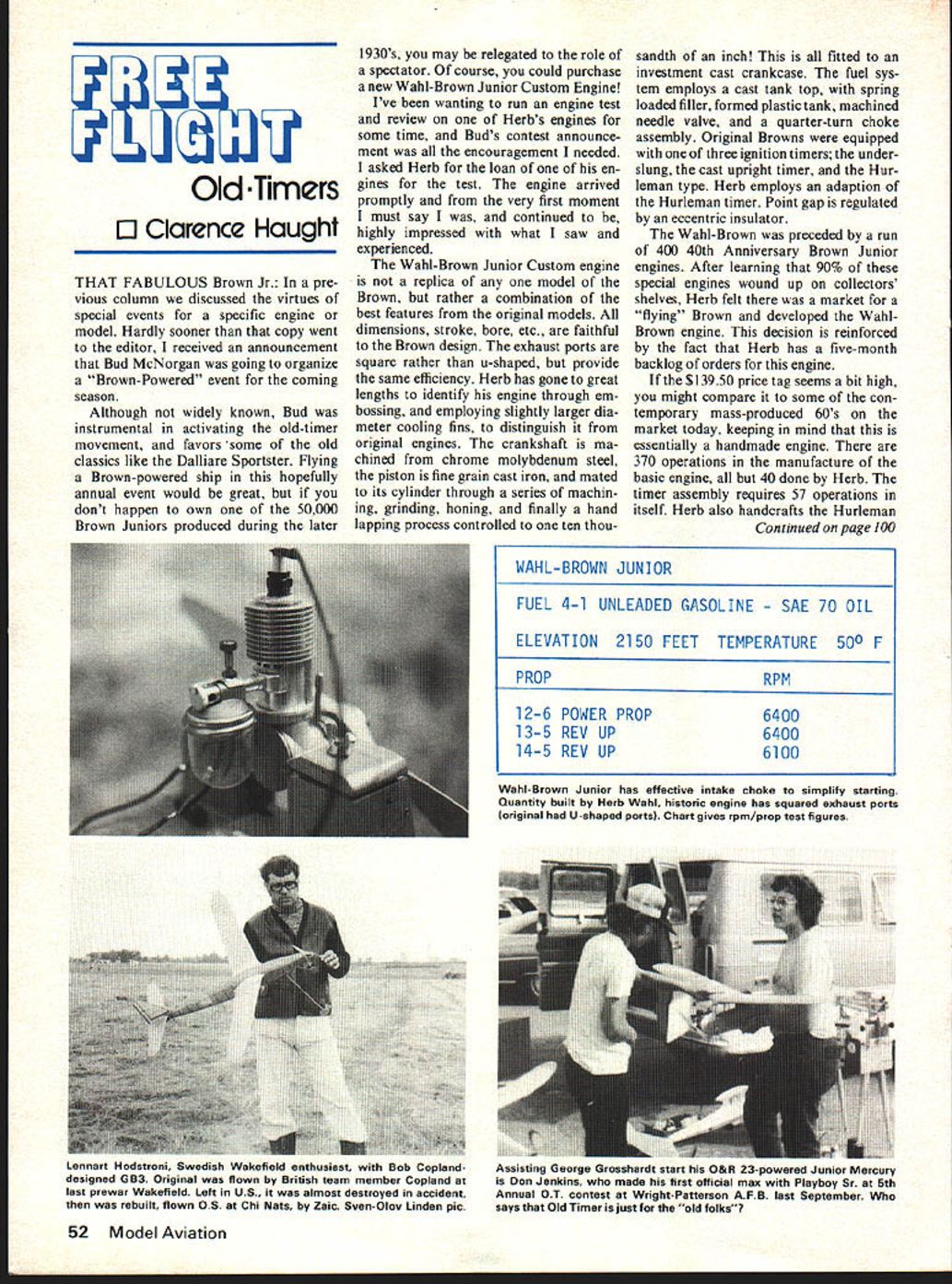
Free Flight: Old-Timers
Clarence Haught
THAT FABULOUS Brown Jr.: In a previous column we discussed the virtues of special events for a specific engine or model. Hardly sooner than that copy went to the editor, I received an announcement that Bud McNorgan was going to organize a "Brown-Powered" event for the coming season.
Although not widely known, Bud was instrumental in activating the old-timer movement, and favors some of the old classics like the Dallaire Sportster. Flying a Brown-powered ship in this hopefully annual event would be great, but if you don't happen to own one of the 50,000 Brown Juniors produced during the later 1930's, you may be relegated to the role of a spectator. Of course, you could purchase a new Wahl-Brown Junior Custom Engine!
I've been wanting to run an engine test and review on one of Herb's engines for some time, and Bud's contest announcement was all the encouragement I needed. I asked Herb for the loan of one of his engines for the test. The engine arrived promptly and from the very first moment I must say I was, and continued to be, highly impressed with what I saw and experienced.
The Wahl-Brown Junior Custom engine is not a replica of any one model of the Brown, but rather a combination of the best features from the original models. All dimensions, stroke, bore, etc., are faithful to the Brown design. The exhaust ports are square rather than U-shaped, but provide the same efficiency. Herb has gone to great lengths to identify his engine through embossing, and employing slightly larger diameter cooling fins, to distinguish it from original engines. The crankshaft is machined from chrome molybdenum steel, the piston is fine grain cast iron, and mated to its cylinder through a series of machining, grinding, honing, and finally a hand lapping process controlled to one ten-thousandth of an inch! This is all fitted to an investment cast crankcase. The fuel system employs a cast tank top, with spring loaded filler, formed plastic tank, machined needle valve, and a quarter-turn choke assembly. Original Browns were equipped with one of three ignition timers; the under-slung, the cast upright timer, and the Hurleman type. Herb employs an adaption of the Hurleman timer. Point gap is regulated by an eccentric insulator.
The Wahl-Brown was preceded by a run of 400 40th Anniversary Brown Junior engines. After learning that 90% of these special engines wound up on collectors' shelves, Herb felt there was a market for a "flying" Brown and developed the Wahl-Brown engine. This decision is reinforced by the fact that Herb has a five-month backlog of orders for this engine.
If the $139.50 price tag seems a bit high, you might compare it to some of the contemporary mass-produced '60s on the market today, keeping in mind that this is essentially a handmade engine. There are 370 operations in the manufacture of the basic engine, all but 40 done by Herb. The timer assembly requires 57 operations in itself. Herb also handcrafts the Hurleman
After mounting the engine on the stand I filled the tank with the recommended 4-to-1 fuel mixture (unleaded gasoline, SAE 70 oil). The Brown long-stroke, high-torque engine normally swings a 14-inch prop of 6-8 pitch. The supply included 12-, 13- and 14-inch props. Following usual practice in breaking an engine in, I used a light propeller load and bolted on a 12-6. The engine hand-started easily after clocking three revolutions using Herb's recommended needle setting of 2 turns. The instruction sheet calls for short initial runs, 5-10 seconds followed by a cooling period. Since the engine was very tight, I found the engine would run about 15 seconds, stopping on its own. After a couple tanks the engine would continue to run until
WAHL-BROWN JUNIOR
FUEL 4-1 UNLEADED GASOLINE - SAE 70 OIL
ELEVATION 2150 FEET TEMPERATURE 50° F
PROP RPM
12-6 POWER PROP 6400
13-5 REV UP 6400
14-5 REV UP 6100
Free Flight: Old-Timers
and the all-important storage envelope. By using an envelope to record data about each motor, and then to store the motor between flights, Stan is assured that he can eliminate most of the unknowns and predict model performance quite well. Many a contest has been lost because the wrong motor was used at a critical time!
Bud Tenny, Box 545, Richardson, TX 75080.
The test engine, like all of its sisters, has been run by Herb, but required breaking in. After mounting the engine on my stand, I filled the tank with the recommended 4-to-1 fuel mixture of unleaded gasoline and SAE 70 oil. The Brown is a long-stroke, high-torque engine, and normally swings a 14-inch prop in 6 or 8 pitch. My prop supply only included 12-, 13-, and 14-inch props, so following my usual practice of breaking in an engine with a light propeller load, I bolted on the 12-6.
The engine had started easily after clocking three revolutions using Herb's recommended needle setting of 2 1/4 turns. The instruction sheet calls for short initial runs of 5 to 10 seconds, followed by a cooling period since the engine was very tight. I found the engine would only run about 15 seconds without stopping on its own; after a couple tanks the engine would continue to run until the fuel was exhausted. I ran the suggested ten tanks through the engine at rich settings before taking any rpm reading. I latched the engine at 6400 rpm on the 12-6 Powerprop. A 13-5 Rev Up gave the same reading. The final run on a 14-5 Rev Up indicated 6100 rpm. All tests were run within 20 minutes at an elevation of 2150 feet and a temperature of 50° F.
Part of the breaking-in was done in the evening. Flame from the exhaust ports suggested a potential fire hazard in closely cowled installations, a fact, no doubt, contributing to the development of accessory exhaust stacks, which Herb also has available.
I did notice two minor faults with the engine. First there is no built-in ratchet system to prevent the needle valve setting to change from vibration. This problem existed on the original Brown and was solved by installing a short piece of fuel tubing between the needle valve proper and the needle valve body. The second item is in relation to the sharp edge of the cam cut on the prop drive washer scraping the movable point. This could be readily corrected by stoning a slight radius at the edge of the cam cut. As this engine belonged to Herb, I did not do anything about it. All in all, this is a very good engine with good smooth power and ease of handling.
Herb also manufactures and stocks a complete line of accessories for ignition engines, as well as made-to-order Hurleman engines, both singles and twins. Herb's catalog is a nice addition to any library, and included appropriate cartoons. Better get on the waiting list, so you can fly in Bud McNorgan's contest next year!
The Very First Thermal: From the Central Indiana Aeromodellers "C.I.A. Informer" — "Magazine editorialists remind us now and then of our first thermal and of the resulting thrill derived therefrom. Well, mine was too long ago to remember, but I saw young Don Jenkins get his first max with an O&R .23 in a Playboy Jr. last Sunday and I will remember that scene for many a year. ... he is a man now. Even his acne was gone by 5 o'clock."
Clarence Haught, Rt. 5, Box 16, Coeur d'Alene, ID 83814.
Transcribed from original scans by AI. Minor OCR errors may remain.

