
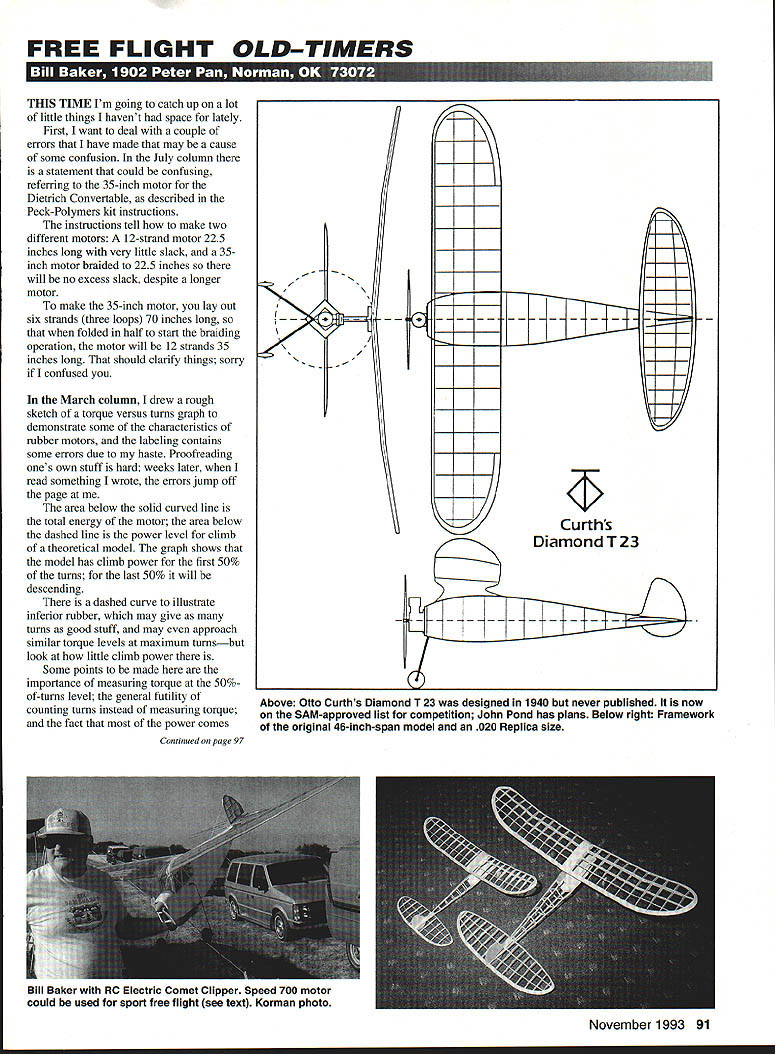
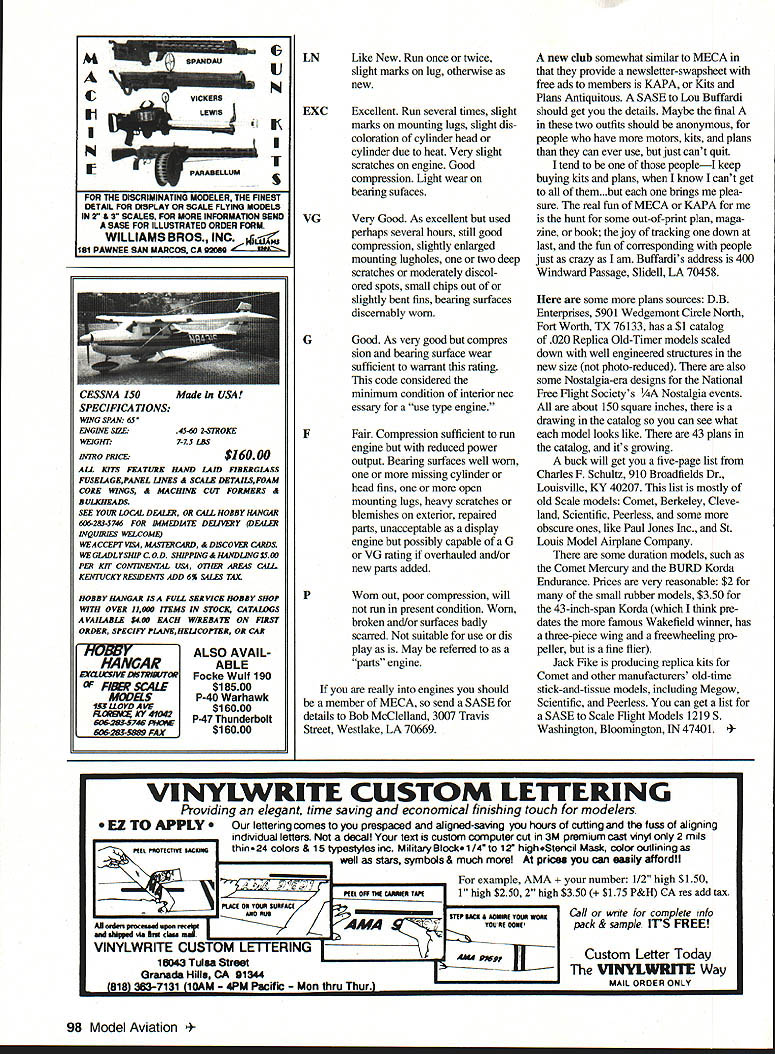
FREE FLIGHT OLD-TIMERS
Bill Baker, 1902 Peter Pan, Norman, OK 73072
THIS TIME
I'm going to catch up on a lot of little things I haven't had space for lately.
First, I want to deal with a couple of errors I have made that may have caused some confusion. In the July column there is a statement that could be confusing, referring to the 35-inch motor for the Dietrich Convertible as described in the Peck-Polymers kit instructions.
The instructions tell how to make two different motors:
- A 12-strand motor 22.5 inches long with very little slack.
- A 35-inch motor braided to 22.5 inches so there will be no excess slack despite a longer motor.
To make the 35-inch motor, lay out six strands (three loops) 70 inches long so that when folded in half to start the braiding operation the motor will be 12 strands, 35 inches long. That should clarify things; sorry if I confused you.
In the March column I drew a rough sketch of a torque-versus-turns graph to demonstrate some characteristics of rubber motors, and the labeling contains some errors due to my haste. Proofreading one's own stuff is hard; weeks later, when I read something I wrote, the errors jump off the page at me.
The area below the solid curved line is the total energy of the motor; the area below the dashed line is the power level for climb of a theoretical model. The graph shows that the model has climb power for the first 50% of the turns; for the last 50% it will be descending.
There is a dashed curve to illustrate inferior rubber, which may give as many turns as good stuff and may even approach similar torque levels at maximum turns—but look at how little climb power there is.
Some points to be made here:
- Measure torque at the 50%–of–turns level.
- Counting turns instead of measuring torque is generally futile.
- Most of the power comes from the last 10–20% of turns possible before running out of stretch completely. BANG! Use a winding tube.
There is a new edition of the Oldtimer Model Supply catalog just out; $2 to P.O. Box 7334, Van Nuys, CA 91409 will get you one.
I hear some rubber flyers are happy with a new lubricant called Sil-Glide, available from NAPA auto parts stores. If you try it, let me know what your experience is so I can pass it on.
One thing I have been looking forward to pointing out is the similarity of rubber power to electric: the highest power is the initial "burst" after a full charge; from then on there is a gradual slowing. The shape of the discharge curve is different in that Ni-Cd batteries give a much flatter slope after the initial burst, so subjectively there is a long plateau with little change in power. But there is a slope to that plateau.
When doing touch-and-goes with my electric RC Comet Clipper, I know it is time to land when the climb rate slows down. But consider this (compared to what I have been trying to teach about rubber): to increase power, add cross-section to your rubber motor; for your electric, add cells. To add duration of run (assuming the same propeller/motor), add length to your rubber motor, or increase cell capacity for your electric.
You can test-fly your rubber motor on partial winds, and your electric on a partial charge. There are some similarities for free flight trim, too. I had a free flight scale electric that I stupidly failed to build in provisions for thrust-line adjustments. All I could do to counter torque was turn the rudder to the right; the model persisted in punching to the left. In my exasperation I really gave it some right rudder, and to my amazement a beautiful right spiral climb resulted—until the power fell off and the model hit the ground. I had crashed before, but this time it got high enough to get some real speed built up. Please learn from my mistakes!
That reminds me of the story about the kid who attempted to ROG his model, which hit a car. The model was very light and undamaged, so the kid tried again with the same result and struck the car in the same spot.
At this point the owner of the car confronted the kid: "That's twice your model has hit my car!" "I know," said the kid. "Well, what are you going to do about it?" said the man. "I think I'll add incidence," said the kid.
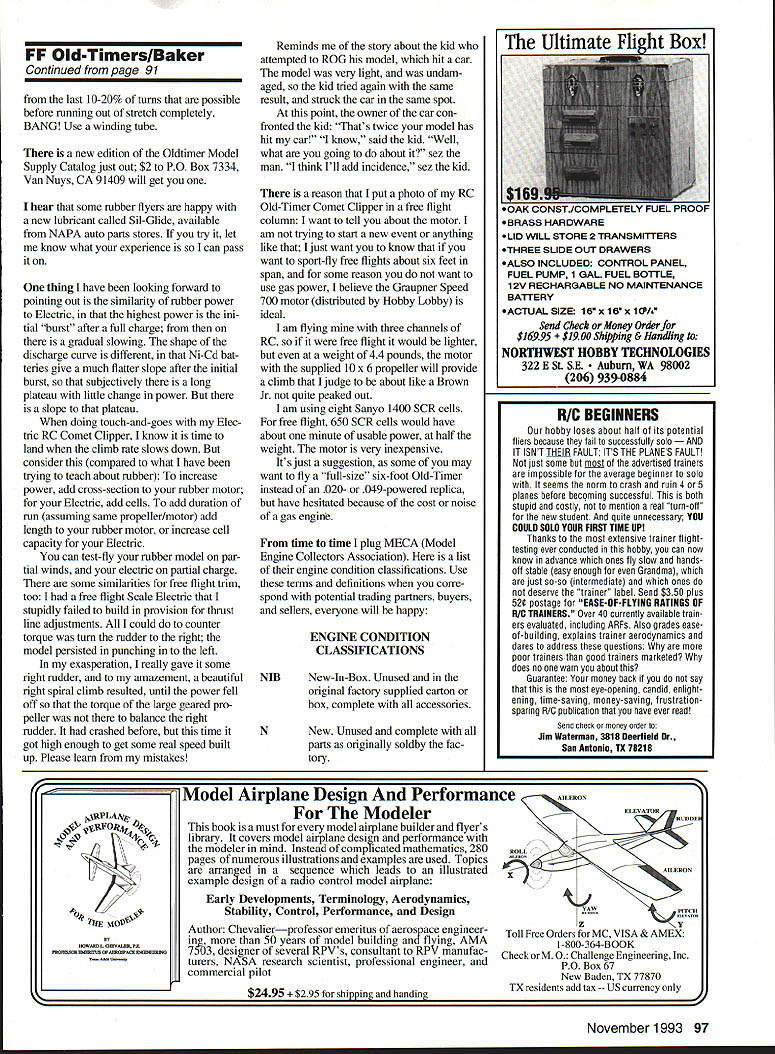
There is a reason I put a photo of my RC Old-Timer Comet Clipper in a free flight column: I want to tell you about the motor. I am not trying to start a new event or anything like that; I just want you to know that if you want to sport-fly free flights about six feet in span and for some reason you do not want to use gas power, I believe the Graupner Speed 700 motor (distributed by Hobby Lobby) is ideal.
I am flying mine with three-channel RC, so if it were free flight it would be lighter. Even at a weight of 4.4 pounds, the motor with the supplied 10 x 6 propeller will provide a climb I judge to be about like a Brown Jr.—quite peaked out.
I am using eight Sanyo 1400 SCR cells. For free flight, 650 SCR cells would have about one minute of usable power at half the weight. The motor is very inexpensive.
It's just a suggestion, as some of you may want to fly a "full-size" six-foot Old-Timer instead of an .020- or .049-powered replica but have hesitated because of the cost or noise of a gas engine.
From time to time I plug MECA (Model Engine Collectors Association). Here is a list of their engine condition classifications. Use these terms and definitions when you correspond with potential trading partners, buyers, and sellers—everyone will be happier!
ENGINE CONDITION CLASSIFICATIONS
- NIB — New-In-Box. Unused and in the original factory-supplied carton or box, complete with all accessories.
- N — New. Unused and complete with all parts as originally sold by the factory.
- LN — Like New. Run once or twice; slight marks on lugs; otherwise as new.
- EXC — Excellent. Run several times; slight marks on mounting lugs; slight discoloration of cylinder head or cylinder due to heat; very slight scratches on engine; good compression; light wear on bearing surfaces.
- VG — Very Good. As Excellent but used perhaps several hours; still good compression; slightly enlarged mounting lug holes; one or two deep scratches or moderately discolored spots; small chips out of or slightly bent fins; bearing surfaces discernibly worn.
- G — Good. As Very Good but compression and bearing surface wear sufficient to warrant this rating. This code is considered the minimum condition of interior necessary for a "use" type engine.
- F — Fair. Compression sufficient to run engine but with reduced power output. Bearing surfaces well worn; one or more missing cylinder or head fins; one or more open mounting lugs; heavy scratches or blemishes on exterior; repaired parts. Unacceptable as a display engine but possibly capable of a C or VG rating if overhauled and/or new parts added.
- P — Worn out, poor compression; will not run in present condition. Worn, broken and/or badly scarred surfaces. Not suitable for use or display as is. May be referred to as a "parts" engine.
If you are really into engines you should be a member of MECA. Send a SASE for details to Bob McClelland, 3007 Travis Street, Westlake, LA 70669.
A new club somewhat similar to MECA that provides a newsletter/swap sheet with free ads to members is KAPA, or Kits and Plans Antiquitors. A SASE to Lou Buffardi should get you the details. Maybe the final "A" in these two outfits should be "anonymous"—for people who have more motors, kits, and plans than they can ever use, but just can't quit.
I tend to be one of those people—I keep buying kits and plans, and when I know I can't build them all... each one still brings me pleasure. The real fun of MECA or KAPA for me is the hunt for some out-of-print plan, magazine, or book; the joy of tracking one down at last; and the fun of corresponding with people just as crazy as I am. Buffardi's address is 400 Windward Passage, Slidell, LA 70458.
Here are some more plans sources:
- D.B. Enterprises, 5901 Wedgemoor Circle North, Fort Worth, TX 76133. They have a $1 catalog of .020 replica Old-Timer models scaled down with well-engineered structures in the new size (not photo-reduced). There are also some nostalgia-era designs for the National Free Flight Society's 1/4A Nostalgia events. All are about 150 square inches; there are 43 plans in the catalog, and it's growing.
- Charles F. Schultz, 910 Broadfields Dr., Louisville, KY 40207. For $1 you get a five-page list mostly of scale models: Comet, Berkeley, Cleveland, Scientific, Peerless, and some more obscure ones like Paul Jones, Inc. and St. Louis Model Airplane Company.
There are some duration models, such as the Comet Mercury and the BURD Korda Endurance. Prices are very reasonable: $2 for the Comet and Small Birds models, $3.50 for the 43-inch-span Korda (which I think predates the more famous Wakefield winner, has a three-piece wing and a freewheeling propeller, and is a fine flier).
Jack Fike is producing replica kits for Comet and other manufacturers' old-time stick-and-tissue models, including Megow, Scientific, and Peerless. Get a list for a SASE to Scale Flight Models, 1219 S. Washington, Bloomington, IN 47401.
Transcribed from original scans by AI. Minor OCR errors may remain.

