
FREE FLIGHT OLD-TIMERS
Bill Baker, 1902 Peter Pan, Norman, OK 73072
This column and the next several will primarily be concerned with gas engines, especially ignition engines used in Old-Timer aircraft. I will, however, continue to provide space for rubber, electrics, and other topics.
Electric free flight — Walt Leonhardt
Walt Leonhardt of Lawrence, Massachusetts wrote recently, saying he is flying free flight with electric power "mainly because here in the East, noise is a real problem." He sent a photo of a Frank Ehling design, the G.E. Cabinette from the June 1942 Model Airplane News. He flies this with a Hi-Line Imp motor and three cells. Walt limits motor run by the timed-charge method, but has also used an old Austin timer to cut the current in other models. The design was originally for an .097 Atom engine. The plan is included in Air Age Gas Models, still available from the publishers of Model Airplane News, and is a real bargain, too.
Walt also flies models of similar size with a VL HY-42 — a geared motor that can use two to four cells, depending on power needs.
Suggestions for sport-flying motors
I have a couple of suggestions for sport-flying motors:
- Tower Hobbies' catalog has the Kyosho Le Mans AP-29 for $19.95. This is a super little motor; I use one in a 1/2A Miss America. The Tower catalog number for the AP-29 is KYOG1929. It is the best small motor I have seen, with power comparable to a Cox Baby Bee.
- An inexpensive power source I haven't tried (but think would be about equivalent) is Hobby Lobby's Speed 400 motor.
Batteries and power levels
I am using 6 × 600 mAh cells for sport RC flying. For free flight, I think four or maybe five 250s would be fine. I mention the RC 1/2A Texaco design because there are so many plans that are just right for this power level.
Do not confuse 1/2A RC Texaco rules with the 1/2A free flight rules for competition. These are very different events; the free flight event allows much larger models. I bring this up because it is easy to convert models intended for the RC event to FF for sport flying.
Miss America motor mounting
In the Miss America, I used a Hayes Products glass-filled nylon mount KM-15R with two slightly oversized holes drilled for 2-56 bolts that go into a short piece of yellow inner Nyrod to clamp the AP-29. No other modification was necessary.
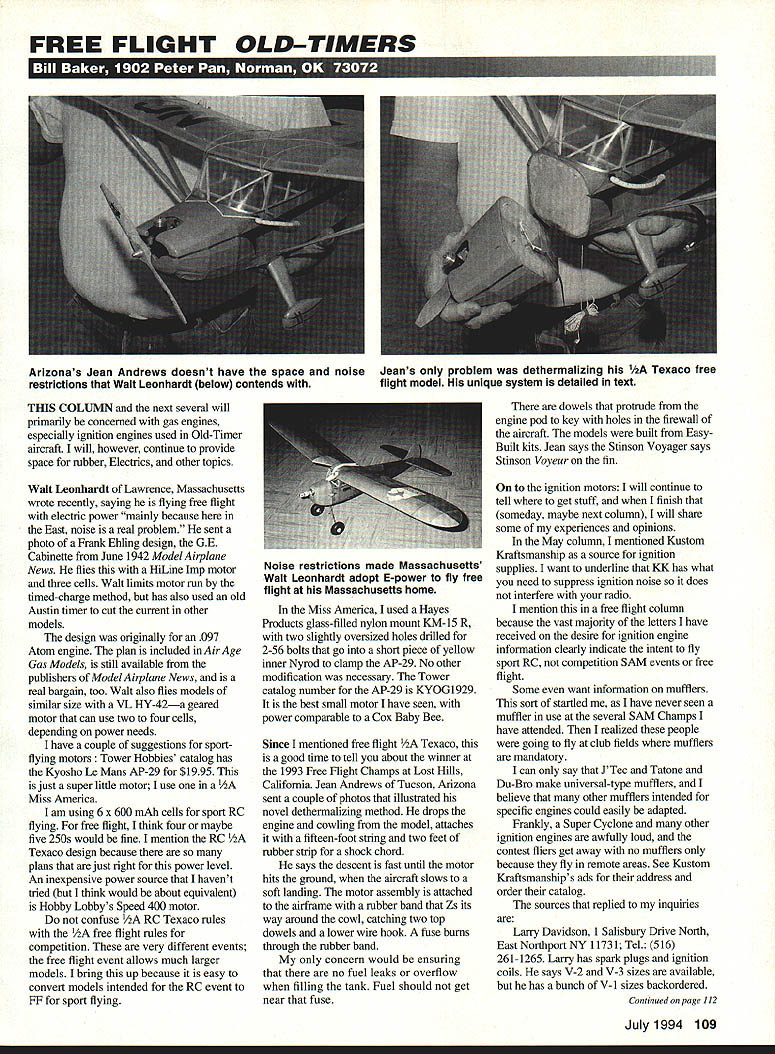
1/2A Texaco winner — novel dethermalizer
Since I mentioned free flight 1/2A Texaco, this is a good time to tell you about the winner at the 1993 Free Flight Champs at Lost Hills, California. Jean Andrews of Tucson, Arizona sent a couple of photos that illustrated his novel dethermalizing method.
- He drops the engine and cowling from the model, attaches it with a fifteen-foot string and two feet of rubber strip for a shock cord.
- The descent is fast until the motor hits the ground, when the aircraft slows to a soft landing.
- The motor assembly is attached to the airframe with a rubber band that zips its way around the cowl, catching two top dowels and a lower wire hook. A fuse burns through the rubber band.
My only concern would be ensuring that there are no fuel leaks or overflow when filling the tank. Fuel should not get near that fuse.
There are dowels that protrude from the engine pod to key with holes in the firewall of the aircraft. The models were built from Easy-Built kits. Jean says the Stinson Voyager even says "Stinson Voyeur" on the fin.
Ignition engines — supplies and sources
On to the ignition motors: I will continue to tell where to get stuff, and when I finish that (someday, maybe next column), I will share some of my experiences and opinions.
In the May column, I mentioned Kustom Kraftsmanship as a source for ignition supplies. I want to underline that Kustom Kraftsmanship has what you need to suppress ignition noise so it does not interfere with your radio. See Kustom Kraftsmanship's ad for their address and order their catalog.
I mention this in a free flight column because the vast majority of letters I have received on the desire for ignition engine information clearly indicate the intent to fly sport RC, not competition SAM events or free flight.
Some even want information on mufflers. This sort of startled me, as I have never seen a muffler in use at several SAM Champs I have attended. Then I realized these people were going to fly at club fields where mufflers are mandatory.
I can only say that JTec, Tatone, and Du-Bro make universal-type mufflers, and I believe that many other mufflers intended for specific engines could easily be adapted. Frankly, a Super Cyclone and many other ignition engines are awfully loud, and the contest fliers get away with no mufflers only because they fly in remote areas.
Suppliers and services
- Larry Davidson
1 Salisbury Drive North, East Northport NY 11731 Tel.: (516) 261-1265 Larry has spark plugs and ignition coils. He says V-2 and V-3 sizes are available, but he has a bunch of V-1 sizes backordered. The V-2 and V-3 sizes are $10 each, and the minimum order is three plugs, or two plugs and a coil — a Modelectric 37 gram coil — at $15. Postage and handling for any orders is $3. (These are not Champion plugs; V-2 size is 1/4 inch long reach, and V-3 is 1/4 inch short reach.)
- Floyd Carter, Aero Ply Research Co.
2029 Crist Dr., Los Altos CA 94024 Tel.: (415) 968-4246 Floyd has an extensive line of ignition components, will convert glow to ignition, and will happily answer ignition questions and problems. Some of his systems, however, may not be legal for SAM free flight competition if they use a system that does not have points. I am impressed by the literature he sent and believe that he really knows what he is doing. I highly recommend sending him a large SASE for his data.
- Aldrich Models
12822 Tarrytown, San Antonio TX 78233 — Engine rebuilding and repair source. Send a SASE for services and price listings.
- Blackburn Aero Engineering
P.O. Box 15143, Amarillo TX 79105 — Engine rebuilding and repair source. Send a SASE for services and price listings.
- Tom Morrison (Super Cyclone engines)
P.O. Box 1809, Show Low AZ 85901 — Manufactures Super Cyclone engines. For a price list, send an SASE. He says parts will fit original engines; I believe he is using original dies, tools, etc.
- RJL Industries
P.O. Box 5, Sierra Madre, CA 91025 — Makes Forster .29 and .35 ignition engines (front-rotor versions) and the Forster .99. These are made on high-tech CNC equipment; parts are said to fit the originals. Several modelers have told me that performance is not as high as the rear-rotor .29, but the engines are still good.
Closing
I will continue to list sources and products for ignition and related gear and, when time permits, will share hands-on experiences and opinions about ignition engines and installation practices.
Transcribed from original scans by AI. Minor OCR errors may remain.

