
Free Flight — Old-Timers
Bill Baker, 1902 Peter Pan, Norman, OK 73072
Photos and product notes
I appreciate letters that contain ignition-engine questions, and in this column I will answer those most frequently asked. First, however, I will briefly discuss the photos and make a couple of product announcements.
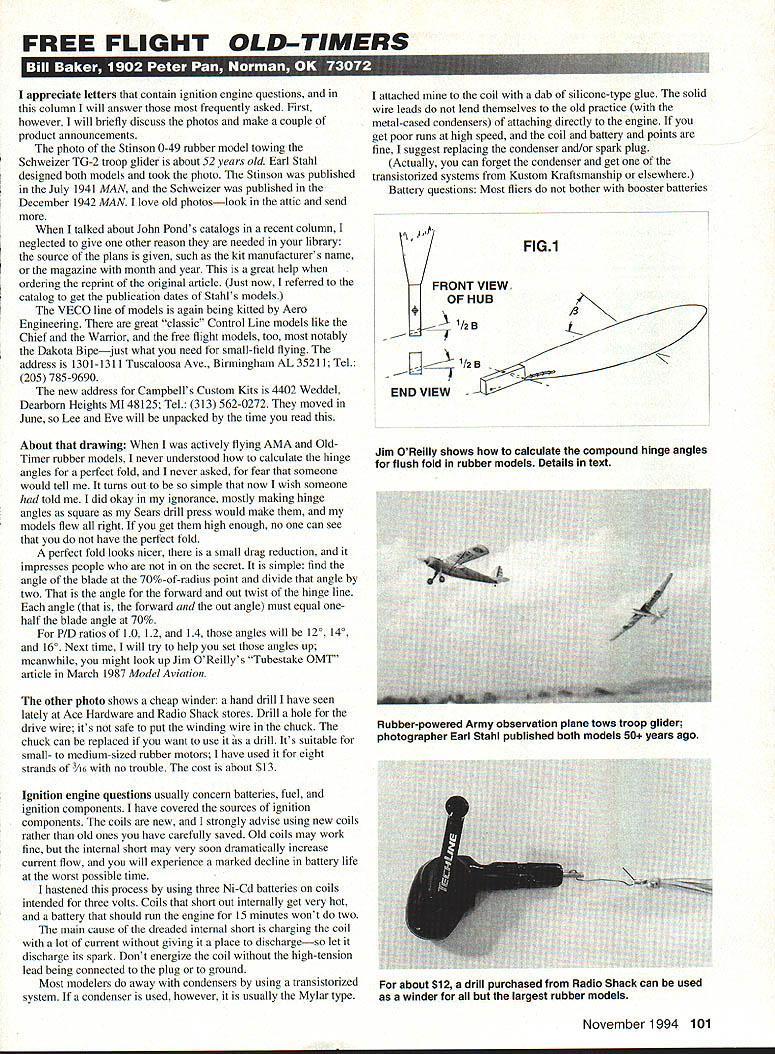
The photo of the Stinson O-49 rubber model towing the Schweizer TG-2 troop glider is about 52 years old. Earl Stahl designed both models and took the photo. The Stinson was published in the July 1941 MAN, and the Schweizer was published in the December 1942 MAN. I love old photos—look in the attic and send them.
When I talked about John Pond's catalogs in a recent column, I neglected to give one other reason they are needed in your library: the source of the plans is given, such as the kit manufacturer's name or the magazine with month and year. This is a great help when ordering the reprint of the original article. (Just now, I referred to the catalog to get the publication dates of Stahl's models.)
The VECO line of models is again being kitted by Aero Engineering. There are great "classic" control-line models like the Chief and the Warrior, and free-flight models too, most notably the Dakota Bipe—just what you need for small-field flying. The address is:
- Aero Engineering, 1301–1311 Tuscaloosa Ave., Birmingham, AL 35211; Tel.: (205) 785-9690.
The new address for Campbell's Custom Kits is:
- Campbell's Custom Kits, 4402 Weddel, Dearborn Heights, MI 48125; Tel.: (313) 562-0272.
They moved in June, so Lee and Eve will be unpacked by the time you read this.
How to get a perfect hinge fold
When I was actively flying AMA and Old-Timer rubber models, I never understood how to calculate the hinge angles for a perfect fold, and I never asked, for fear that someone would tell me. It turns out to be so simple that now I wish someone had told me. I did okay in my ignorance, mostly making hinge angles as square as my Sears drill press would make them, and my models flew all right. If you get them high enough, no one can see that you do not have the perfect fold.
A perfect fold looks nicer, gives a small drag reduction, and impresses people who are not in on the secret. It is simple:
- Find the angle of the blade at the 70%-of-radius point.
- Divide that angle by two. That is the angle for the forward and out twist of the hinge line.
- Each angle (the forward angle and the out angle) must equal one-half the blade angle at 70%.
For P/D ratios of 1.0, 1.2, and 1.4, those angles will be 12°, 14°, and 16°. Next time I will try to help you set those angles up; meanwhile, you might look up Jim O'Reilly's "Tubestake OMT" article in the March 1987 Model Aviation.
Cheap winder
The other photo shows a cheap winder: a hand drill I have seen lately at Ace Hardware and Radio Shack stores. Drill a hole for the drive wire; it's not safe to put the winding wire in the chuck. The chuck can be replaced if you want to use it as a drill. It's suitable for small- to medium-sized rubber motors; I have used it for eight strands of 3/16 with no trouble. The cost is about $13.
Ignition engines: coils, condensers, and points
Ignition-engine questions usually concern batteries, fuel, and ignition components. I have covered the sources of ignition components. The coils are new, and I strongly advise using new coils rather than old ones you have carefully saved. Old coils may work fine, but an internal short may very soon dramatically increase current flow, and you will experience a marked decline in battery life at the worst possible time.
I hastened this process by using three Ni-Cd batteries on coils intended for three volts. Coils that short out internally get very hot, and a battery that should run the engine for 15 minutes won't do two.
The main cause of the dreaded internal short is charging the coil with a lot of current without giving it a place to discharge—so let it discharge its spark. Don't energize the coil with the high-tension lead connected to the plug or to ground.
Most modelers do away with condensers by using a transistorized system. If a condenser is used, however, it is usually the Mylar type. I attached mine to the coil with a dab of silicone-type glue. The solid-wire leads do not lend themselves to the old practice of the metal-cased condensers attaching directly to the engine. If you get poor runs at high speed, and the coil and battery and points are fine, I suggest replacing the condenser and/or spark plug.
Actually, you can forget the condenser and get one of the transistorized systems from Kustom Kraftsmanship (or elsewhere).
Batteries
Battery questions: Most fliers do not bother with booster batteries anymore, but it is okay if you want to use them. The current drain of an ignition motor is about four amps, which means that a 250 mAh Ni-Cd would give you almost four minutes—enough for three flights if you start and launch quickly. In practice, I would recharge after two flights.
- The 250 mAh size is okay for class A models where weight is critical.
- For larger models, I would use two 500–600 mAh Ni-Cds. I prefer these because I am accustomed to fast-charging in the field.
- Others prefer alkaline batteries; they have great capacity. Even the AAA size gives more than enough power.
I bet most of the problems of years ago with ignition were caused by the short life of the old carbon-zinc pencils. The astounding shelf life and capacity of the alkaline cells is what makes most people leave off booster circuits these days.
Alkaline or Ni-Cd is a matter of personal preference. Larry Davidson (1 Salisbury Drive, North East, Northport, NY 11731; Tel.: (516) 261-1256), who is a source for spark plugs and coils, says his coils are rated for 2.4 to 3.6 volts, but he uses two Ni-Cds. And he is a champion competition flier.
Fuel and oil
Another champion competition flier, who is my guru when it comes to ignition in general and fuels in particular, is Bill Schmidt. People seem to worry about fuel a lot. Modern unleaded gas is not the same as the old white gas, and where do you get 70-weight oil? Bill says you can get 70-weight oil, Castrol brand, at your friendly Harley-Davidson motorcycle shop.
However, he avoids using it because it fouls expensive plugs, and besides, if you insist on burning gasoline, the unleaded stuff we burn now will mix with castor oil, unlike the old white gas. So I say use castor, and Bill says to use alcohol to mix with it because it runs 130° cooler than gas, and "heat is the biggest factor in the high ignition engines."
Klotz KL-200 is a straight synthetic oil; KL-100 is a castor-oil and synthetic blend that will mix with gasoline or alcohol, and it's what I would use. Beware of using alcohol-based fuel in some old plastic tanks. The Klotz oil that Kustom Kraftsmanship sells is the synthetic/castor blend, which is what I would use with methanol, unless the rules you fly under require gasoline.
Closing
This is the last column for '94. I think I will be doing it in '95, so keep those cards and letters coming.
Transcribed from original scans by AI. Minor OCR errors may remain.

