
FREE FLIGHT OLD-TIMERS
Bill Baker
1902 Peter Pan, Norman OK 73072
Litespan plus Airspan plus Polyspan equals headspin. At least for me it has been very confusing, but I think I have it straight now and will share it with you.
At last there is a new product that will be superior to my beloved Japanese tissue (and even silk) for free flight models, and many RC models too.
The free flight community has not overwhelmingly accepted the iron-on heat-shrink plastics as the RC fliers have. Weight has been an issue, especially for the smaller free flight models, and the structural importance of the inelastic doped papers and silk has limited the use of the plastics.
I once had a Goldberg/Comet sailplane with a Whitecase McCoy .60 that was covered with an iron-on fabric, and it flew great until I opened the McCoy up a notch and watched a vertical climb with the wing fluttering. I also had a Spacer that flew fine on partial power but crashed every time the engine was running right. I eventually figured out that the wing was twisting under load. Most free flight structures depend on the covering material for torsional rigidity.
Litespan
Litespan has been available for some time, distributed by several suppliers including Hobby Lobby and Hobby Supply South. (If you are a stick-and-tissue person, you need the Hobby Supply South catalog. It's $4 from 5060 Glade Rd., Acworth, GA 30101.) Litespan is a thin, light, heat-shrinkable plastic that comes in colors and sticks on with RC-56, or Formula 560 made by Pacer. Many of those who have tried it prefer to glue the plastic to the framework with one of the above rather than to use the Balsaloc sold with Litespan. (You are supposed to coat the structure with Balsaloc and then iron the plastic to the frame.) Anyway, any residual wrinkles will heat-shrink out. It is very puncture- and moisture-resistant.
The bad news is it is just a bit shy of being inelastic. I have encountered comments in newsletters about it being unsuitable for large OT fuselages because of the twist under load; just not the rigidity we need, at least for larger models. The good news is that Polyspan and Airspan have the rigidity we seek.
Polyspan
Polyspan is a non-woven polyester that is a lightweight version of common dress-lining material. To quote the 1995 Model Research Labs catalog: "It goes on with dope just like silkspan, seals with 2 coats of thin dope, shrinks like silk, looks like lightweight tissue, has no humidity problems, is stronger than silk, and a lot cheaper." This stuff is so tough that it is sometimes easier to cut with scissors than with a razor blade. I think this material will also replace the 0.5 oz. fiberglass as a paint base on the RC pattern models; it is a lot lighter and stronger than the fiberglass.
In the early '70s I covered a pattern model with dress-lining material sold by Southern R/C Products as Gatorhide, if I recall correctly. It was tough. I wore several engines out flying it. Never had a hole in the covering.
Polyspan is a trademark owned by Starline International.
- Starline International, 6146 East Cactus Wren Rd., Scottsdale, AZ 85253; catalog $2.
Polyspan comes in white only, but can be colored with aniline dye or most pigmented paints after being first sealed with nitrate dope. I called Starline, and proprietor Sal Fruciano said that instead of adding the dye to the dope, it is better to first apply a couple coats of dope and then put the dye in some thinner and spray it on. Or you can put epoxy or other fuelproof paint on top of the nitrate if you want an opaque and/or fuelproof finish.
Model Research Labs / Curt Stevens
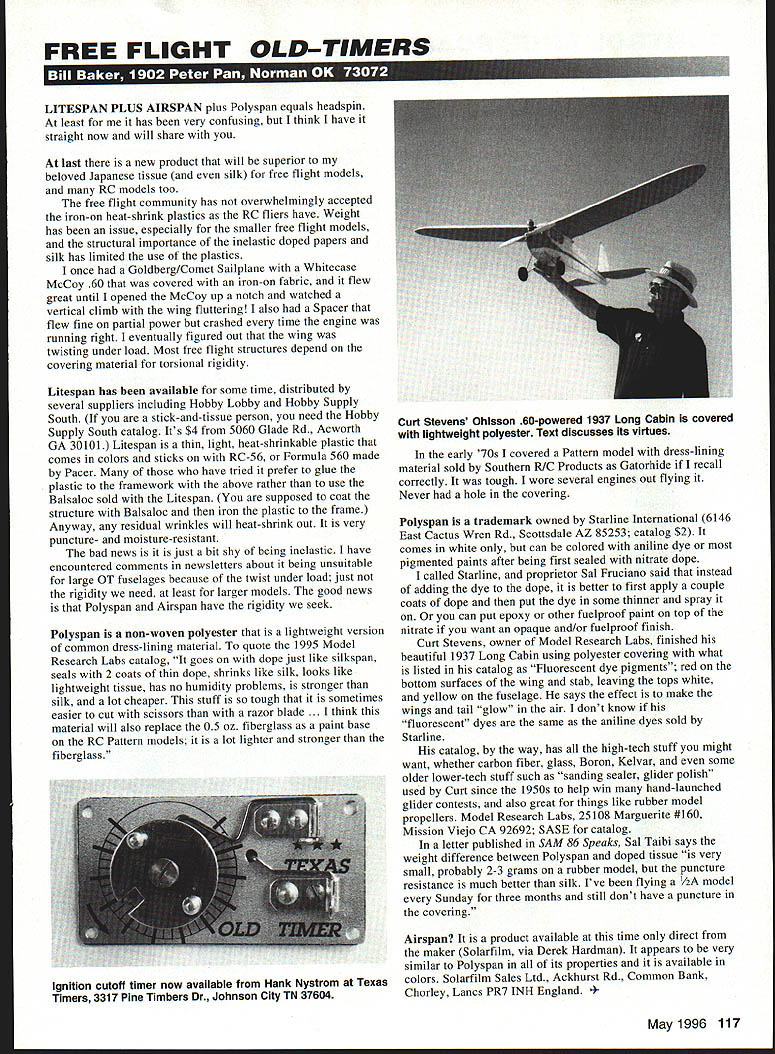
Curt Stevens, owner of Model Research Labs, finished his beautiful 1937 Long Cabin using polyester covering with what is listed in his catalog as "fluorescent dye pigments": red on the bottom surfaces of the wing and stab, leaving the tops white, and yellow on the fuselage. He says the effect is to make the wings and tail "glow" in the air. I don't know if his "fluorescent" dyes are the same as the aniline dyes sold by Starline.
His catalog, by the way, has all the high-tech stuff you might want, whether carbon fiber, glass, Boron, Kevlar, and even some older lower-tech items such as sanding sealer and glider polish used by Curt since the 1950s to help win many hand-launched glider contests — also great for things like rubber model propellers.
- Model Research Labs, 25108 Marguerite #160, Mission Viejo, CA 92692; SASE for catalog.
In a letter published in SAM 86 Speaks, Sal Taibi says the weight difference between Polyspan and doped tissue "is very small, probably 2–3 grams on a rubber model, but the puncture resistance is much better than silk. I've been flying a 1/2A model every Sunday for three months and still don't have a puncture in the covering."
Airspan
Airspan is a product available at this time only direct from the maker (Solarfilm, via Derek Hardman). It appears to be very similar to Polyspan in all of its properties and it is available in colors.
- Solarfilm Sales Ltd., Ackhurst Rd., Common Bank, Chorley, Lancs PR7 1NH, England.
Transcribed from original scans by AI. Minor OCR errors may remain.

