
FREE FLIGHT OLD-TIMERS
Bill Baker, 1902 Peter Pan, Norman OK 73072
Ignition coil polarity — Floyd Carter's experiment
I have answers for two mysteries! I am referring to my quest for the designer of the Testor Endurance Hand-Launched Glider (HLG) of the 1940s, and the ignition coil polarity issue.
Floyd Carter, who walks the walk as well as he talks the talk, set up an experiment dealing with polarity:
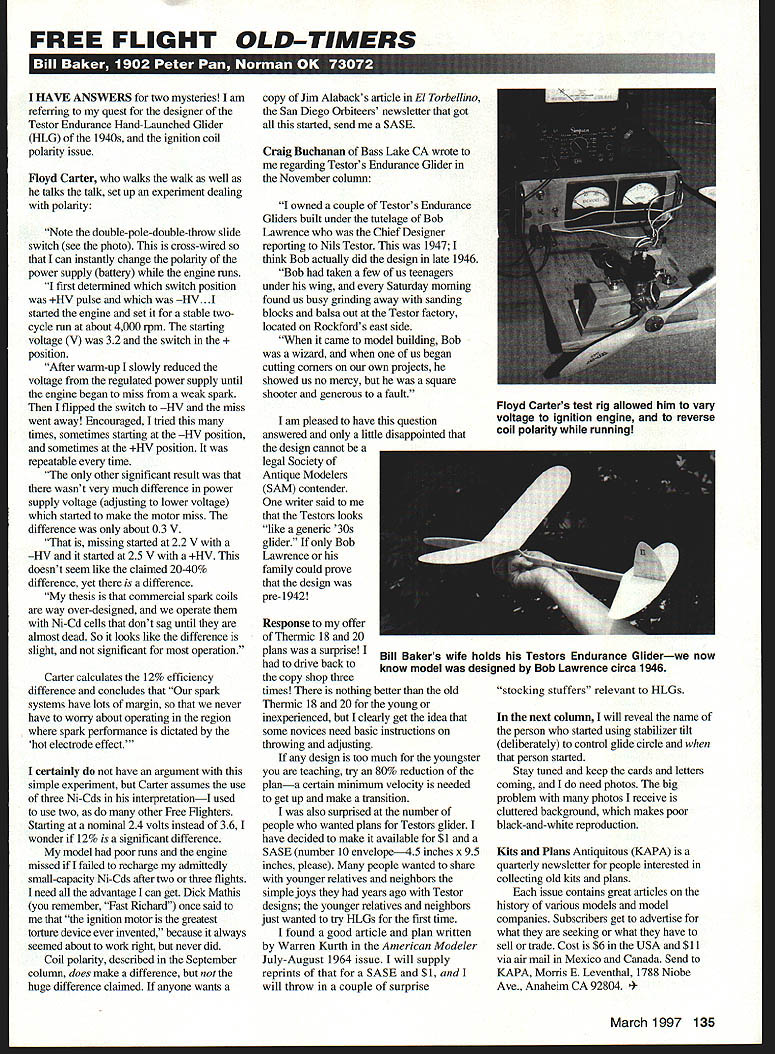
"Note the double-pole-double-throw slide switch (see the photo). This is cross-wired so that I can instantly change the polarity of the power supply (battery) while the engine runs.
"I first determined which switch position was +HV pulse and which was -HV... I started the engine and set it for a stable two-cycle run at about 4,000 rpm. The starting voltage (V) was 3.2 and the switch in the + position.
"After warm-up I slowly reduced the voltage from the regulated power supply until the engine began to miss from a weak spark. Then I flipped the switch to -HV and the miss went away! Encouraged, I tried this many times, sometimes starting at the -HV position, and sometimes at the +HV position. It was repeatable every time.
"The only other significant result was that there wasn't very much difference in power supply voltage (adjusting to lower voltage) which started to make the motor miss. The difference was only about 0.3 V.
"That is, missing started at 2.2 V with a -HV and it started at 2.5 V with a +HV. This doesn't seem like the claimed 20–40% difference, yet there is a difference.
"My thesis is that commercial spark coils are way over-designed, and we operate them with Ni-Cd cells that don't sag until they are almost dead. So it looks like the difference is slight, and not significant for most operation."
Carter calculates the 12% efficiency difference and concludes that "Our spark systems have lots of margin, so that we never have to worry about operating in the region where spark performance is dictated by hot electrode effect."
I certainly do not have an argument with this simple experiment, but Carter assumes the use of three Ni-Cds in his interpretation — I used two — as do many other Free Flighters. Starting at a nominal 24 volts instead of 36, I wonder if 12% is a significant difference.
My model had poor runs and the engine missed if I failed to recharge my admittedly small-capacity Ni-Cds after two or three flights. I need all the advantage I can get. Dick Mathis (you remember, "Fast Richard") once said that "the ignition motor is the greatest torture device ever invented," because it always seemed about to work, but never did.
Coil polarity, described in the September column, does make a difference, but not the huge difference claimed. If anyone wants a copy of Jim Alaback's article in El Torbellino, the San Diego Orbiteers' newsletter that got all this started, send me a SASE.
Testor Endurance Glider — designer identified
Craig Buchanan of Bass Lake, CA wrote to me regarding Testor's Endurance Glider in the November column:
"I owned a couple of Testor's Endurance Gliders built under the tutelage of Bob Lawrence who was the Chief Designer reporting to Nils Testor. This was 1947; I think Bob actually did the design in late 1946.
"Bob had taken a few of us teenagers under his wing, and every Saturday morning found us busy grinding away with sanding blocks and balsa out at the Testor factory, located on Rockford's east side.
"When it came to model building, Bob was a wizard, and when one of us began cutting corners on our own projects, he showed us no mercy, but he was a square shooter and generous to a fault."
I am pleased to have this question answered and only a little disappointed that the design cannot be a legal Society of Antique Modelers (SAM) contender. One writer said to me that the Testors looks "like a generic '30s glider." If only Bob Lawrence or his family could prove that the design was pre-1942!
Plans and reprints available
Response to my offer of Thermic 18 and 20 plans was a surprise! I had to drive back to the copy shop three times! There is nothing better than the old Thermic 18 and 20 for the young or inexperienced, but I clearly get the idea that some novices need basic instructions on throwing and adjusting.
If any design is too much for the youngster you are teaching, try an 80% reduction of the plan — a certain minimum velocity is needed to get up and make a transition.
I was also surprised at the number of people who wanted plans for Testors' glider. I have decided to make it available for $1 and a SASE (number 10 envelope — 4.5 inches x 9.5 inches, please). Many people wanted to share with younger relatives and neighbors the simple joys they had years ago with Testor designs; the younger relatives and neighbors just wanted to try HLGs for the first time.
I found a good article and plan written by Warren Kurth in the American Modeler, July–August 1964 issue. I will supply reprints of that for a SASE and $1, and I will throw in a couple of surprise "stocking stuffers" relevant to HLGs.
How to request plans or reprints:
- Testors' Endurance Glider plan: $1 + number 10 SASE (4.5" x 9.5").
- Warren Kurth reprint (American Modeler, Jul–Aug 1964): $1 + SASE; includes a couple of surprise HLG items.
Upcoming column and photos
In the next column, I will reveal the name of the person who started using stabilizer tilt (deliberately) to control glide circle and when that person started.
Stay tuned and keep the cards and letters coming. I do need photos. The big problem with many photos I receive is cluttered background, which makes poor black-and-white reproduction.
Kits and Plans Antiquitous (KAPA)
Kits and Plans Antiquitous (KAPA) is a quarterly newsletter for people interested in collecting old kits and plans. Each issue contains great articles on the history of various models and model companies. Subscribers get to advertise what they are seeking or what they have to sell or trade.
Subscription cost and address:
- $6 in the USA.
- $11 via air mail to Mexico and Canada.
Send subscriptions and correspondence to: KAPA Morris E. Leventhal 1788 Niobe Ave. Anaheim, CA 92804
Transcribed from original scans by AI. Minor OCR errors may remain.

