
Free Flight: Outdoor
Dick Mathis
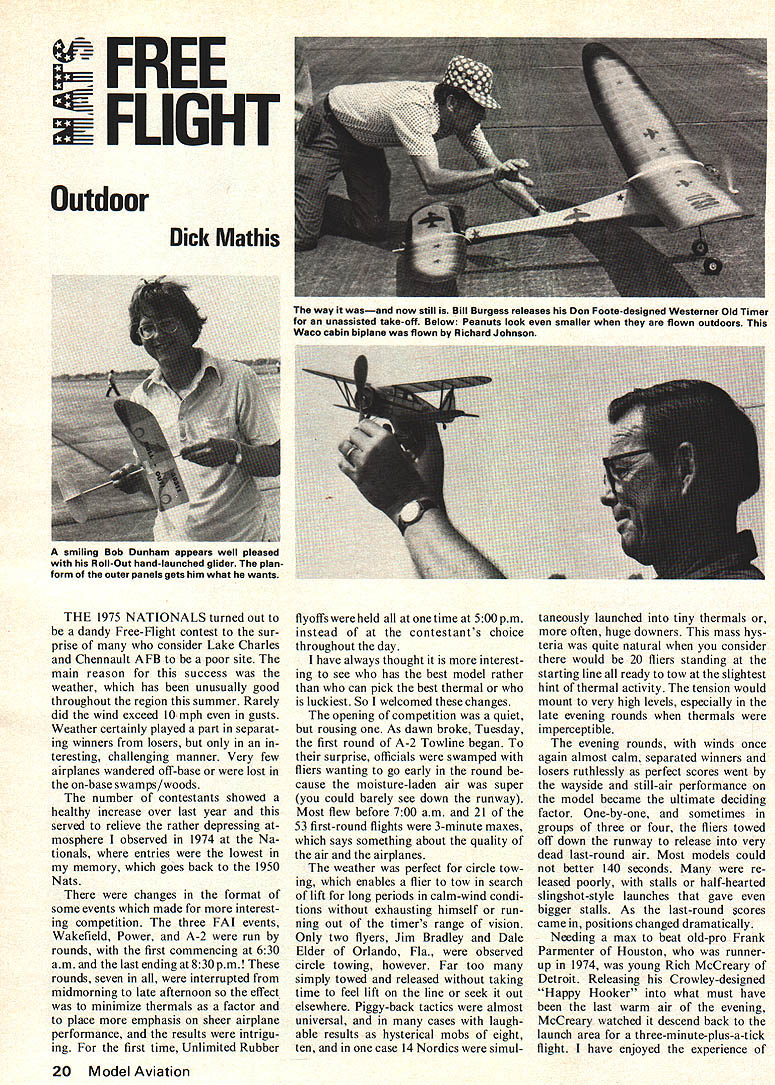
THE 1975 NATIONALS turned out to be a dandy Free-Flight contest to the surprise of many who consider Lake Charles and Chennault AFB to be a poor site. The main reason for this success was the weather, which has been unusually good throughout the region this summer. Rarely did the wind exceed 10 mph even in gusts. Weather certainly played a part in separating winners from losers, but only in an interesting, challenging manner. Very few airplanes wandered off-base or were lost in the on-base swamps/woods.
The number of contestants showed a healthy increase over last year and this served to relieve the rather depressing atmosphere I observed in 1974 at the Nationals, where entries were the lowest in my memory, which goes back to the 1950 Nats.
There were changes in the format of some events which made for more interesting competition. The three FAI events, Wakefield, Power, and A-2, were run by rounds, with the first commencing at 6:30 a.m. and the last ending at 8:30 p.m.! These rounds, seven in all, were interrupted from midmorning to late afternoon so the effect was to minimize thermals as a factor and to place more emphasis on sheer airplane performance, and the results were intriguing. For the first time, Unlimited Rubber flyoffs were held all at one time at 5:00 p.m. instead of at the contestant's choice throughout the day.
I have always thought it is more interesting to see who has the best model rather than who can pick the best thermal or who is luckiest. So I welcomed these changes.
The opening of competition was a quiet but rousing one. As dawn broke Tuesday, the first round of A-2 Towline began. To their surprise, officials were swamped with fliers wanting to go early in the round because the moisture-laden air was so super you could barely see down the runway. Most flew before 7:00 a.m., and 21 of the 53 first-round flights were 3-minute maxes, which says something about the quality of the air and the airplanes. The weather was perfect for circle towing, which enables a flier to tow in search of lift for long periods in calm-wind conditions without exhausting himself or running out of the timer's range of vision. Only two flyers, Jim Bradley and Dale Elder of Orlando, Fla., were observed circle towing, however. Far too many simply towed and released without taking time to feel the line or seek out elsewhere. Piggy-back tactics were almost universal and in many cases produced laughable results as hysterical mobs of eight, ten, and in one case 14 Nordics were simultaneously launched into tiny thermals or, more often, huge downers. This mass hysteria was quite natural when you consider there would be 20 fliers standing at the starting line all ready to tow at the slightest hint of thermal activity. The tension would mount to very high levels, especially in the late evening rounds when thermals were imperceptible.
The evening rounds, with winds once again almost calm, separated winners and losers ruthlessly as perfect scores went by the wayside and still-air performance became the ultimate deciding factor. One-by-one, and sometimes in groups of three or four, the fliers towed off down the runway to release into very dead last-round air. Most models could not better 140 seconds. Many were released poorly, with stalls or half-hearted slingshot-style launches that gave even bigger stalls. As the last-round scores came in, positions changed dramatically.
Needing a max to beat old pro Frank Parmenter of Houston, who was runner-up in 1974, was young Rich McCreary of Detroit. Releasing his Crowley-designed "Happy Hooker" into what must have been the last warm air of the evening, McCreary watched it descend back toward the launch area for a three-minute-plus-a-tick flight. making a winning flight at the Nationals before, but usually downwind of the event in relative solitude while chasing the model. Rich, however, picked his model up not 25 feet from event headquarters and the ensuing victory celebration by the Detroit Balsa Bugs was a fitting climax to the best Nordic A-2 event at the Nats in years.
Design-wise, there is little new in A-2. Most fliers used originals or scratch-built magazine designs, since there are no competitive kits being manufactured.
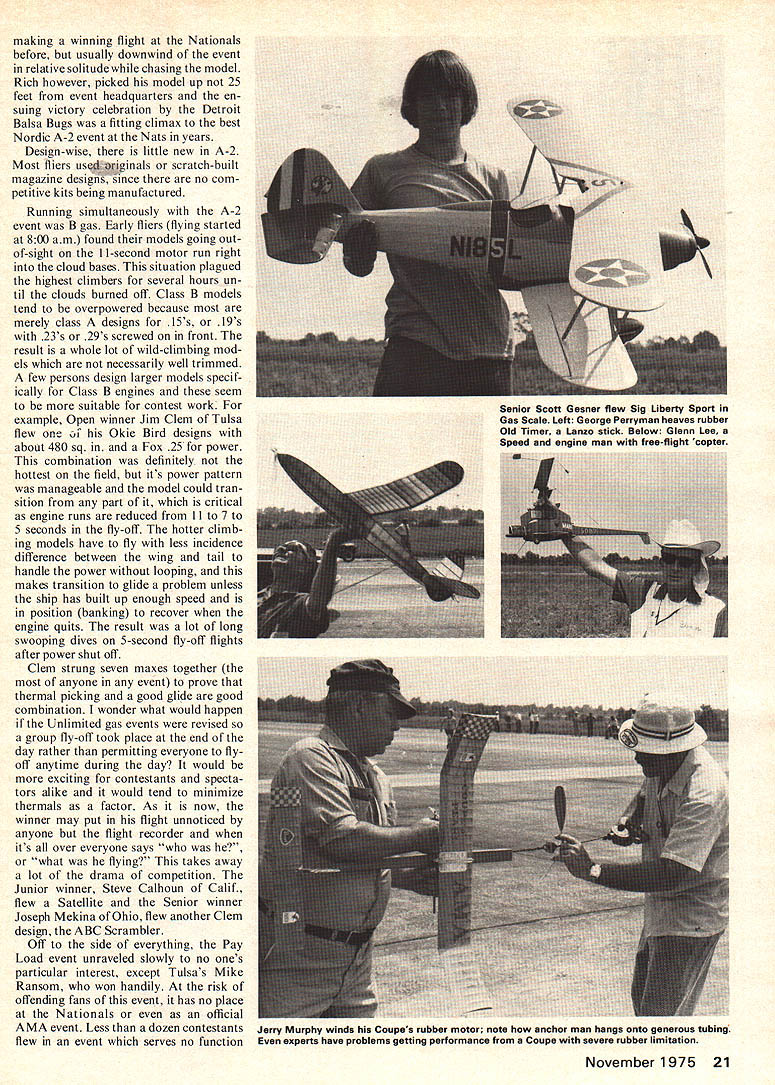
Running simultaneously with the A-2 event was B gas. Early fliers (flying started at 8:00 a.m.) found their models going out-of-sight on the 11-second motor run right into the cloud bases. This situation plagued the highest climbers for several hours until the clouds burned off. Class B models tend to be overpowered because most are merely class A designs for .15s, or .19s with .23s or .29s screwed on in front. The result is a whole lot of wild-climbing models which are not necessarily well trimmed. A few persons design larger models specifically for Class B engines and these seem to be more suitable for contest work. For example, Open winner Jim Clem of Tulsa flew one of his Okie Bird designs with about 480 sq. in. and a Fox .25 for power. This combination was definitely not the hottest on the field, but its power pattern was manageable and the model could transition from any part of it, which is critical as engine runs are reduced from 11 to 7 to 5 seconds in the fly-off. The hotter climbing models have to fly with less incidence difference between the wing and tail to handle the power without looping, and this makes transition to glide a problem unless the ship has built up enough speed and is in position (banking) to recover when the engine quits. The result was a lot of long swooping dives on 5-second fly-off flights after power shut off.
Clem strung seven maxes together (the most of anyone in any event) to prove that thermal picking and a good glide are a good combination. I wonder what would happen if the Unlimited gas events were revised so a group fly-off took place at the end of the day rather than permitting everyone to fly-off anytime during the day? It would be more exciting for contestants and spectators alike and it would tend to minimize thermals as a factor. As it is now, the winner may put in his flight unnoticed by anyone but the flight recorder and when it's all over everyone says "who was he?", or "what was he flying?" This takes away a lot of the drama of competition. The Junior winner, Steve Calhoun of Calif., flew a Satellite and the Senior winner Joseph Mekina of Ohio, flew another Clem design, the ABC Scrambler.
Off to the side of everything, the Pay Load event unraveled slowly to no one's particular interest, except Tulsa's Mike Ransom, who won handily. At the risk of offending fans of this event, it has no place at the Nationals or even as an official AMA event. Less than a dozen contestants flew in an event which serves no function. When almost two decades ago Pan American Airways sponsored Pay Load, and there was lots of interest and several kits, it made sense, but not now.
There are some other events that fit this description equally well at the Nationals: Free-Flight Helicopter, Clipper Cargo, and Rocket, to name three. I wonder also whether we really prove anything by having A and B gas, except it gives most of us a chance to fly the same airplane in two events. How about Coupe Rubber? As a Junior and Senior event, Coupe is a flop, with most of the kids flying Unlimited Rubber instead of Coupe, which is so restricted by rubber limits, even Wakefield experts can't make them go in a satisfying way.
Add this to the fact that there were "unofficial" events for two kinds of electric powered free flights; Rise-off-Water Power; Night Flying; Class D gas; Rubber Speed; plus all the Old Timer events, and we end up with somewhere between 27 and 30 different events (not counting Indoor) being flown in five days. The skeptical reader will say this is sour grapes from a guy who is exhausted after trying to do a magazine report on all of it, but I invite consideration of the question of whether all these events are desirable.
I tried to sample opinions on this question, and the general feeling is the schedule is too heavy for the Nationals. Certainly some new events, like Old Timer, are worthwhile experiments, but others, as times and trends have changed, have lost their fascination for all but a few, and are only a drain on officiating manpower and trophy sponsorships.
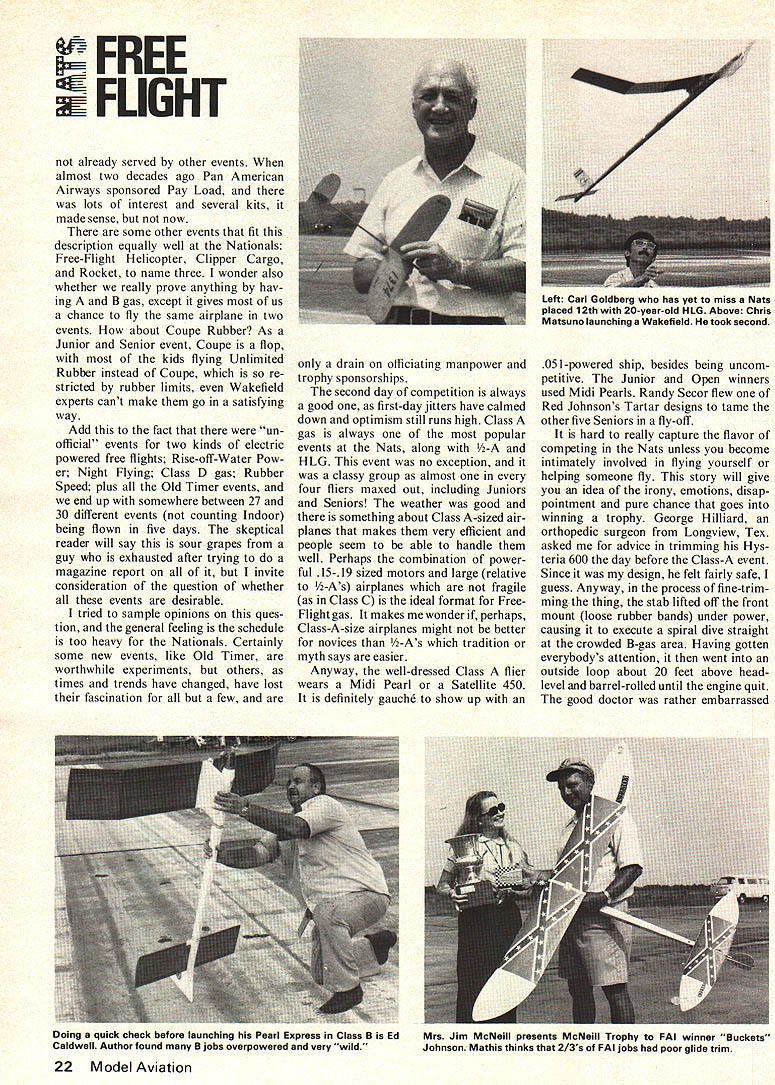
The second day of competition is always a good one, as first-day jitters have calmed down and optimism still runs high. Class A gas is always one of the most popular events at the Nats, along with 1/2-A and HLG. This event was no exception, and it was a classy group as almost one in every four fliers maxed out, including Juniors and Seniors! The weather was good and there is something about Class A-sized airplanes that makes them very efficient and people seem to be able to handle them well. Perhaps the combination of powerful .15-.19 sized motors and large (relative to 1/2-A's) airplanes which are not fragile (as in Class C) is the ideal format for Free-Flight gas. It makes me wonder if, perhaps, Class A-size airplanes might not be better for novices than 1/2-A's which tradition or myth says are easier.
Anyway, the well-dressed Class A flier wears a Midi Pearl or a Satellite 450. It is definitely gauche to show up with an .051-powered ship, besides being uncompetitive. The Junior and Open winners used Midi Pearls. Randy Secor flew one of Red Johnson's Tartar designs to tame the other five Seniors in a fly-off.
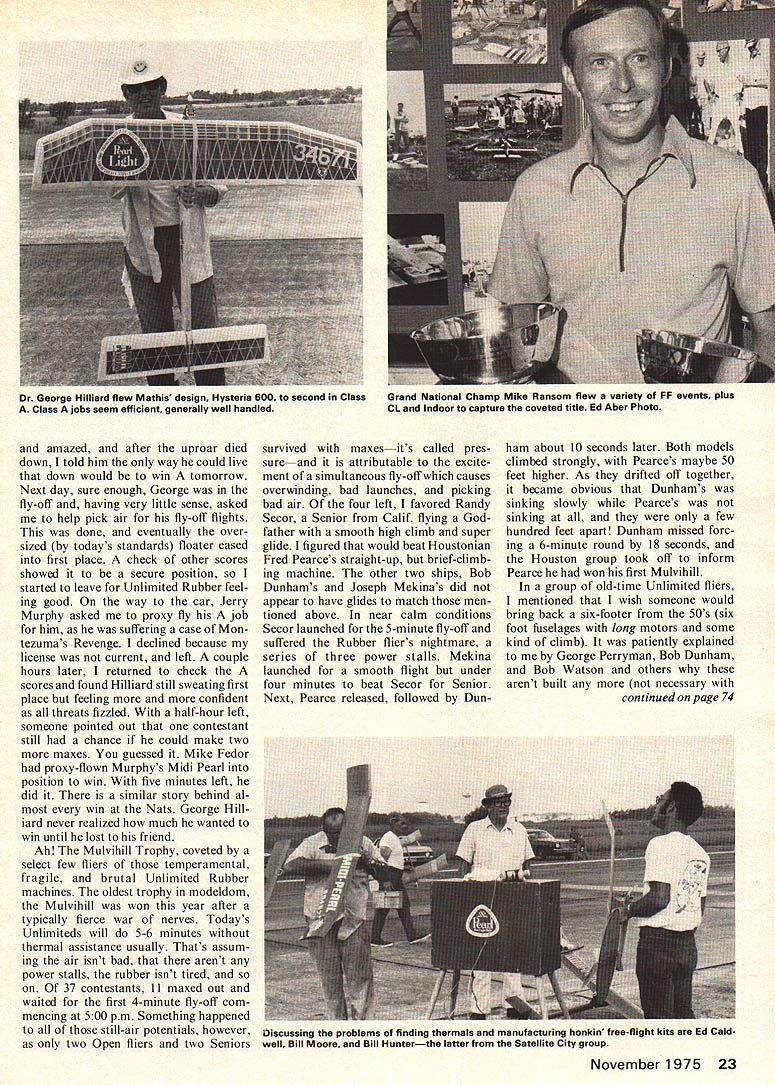
It is hard to really capture the flavor of competing in the Nats unless you become intimately involved in flying yourself or helping someone fly. This story will give you an idea of the irony, emotions, disappointment and pure chance that goes into winning a trophy. George Hilliard, an orthopedic surgeon from Longview, Tex., asked me for advice in trimming his Hysteric 600 the day before the Class-A event. Since it was my design, he felt fairly safe, I guess. Anyway, in the process of fine-trimming the thing, the stab lifted off the front mount (loose rubber bands) under power, causing it to execute a spiral dive straight at the crowded B-gas area. Having gotten everybody's attention, it then went into an outside loop about 20 feet above head level and barrel-rolled until the engine quit. The good doctor was rather embarrassed. and amazed, and after the uproar died down, I told him the only way he could live that down would be to win A tomorrow. Next day, sure enough, George was in the fly-off and, having very little sense, asked me to help pick air for his fly-off flights. This was done, and eventually the oversized (by today's standards) floater eased into first place. A check of other scores showed it to be a secure position, so I started to leave for Unlimited Rubber feeling good. On the way to the car, Jerry Murphy asked me to proxy fly his A job for him, as he was suffering a case of Montezuma's Revenge. I declined because my license was not current, and left. A couple hours later, I returned to check the A scores and found Hilliard still sweating first place but feeling more and more confident as all threats fizzled. With a half-hour left, someone pointed out that one contestant still had a chance if he could make two more maxes. You guessed it. Mike Fedor had proxy-flown Murphy's Midi Pearl into position to win. With five minutes left, he did it. There is a similar story behind almost every win at the Nats. George Hilliard never realized how much he wanted to win until he lost to his friend.
Ah! The Mulvihill Trophy, coveted by a select few fliers of those temperamental, fragile, and brutal Unlimited Rubber machines. The oldest trophy in modeldom, the Mulvihill was won this year after a typically fierce war of nerves. Today's Unlimiteds will do 5-6 minutes without thermal assistance usually. That's assuming the air isn't bad, that there aren't any power stalls, the rubber isn't tired, and so on. Of 37 contestants, 11 maxed out and waited for the first 4-minute fly-off commencing at 5:00 p.m. Something happened to all of those still-air potentials, however, as only two Open fliers and two Seniors survived with maxes—it's called pressure—and it is attributable to the excitement of a simultaneous fly-off which causes overwinding, bad launches, and picking bad air. Of the four left, I favored Randy Secor, a Senior from Calif. flying a Godfather with a smooth high climb and super glide. I figured that would beat Houston's Fred Pearce's straight-up, but brief-climb machine. The other two ships, Bob Dunham's and Joseph Mekina's did not appear to have glides to match those mentioned above. In near calm conditions Secor launched for the 5-minute fly-off and suffered the Rubber flier's nightmare, a series of three power stalls. Mekina launched for a smooth flight but under four minutes to beat Secor for Senior. Next, Pearce released, followed by Dunham about 10 seconds later. Both models climbed strongly, with Pearce's maybe 50 feet higher. As they drifted off together, it became obvious that Dunham's was sinking slowly while Pearce's was not sinking at all, and they were only a few hundred feet apart! Dunham missed forcing a 6-minute round by 18 seconds, and the Houston group took off to inform Pearce he had won his first Mulvihill.
In a group of old-time Unlimited fliers, I mentioned that I wish someone would bring back a six-footer from the 50's (six foot fuselages with long motors and some kind of climb). It was patiently explained to me by George Perryman, Bob Dunham, and Bob Watson and others why these aren't built any more (not necessary with
Free Flight: Outdoor
Dick Mathis
The 1975 Nationals turned out dandy. The Free-Flight contest was a surprise considering Lake Charles Chennault AFB a poor site; the main reason for success was the weather — unusually good throughout the region for summer. Rarely did wind exceed 10 mph gusts. Weather certainly played a part in separating winners and losers in an interesting, challenging manner. Very few airplanes wandered off-base or were lost in on-base swamps and woods. The number of contestants showed a healthy increase over last year and served to relieve the rather depressing atmosphere observed at the 1974 Nationals — entries the lowest I can remember; it goes back to the 1950 Nats.
Changes in the Nats format made some events more interesting competition-wise. Three FAI events — Wakefield, Power and A-2 — ran rounds first, commencing 6:30 a.m., the last ending at 8:30 p.m. Rounds seven, interrupted mid-morning and late afternoon to minimize thermal factors, placed emphasis on sheer airplane performance. The results were intriguing for the first time. Unlimited Rubber flyoffs were held at 5:00 p.m. instead of contestants' choice throughout the day. I have always thought it more interesting to see which has the best model rather than who can pick the best thermal — the luckiest — so the welcomed changes made the opening competition quietly rousing.
As dawn broke Tuesday, the first round A-2 towline began. A surprise — officials were swamped with fliers wanting to go early in the round because the moisture-laden air made it hard to see down the runway. Most flew before 7:00 a.m. Twenty-one of 53 first-round flights were 3-minute maxes, which says something about the quality of the air and the airplanes. Weather was perfect. Circle towing enables the flier to tow and search for lift long periods. In calm-wind conditions it is exhausting, running out timers and range of vision. Only two flyers, Jim Bradley and Dale Elder of Orlando, Fla., observed circle towing, however. Far too simply towed, released, taking time to feel the lift line and seek out elsewhere.
Piggy-back tactics were almost universal; the results were laughable in many cases — hysterical mobs of eight to ten, in one case 14 Nordics, simultaneously launched into tiny thermals and often huge downers. Mass hysteria is quite natural when you consider there would be 20 fliers standing on the starting line ready to tow at the slightest hint of thermal activity; tension would mount to very high levels, especially in late-evening rounds when thermals were imperceptible. Evening rounds, with winds once again almost calm, separated winners and losers ruthlessly. Perfect scores went by the wayside and still-air performance of the model became the ultimate deciding factor.
One-by-one, sometimes groups of three or four, fliers towed off down the runway and released into very dead last-round air. Most models could better 140 seconds; poorly-released models stalled. Half-hearted slingshot-style launches gave bigger stalls. As last-round scores came in, positions changed dramatically. Needing a max to beat old pro Frank Parmenter of Houston (runner-up in 1974) was young Rich McCreary of Detroit. Releasing a Crowley-designed Happy Hooker in what must have been the last warm-air evening, McCreary watched it descend back toward the launch area — a three-minute-plus-a-tick flight. Rich picked the model up about 25 feet from the event headquarters, ensuing victory celebration for Detroit.
Running simultaneously with the A-2 event was B gas. Early fliers started about 8:00 a.m. and found models going out of sight on an 11-second motor run right to the cloud bases; the situation plagued the highest climbers for several hours until clouds burned off. Class B models tend to be overpowered because some are merely straight class designs running 15s, 19s, 23s, 29s screwed on the front — the result being a whole lot of wild-climbing models not necessarily well trimmed. Few persons design larger models specifically; Class B engines seem suitable for contest work. For example, Open winner Jim Clem of Tulsa flew an Okie Bird design of about 480 sq. in. with a Fox 25. American Balsa Corporation with which I am not associated.) Bryan Nix thus added another first place to his first Nationals. I wonder how many more times the U.S. Kid will have to win a Nationals event before the NFFS sees fit to award it the "design of the year" honor?
AMA and NFFS scholarship winner Joseph Mekina was the Senior winner and, since his time was better than the Junior and Open winners, he won the coveted Tulsa Gluedobbers perpetual award. As it turned out, Seniors were much tougher than the Opens judging by comparative times. I guess this means their arms are usually better, or that they take the contest more seriously.
Mekina started with a Max Flyer design, found it wouldn't stay in the lift, and switched to his own Maxwell design for all his maxes. Ray Harper, the Max Flyer's designer, is one Open flier who takes HLG seriously. He almost won this year, but had his model fall out of the thermal just short of a max. He flew his light gliders early in hopes of taking advantage of the gentle lift. The winner, Frank Sharpton, waited until the crowds died down and the thermals got stronger to fly his original design.
With a few notable exceptions, the standard of HLG flying is not as high as it should be. There is too much design-hopping, where fliers constantly try new designs in hopes of improving when it is in fact their techniques that need work. Higher standards of workmanship and finish are needed, as are dethermalizers, which are admittedly much more prevalent than five years ago. Finally, the art of piggy backing needs to be pursued more systematically. The conditions should have generated winding scores of at least six straight maxes considering the piggy-back opportunities and the weather.
Lurking in 12th place in HLG, believe it or not, was Carl Goldberg flying a 20-year-old glider!
A-1 towline is not as prestigious as A-2, and most serious A-2 men won't be bothered with it, but it is always a great event at the Nats with many people competing who don't normally fly towline. Perhaps this is because a competitive A-1 is easier to build than an A-2. Like HLG, A-1 is a thermal event — no thermal, you lose. Mike Ransom maxed out to win Open.
By the time 1/2-A Gas, the largest Free-Flight event of all, rolls around, everybody is getting tired and wondering what it takes to win a trophy. 1/2-A Free Flights have run a complete cycle over the years since I first witnessed the event at the Nats in 1950. Then, airplanes ran 175 sq. in. on the average. Gradually, as engines developed more power, sizes went over 400 sq. in. Then, as motor runs were reduced, size came back to about 210, which is the area of a Mini Pearl. While they are very hot, the small Mini Pearls and small Satellites do require thermal help to max, which is where their high climb comes in. It gets them high enough to hit the thermals where they are bigger, and this is necessary if fly-offs require 5-second motor runs. You might wonder why I don't know what Norman Poti, the open winner, flew, but this is another case of the winner emerging out of the chaos and no one knowing what happened — even the people he beat.
Steve Calhoun flew a Satellite to win Junior, and I am sorry to say I don't know what design Mike Stoffel flew to win Senior. Let's have fly-offs all at one time so East Richard can keep better track of things! One striking note to all this is that Mini Pearls and Satellites have just about completely established themselves as the standard designs. So now it's time for an exciting new design! It is variety of choice in kits that keeps this event going, so let's hope something happens.
A night-flying event (unofficial, sponsored by the Western Freeflight Association) was held Friday from 9 to 12. A terrific thunderstorm blew up right at 9:00 and everyone left, or so we thought, and the Satellite City bunch thought otherwise. As it turned out, one side of the huge airbase was drenched and the other stayed dry. Once the wind died, a bang-up night-flying session ensued. Randy Secor, who has done his share of night flying in Calif., now flying a Tartar. Phil Bayly flew a 400 with .09-powered job for second, with Penny Johnson flying a Tartar for third. Those who had never witnessed a night contest were enthralled. It is a sensory delight with noise amplified in the denser air, glowing lights that race off into the void and then seem to stop in mid-air like a star. You can't tell whether an airplane is 500 feet high or 100, and if it gets out of trim, you'd better pack up because there is no hint that the model is climbing except the noise of the motor diminishing. I think night flying could catch on in the East (or, anywhere other than Calif.) once more people see it. By the way, there were definitely no thermals after 9:00 even with no hint of a breeze.
Saturday was "C" day and the Class-C gassie of today is a thing to behold. 1000 sq. in. wings are common now because that's about what it takes to slow the latest honkin' .40's down. The superior performance potential of these airplanes is not so obvious because they do not appear to climb as high as smaller ships, but they actually go higher. Once the gliding starts, nothing else touches them. Satellites were prevalent, but there was a surprising number of Maxi and Mama Pearls, as flown by the Pearl Team from Houston. Tulsan Tom Farmer's Maxi Pearl edged Bill Hunter's Satellite 1000 for first. Tom had Bill Chenault, the Pearl's founder, helping with thermal selection. A new slimmed-down Sal Taibi had maxed out, but waited too long for an improvement in the weather, which had gotten breezy. Satellites locked up Senior and Junior tightly. It was pleasing to see so many young fliers like Bob and Tom Scully and "Mini"-Fred and Steve Calhoun handling these monsters so well. One of the biggest problems hurting everyone in the fly-offs was power-glide transition. Large airplanes are much more critical in this area.
Adjacent to the C event, the Jetex event hissed and fizzled along with Chris Matsuno leading handsomely. Matsuno, from St. Louis, is very adept at the less familiar events, as are Mike Ransom, Mike Fedor, and Jerry Murphy. It takes special patience to make a Jetex, or a Coupe, a Pay Load, or a Rubber Speed model go.
Matsuno was also leading Wakefield after the fourth round, slightly ahead of Fred Pearce. Wakefields especially were hurt by the early morning round schedule because it was damp and dead. Matsuno's high-aspect-ratio model had by far the best glide and appeared to be one of the few models capable of an unaided max. Eventually, however, Pearce edged him out to complete a sweep of the rubber events, Coupe, Unlimited, and Wakefield.
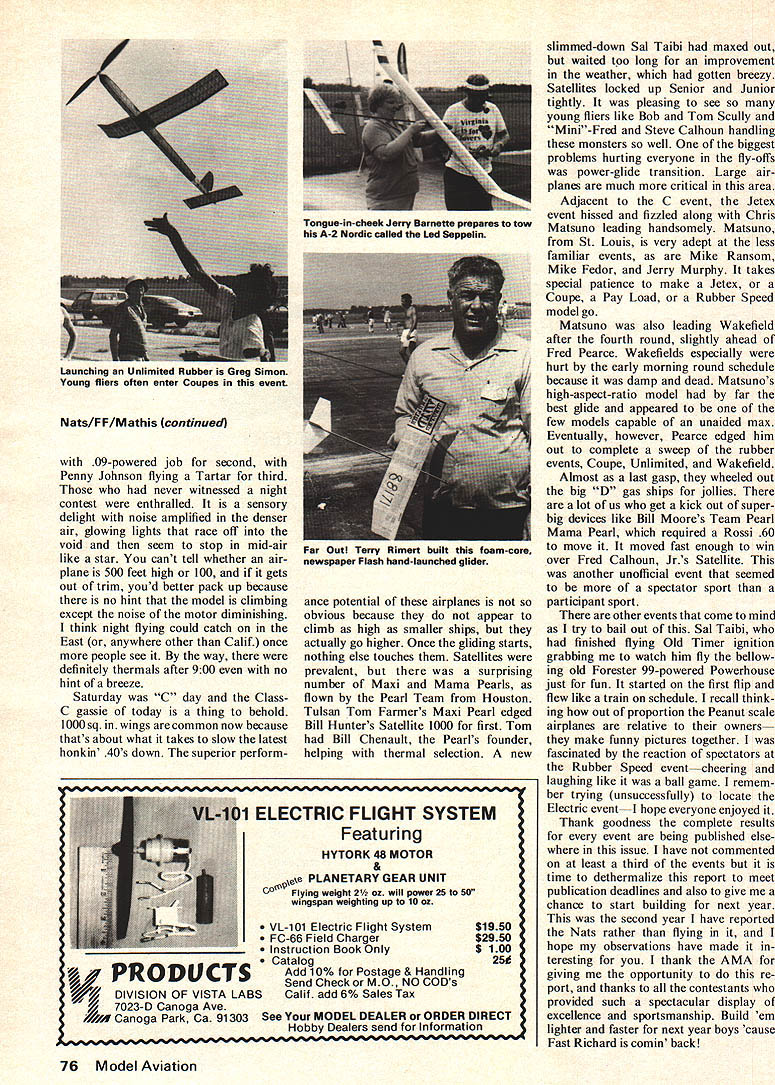
Almost as a last gasp, they wheeled out the big "D" gas ships for jollies. There are a lot of us who get a kick out of super-big devices like Bill Moore's Team Pearl Mama Pearl, which required a Rossi .60 to move it. It moved fast enough to win over Fred Calhoun, Jr.'s Satellite. This was another unofficial event that seemed to be more of a spectator sport than a participant sport.
There are other events that come to mind. I remember trying to bail out of this one — Sal Taibi, who had finished flying Old Timer ignition, grabbed me to watch him fly the bellowed-up and larger .99-powered Powerhouse, just for fun. It started on the first flip and flew like a train on schedule. I recall thinking how out of proportion the Pearl scale is and the airplanes are relative to their owners — they make funny pictures together. I was fascinated by the reaction of spectators at the Rubber Speed event — cheering and laughing like it was a ball game. I remember trying (unsuccessfully) to locate the Electric event — I hope everyone enjoyed it.
Thank goodness the complete results for every event are being published elsewhere in this issue. I have not commented on at least a third of the events but it is time to determine the time report to meet publication deadlines and to give me a chance to start building for next year. This was the second year I have reported the Nats rather than flying in it, and I hope my observations have made it interesting for you. I thank the AMA for giving me the opportunity to do this report, and thanks to all the contestants who provided such a spectacular display of excellence and sportsmanship. Build 'em lighter and faster for next year boys 'cause Fast Richard is comin' back!
Transcribed from original scans by AI. Minor OCR errors may remain.

