
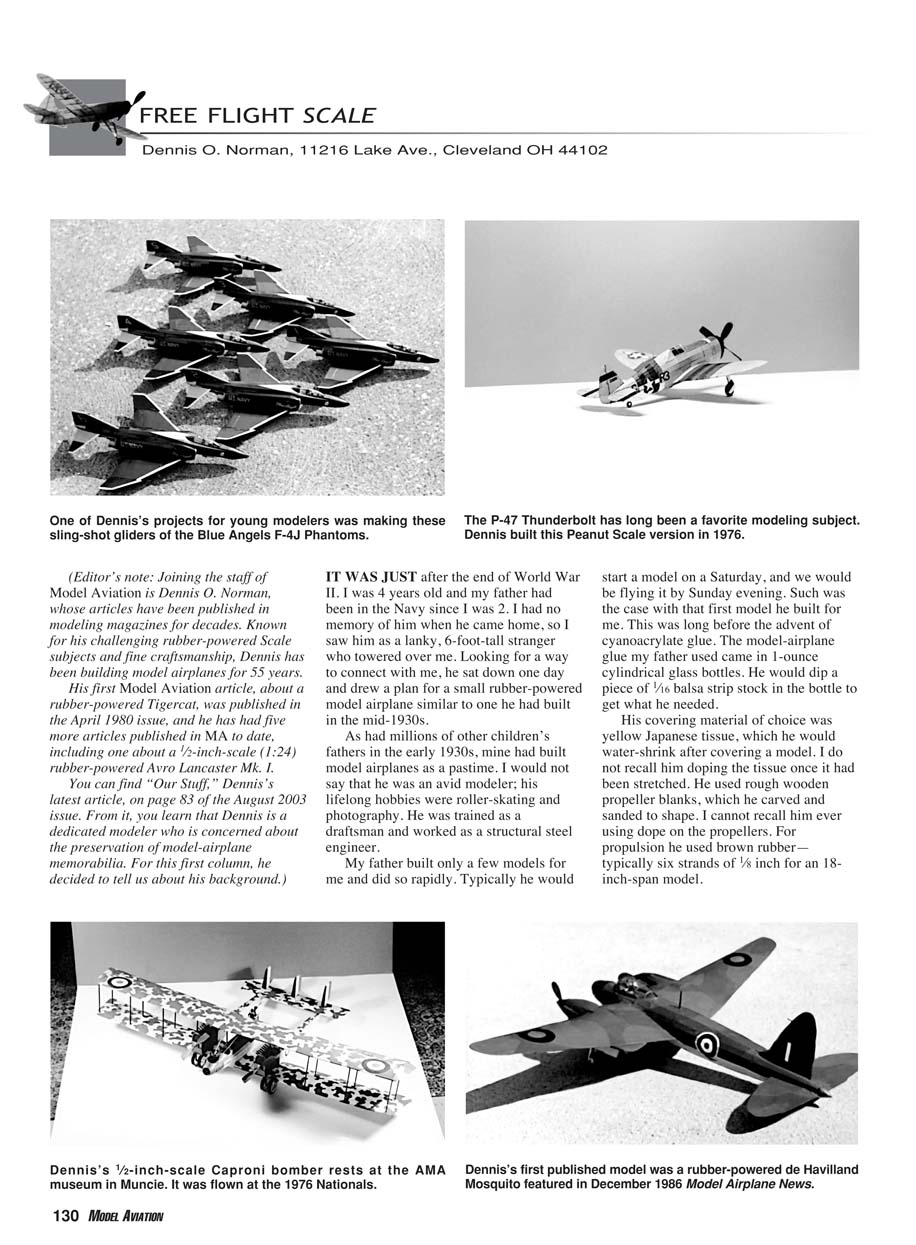
FREE FLIGHT SCALE
Dennis O. Norman, 11216 Lake Ave., Cleveland OH 44102
Editor's note
Joining the staff of Model Aviation is Dennis O. Norman, whose articles have been published in modeling magazines for decades. Known for his challenging rubber-powered Scale subjects and fine craftsmanship, Dennis has been building model airplanes for 55 years. His first Model Aviation article, about a rubber-powered Tigercat, was published in the April 1980 issue, and he has had five more articles published in MA to date, including one about a 1/2-inch-scale (1:24) rubber-powered Avro Lancaster Mk. I. You can find "Our Stuff," Dennis's latest article, on page 83 of the August 2003 issue. From it, you learn that Dennis is a dedicated modeler who is concerned about the preservation of model-airplane memorabilia. For this first column, he decided to tell us about his background.
It was just after the end of World War II. I was 4 years old and my father had been in the Navy since I was 2. I had no memory of him when he came home, so I saw him as a lanky, 6-foot-tall stranger who towered over me. Looking for a way to connect with me, he sat down one day and drew a plan for a small rubber-powered model airplane similar to one he had built in the mid-1930s.
As had millions of other children's fathers in the early 1930s, mine had built model airplanes as a pastime. I would not say that he was an avid modeler; his lifelong hobbies were roller-skating and photography. He was trained as a draftsman and worked as a structural steel engineer. My father built only a few models for me and did so rapidly. Typically he would start a model on a Saturday, and we would be flying it by Sunday evening. Such was the case with that first model he built for me.
This was long before the advent of cyanoacrylate glue. The model-airplane glue my father used came in 1-ounce cylindrical glass bottles. He would dip a piece of 1/16 balsa strip stock in the bottle to get what he needed. His covering material of choice was yellow Japanese tissue, which he would water-shrink after covering a model. I do not recall him doping the tissue once it had been stretched. He used rough wooden propeller blanks, which he carved and sanded to shape. I cannot recall him ever using dope on the propellers. For propulsion he used brown rubber—typically six strands of 1/8 inch for an 18-inch-span model.
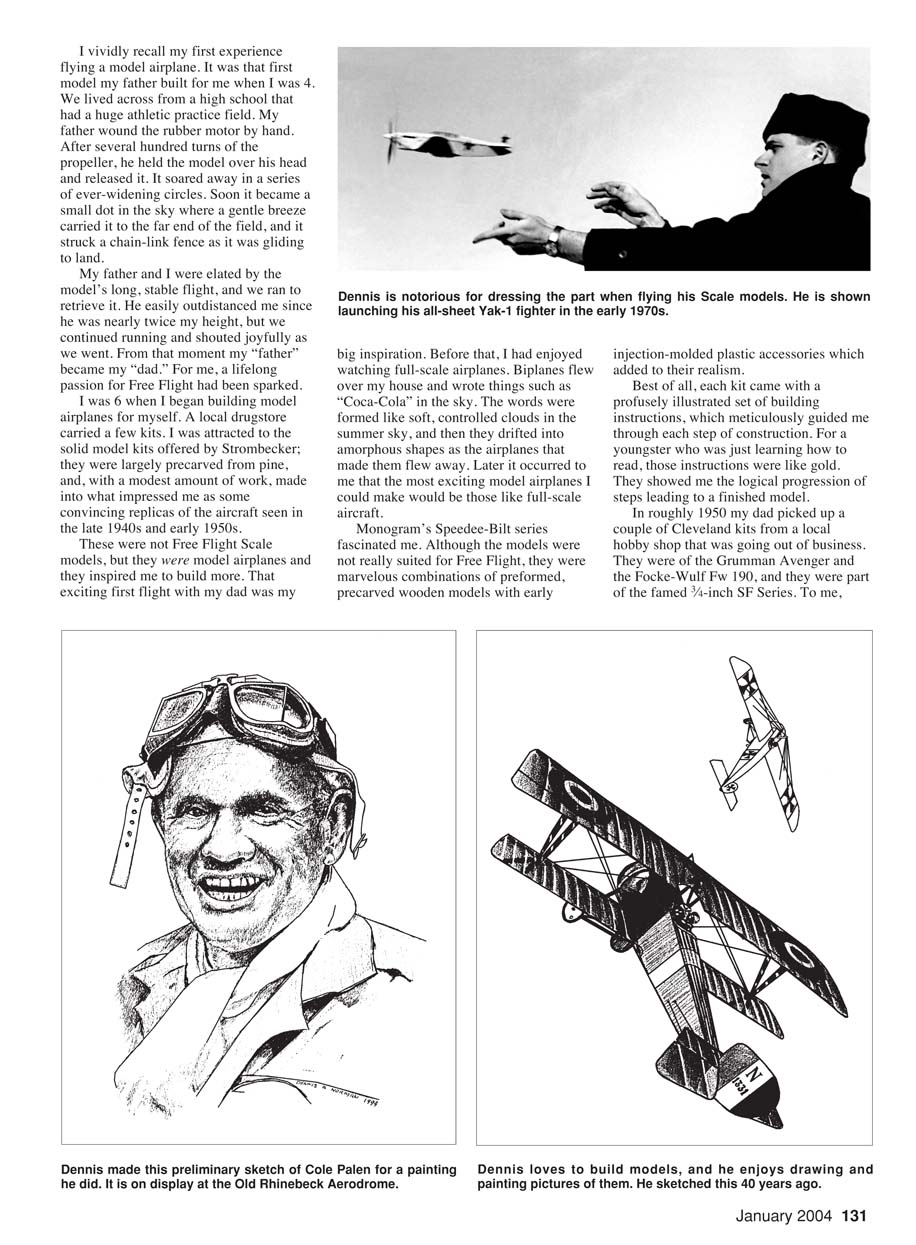
I vividly recall my first experience flying a model airplane. It was that first model my father built for me when I was 4. We lived across from a high school that had a huge athletic practice field. My father wound the rubber motor by hand. After several hundred turns of the propeller, he held the model over his head and released it. It soared away in a series of ever-widening circles. Soon it became a small dot in the sky where a gentle breeze carried it to the far end of the field, and it struck a chain-link fence as it was gliding to land. My father and I were elated by the model's long, stable flight, and we ran to retrieve it. He easily outdistanced me since he was nearly twice my height, but we continued running and shouted joyfully as we went. From that moment my "father" became my "dad." For me, a lifelong passion for Free Flight had been sparked.
I was 6 when I began building model airplanes for myself. A local drugstore carried a few kits. I was attracted to the solid model kits offered by Strombecker; they were largely precarved from pine, and, with a modest amount of work, made a big impression. Before that, I had enjoyed watching full-scale airplanes. Biplanes flew over my house and wrote things such as "Coca-Cola" in the sky. The words were formed like soft, controlled clouds in the summer sky, and then they drifted into amorphous shapes as the airplanes that made them flew away. Later it occurred to me that the most exciting model airplanes I could make would be those like full-scale aircraft.
Monogram's Speedee-Bilt series fascinated me. Although the models were not really suited for Free Flight, they were marvelous combinations of preformed, precarved wooden models with early injection-molded plastic accessories that added to their realism.
Best of all, each kit came with a profusely illustrated set of building instructions, which meticulously guided me through each step of construction. For a youngster who was just learning how to read, those instructions were like gold. They showed me the logical progression of steps leading to a finished model.
In roughly 1950 my dad picked up a couple of Cleveland kits from a local hobby shop that was going out of business. They were of the Grumman Avenger and the Focke-Wulf Fw 190, and they were part of the famed 3/4-inch SF Series. To me, they were large, complex, and expensive. I think they sold for $10 each at the time, but Dad bought them for half price.
I was delighted with the kits, and at the age of 8 I attempted to build the 3/4-inch Grumman Avenger. I managed to make the basic airframe, which I covered with red tissue paper and painted with dark-blue dope. I could not figure out how to make the cockpit canopy and I do not remember having a propeller or rubber motor, but I did get in a few short glides before crashing my creation beyond repair.
However, I was not discouraged. I was inspired to build more models. I realized that my first effort had been beyond my abilities. I learned that I could build the simpler kits that Comet and Guillows offered, and I persisted.
In 1951, when I was 9, I was inspired by a Control Line model of a Spitfire that was printed in a magazine. The model had such graceful lines, and it inspired me to draw my own plans for a 36-inch-span rubber-powered version.
I didn't make enough formers for the fuselage, and it had more curves than a hula dancer. The wings and tail were okay, but I had no clue how to fashion a spinner, propeller, canopy, etc. I painted my Spitfire with light-blue house paint. It was comical, but my mom and dad proudly showed it to friends and neighbors.
One of our neighbors built model airplanes for his son, and I spent many enjoyable hours visiting their basement and working on modeling projects. There were also a few children at school who showed an interest in building model airplanes, but most were soon distracted by other things. My brother, who is 6½ years my junior, also became a modeler. He is an award-winning IPMS figure painter who is still very active today.
I built models of ships, tanks, soldiers, etc., as a child and made models from paper, wood, plastic, and other materials. Later I dabbled in Control Line and Radio Control, but Free Flight Scale has always been my thing.
I have definitely benefited from studying other modelers' work. For instance, an article I read about the use of waxed male molds to build wooden rowboats inspired the techniques I used to build my Lancaster. I do not build plastic models, but I have a large collection of them for use as three-dimensional references when I design Free Flight Scale subjects. Also, the plastic models usually have interesting decal sheets that can be enlarged for application to my models.
I have been called a "master modeler." To my knowledge, there are no formal parameters for using that term in the U.S. I am told that model building has been considered a learned discipline in Europe. The term "master modeler," as I understand it, is an honorary title bestowed on one by others who understand and appreciate his or her efforts and achievements.
I was first called a "master modeler" in the 1970s when I won a contest in Model Builder magazine. The prize was a handy modeling vise that I still use. It is an honor to be regarded as a "master," but I do not dwell on it. I'm still learning from others all the time, and I believe that it is important for all of us to share our ideas. This is what keeps Free Flight Scale a vibrant part of model aviation.
It is important to me that this column's readers inform me not only of their accomplishments but of their attempts to achieve new goals. Only by sharing can we develop the healthy and useful dialogue needed to sustain our inspiration and assure the continued health and growth of our hobby.
I am publishing a series of monographs featuring full-color, predecorated Japanese-tissue covering. I described my method for doing this in my article "Color Copier Techniques" in the June 2002 Model Aviation. Subjects are available in 13-inch spans (Peanut Scale) and 17¼-inch spans. These are being well received at shows, where they are available for $20 each (for Peanut) and $30 each (for the larger size). I am also marketing them by mail for $22.50 (for Peanut) and $34 (for the larger size). In addition, I am assisting modelers and their families in the sale of their collections.
As for this column, I plan to continue to expand the dialogue between Free Flight Scale modelers everywhere. New modelers are coming into Free Flight Scale, and it is important to make them aware of the classic techniques of building and flying Scale models.
It is also important that we introduce children to model-airplane building and encourage them to become a part of our hobby, so I will try to give exposure to those who help youngsters learn about modeling. I will also try to make others aware of new products and techniques that further our progress.
AMA is the premier U.S. model-aviation organization, and a high percentage of U.S. modelers belong to it. However, there are U.S. modelers who build Free Flight Scale models and do not belong to AMA. There are also foreign modelers who are doing spectacular things in Free Flight Scale. I want to make Model Aviation readers aware of the talented individuals—domestic and foreign—who enrich our hobby today.
Model Aviation
Transcribed from original scans by AI. Minor OCR errors may remain.

