
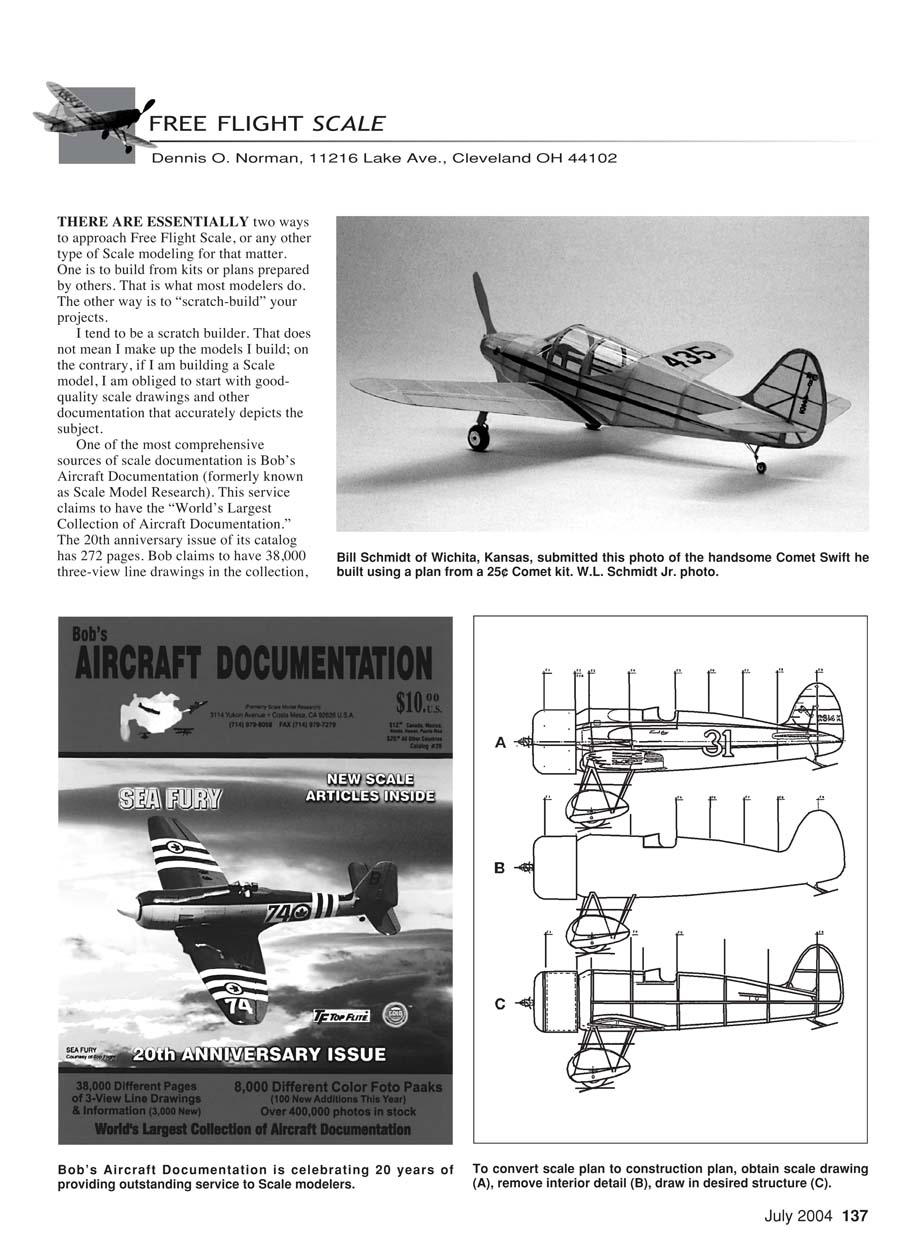
FREE FLIGHT SCALE
Dennis O. Norman 11216 Lake Ave., Cleveland, OH 44102
Approaches to Scale Modeling
There are essentially two ways to approach Free Flight Scale, or any other type of scale modeling. One is to build from kits or plans prepared by others — this is what most modelers do. The other way is to scratch-build your projects.
I tend to be a scratch builder. That does not mean I make up the models I build; on the contrary, if I am building a scale model I am obliged to start with good-quality scale drawings and other documentation that accurately depict the subject.
Sources of Scale Documentation
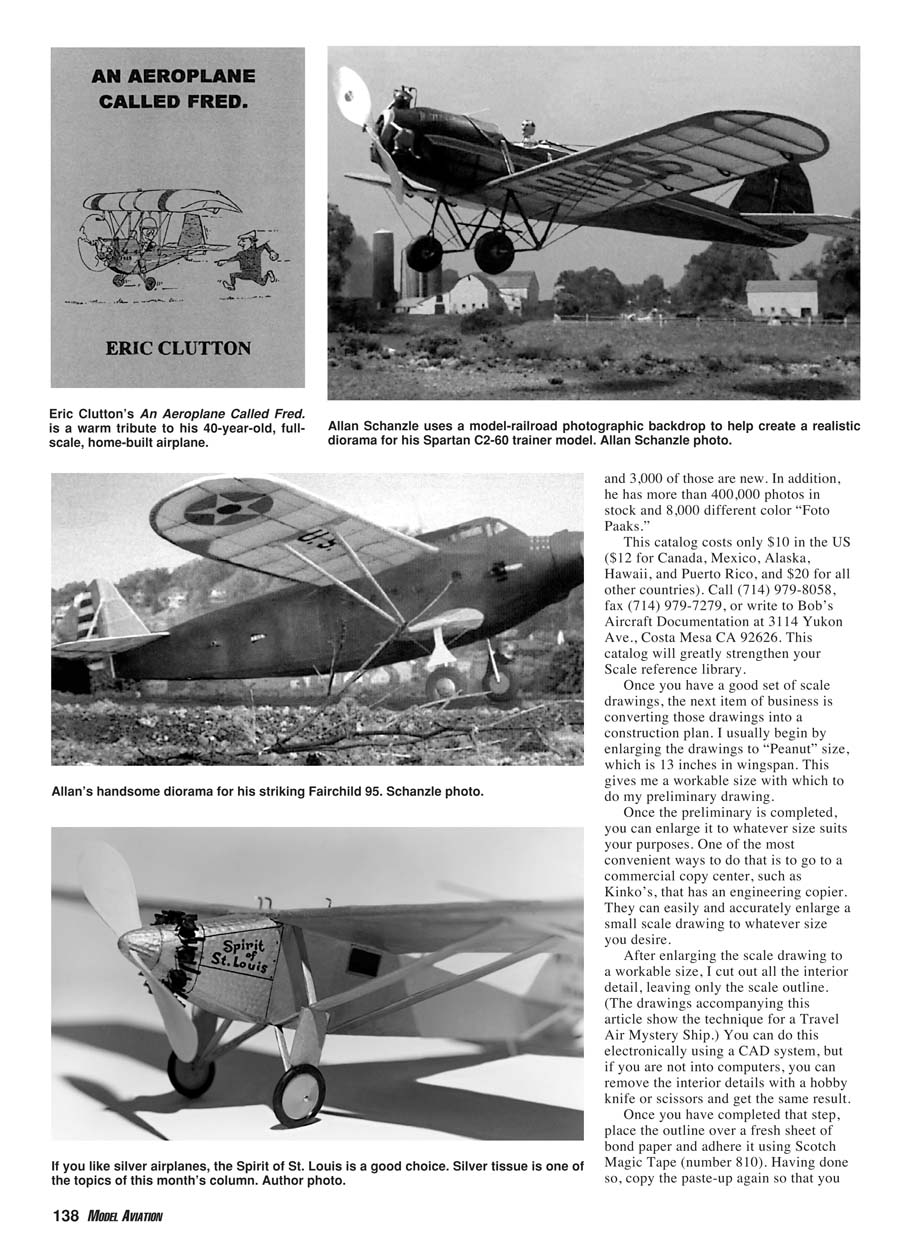
One of the most comprehensive sources of scale documentation is Bob's Aircraft Documentation (formerly Scale Model Research). This service claims to have the "World's Largest Collection of Aircraft Documentation." The 20th-anniversary issue of its catalog has 272 pages. Bob claims to have 38,000 three-view line drawings in the collection, and 3,000 of those are new. In addition, he has more than 400,000 photos in stock and 8,000 different color "Foto Paaks."
The catalog costs $10 in the U.S. ($12 for Canada, Mexico, Alaska, Hawaii, and Puerto Rico, and $20 for all other countries). Contact Bob's Aircraft Documentation:
- Phone: (714) 979-8058
- Fax: (714) 979-7279
- Mail: 3114 Yukon Ave., Costa Mesa, CA 92626
This catalog will greatly strengthen your scale reference library.
Converting Drawings into Construction Plans
Once you have good scale drawings, the next step is converting those drawings into a construction plan. My usual approach:
- Enlarge the drawings to "Peanut" size (13 inches wingspan) to create a workable preliminary drawing.
- When the preliminary drawing is completed, enlarge it to the final size you want. A commercial copy center (e.g., Kinko's) with an engineering copier can accurately enlarge small drawings to any desired size.
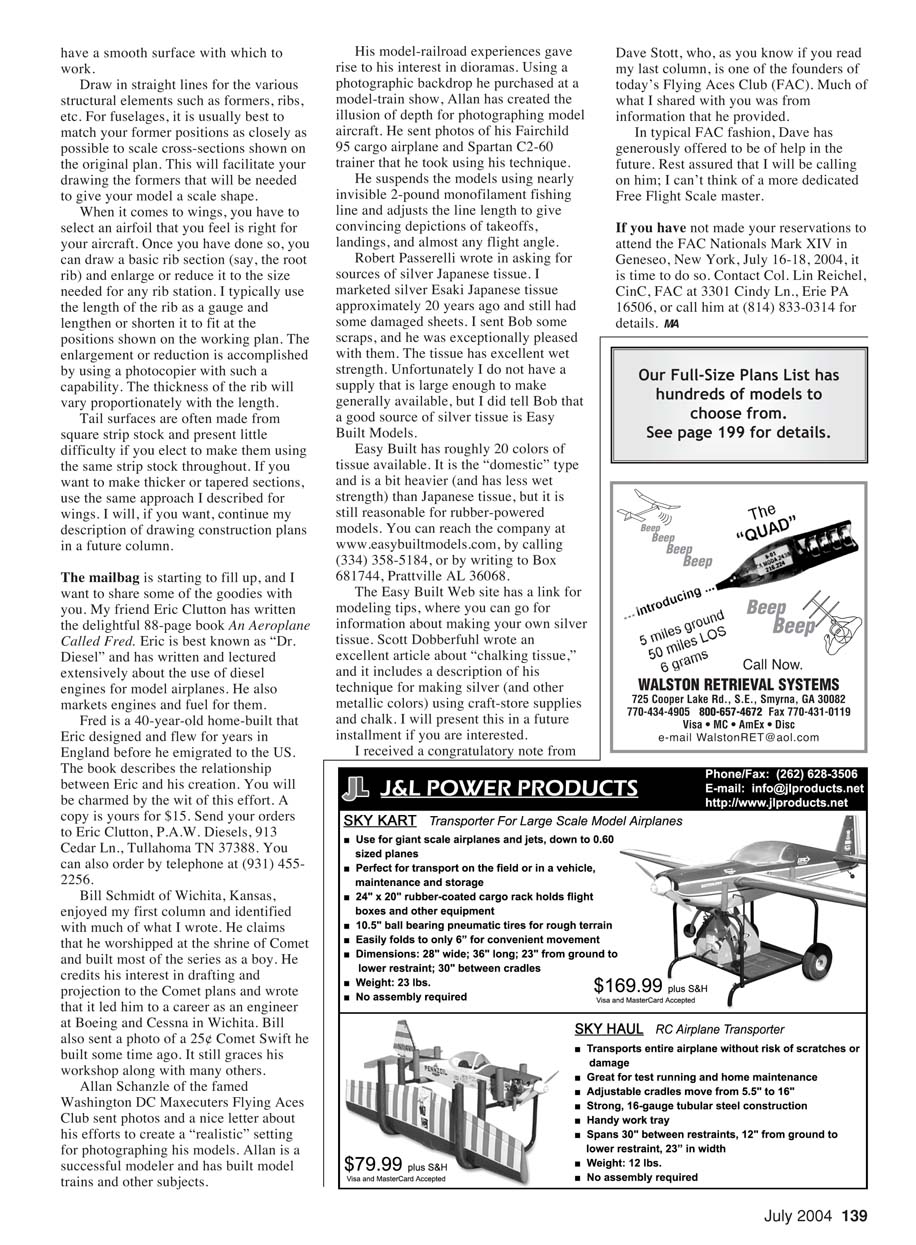
- After enlarging to a workable size, cut out all interior detail, leaving only the scale outline. (The drawings accompanying this article show the technique for a Travel Air Mystery Ship.) You can do this electronically with a CAD system, or manually with a hobby knife or scissors.
- Place the outline over a fresh sheet of bond paper and adhere it using Scotch Magic Tape (No. 810).
- Copy the pasted-up outline so you have a smooth surface to work on.
- Draw in straight lines for structural elements such as formers, ribs, etc.
For fuselages, match former positions to the scale cross-sections shown on the original plan. This facilitates drawing the formers needed to give your model a scale shape.
Wings and Tail Surfaces
- When it comes to wings, select an airfoil that suits your aircraft. Draw a basic rib section (for example, the root rib) and then enlarge or reduce it to the size needed for each rib station. I typically use the length of the rib as a gauge and adjust it to fit at the positions shown on the working plan. Use a photocopier with scaling capability to enlarge or reduce ribs; rib thickness will vary proportionately with length.
- Tail surfaces are often made from square strip stock and present little difficulty if you use the same stock throughout. If you want thicker or tapered sections, use the same photocopy scaling approach described for wings.
I will continue my description of drawing construction plans in a future column if there is interest.
Mailbag
- An Aeroplane Called Fred
My friend Eric Clutton has written the delightful 88-page book An Aeroplane Called Fred. Eric (best known as "Dr. Diesel") has written and lectured extensively about diesel engines for model airplanes and markets engines and fuel for them. Fred is a 40-year-old home-built that Eric designed and flew for years in England before emigrating to the U.S. The book describes the relationship between Eric and his creation and is full of charm and wit. Price: $15. Order from: Eric Clutton, P.A.W. Diesels, 913 Cedar Ln., Tullahoma, TN 37388. Phone: (931) 455-2256.
- Bill Schmidt (Wichita, KS)
Bill enjoyed my first column and identified with much of what I wrote. He remembers worshipping at the shrine of Comet, building most of the series as a boy, and credits his interest in drafting and projection to the Comet plans. That interest led to a career as an engineer at Boeing and Cessna in Wichita. Bill sent a photo of a 25¢ Comet Swift he built long ago; it still graces his workshop.
- Allan Schanzle (Washington, DC) — Maxecutters Flying Aces Club
Allan sent photos and a letter about creating realistic settings for photographing models. A successful modeler who has also built model trains, Allan used his model-railroad experience to create dioramas and photographic backdrops purchased at model-train shows. He suspends models with nearly invisible 2-pound monofilament fishing line, adjusting line length to depict takeoffs, landings, and various flight angles convincingly. He sent photos of his Fairchild 95 cargo airplane and Spartan C2-60 trainer using this technique.
- Robert Passerelli — Silver Japanese Tissue
Robert asked for sources of silver Japanese tissue. About 20 years ago I marketed silver Esaki Japanese tissue and still had some damaged sheets; I sent Bob some scraps. The tissue has excellent wet strength, but my supply is too small for general sale. A good source of silver tissue is Easy Built Models.
Easy Built Models offers roughly 20 colors of tissue. It is domestic-type tissue (a bit heavier and with less wet strength than true Japanese tissue) but still reasonable for rubber-powered models. Contact Easy Built Models:
- Web: www.easybuiltmodels.com
- Phone: (334) 358-5184
- Mail: Box 681774, Prattville, AL 36068
The Easy Built website has a link for modeling tips, including Scott Dobberfuhl’s article about "chalking tissue," which describes making silver (and other metallic colors) using craft-store supplies and chalk. I will present this technique in a future installment if readers are interested.
- Dave Stott and the Flying Aces Club (FAC)
I received a congratulatory note from Dave Stott, one of the founders of today's FAC. Much of what I shared in my last column came from information he provided. Dave has generously offered future help; I will be calling on him, as I can’t think of a more dedicated Free Flight Scale master.
Events
If you have not made reservations to attend the FAC Nationals Mark XIV in Geneseo, New York, July 16–18, 2004, it is time to do so. Contact:
- Col. Lin Reichel, CinC, FAC
3301 Cindy Ln., Erie, PA 16506 Phone: (814) 833-0314
Transcribed from original scans by AI. Minor OCR errors may remain.

