

Free Flight: Scale-Sport
Ralph D. Kuenz
I JUST FINISHED very carefully packing a Cleveland kit of the Curtiss P-40 for mailing to the winner of the "name calling" contest. The difficult part was writing out the name and address label on the box, deciding who to name as winner. Some entries came with a description of the character's life history, family lineage, the works. Tough decision.
Our character is Stewart Piddley, Stu for short, so named by Leland Staven of Decatur, GA. Lee submitted 13 names in his successful effort to obtain the P-40. Congratulations Lee. I'd like also to say thanks for all the letters and comments sent in with those submitting names.
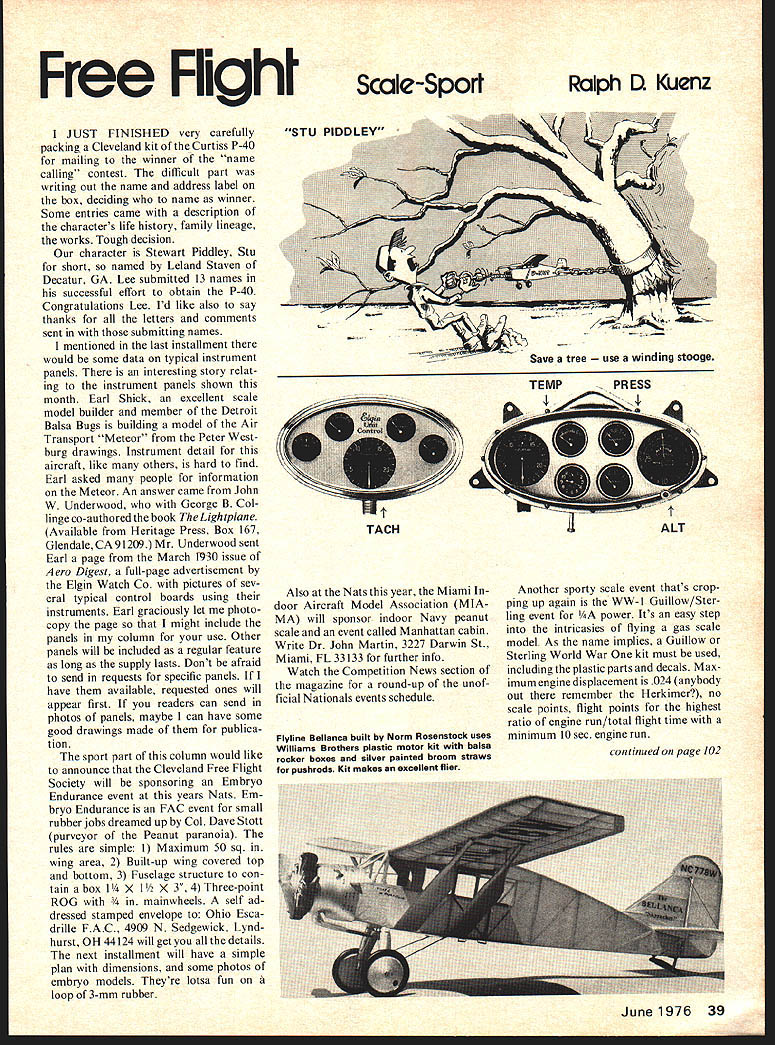
I mentioned in the last installment there would be some data on typical instrument panels. There is an interesting story relating to the instrument panels shown this month. Earl Snick, an excellent scale model builder and member of the Detroit Balsa Bugs is building a model of the Air Transport "Meteor" from the Peter Westburg drawings. Instrument detail for this aircraft, like many others, is hard to find. Earl asked many people for information on the Meteor. An answer came from John W. Underwood, who with George B. Collinge co-authored the book The Lightplane (Available from Heritage Press, Box 167, Glendale, CA 91209). Mr. Underwood sent Earl a page from the March 1930 issue of Aero Digest, a full-page advertisement by the Elgin Watch Co. with pictures of several typical control boards using their instruments. Earl graciously let me photocopy the page so that I might include the panels in my column for your use. Other panels will be included as a regular feature as long as the supply lasts. Don't be afraid to send in requests for specific panels. If I have them available, requested ones will appear first. If readers can send in photos of panels, maybe I can have some good drawings made of them for publication.
The sport part of this column would like to announce that the Cleveland Free Flight Society will be sponsoring an Embryo Endurance event at this year's Nats. Embryo Endurance is an FAC event for small rubber jobs dreamed up by Col. Dave Stott (purveyor of the Peanut paranoia). The rules are simple: 1) Maximum 50 sq. in. wing area, 2) Built-up wing covered top and bottom, 3) Fuselage structure to contain a box 1 x 1 x 3, 4) Three-point ROG with 1/4 in. mainwheels. A self addressed stamped envelope to: Ohio Escadrille F.A.C., 4909 N. Sedgewick, Lyndhurst, OH 44124 will get you all the details.
The next installment will have a simple plan with dimensions, and some photos of embryo models. They're lotsa fun on a loop of 3-mm rubber.
Also at the Nats this year, the Miami Indoor Aircraft Model Association (MIAMA) will sponsor an indoor Navy peanut scale and an event called Manhattan cabin. Write Dr. John Martin, 3227 Darwin St., Miami, FL 33133 for further info. Watch the Competition News section of the magazine for a round-up of the unofficial Nationals events schedule.
Another sporty scale event that's cropping up again is the WW-I Guillow/Sterling event for 1/4 A power. It's an easy step into the intricacies of flying gas scale models. As the name implies, a Guillow or Sterling World War One kit must be used, including the plastic parts and decals. Maximum engine displacement is .024 (anybody out there remember the Herkimer?), no scale points, flight points for the highest ratio of engine run/total flight time with a minimum 10 sec. engine run. JUST FINISHED very carefully packing Cleveland kit Curtiss P-40 for mailing to the winner. Name-calling contest — the difficult part is writing out the name and address label, and deciding the name-winner. Some entries came with descriptions of the characters, life history, family lineage and works. Tough decision. The character Stewart Piddley (Stu for short) named Leland Staven, Decatur, GA. Lee submitted 13 names in a successful effort to obtain the P-40. Congratulations, Lee.
I'd like also to say thanks for the letters and comments sent in submitting names I mentioned last installment. Some data on typical instrument panels and an interesting story relating to the instrument panels shown last month: Earl Shick, an excellent scale model builder and member of Detroit Balsa Bugs, is building a model Air Transport Meteor from Peter Westburg drawings. Instrument detail on aircraft like this is, as with others, hard to find. Earl asked people for information on the Meteor. An answer came from John W. Underwood. George B. Collinge co-authored the book Lightplane, available from Heritage Press, Box 167, Glendale, CA 91209. Mr. Underwood sent Earl a page from the March 1930 issue of Aero Digest — a full-page advertisement by Elgin Watch Co. pictures several typical control boards using instruments. Earl graciously let me photocopy the page; I might include the panels in this column for use. Other panels will be included as a regular feature as long as the supply lasts. Don't be afraid to send requests for specific panels; if I have the panels requested, they will appear first. Readers can send photos of panels; maybe I can have some good drawings made for publication.
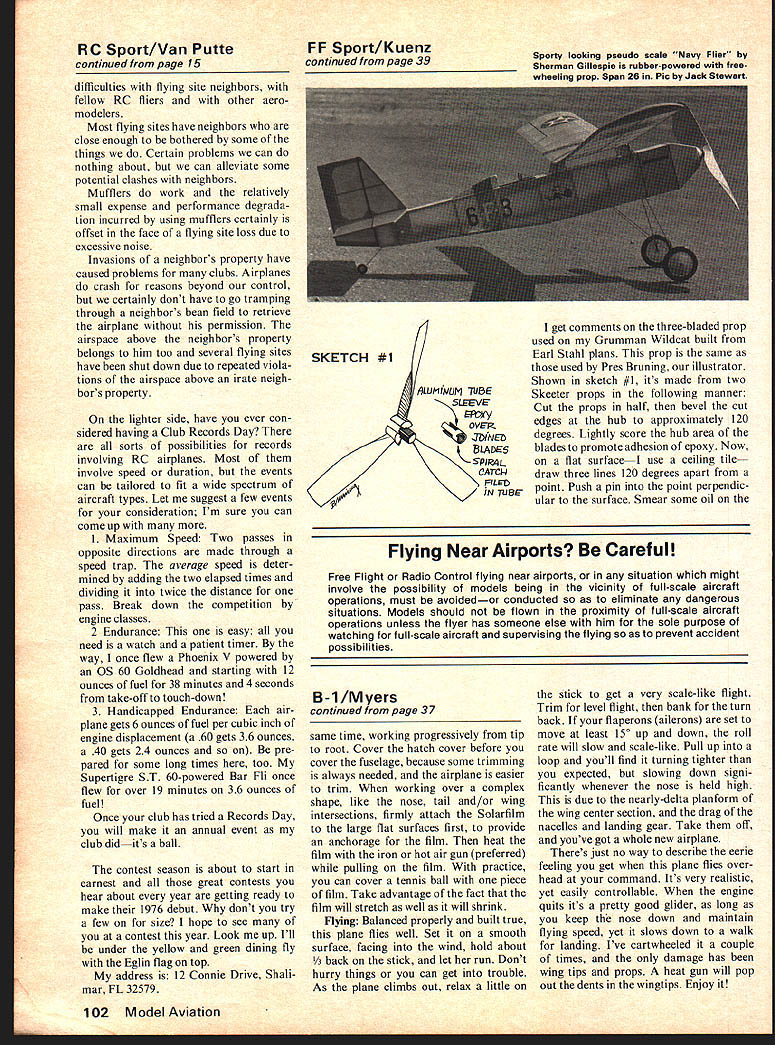
I get comments on the three-bladed prop used on my Grumman Wildcat built from Earl Stahl plans. This prop is the same as those used by Pres Bruning, our illustrator. Shown in sketch #1, it's made from two Skeeter props in the following manner: cut the props in half, then bevel the cut edges at the hub to approximately 120 degrees. Lightly score the hub area of the blades to promote adhesion of epoxy. Now, on a flat surface (a ceiling tile will do), draw three lines 120 degrees apart from a point. Push a pin into the point perpendicular to the surface. Smear some oil on the ...
Flying Near Airports? Be Careful!
Free Flight or Radio Control flying near airports, or in any situation which might involve the possibility of models being in the vicinity of full-scale aircraft operations, must be avoided — or conducted so as to eliminate any dangerous situations. Models should not be flown in the proximity of full-scale aircraft operations unless the flyer has someone else with him for the sole purpose of watching for full-scale aircraft and supervising the flying so as to prevent accident possibilities. pin to prevent epoxy from adhering to it. Stack the three blades sandwich style and nick them all on the tip with a knife at the same place. Set one blade with the hub against the vertical pin and the notch on the tip directly over one of the lines. Tape or pin the blade in this position. Do the same with the other two blades. Using plastic cement, cement the blades together. When dry, slip the notched 1/4-in. aluminum tubing (with a spiral catch fitted in the forward end) over the blades and coat well with 5-minute epoxy. Spray with silver enamel when balanced — who ever heard of a red prop on a Wildcat!
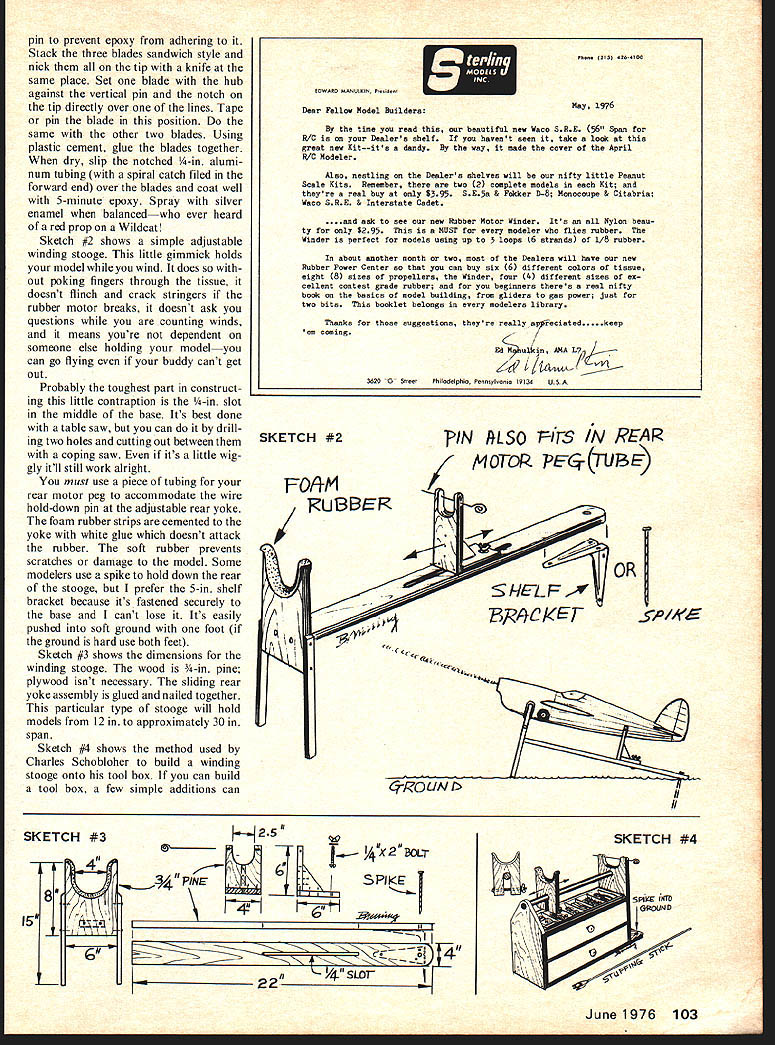
Sketch #2 shows a simple adjustable winding stooge. This little gimmick holds your model while you wind. It does so without poking fingers through the tissue, it doesn't flinch and crack stringers if the rubber motor breaks, it doesn't ask you questions while you are counting winds, and it means you're not dependent on someone else holding your model — you can go flying even if your buddy can't get there.
Probably the toughest part in constructing this little contraption is the 1/4-in. slot in the middle of the base. It's best done with a table saw, but you can do it by drilling two holes and cutting out between them with a coping saw. Even if it's a little wiggly it'll still work alright.
You must use a piece of tubing for your rear motor peg to accommodate the wire hold-down pin at the adjustable rear yoke. The foam rubber strips are cemented to the yoke with white glue which doesn't attack the rubber. The soft rubber prevents scratches or damage to the model. Some modelers use a spike to hold down the rear of the stooge, but I prefer the 5-in. shelf bracket because it's fastened securely to the base and I can't lose it. It's easily pushed into soft ground with one foot (if the ground is hard use boot feet).
Sketch #3 shows the dimensions for the winding stooge. The wood is 3/4-in. pine; plywood isn't necessary. The sliding rear yoke assembly is glued and nailed together. This particular type of stooge will hold models from 12 in. to approximately 30 in. span.
Sketch #4 shows the method used by Charles Schoblocher to build a winding stooge onto his tool box. If you can build a tool box, a few simple additions can... eliminate the need to carry another piece of equipment onto the flying field. The sliding front yoke in this case is made from plywood. Notice that the base of the box is extended to provide a lip for spike holes.
Ron Sears, a Cloudbuster member, is using a flexible transparent tape with the trade name "Blenderm" for masking his models. This tape, made by 3M Company, is a plastic bandage tape for first aid. Ron says the tape is easy to work around curves and removes easily. (Works well as a bandage too.) Ask for Blenderm #1525 bandage tape at your druggist.
Here are some more sources for scale information. Fairchild Aircraft Industries, Inc., Century Blvd., Germantown, MD 20767; Great Lakes Aircraft Company, P.O. Box 1132, Wichita, KS 67202; Grumman American Aviation Corp., 318 Bishop Rd., Cleveland, OH 44143.
Our cartoon artist Bill Caldwell has outdone himself with the fine drawing this issue. It makes writing this column a lot easier having professional backup like Bill, Pres Bruning, and the many good photographers who submit pictures for the column. Thanks, guys.
Along with the Embryo, next month will bring some info on winding tubes, finishing techniques for lightweight models, more instruments, and perhaps some info on engine details.
My address is 14645 Stahelin, Detroit, MI 48223.
WANTED: ideas, happenings, hints/kinks, how-to sketches, photos, news, etc. Send to the columnist at the above address. No commitment for use. Please include a stamped, self-addressed envelope if you want photos returned. Model Aviation will pay $5 to the contributor.
Transcribed from original scans by AI. Minor OCR errors may remain.

