
Free Flight: Scale-Sport
Bill Warner
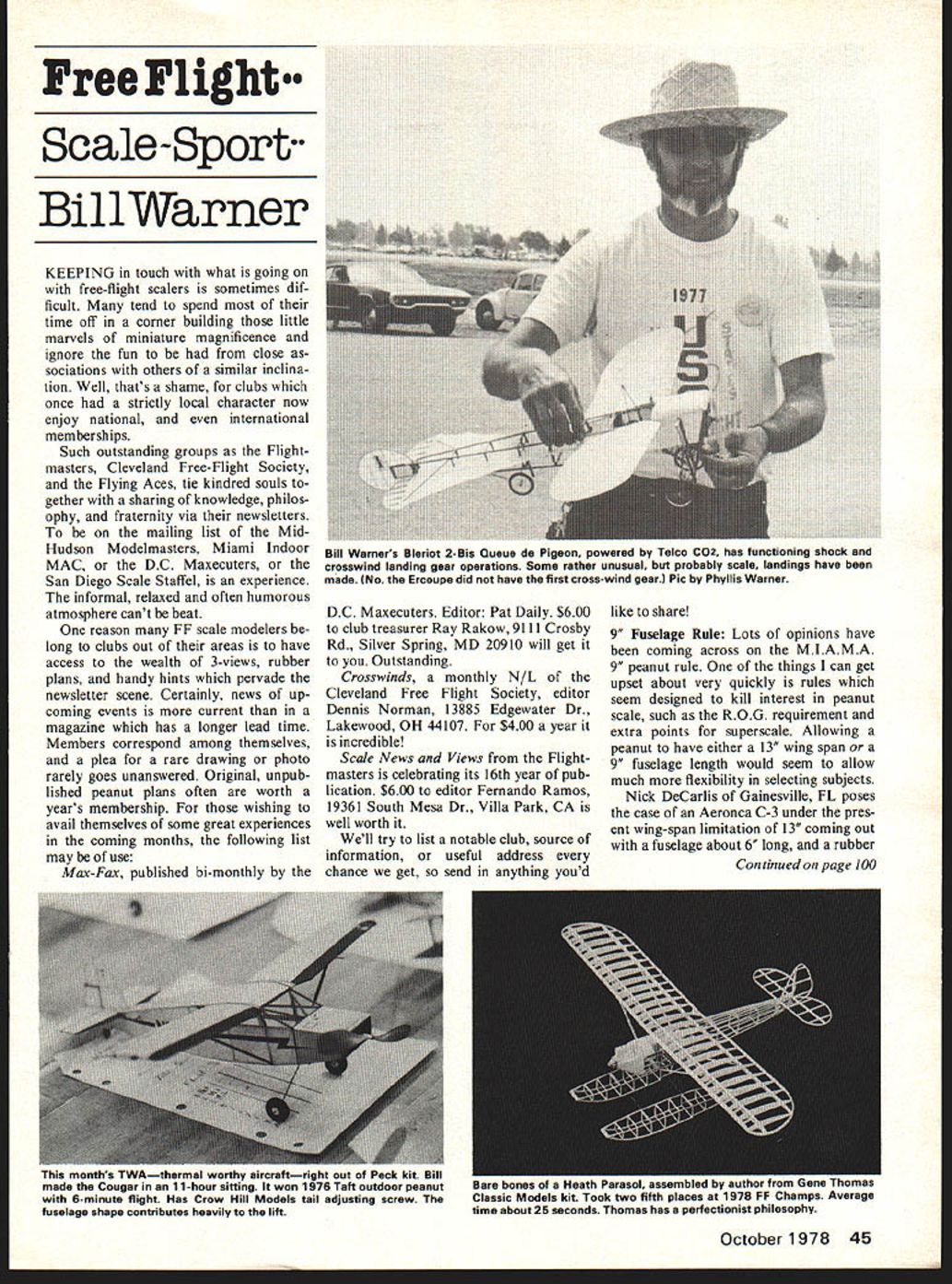
KEEPING in touch with what is going on with free-flight scalers is sometimes difficult. Many tend to spend most of their time off in a corner building those little marvels of miniature magnificence and ignore the fun to be had from close associations with others of a similar inclination. Well, that's a shame, for clubs which once had a strictly local character now enjoy national, and even international memberships.
Such outstanding groups as the Flightmasters, Cleveland Free-Flight Society, and the Flying Aces tie kindred souls together with a sharing of knowledge, philosophy, and fraternity via their newsletters. To be on the mailing list of the Mid-Hudson Modelmasters, Miami Indoor MAC, the D.C. Maxecuters, or the San Diego Scale Staffel is an experience. The informal, relaxed and often humorous atmosphere can't be beat.
One reason many FF scale modelers belong to clubs out of their areas is to have access to the wealth of 3-views, rubber plans, and handy hints which pervade the newsletter scene. Certainly, news of upcoming events is more current than in a magazine which has a longer lead time. Members correspond among themselves, and a plea for a rare drawing or photo rarely goes unanswered. Original, unpublished peanut plans often are worth a year's membership. For those wishing to avail themselves of some great experiences in the coming months, the following list may be of use:
- Max-Fax, published bi-monthly by the D.C. Maxecuters. Editor: Pat Daily. $6.00 to club treasurer Ray Rakow, 9111 Crosby Rd., Silver Spring, MD 20910 will get it to you. Outstanding.
- Crosswinds, a monthly newsletter of the Cleveland Free Flight Society. Editor: Dennis Norman, 13885 Edgewater Dr., Lakewood, OH 44107. For $4.00 a year it is incredible!
- Scale News and Views from the Flightmasters is celebrating its 16th year of publication. $6.00 to editor Fernando Ramos, 19361 South Mesa Dr., Villa Park, CA is well worth it.
We'll try to list a notable club, source of information, or useful address every chance we get, so send in anything you'd like to share!
9" Fuselage Rule
Lots of opinions have been coming across on the M.I.A.M.A. 9" peanut rule. One of the things I can get upset about very quickly is rules which seem designed to kill interest in peanut scale, such as the R.O.G. requirement and extra points for superscale. Allowing a peanut to have either a 13" wing span or a 9" fuselage length would seem to allow much more flexibility in selecting subjects.
Nick DeCarlis of Gainesville, FL poses the case of an Aeronca C-3 which, under the present wing-span limitation of 13", comes out with a fuselage about 6" long and a rubber motor space of only 5". The resulting model would not look out of place in a judging lineup with the Lacey/Fike low-aspect-ratio bunch, now would it? Personally, I think that this rule change, coupled with a minimum weight requirement, would be all that is needed as far as peanut rules go. If one wants to make a superscale ship, fly AMA Scale. For ultralight builders, there's Pennyplane. Let's keep Peanut loose! Maybe a 50-second max would help?
Miniprofiles, Anyone?
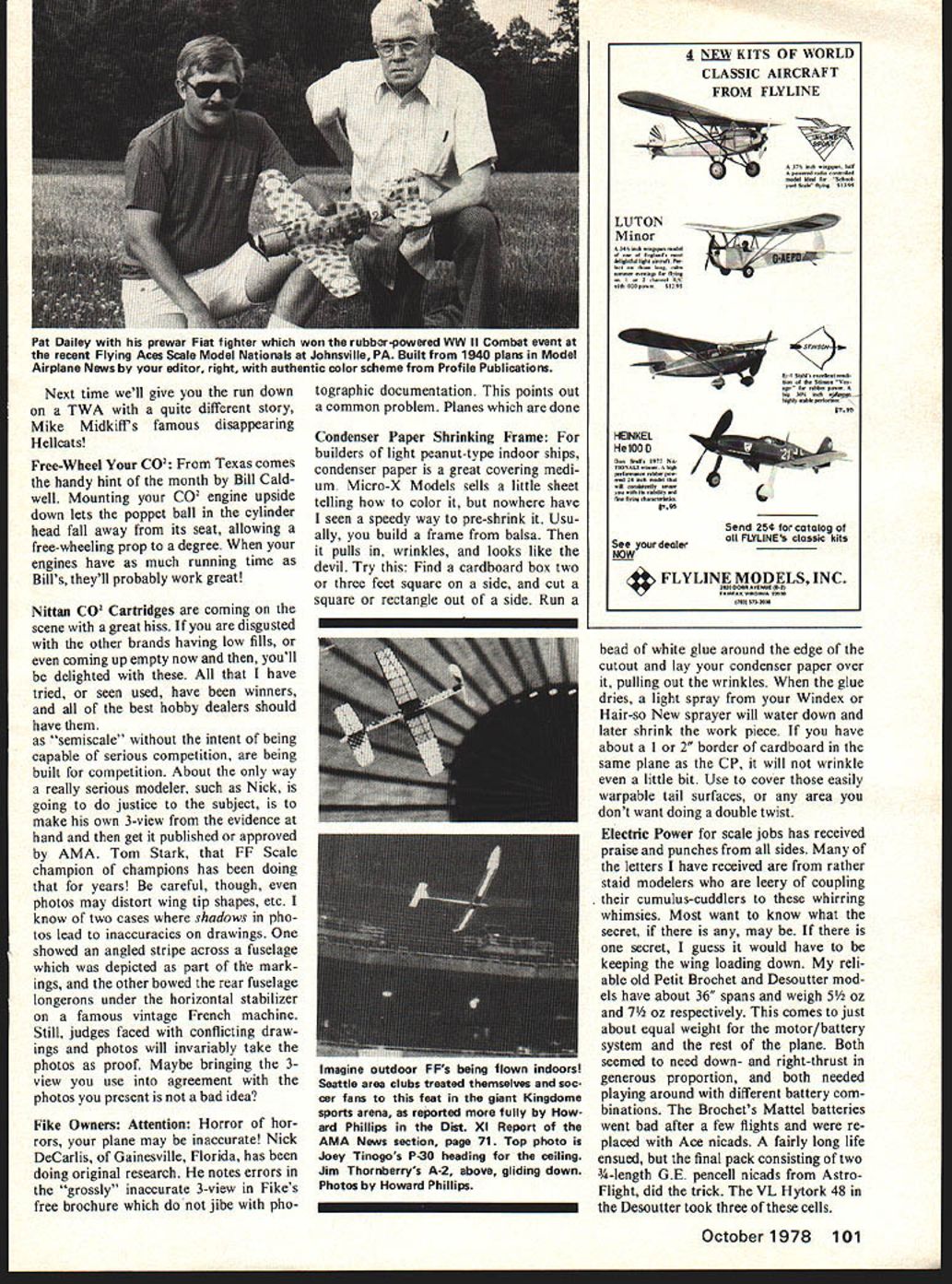
Phil Koopman, of Vintage Aero — the people who have a "do-it-yourself" spoke-wheel kit for your wheel-wonders on the market — has a deal for those of you who'd like to make the transition into mini-scale from Slick Streaks. Somewhere between the very simple beginner's plane and the considerably more sophisticated peanut or built-up rubber scale ship is a large gap. What do you give a kid to make after that Delta Dart? Combining the simplicity of the "plan-is-the-covering" approach with a profile fuselage and built-up (albeit flat) wing offers a good way to continue on. The Vintage Aero Mini-Profile series, including such all-time greats as the Nesmith Cougar, the DH-6, and the Pietenpol Air Camper, is a welcome addition to your hobby dealer's shelves.
TWA (Thermal-Worthy Aircraft)
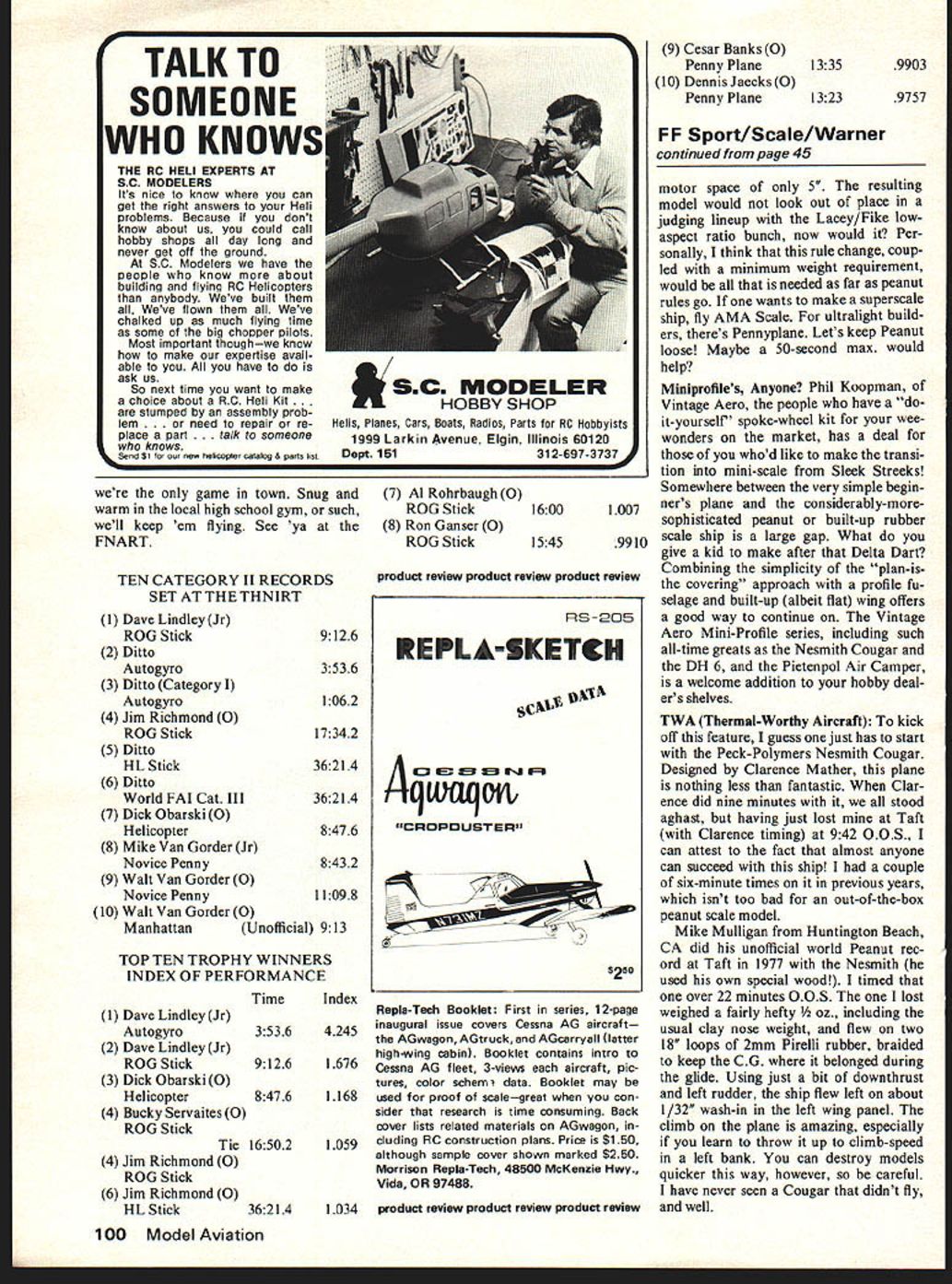
To kick off this feature, I guess one just has to start with the Peck-Polymers Nesmith Cougar. Designed by Clarence Mather, this plane is nothing less than fantastic. When Clarence did nine minutes with it, we all stood aghast, but having just lost mine at Taft (with Clarence timing) at 9:42 O.O.S., I can attest to the fact that almost anyone can succeed with this ship! I had a couple of six-minute times on it in previous years, which isn't too bad for an out-of-the-box peanut scale model.
Mike Mulligan from Huntington Beach, CA did his unofficial world Peanut record at Taft in 1977 with the Nesmith (he used his own special wood!). I timed that one over 22 minutes O.O.S. The one I lost weighed a fairly hefty 1/2 oz., including the usual clay nose weight, and he won on two 18" loops of 2mm Pirelli rubber, braided to keep the C.G. where it belonged during the glide. Using just a bit of downthrust and left rudder, the ship flew left on about 1/32" wash-in in the left wing panel. The climb on the plane is amazing, especially if you learn to throw it up to climb-speed in a left bank. You can destroy models quicker this way, however, so be careful. I have never seen a Cougar that didn't fly well.
Next time we'll give you the run down on a TWA with a quite different story: Mike Midkiff's famous disappearing Hellcats!
Free-Wheel Your CO2
From Texas comes the handy hint of the month by Bill Caldwell. Mounting your CO2 engine upside down lets the poppet ball in the cylinder head fall away from its seat, allowing a free-wheeling prop to a degree. When your engines have as much running time as Bill's, they'll probably work great!
Nittan CO2 cartridges are coming on the scene with a great hiss. If you are disgusted with the other brands having low fills, or even coming up empty now and then, you'll be delighted with these. All that I have tried, or seen used, have been winners, and all of the best hobby dealers should have them.
Semiscale and Accuracy
Planes done as "semiscale" without the intent of being capable of serious competition are sometimes being built for competition. About the only way a really serious modeler, such as Nick, is going to do justice to the subject is to make his own 3-view from the evidence at hand and then get it published or approved by AMA. Tom Stark, that FF scale champion of champions, has been doing that for years!
Be careful, though — even photos may distort wing tip shapes, etc. I know of two cases where shadows in photos led to inaccuracies on drawings. One showed an angled stripe across a fuselage which was depicted as part of the markings, and the other bowed the rear fuselage longerons under the horizontal stabilizer on a famous vintage French machine. Still, judges faced with conflicting drawings and photos will invariably take the photos as proof. Maybe bringing the 3-view you use into agreement with the photos you present is not a bad idea!
Fike Owners
Attention: Horror of horrors, your plane may be inaccurate! Nick DeCarlis, of Gainesville, Florida, has been doing original research. He notes errors in the grossly inaccurate 3-view in Fike's free brochure which do not jibe with photographic documentation. This points out a common problem with published drawings and promotional material.
Condenser Paper Shrinking Frame
For builders of light peanut-type indoor ships, condenser paper is a great covering medium. Micro-X Models sells a little sheet telling how to color it, but nowhere have I seen a speedy way to pre-shrink it. Usually, you build a frame from balsa. Then it pulls in, wrinkles, and looks like the devil. Try this: find a cardboard box two or three feet square on a side, and cut a square or rectangle out of a side. Run a bead of white glue around the edge of the cutout and lay your condenser paper over it, pulling out the wrinkles. When the glue dries, a light spray from your Windex or Hair-So New sprayer will water down and later shrink the work piece. If you have about a 1" or 2" border of cardboard in the same plane as the condenser paper, it will not wrinkle even a little bit. Use this to cover those easily warppable tail surfaces, or any area you don't want doing a double twist.
Electric Power for Scale Jobs
Electric power for scale jobs has received praise and punches from all sides. Many of the letters I have received are from rather staid modelers who are leery of coupling their cumulus-cuddlers to these whirring whimsies. Most want to know what the secret, if there is any, may be. If there is one secret, I guess it would have to be keeping the wing loading down.
My reliable old Petit Brochet and Desoutter models have about 36" spans and weigh 5½ oz and 7½ oz respectively. This comes to just about equal weight for the motor/battery system and the rest of the plane. Both seem to need down- and right-thrust in generous proportion, and both needed playing around with different battery combinations. The Brochet's Mattel batteries went bad after a few flights and were replaced with Ace nicads. A fairly long life resulted, but the final pack consisting of two 3/4-length G.E. pencil nicads from Astro-Flight did the trick. The VIL Hytork 48 in the Desoutter took three of these cells.
Charging at 2 amps for two minutes gives flights of between one and two minutes in either plane. Both of these are geared drives. The Astro-Flight motors are hotter, direct drives, and weigh a bit more due to the .02's 4-cell battery pack. I used the 4-cell pack for three Astro .010's with good results. (Unfortunately, these .010's are not yet in mass production due to limited demand.)
So, if you're contemplating getting into electric, be prepared to build light (rubber-ship style), not too small, and experiment with batteries and props. Bob Boucher of Astro-Flight warns against too-large props burning out motors. However, a change from the stock 7" Mattel plastic prop to an 8" paulownia prop added about 25% more power to the Brochet!
One last tip: don't use too-small diameter wire trying to save weight. The resistance loss isn't worth it. Hank Fasola of VL (Vista Labs) recommends at least 20 gauge. Both Astro-Flight and VL have great instructions with their motors which, if read over a couple of times, should help you avoid pitfalls, such as over-charging, etc. I haven't had experience with the German Graupner motors, but E. Fillon has been using them for several years with good results.
The Flightmasters Annual scale meet, drawing FF scale modelers from as far as Texas, Nevada, and Arizona, has become a Mecca for both rubber and power enthusiasts. With judging on Saturday night, Sept. 30, and flying Sunday, Oct. 1, the meet allows plenty of time for build sessions and stocking up on new ideas for the coming year. Contact Fernando Ramos (address given earlier) or myself if you're going to be in the Los Angeles area then.
Keep the good ideas and photos coming, gang!
Bill Warner 423-C San Vicente Blvd. Santa Monica, CA 90402.
Transcribed from original scans by AI. Minor OCR errors may remain.

