
Free Flight: Scale-Sport
Bill Warner
TWA of the Month
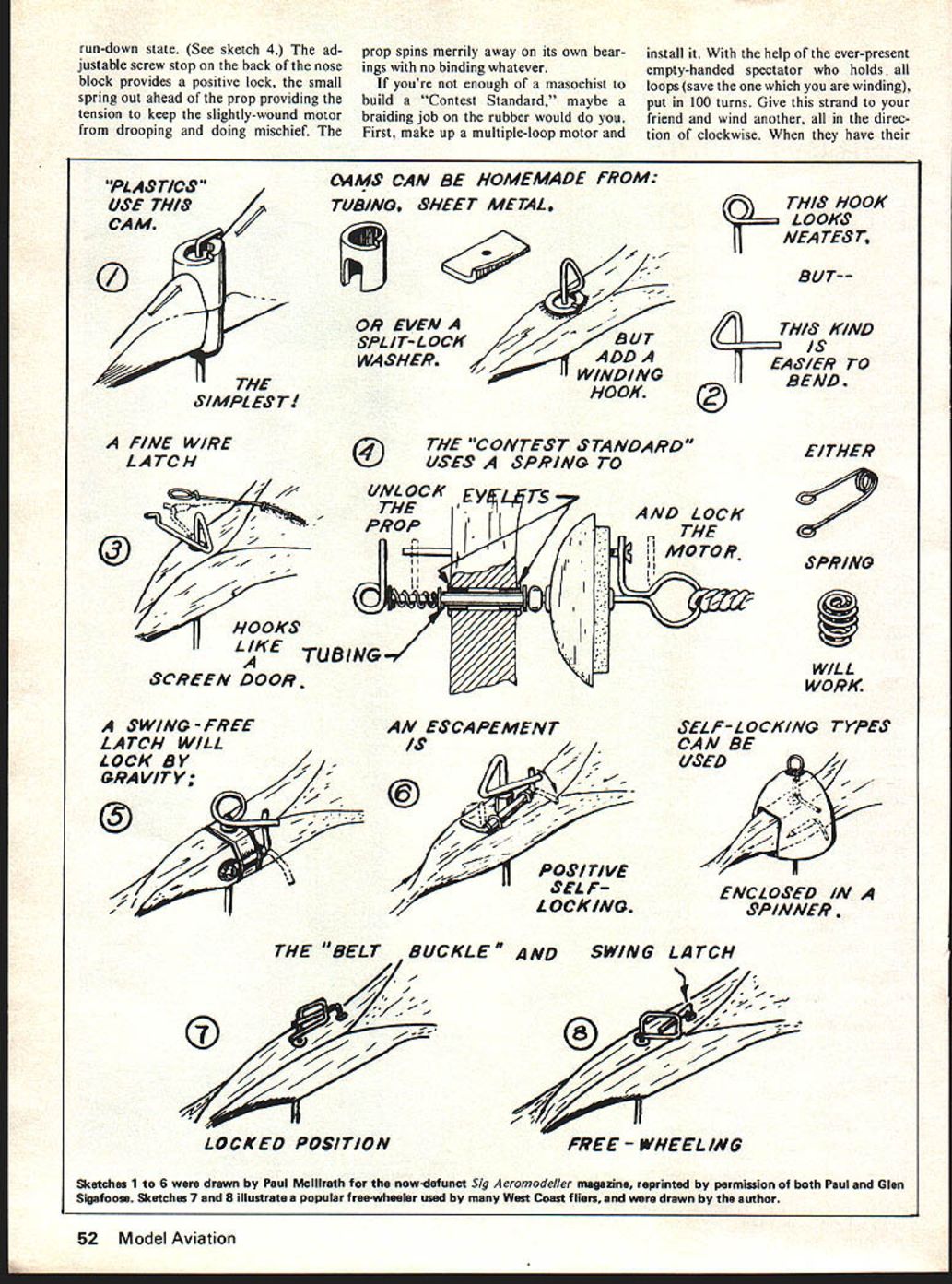
This month's thermal-worthy airplane is the Zero with which "Iron Mike" Midkiff did five minutes and a mile cross-country in a relatively windy thermal. The ship was an R. Peck design with an 18" wingspan, a 7½ x 16" pitch prop, two loops of 1/8" rubber 22" long, and a weight of just over an ounce (minus the motor). Mike built it with landing gear down, which seemed to actually help performance! The windier it got, the better the plane flew. A large amount of down and right thrust was needed due to the short nose. The only way the plane would fly was left-left. Have you had a scale job which proved thermal-worthy? If so, send me the vital statistics to share with others who are just dying to lose models!
Free-wheeling props
One of the secrets of a plane which will thermal is a good free-wheeling prop. "Iron Mike" has this to say about it:
"A large, high-pitch prop is extremely efficient in providing thrust spread over a long unwinding period and is a real must for any duration, but when it comes to the glide portion of the flight, that prop is a real 'drag.' There is no way that an acceptable glide can be achieved without either folding the blades back or free-wheeling that prop. There is something satisfying about seeing the prop turning all the time as opposed to the blades folded against the cowl."
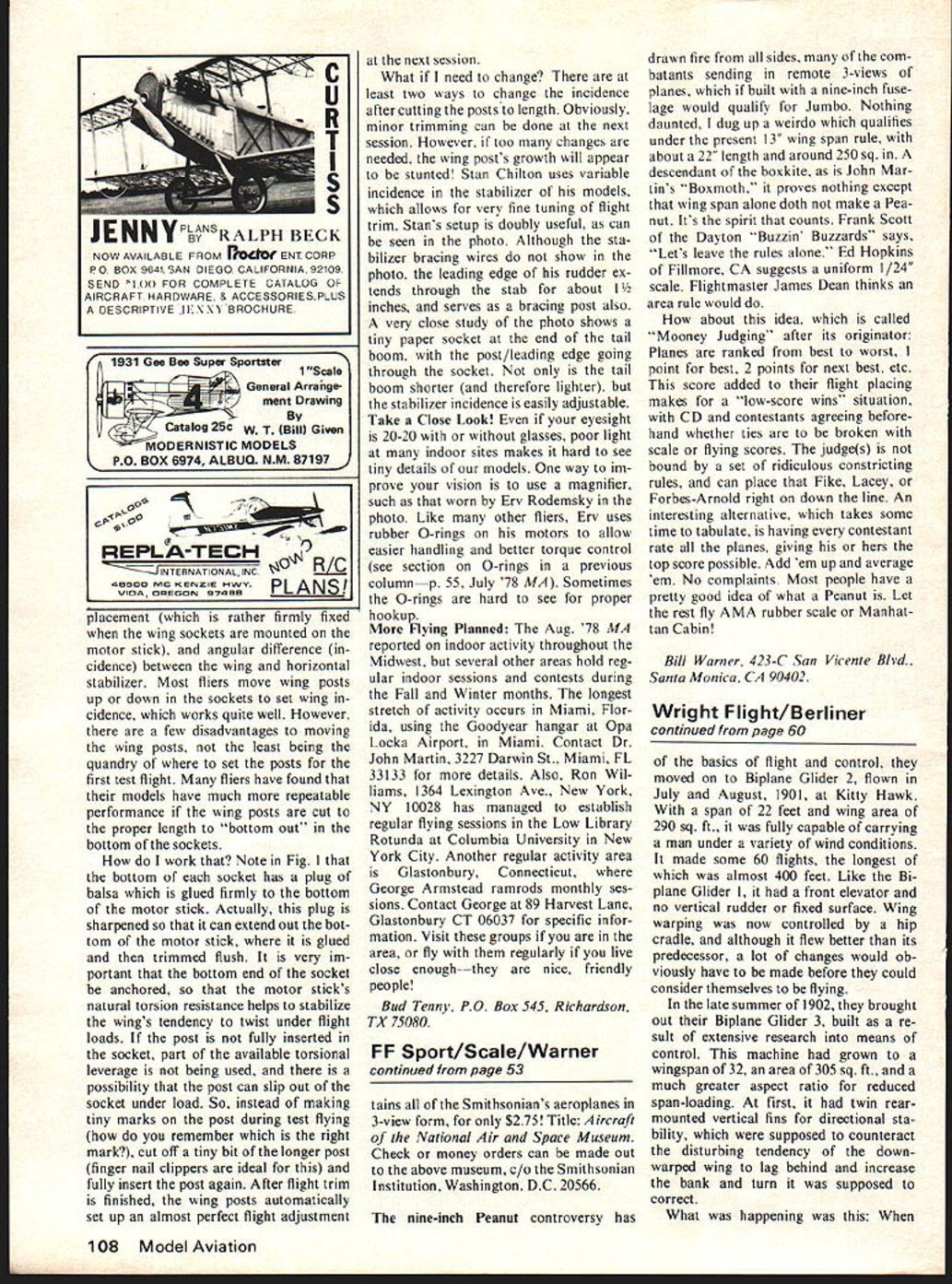
Some free-wheelers are very simple, like a small lock-washer epoxied to the prop (sketch 2). Some can be rather elaborate with a spring-tensioning device with a tube bearing-sleeve which allows frictionless free-wheeling even with rubber tension left. A free-wheeling device must be strong enough to withstand a fully-wound motor and at the same time allow the prop to spin easily in the glide. Bench-wind a motor with the prop and nose-block assembly and check its operation before you fly. There is nothing more frustrating than a jammed free-wheeler 200 feet in the air putting your model into a steep spiral!
Mike acknowledges that just the free-wheeler may not be enough to solve the glide problem, and that braiding the motor may be needed. As you probably know, rubber motors have a nasty tendency to bunch up as they run down if you use the extra-long variety, always on the floor and usually in the tail of your model. A couple of ways around this C.G.-changing, glide-ruining phenomenon is to use a device which stops the motor before it gets to the escapement tube in the run-down state (see sketch 4). The adjustable screw stop on the back of the nose block provides a positive lock, the small spring out ahead of the prop providing the tension to keep the slightly-wound motor from drooping and doing mischief. The prop spins merrily away on its own bearings with no binding whatever.
Braiding the motor
If you're not enough of a masochist to build a "Contest Standard," maybe a braiding job on the rubber would do you. Braiding makes the motor less prone to bunching and reduces end-tension so the prop can free-wheel during the glide.
- Make up a multiple-loop motor and install it.
- With the help of a spectator who holds all loops (save the one you are winding), put in 100 turns on one strand.
- Give this strand to your friend and wind another strand, all in the same direction (clockwise).
- When both have their loops, wind the strands together so the winds gather upon themselves.
- Gather the loose ends onto the winder and wind together in the opposite direction.
- Wind the motor into the model instead of letting the model hang.
Notes:
- If the motor binds you may have to rebraid or let out a few winds.
- Braiding tends to reduce end-tension so the prop spins fine, but it also allows bunches or knots to form at the rear; the plane may need added turns to the loop to pull up.
- Braided motors are especially effective on planes that have the undesirable feature of having the rubber motor behind the wing. Front builders move the peg forward to get the rubber weight and the CG correct—usually about one-third of the way back from the leading edge.
Escapements and locking devices
I have used the escapement type shown in sketch 6 for many years and find it quite easy and foolproof. I prefer to bind the escapement tube with thread and then epoxy it. I have noticed that many West Coast fliers use the "belt buckle" locking device shown in sketches 7 and 8. Seems to do the job. The swing-latch should be just far enough out on the blade to clear the "buckle" part of the prop shaft. The length of the latch should just take it past the prop shaft where it enters the hub.
Recommended reading
Bob Peck recommends a book which contains all of the Smithsonian's aeroplanes in 3-view form, for only $2.75! Title: Aircraft of the National Air and Space Museum. Checks or money orders can be made out to the above museum, c/o the Smithsonian Institution, Washington, D.C. 20566.
The nine-inch Peanut controversy
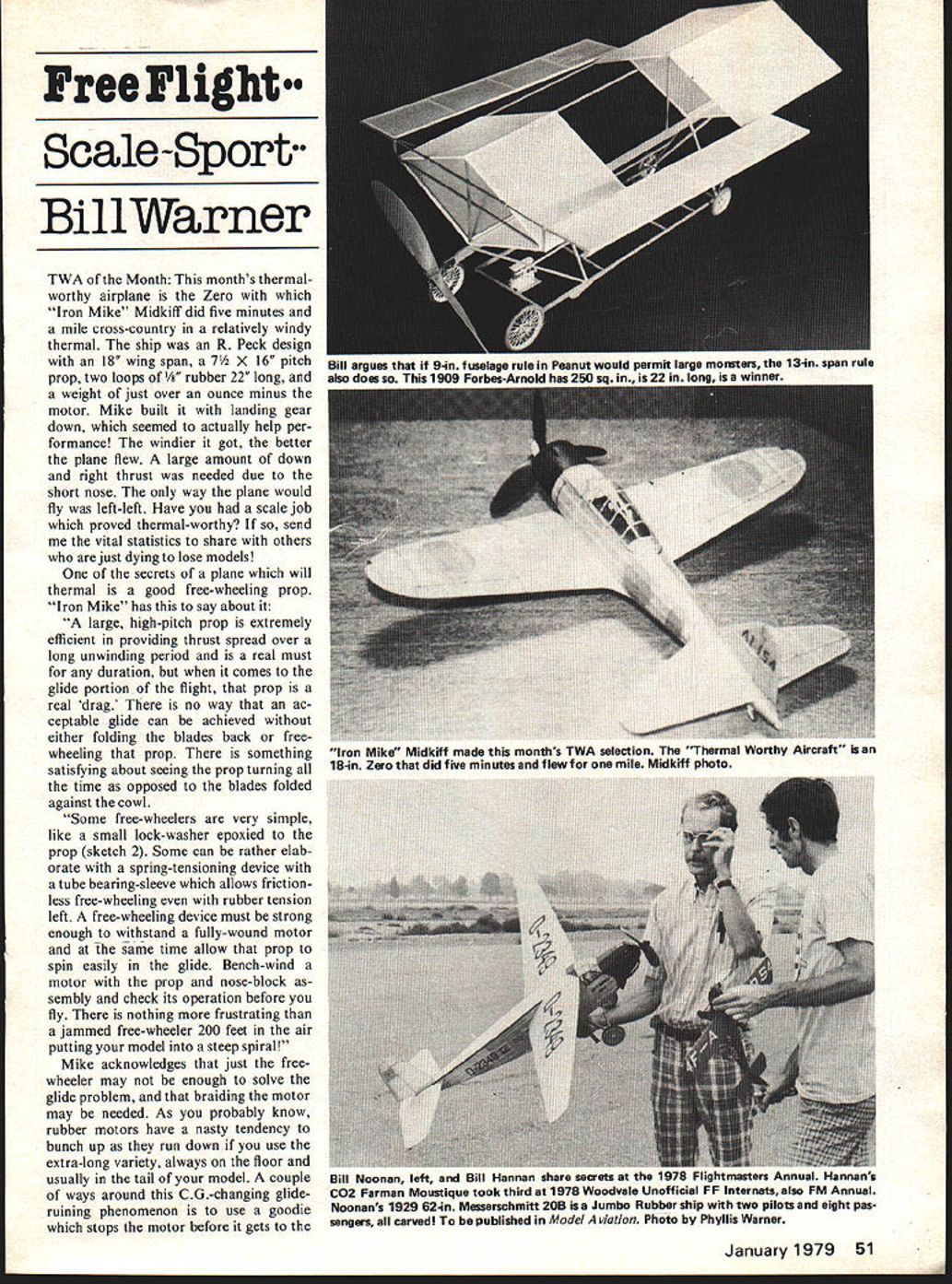
The nine-inch Peanut controversy has drawn fire from all sides, many of the combatants sending in remote 3-views of planes which, if built with a nine-inch fuselage, would qualify for Jumbo. Nothing daunted, I dug up a weirdo which qualifies under the present 13" wingspan rule, with about a 22" length and around 250 sq. in. A descendant of the boxkite, as is John Martin's "Boxmoth," it proves nothing except that wingspan alone does not make a Peanut. It's the spirit that counts.
Opinions:
- Frank Scott of the Dayton "Buzzin' Buzzards" says, "Let's leave the rules alone."
- Ed Hopkins of Fillmore, CA suggests a uniform 1/24 scale.
- Flightmaster James Dean thinks an area rule would do.
Mooney Judging (an alternative)
How about this idea, called "Mooney Judging" after its originator:
- Planes are ranked from best to worst by the judge(s): 1 point for best, 2 points for next best, etc.
- This score, added to their flight placing, makes for a "low-score wins" situation.
- The CD and contestants agree beforehand whether ties are to be broken with scale or flying scores.
- The judge(s) are not bound by a set of restrictive rules and can place designs in a sensible order.
An interesting alternative, which takes more time to tabulate, is having every contestant rate all the planes, giving his or her top score possible. Add them up and average them. No complaints. Most people have a pretty good idea of what a Peanut is. Let the rest fly AMA rubber scale or Manhattan Cabin!
Bill Warner 423-C San Vicente Blvd. Santa Monica, CA 90402
Transcribed from original scans by AI. Minor OCR errors may remain.

