
Free Flight: Scale Sport
Bill Warner
Georgia's Special
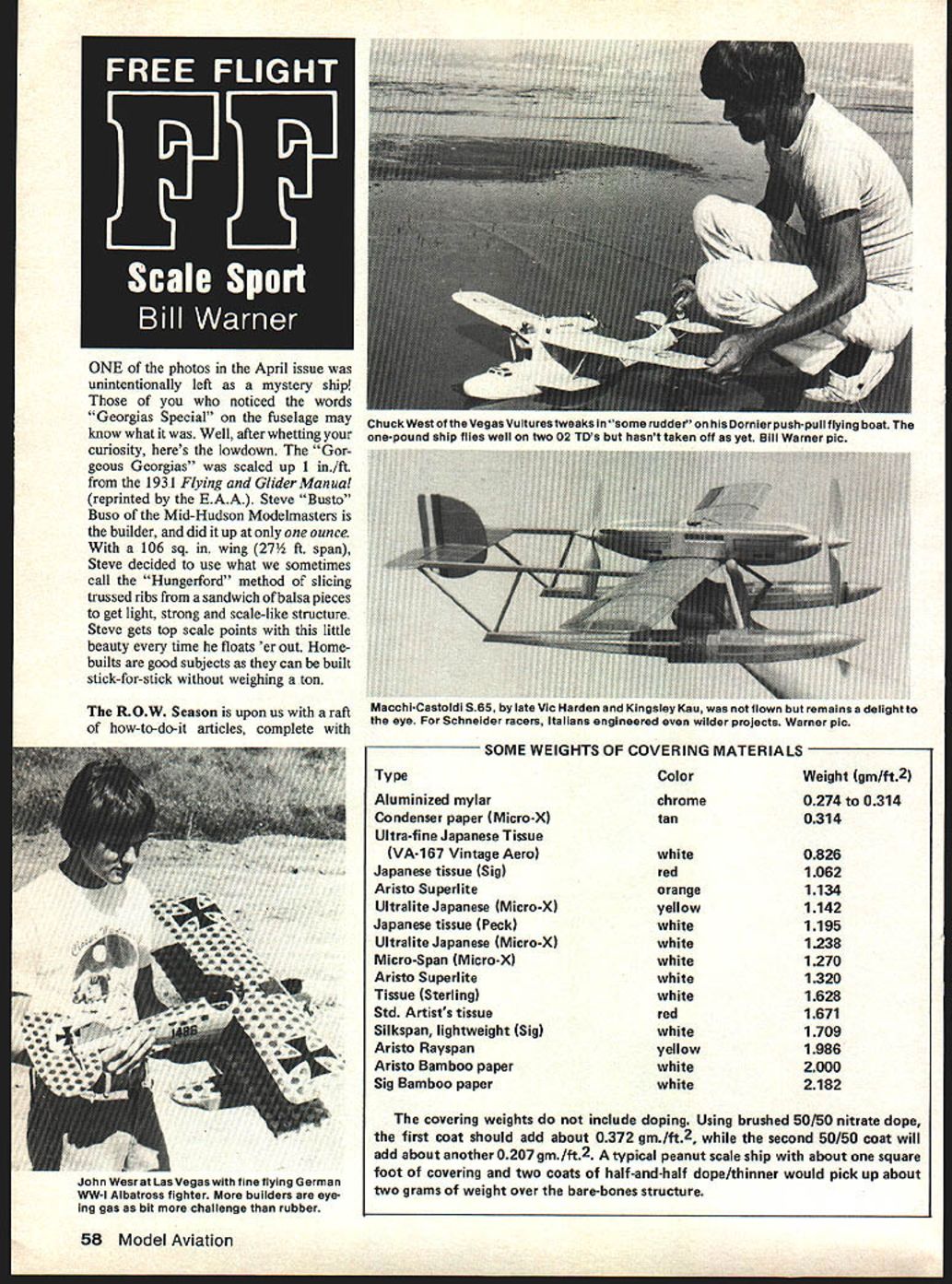
One of the photos in the April issue was unintentionally left as a mystery ship. Those of you who noticed the words "Georgia's Special" on the fuselage may know what it was. Well, after whetting your curiosity, here's the lowdown. The "Gorgeous Georgias" was scaled up 1 in./ft. from the 1931 Flying and Glider Manual (reprinted by the E.A.A.). Steve "Busto" Buso of the Mid-Hudson Modelmasters is the builder, and he did it up at only one ounce. With a 106 sq. in. wing (27½ in. span), Steve decided to use what we sometimes call the "Hungerford" method of slicing trussed ribs from a sandwich of balsa pieces to get light, strong and scale-like structure. Steve gets top scale points with this little beauty every time he floats 'er out. Homebuilts are good subjects as they can be built stick-for-stick without weighing a ton.
The R.O.W. season is upon us with a raft of how-to-do-it articles, complete with...
Some weights of covering materials
- Type: Aluminized mylar — Color: chrome — Weight (gm/ft.2): 0.274 to 0.314
- Type: Condenser paper (Micro-X) — Color: tan — Weight (gm/ft.2): 0.314
- Type: Ultra-fine Japanese Tissue (VA-167 Vintage Aero) — Color: white — Weight (gm/ft.2): 0.826
- Type: Japanese tissue (Sig) — Color: red — Weight (gm/ft.2): 1.062
- Type: Aristo Superlite — Color: orange — Weight (gm/ft.2): 1.134
- Type: Ultralite Japanese (Micro-X) — Color: yellow — Weight (gm/ft.2): 1.142
- Type: Japanese tissue (Peck) — Color: white — Weight (gm/ft.2): 1.195
- Type: Ultralite Japanese (Micro-X) — Color: white — Weight (gm/ft.2): 1.238
- Type: Micro-Span (Micro-X) — Color: white — Weight (gm/ft.2): 1.270
- Type: Aristo Superlite — Color: white — Weight (gm/ft.2): 1.320
- Type: Tissue (Sterling) — Color: white — Weight (gm/ft.2): 1.628
- Type: Std. Artist's tissue — Color: red — Weight (gm/ft.2): 1.671
- Type: Silkspan, lightweight (Sig) — Color: white — Weight (gm/ft.2): 1.709
- Type: Aristo Rayspan — Color: yellow — Weight (gm/ft.2): 1.986
- Type: Aristo Bamboo paper — Color: white — Weight (gm/ft.2): 2.000
- Type: Sig Bamboo paper — Color: white — Weight (gm/ft.2): 2.182
The covering weights do not include doping. Using brushed 50/50 nitrate dope, the first coat should add about 0.372 gm./ft.2, while the second 50/50 coat will add about another 0.207 gm./ft.2. A typical peanut-scale ship with about one square foot of covering and two coats of half-and-half dope/thinner would pick up about two grams of weight over the bare-bones structure.
Mathematical formulas
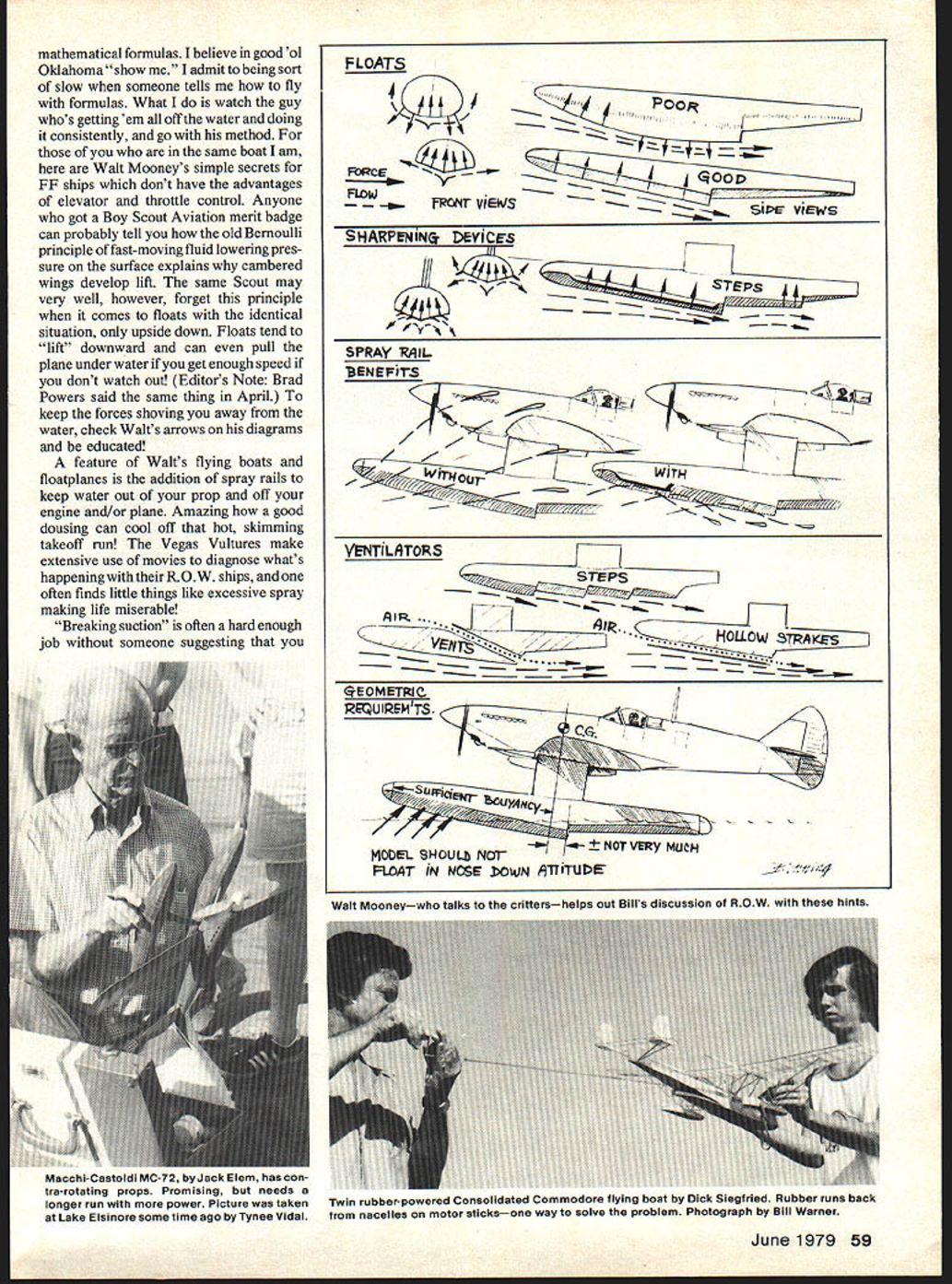
I believe in good ol' Oklahoma "show me." I admit to being sort of slow when someone tells me how to fly with formulas. What I do is watch the guy who's getting 'em all off the water and doing it consistently, and go with his method. For those of you who are in the same boat I am, here are Walt Mooney's simple secrets for free-flight ships that don't have the advantages of elevator and throttle control.
Anyone who got a Boy Scout Aviation merit badge can probably tell you how the old Bernoulli principle of fast-moving fluid lowering pressure on the surface explains why cambered wings develop lift. The same Scout may very well, however, forget this principle when it comes to floats with the identical situation, only upside down. Floats tend to "lift" downward and can even pull the plane under water if you get enough speed unless you watch out! (Editor's Note: Brad Powers said the same thing in April.) To keep the forces shoving you away from the water, check Walt's arrows on his diagrams and be educated!
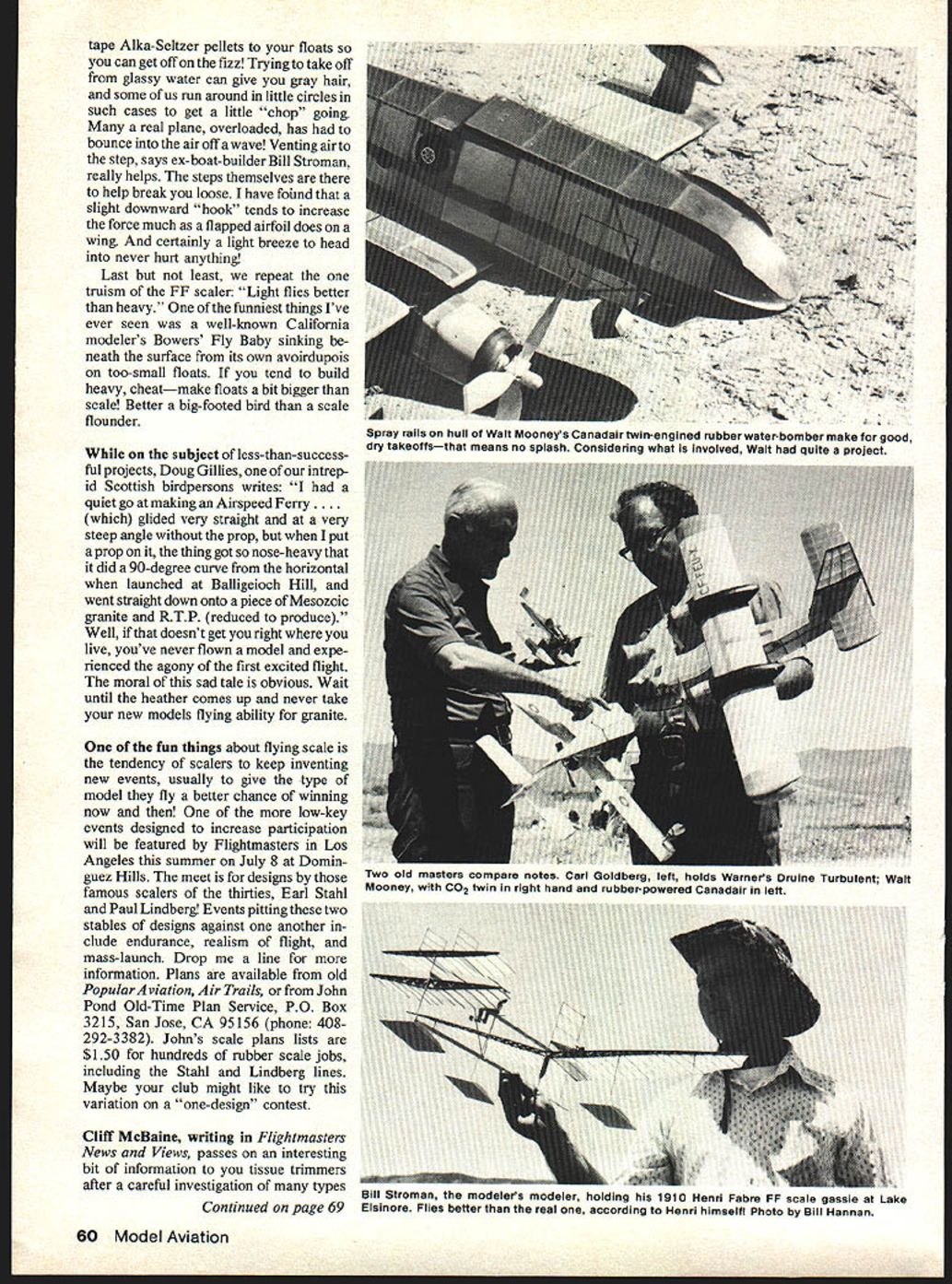
A feature of Walt's flying boats and floatplanes is the addition of spray rails to keep water out of your prop and off your engine and/or plane. Amazing how a good dousing can cool off that hot, skimming takeoff run! The Vegas Vultures make extensive use of movies to diagnose what's happening with their R.O.W. ships, and one often finds little things like excessive spray making life miserable.
"Breaking suction" is often a hard enough job without someone suggesting that you tape Alka-Seltzer pellets to your floats so you can get off on the fizz! Trying to take off from glassy water can give you gray hair, and some of us run around in little circles in such cases to get a little "chop" going. Many a real plane, overloaded, has had to bounce into the air off a wave! Venting air to the step, says ex-boat-builder Bill Stroman, really helps. The steps themselves are there to help break you loose. I have found that a slight downward "hook" tends to increase the force much as a flapped airfoil does on a wing. And certainly a light breeze to head into never hurt anything!
Last but not least, we repeat the one truism of the free-flight scaler: "Light flies better than heavy." One of the funniest things I've ever seen was a well-known California modeler's Bowers' Fly Baby sinking beneath the surface from its own avoirdupois on too-small floats. If you tend to build heavy, cheat—make floats a bit bigger than scale! Better a big-footed bird than a scale flounder.
While on the subject of less-than-successful projects, Doug Gillies, one of our intrepid Scottish birdpersons, writes: "I had a quiet go at making an Airspeed Ferry . . . (which) glided very straight and at a very steep angle without the prop, but when I put a prop on it, the thing got so nose-heavy that it did a 90-degree curve from the horizontal when launched at Balligeoch Hill, and went straight down onto a piece of Mesozoic granite and R.T.P. (reduced to produce)." Well, if that doesn't get you right where you live, you've never flown a model and experienced the agony of the first excited flight. The moral of this sad tale is obvious: wait until the heather comes up and never take your new model's flying ability for granite.
One-design and Flightmasters meet
One of the fun things about flying scale is the tendency of scalers to keep inventing new events, usually to give the type of model they fly a better chance of winning now and then! One of the more low-key events designed to increase participation will be featured by Flightmasters in Los Angeles this summer on July 8 at Dominguez Hills. The meet is for designs by those famous scalers of the thirties, Earl Stahl and Paul Lindberg! Events pitting these two stables of designs against one another include endurance, realism of flight, and mass-launch. Drop me a line for more information. Plans are available from Popular Aviation, Air Trails, or from John Pond Old-Time Plan Service, P.O. Box 3215, San Jose, CA 95156 (phone: 408-292-3382). John's scale plans lists are $1.50 for hundreds of rubber scale jobs, including the Stahl and Lindberg lines. Maybe your club might like to try this variation on a "one-design" contest.
Tissue weight findings
Cliff McBaine, writing in Flightmasters News and Views, passes on an interesting bit of information to you tissue trimmers after a careful investigation of many types of tissue weights done on an analytical chemical balance scale with an accuracy of 0.001 grams, using 11 sq. ft. samples. Amazingly, Cliff found that within a line of tissue colors from three suppliers, white was heavier than colored! In the Peck tissue, it was 4% heavier; Micro-X Ultralite was 8.4% heavier; and Aristo Superlite 16.4% heavier. And all along we've been on the assumption that white was lighter. Another myth exploded!
Cliff's findings, now two years old, are included as an indication of how weights of covering materials may vary, and not necessarily what any supplier's tissue may weigh at this time (see chart).
Well, gang, send in those Thermal-Worthy-Aircraft pix and specs; this month's prize goes a-begging!
Fifth Annual National Capital Indoor Rubber Scale Contest
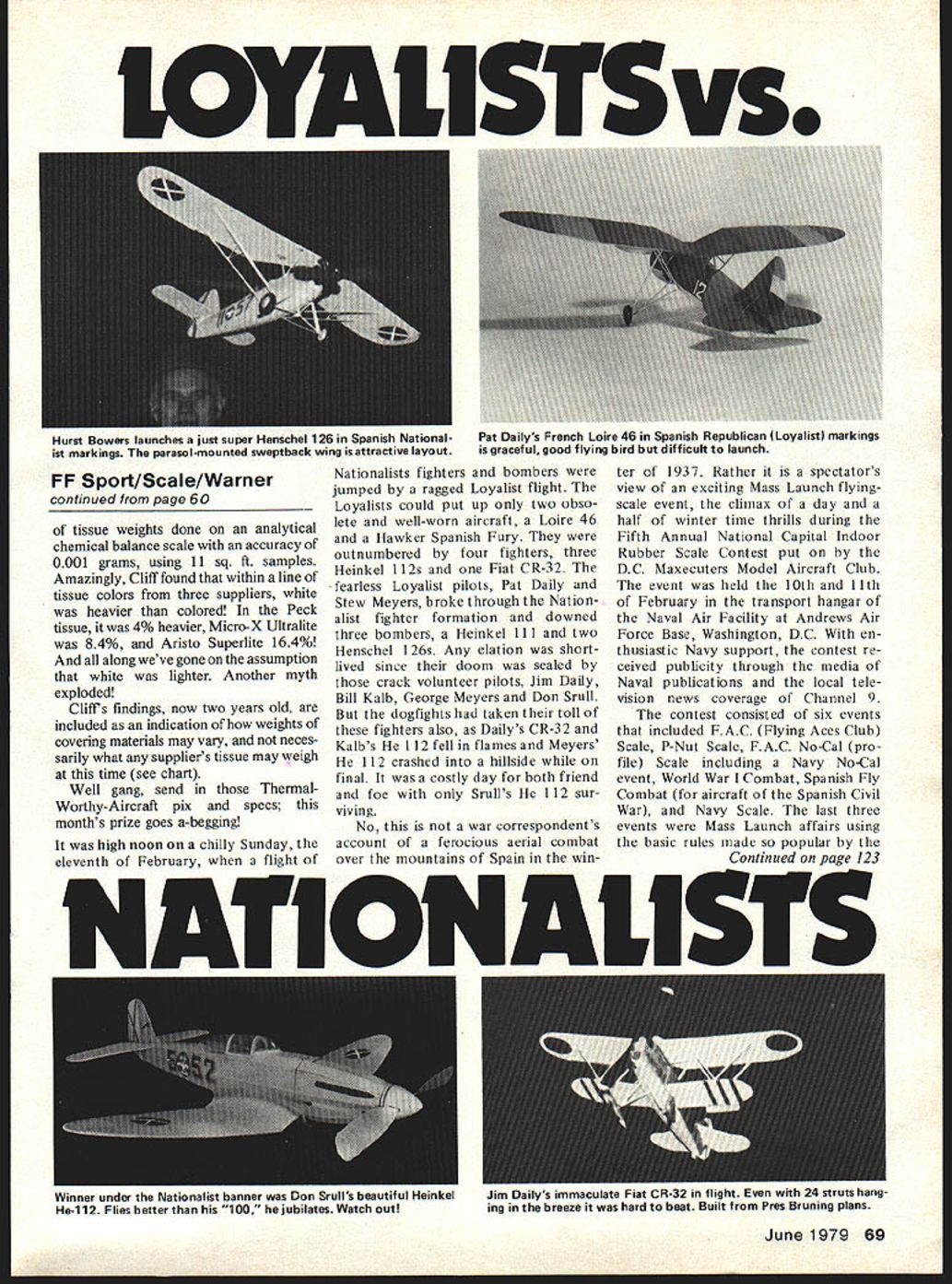
It was high noon on a chilly Sunday, the eleventh of February, when a flight of Nationalist fighters and bombers were jumped by a ragged Loyalist flight. The Loyalists could put up only two obsolete and well-worn aircraft, a Loire 46 and a Hawker Spanish Fury. They were outnumbered by four fighters, three Heinkel 112s and one Fiat CR-32. The fearless Loyalist pilots, Pat Daily and Stew Meyers, broke through the Nationalist fighter formation and downed three bombers, a Heinkel 111 and two Henschel 126s. Any elation was short-lived since their doom was sealed by those crack volunteer pilots, Jim Daily, Bill Kalb, George Meyers and Don Srull. But the dogfights had taken their toll of these fighters also, as Daily's CR-32 and Kalb's He 112 fell in flames and Meyers' He 112 crashed into a hillside while on final. It was a costly day for both friend and foe with only Srull's He 112 surviving.
No, this is not a war correspondent's account of a ferocious aerial combat over the mountains of Spain in the winter of 1937. Rather it is a spectator's view of an exciting Mass Launch flying-scale event, the climax of a day and a half of wintertime thrills during the Fifth Annual National Capital Indoor Rubber Scale Contest put on by the D.C. Maxecuters Model Aircraft Club. The event was held the 10th and 11th of February in the transport hangar of the Naval Air Facility at Andrews Air Force Base, Washington, D.C. With enthusiastic Navy support, the contest received publicity through the media of Naval publications and the local television news coverage of Channel 9.
The contest consisted of six events that included F.A.C. (Flying Aces Club) Scale, P-Nut Scale, F.A.C. No-Cal (profile) Scale including a Navy No-Cal event, World War I Combat, Spanish Civil Combat (for aircraft of the Spanish Civil War), and Navy Scale. The last three events were Mass Launch affairs using the basic rules made so popular by the F.A.C. Thompson Trophy Races, where several planes are launched at one time, the first plane down being eliminated. This is repeated over and over until only one plane, the winner, remains.
In the past, this mid-winter contest has attracted contestants from as far as Connecticut, Missouri and Philadelphia. This year was no exception, with a hardy group of F.A.C.ers journeying from Philadelphia and other points outside the Washington metropolitan area. Some 94 aircraft were entered in the many events by 29 modelers, including several juniors. Both of the new events added this year, Navy Scale and Spanish Fly Combat, were popular.
Navy Scale was interesting because of the variety of aircraft. Designs covered the spectrum from the earliest days of Naval Aviation history, represented by the Cox Submarine Scout, to World War II, represented by Navy Scale winner Les King's Grumman Bearcat. To see nine colorful Navy jobs all cruising around at the same time is almost too much to take!
P-Nut Scale attracted the largest turnout with 21 entries. Dave Rees picked up a well-deserved first place with an immaculate Corona Cougar. Junior P-Nut saw seven entries, with Greg Leffler winning first with a Luton Major.
F.A.C. Scale produced 17 aircraft. Allan Schanze's pretty Tiger Moth (a Hi-Flyer kit) was tops with 56 of a possible 62 points. The F.A.C. bonus point system for unusual designs proved to be Allan's undoing since two low-wing canard pushers, Don Srull's Shinden and George Meyers' Vari-Viggen, received 40 points each for bonuses. Since both topped 30 seconds easily in the cold hangar, one questions the wisdom of too many bonus points. Don Srull won first by only one point. Junior F.A.C. Scale produced a two-way tie for first between Brian Gerstenberg and Mike Escalante.
World War I Combat produced 10 entries ranging from Pat Daily's Rumpler C.IV to Steve Meyers' Fokker EIII. The final was a rematch of last year's finalists, with Don Srull's DH-6 pitted against George Meyers' Siemens Monoplane. This year it was George's turn to win.
No-Cal and other event winners and full placings were reported at the meet; overall, the contest drew enthusiastic participation and made good use of the hangar venue and Navy cooperation.
Photographing Dulles Airport with Snapshot II
I have often thought of photographing Dulles Airport because of its attractive buildings. In an effort to get close to Dulles, I cleared the view with the tower to fly at Hutchinson Elementary School, which was about one mile from the Dulles property and at the regular approach pattern.
After seeing the finished slides I called Dulles and thanked them for their cooperation. I mentioned my interest in flying at the airport and asked if it would be possible. Then tower personnel asked a few questions about the model and myself and suggested that if Safety & Operations agreed to the flights, the tower would clear me during their slowest part of the day, between 9 a.m. and noon.
I then spoke with Hugh Gudger in Safety & Operations who had many more questions about the project. Hugh agreed to the flights and instructed me to call in each morning to see if their schedule would be clear. There were other activities to wait on such as a movie being filmed on Thursday. When I called operations on Friday, Hank Cloudier was on duty and Hank asked if I would like to come out on Saturday. Now you know rain clouds just wait around for Saturdays, and I also wanted to fly when there was less chance of someone flying at one of the nearby school yards. Hank understood my anxiety to fly and invited me to come on out. It did rain that Saturday, but everything was packed and ready.
Ron Zuehl, who is an amateur photographer, was leaving for work when he saw me loading the car. I told him the Dulles flight was just approved and I had tried to get in touch with him earlier to have him photograph the event. His face looked as if he had been let out of Christmas. By the time I had finished packing, he was there with his camera equipment and the day off.
At the Dulles Safety & Operations office I presented my material on Snapshot II and what I had planned for the best shots of the area. Hank selected the location I was hoping for, the heliport which was about 1,000 feet from the tower. After checking the wind direction we were on our way. As we were driving down the access strip to the heliport, I was trying to ignore the butterflies in my stomach. Dawn and I set up the equipment and followed the checklist prepared earlier. The checklist may sound like I was playing airline pilot but I knew I would be in shock and probably forget something. The tower cleared us for the first takeoff through the radio in the car Hank was driving. The car had speakers in the grill so anything the tower wanted to say to me didn't have to go through anyone else.
As Snapshot II climbed smoothly into the air from a realistic takeoff I began to watch the aircraft in relation to the position of the tower and to the ground point we had established for reference. On the first flight I ended up with a hole in the wing when the aircraft snapped off from a high spot over the heliport. I concluded that the fuel mixture was a little rich and leaned it for the next few flights. The tower cleared me for a second flight and all went well. The pilot on the helicopter was friendly and waved as he flew by.
I had asked for the time, frame count, and sun coverage information, and the reply was: six minutes, 18 frames, and sun in 30 seconds. A little boy about four years old turned to a young friend and said in an excited voice, "She knows everything, she even knows when the sun will shine."
The first flight netted only four frames but we completed the roll on the second flight after adjusting the film-advance servo.
Transcribed from original scans by AI. Minor OCR errors may remain.

