

Free Flight: Scale Sport
Bill Warner
Superscale and the joy of flying scale models
SUPERSCALE always draws a crowd at the judging table and on the flying ground. Finely done structure and loads of detail are magnificent to see, and many modelers love to make models of this type. The joy of seeing a model in the air doing what it was originally designed to do is one of the most outstanding artistic experiences. A good friend of mine, when asked his opinion on enlarging the "stand-off" scale judging circle, replied, "Why don't you guys just build better models?"
How "scale" a model is will always be a matter of personal taste and reflects the builder's abilities and mental image of what the plane should be when it is finished. Someone like Bill Caldwell, flying thousands of flights by himself out in the middle of Texas, is not going to make the same model as someone who wants the glory of being a NATS trophy winner. The model will be done a lot differently. As there is really no upper limit to the superscale ship—which could in theory be constructed of aluminum, have all working instruments, retracts, etc.—the real question facing scale builders is how non-scale one can go and still remain in the category.
Perhaps it's in order to re-evaluate now and then whether it is more important to equal or surpass our last scale job each time we build a new one. Some guys feel diminished if they make a semi-scale plane after their superscale trophy winner got so many compliments. That's a shame, because the work-to-fun ratio can be very high on a simple ship. If all you do is make ships designed to win contests or impress people with the amount of detail you can hang on, you may miss a lot of great time in the air! You can have a creative burst that leads you to find things that are good and worthwhile in any scale job, even if it's stretched a ways.
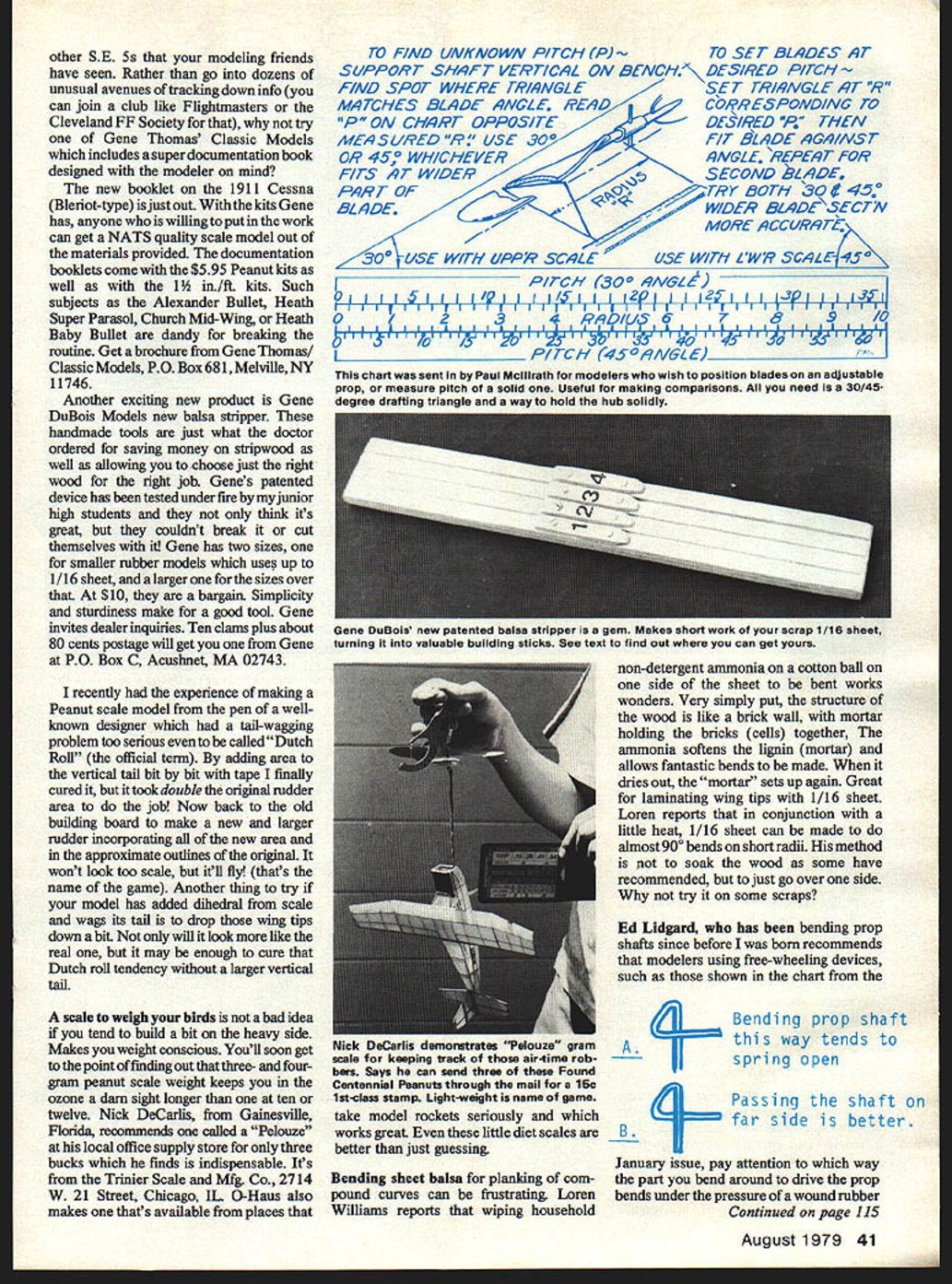
Sherman Gillespie's Ideal "Bleriot" is not what most would call an Easy Bee. Perhaps we should all make something which stretches the lower limits of this great area called "scale" now and then, just to explore possibilities and relax! An "almost scale" job may not be our choice for the Flightmasters Annual, but you can have a lot of fun chasing it through the buttercups on a sunny Sunday morning.
Documentation and unusual subjects
For the modeler new to serious scale, finding adequate documentation can be a problem. Tons of material exist on Hawker Hurricanes, P-51s, Piper Cubs, and other overdone subjects, but who wants to keep building what everyone else builds forever? After all, the builder of an S.E.5 always runs the risk of having his or her model compared to all the dozens of other S.E.5s that your modeling friends have seen.
Rather than go into dozens of unusual avenues of tracking down info (you can join a club like Flightmasters or the Cleveland FF Society for that), why not try one of Gene Thomas' Classic Models, which includes a super documentation book designed with the modeler in mind? The new booklet on the 1911 Cessna (Bleriot-type) is just out. With the kits Gene has, anyone willing to put in the work can get a NATS-quality scale model out of the materials provided. The documentation booklets come with the $5.95 Peanut kits as well as with the 1-1/2 in./ft. kits. Subjects such as the Alexander Bullet, Heath Super Parasol, Church Mid-Wing, or Heath Baby Bullet are dandy for breaking the routine. Get a brochure from Gene Thomas / Classic Models, P.O. Box 681, Melville, NY 11746.
Tools and new products
Another exciting new product is Gene DuBois Models' new balsa stripper. These handmade tools are just what the doctor ordered for saving money on stripwood as well as allowing you to choose just the right wood for the right job. Gene's patented device has been tested under fire by my junior high students: they not only think it's great, but they couldn't break it or cut themselves with it! Gene has two sizes—one for smaller rubber models which uses up to 1/16" sheet, and a larger one for sizes over that. At $10, they are a bargain. Simplicity and sturdiness make for a good tool. Gene invites dealer inquiries. Ten dollars plus about 80 cents postage will get you one from Gene at P.O. Box C, Acushnet, MA 02743.
Flight trimming and rudder/dihedral fixes
I recently made a Peanut scale model from the pen of a well-known designer that had a tail-wagging problem too serious to be called "Dutch roll" (the official term). By adding area to the vertical tail bit by bit with tape I finally cured it, but it took double the original rudder area to do the job! Back to the old building board to make a new and larger rudder incorporating all of the new area and in the approximate outlines of the original. It won't look too scale, but it will fly! (That's the name of the game.)
Another thing to try if your model has added dihedral from scale and wags its tail is to drop the wing tips down a bit. Not only will it look more like the real one, but it may be enough to cure that Dutch roll tendency without enlarging the vertical tail.
Weighing your models
A scale to weigh your birds is not a bad idea if you tend to build on the heavy side. It makes you weight-conscious. You'll soon find that a three- or four-gram peanut-scale weight keeps you in the ozone a darn sight longer than one at ten or twelve grams. Nick DeCarlis, from Gainesville, Florida, recommends a scale called a "Pelouze" at his local office supply store for only three bucks; he finds it indispensable. It's from the Triner Scale and Mfg. Co., 2714 W. 21st Street, Chicago, IL. Ohaus also makes one that's available from places that sell scales.
Bending sheet balsa
Bending sheet balsa for planking compound curves can be frustrating. Loren Williams reports that wiping household non-detergent ammonia on a cotton ball and rubbing one side of the sheet to be bent works wonders. Very simply put, the structure of the wood is like a brick wall, with mortar holding the bricks (cells) together. The ammonia softens the lignin (the "mortar") and allows fantastic bends to be made. When it dries out, the "mortar" sets up again. Great for laminating wing tips with 1/16" sheet. Loren reports that in conjunction with a little heat, 1/16" sheet can be made to do almost 90° bends on short radii. His method is not to soak the wood as some have recommended, but to just go over one side. Try it on some scraps first.
Prop-shaft bending and free-wheeling devices
Ed Lidgard, who has been bending prop shafts since before I was born, recommends that modelers using free-wheeling devices pay attention to which way the bent part will be forced under the pressure of a wound rubber motor. The bend should be on the side of the shaft facing the driven part so that it will bend back toward the central prop shaft, not away from it. This is not too important with large-diameter wire or light motors, but it can become important. Ed's right—I have had to do some quick thread wrapping at the flying site myself as payment for not considering this.
Thermal-worthy aircraft: Rearwin Speedsters
Thermal-worthy aircraft are Rearwin Speedsters! Having seen Ken Sykora do over seven minutes with his Earl Stahl Speedster and Bob Oslan win at Taft with consistent over-two-minute flights, I cannot recommend this little beauty too highly. John Pond, P.O. Box 3215, 1722 Junction, Bldg. "D," San Jose, CA 95156, lists no fewer than 24 Rearwin Speedster plans. A two-dollar bill to John will bring you the 27-inch span (20F-1) plan of the Stahl machine.
Thanks for the cards, letters, photos, and encouragement!
Editor's Note
What Bill says about the Speedster is understated. It is a superb subject with good looks, magnificent stability, and a force diagram that is just perfect. If one of Pond's 24 plans mentioned by Bill is for the Ed Naudzius Rearwin Speedster, buy it! At either the 1940 or 1941 Nats, this remarkable flier stopped the Nats with a glide that passed over the entire line of gas pits — a memorable picture. You can get an excellent kit for the Stahl Rearwin from Flyline for $8.95. We've seen it fly at "Shanghai La."
Bill Warner 423-C San Vicente Blvd. Santa Monica, CA 90402
Transcribed from original scans by AI. Minor OCR errors may remain.

