
Free Flight: Scale Sport
Bill Warner
SCALE 80 is the catchy little slogan of the Ottawa World Champs coming up next summer. A great deal of pressure is mounting for the inclusion of a FF scale event such as took place along with the 1978 Woodvale Internats. Although the principal site, adjacent to a "live" runway, precludes FF activity near the RC and UC area, other more "primitive" sites have been proposed. This should delight most FF scale modelers who usually prefer tall grass to asphalt, and who like the more relaxed atmosphere anyway.
Bill Hannan and Bob Underwood of the AMA's scale branch called A.S.A. (Association of Scale Aeromodellers — formerly known as N.A.S.A.) have been quite active in promoting the event. A.S.A. not only pushes scale from the competition point of view, but is deeply involved in making scale data more accessible. Jamie Gielens' compilation of scale sources went out to all members this year and made the $5.00 yearly membership fee seem well worth it. If you'd like to be a part of A.S.A., write to Bob Underwood, 4109 Concord Oaks Dr., St. Louis, MO 63128.
Gram-seconds for rubber-powered contests
If you make heavy models, then you will love "gram-seconds" for determining rubber-powered contest winners. Gram-seconds — the practice of multiplying a model's flight time by its weight in grams — was used to make a recent Flightmasters West "Beat Walt Mooney" Contest more interesting. The meet, open to any Walt Mooney design, was flown in a standard-size high school gym.
Four- and five-gram Peanuts, such as flown by Ken Johnson and Andy Faykun, may have been breaking the magic minute easily, but in the final analysis, Walt Mooney's reliable .01 Tiger turned its .32 flight into the winning time when it was multiplied by its 29-gram (the heaviest plane in the air) weight. The reasoning was that a plane has to be more efficient to do a respectable time with all that extra avoirdupois. It was refreshing to see a club have at least one event in which those of us who just can't build 'em like Easy Bees have a chance!
Using drag to your advantage
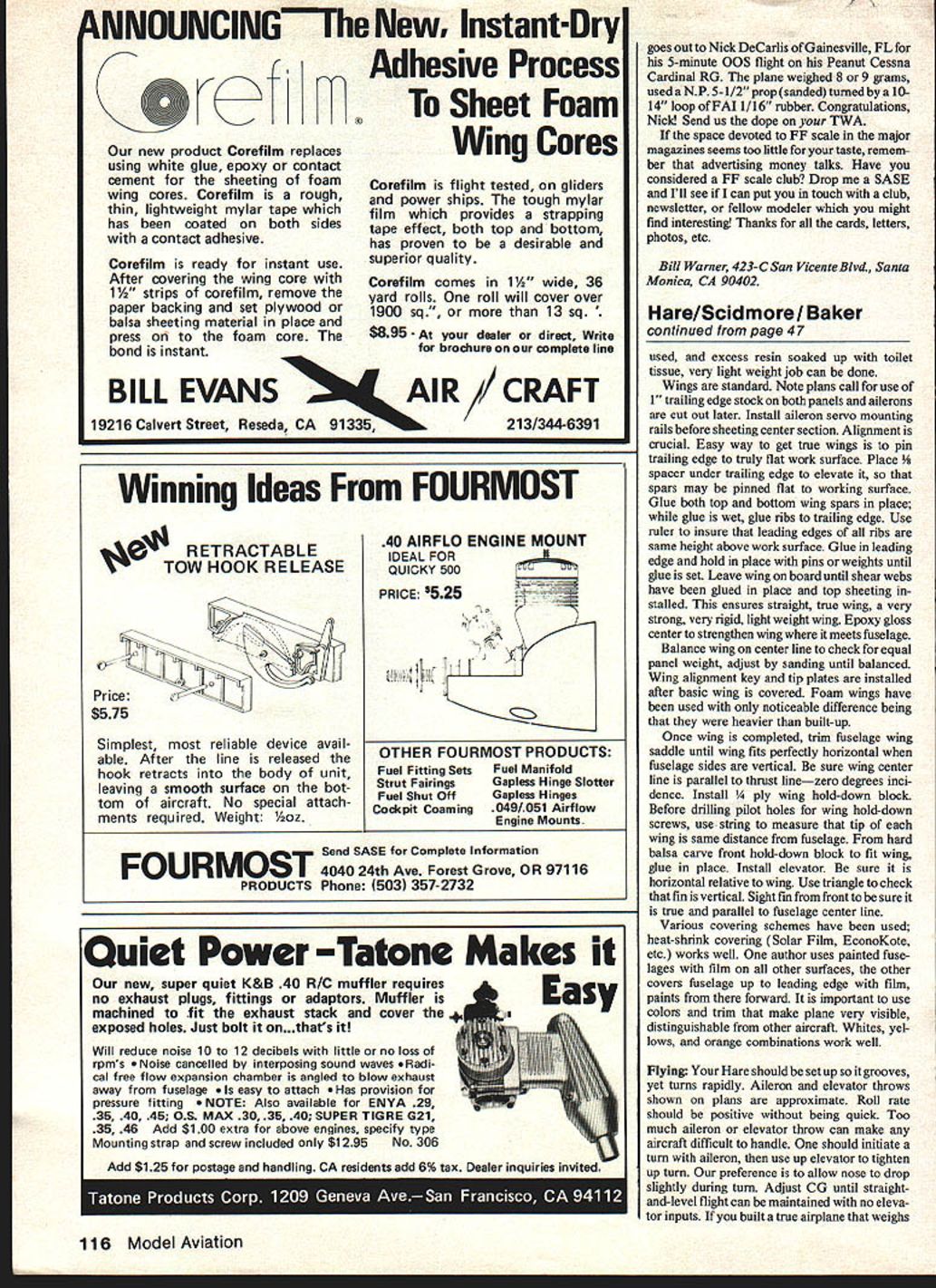
Let's talk about using drag to your advantage in trimming that recalcitrant scale job. Joe Tschirig's DFW Floh (flea) brought many guffaws and wisecracks when brought to a Flightmasters' meeting. Many scalers who have been spoiled by perfectly proportioned models tend to scoff at the unusual subject now and then. The ridiculously short tail moment of the DFW was bound to give trouble on R.O.G., and certainly the longitudinal and directional stability was going to prove hairy in the air, said some. Imagine the red faces when Joe's plane not only made a beautiful straight takeoff, but buzzed around the field for several minutes before returning to the strip for a perfect landing.
When the applause died away, Joe, an aeronautical engineer by trade, disclosed the secret — a 200-ft length of 2-lb monofilament attached to the tail. Played out during the takeoff from a spinning reel with slight tension held between thumb and forefinger, the line eliminated the ground-looping tendency. In the air, it acted like the tail of a kite and kept the Floh rock-steady. The line was completely invisible to spectators and did not harm the aesthetics of the flight in any way. This little trick may draw some fire from serious contest fliers, but it is certain to find supporters among the modelers who like to build weird subjects and have them fly to boot.
Dragging a string is nothing new. I remember a few years ago when Jim Adams was getting gray hair watching his diesel-powered Loening amphibian doing circle after circle on the water instead of using its speed for a liftoff. A couple of feet of string dragging behind the outside wing was enough to straighten out the takeoff run and had no great effect in the air. A simple solution to a vexing problem.
Drag tab tips
Adding a drag tab to a plane which resists your efforts to get it circling nicely also can often make your day. A 1 x 1/4 x 1/16" tab or "flap," glued along the trailing edge out near the wing tip with the 1/4" dimension 90 degrees to the airflow, will provide more than enough drag to pull that wing rearward and give you a fairly safe turn. It is fairly unobtrusive under the wing, and can be trimmed smaller and smaller until just the right diameter circles are obtained.
Planes trimmed into a circle with the drag tab seem to have less tendency to dive in or develop nasty tendencies which often accompany using rudder and thrust adjustments alone. A 1/16" sheet tab is much more reliable than sticking on paper or card "ailerons" which always seem to be moving. Remember, the face of the tab should be positioned so as to get the maximum push of the airflow rearward. Having it angled downward to increase the lift component may reduce its value. Use the "full-flap" position, near the tip, and end one wing only!
Getting a kid started — Peck-Polymers
Want to get a kid started in modeling the right way? Want to get all the stuff you need without the frustration of having your local hobby dealer give you a funny look when you ask for rubber accessories? I suggest that your $1.00 investment in a Peck-Polymers "Wish Book" will be the best buck you ever spent. Bob and Sandy Peck not only put out their own line of contest-winning kits, but handle hundreds of other items to make your modeling exciting. Whether it's Peanut plans from France, black Sleek-Streek wheels, 4-in. long diamond-loop prop shafts, Ansul CO2 bottles, nylon nose buttons, rubber and winders, or a Phineas Pinkham storybook, you can get it from P.P.
- Peanut plans from France
- Black Sleek-Streek wheels
- 4-in. long diamond-loop prop shafts
- Ansul CO2 bottles
- Nylon nose buttons
- Rubber and winders
- Phineas Pinkham storybook
Peck-Polymers: P.O. Box 2498, La Mesa, CA 92041.
Electric power — The Quiet Revolution
The definitive treatise on electric power so far has just been published by Bob Boucher of Astro Flight. No modeler should overlook this book. It takes the entire electric model-power area and makes it understandable at all levels. If you want smooth, relatively reliable, quiet power for your scale models, or perhaps just want a reasonable approach to multi-engined subjects, you should investigate electric. Entitled The Quiet Revolution, the book may be obtained from Astro Flight, 13377 Beach Blvd., Venice, CA 90291. $5.95 PP.
Congratulations — Nick DeCarlos
A tip of the hat goes out to Nick DeCarlos of Gainesville, FL for his 5-minute OOS flight on his Peanut Cessna Cardinal RG. The plane weighed 8 or 9 grams, used a N.P.-5-1/2" prop (sanded) turned by a 10–14" loop of FAI 1/16" rubber. Congratulations, Nick! Send us the dope on your TWA.
Closing / Contact
If the space devoted to FF scale in the major magazines seems too little for your taste, remember that advertising money talks. Have you considered a FF scale club? Drop me a SASE and I'll see if I can put you in touch with a club, newsletter, or fellow modeler which you might find interesting! Thanks for all the cards, letters, photos, etc.
Bill Warner 423-C San Vicente Blvd. Santa Monica, CA 90402
Transcribed from original scans by AI. Minor OCR errors may remain.

