
Free Flight: Scale Sport
Bill Warner
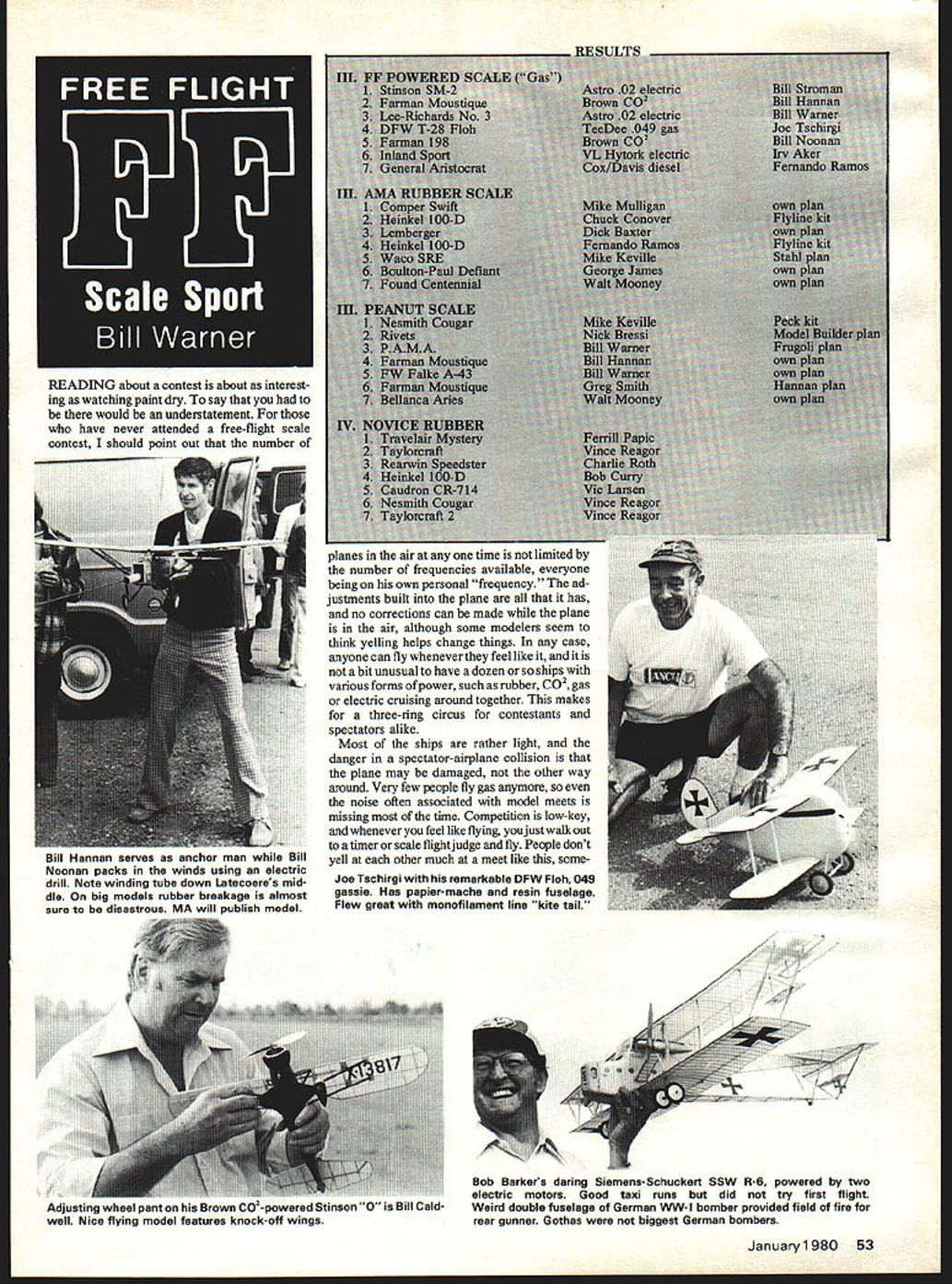
Reading about a contest is about as interesting as watching paint dry. To say that you had to be there would be an understatement. For those who have never attended a free-flight (FF) scale contest, it should be pointed out that the number of planes in the air at any one time is not limited by radio frequencies—everyone being on his own personal "frequency." The adjustments built into the plane are all that it has, and no corrections can be made while the plane is in the air (although some modelers seem to think yelling helps). Anyone can fly whenever they feel like it, and it is not at all unusual to have a dozen or so ships with various forms of power cruising around together. This makes for a three-ring circus for contestants and spectators alike.
Typical power types include:
- Rubber
- CO2
- Gas (less common these days)
- Electric
Most ships are rather light; the danger in a spectator–airplane collision is usually that the plane will be damaged, not the spectator. Very few people fly gas anymore, so the noise often associated with model meets is missing most of the time. Competition is low-key: when you feel like flying, you walk out to a timer or scale flight judge and fly. People don't yell at each other much at a meet like this, and contestants spend as much time helping each other as trying to better their times.
The Flightmasters Annual
For 28 years, the Flightmasters Annual has been the premier FF scale contest in the country, drawing top modelers from the U.S. and abroad. The meet consistently inspires and amazes all who attend because of the craftsmanship, daring, and research that produces hundreds of superb ships. Over a hundred official entries meet in Southern California each September; for every superb plane on exhibit, at least three or four others lurk in contestants' trunks just waiting to amaze the crowds.
Beneath battered exteriors of non-entries throb stout hearts and memories of realistic flights and thermals from bygone days. Fliers know nowhere else will they find such an appreciative audience. A compliment from a spectator in a golf cap and alligator shirt might be worth three points; from a freckle-faced twelve-year-old, five or six. A "That's really great!" from a fellow scale modeler like Walt Mooney or Bill Hannan? Worth ten on a scale of one to ten.
Contest Mechanics
Just after noon on a Saturday late in September, when a big high-pressure area sits over Los Angeles, a bunch of dedicated volunteers sets up a hall full of tables and begins registering models brought in from places as far away as Vancouver, Las Vegas, Gainesville, and Lake Havasu. The San Diego contingent arrives in force, old friends reconnect, and the usual barbs—"It'll never fly!" and "Too bad there was never a real one like that!"—are exchanged with rolling eyes and good-natured moans.
Judges fondle and caress the finest FF scale models one could hope for. Questions about finishes or where a three-view was found are treasured more than any trophy. A panel of volunteer judges goes about the thankless task of awarding points for such details as the correct number of ribs or registration numbers in your scale presentation. If you want to improve your own models, volunteer to judge and steal everyone's best ideas—thankless, but not unrewarded.
About five p.m., special awards not contingent on flying are presented. Afterward, the crowd adjourns to cool off and prepare for the evening banquet at a local restaurant.
Judging, Awards, and Banquet
Over cocktails while waiting for dinner, lies are exchanged, new jokes shared, and friendships appreciated. Despite having gorged on the incredible display of scale models all afternoon, attendees typically enjoy a full banquet. Highlights included Bill Hannan's short but incisive speech urging appreciation of this remarkable fellowship and Vic Larsen's presentation about Bobby Haight's Prairie Bird, which reportedly disappeared in a Nebraska thermal and later reappeared in a Dallas backyard.
Flying at Mile Square
Up before dawn to get in flight tests, the intrepid birdmen descend on the WWII vintage aerodrome in Fountain Valley known as Mile Square. The only obstacles on the field are the hundred or so cars containing essential kit: models, repair kits, cameras, winding stooges (mechanical devices to hold a plane while you wind), and iced beverages. To avoid these necessary menaces, many aviators grab plenty of altitude on launch rather than putter around at antenna level.
Trying to see everything—fly, take pictures, qualify a model or a proxy entry, and shoot the breeze—makes for a hectic but magical morning. You feel like a kid in a candy store with Grandma's credit card: you try to do it all, and describing it is episodic and incomplete at best.
I start for the flight judge with a Lee-Richards monoplane in hand, charged and ready. I stop to watch Nick Bress's amazing Peanut "Rivets" becoming smaller overhead. Ferrell Paick, winner of the novice rubber class, launches a very un-novice-like flight on his rubber FW-190 longnose which zooms to 200 feet. Ced Galloway, retired Lockheed master modeler, sends his Baby Cessna CO2 purring off in graceful circles.
My turn: set her down, aim into the wind, flip the switch, and turn loose. She bores down the runway, pulls up, starts to stall, but when the increased angle of attack lets air pour over the rear via the "doughnut hole," she settles down. Not a winning flight, I think, but we're on the board! Retrieval and back to the car for another plane.
On the way back I watch Fernando Ramos and Bobby Haight flip their diesels. Early in the morning, a friendly jest about "trying electric" can still be tolerated. Arriving back, I see Dick Baxter's famous five-minute Lemberger Peanut biplane on the ground flatter than a teacher's walk in September—tire tracks adorned the mangled mass. Baxter threatens to fly it Frisbee-fashion just to keep the competition stirred up. Mooney offers to help qualify Nick DeCarlis' CO2 Loening M-8; a perfect proxy flier, he heads for the weeds. Guy Larsen's rubber Martin-Baker floats overhead and the guttural growl of a cowl-ed diesel marks Haight's Miss Columbia, whose graceful flight ends a few seconds short of the 20-second minimum on a wingtip.
Bill Stroman's sensational takeoff and steady flight lock his Stinson Jr. electric into first place; he grins from ear to ear while bounding over the terrain in hot pursuit. Bill Noonan launches his lovely Missel Thrush biplane cruising away escorted by several smaller planes. Joe Tschirgi's grotesque DFW Floh gathers itself from the runway and buzzes away on a 200-foot monofilament "kite tail"—all flying halts to watch. After ambling over the golf course, it turns back toward the field, wagging its wings inexplicably, and a back-on-the-field landing draws applause.
Notable Flights and Models
Many great flights and fine models included:
- Vince Reago's Taylorcraft contingent
- Charlie Roth's Rearwin Speedster
- George James' Bouton-Paul night-fighter
- Mike Keville's Waco SRE
- Bill Hannan's Farman Moustiques and their clever pilots
- H-100s of Mikkelson, Ramos, Curry, and Connover
- Mulligan's rubber-winning Comper Swift
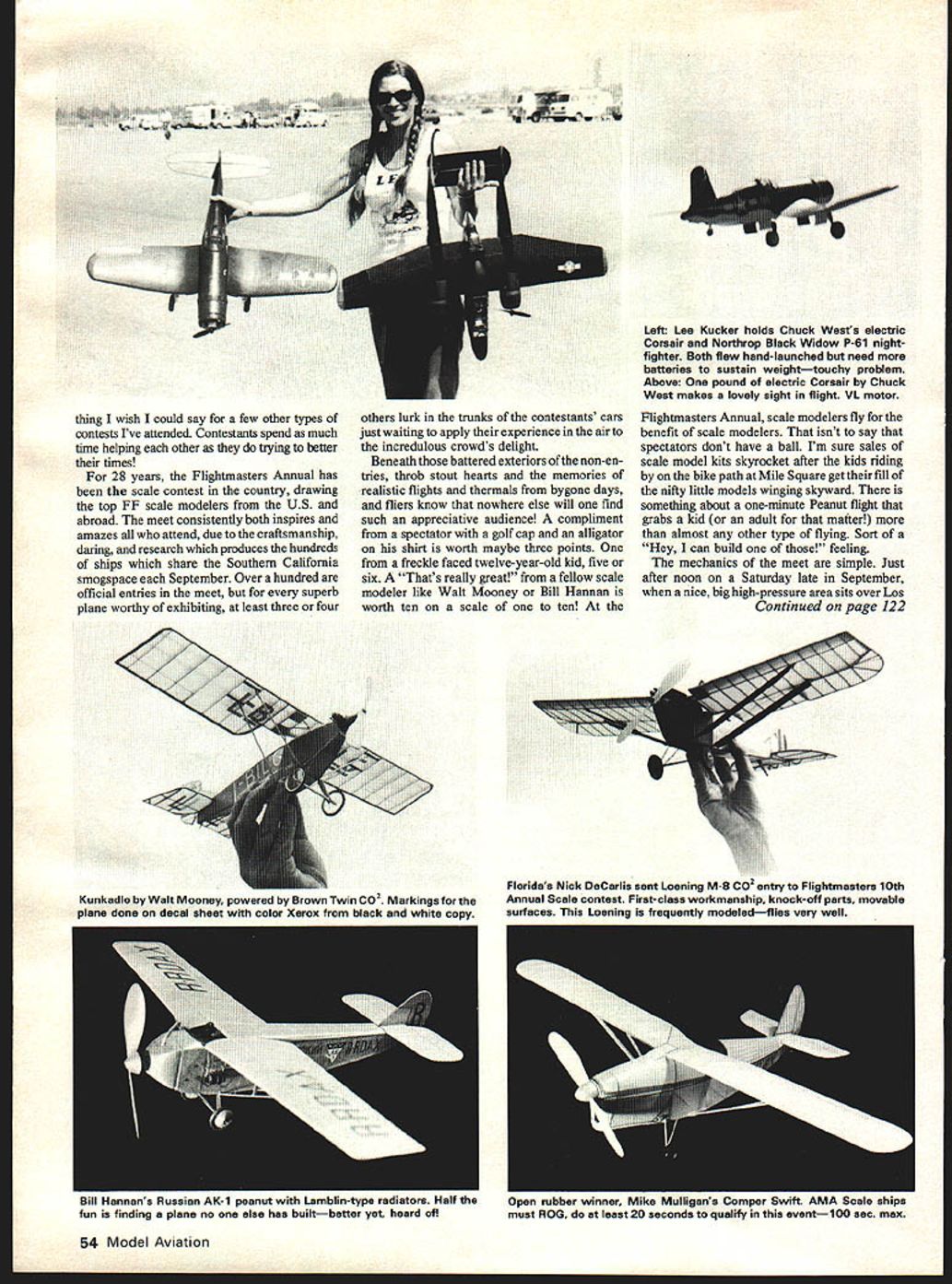
- West's Corsair and Black Widow electrics
- Dick Howard's wee 6"–span Chambermaid
- Bill Caldwell's CO2 Stinson "O" and Monocoupe
- George Smith's Farman
- Papic's Travelair Mystery Peanut
- Irv Aker's outstanding electric Inland Sport (Flyline kit)
- Bill Burgess' D.VIII (the only RC ship present)
- Vic Larsen's Caudron C-714
- Bob Peck's Baby Ace and Cougar
A tour down the trunk line allowed leisurely appreciation of many more fine models:
- Dick Allen's Standard Model "J" Jumbo rubber ship (all the way from Vancouver, B.C.)
- Dick Howard's collection of "half-Peanuts" (Leopard Moth, Ponnier monoplane, Chambermaid), and a BD-5 just off the building board
- Dick Nelson's DH-6 and Cougar
- Keville's winning Peanut Cougar
- Dozens more that space forbids listing
Want to Join?
If you'd like to share in the excitement of this type of modeling, Flightmasters is dedicated to furthering it and would be glad to send information about the club and its newsletter/journal. Contact:
Flightmasters 423-C San Vicente Blvd. Santa Monica, CA 90402
Bill Warner 423-C San Vicente Blvd. Santa Monica, CA 90402
Transcribed from original scans by AI. Minor OCR errors may remain.

