
Free Flight: Scale Sport
Bill Warner
T.W.A. Award and Notes
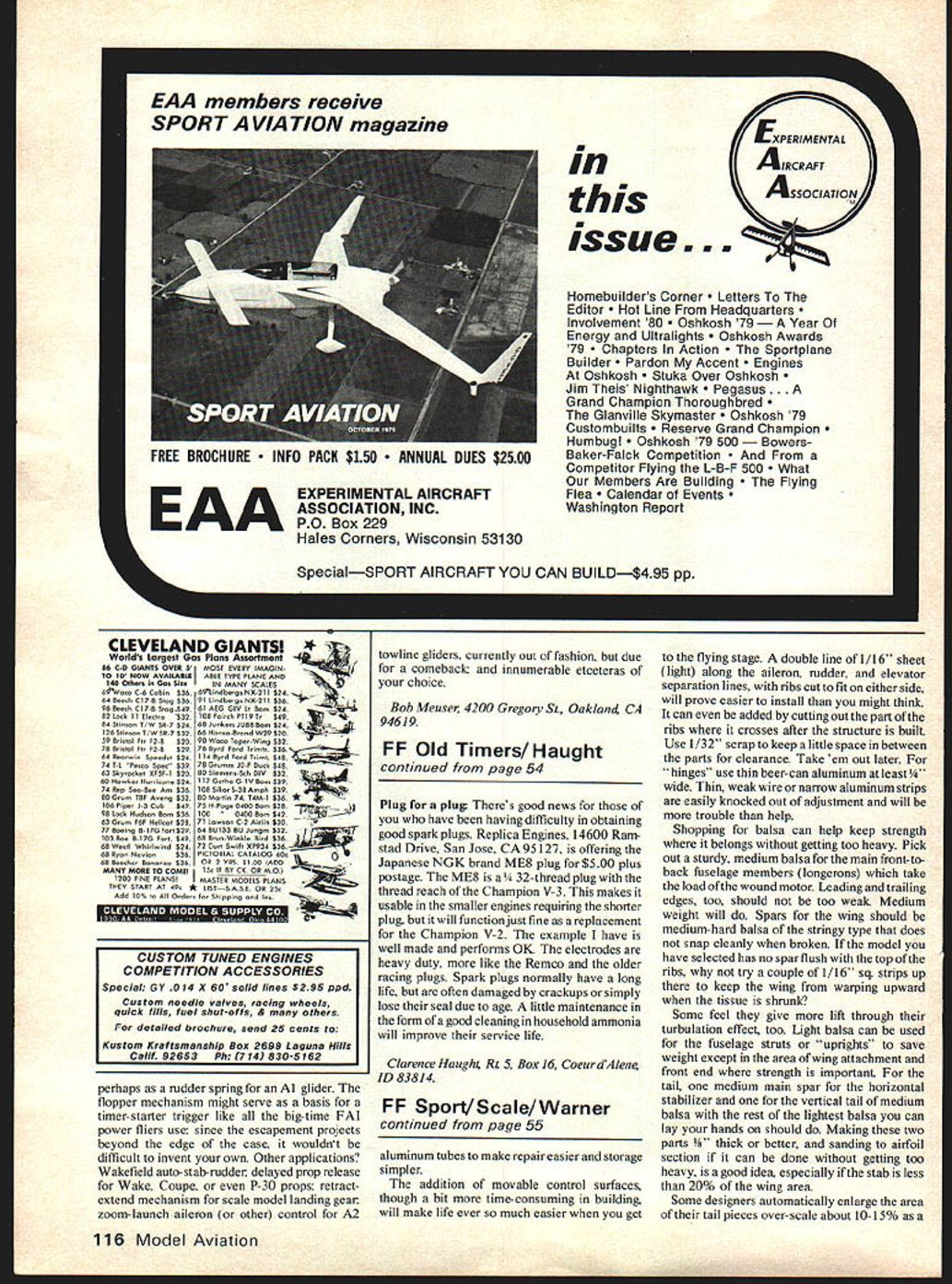
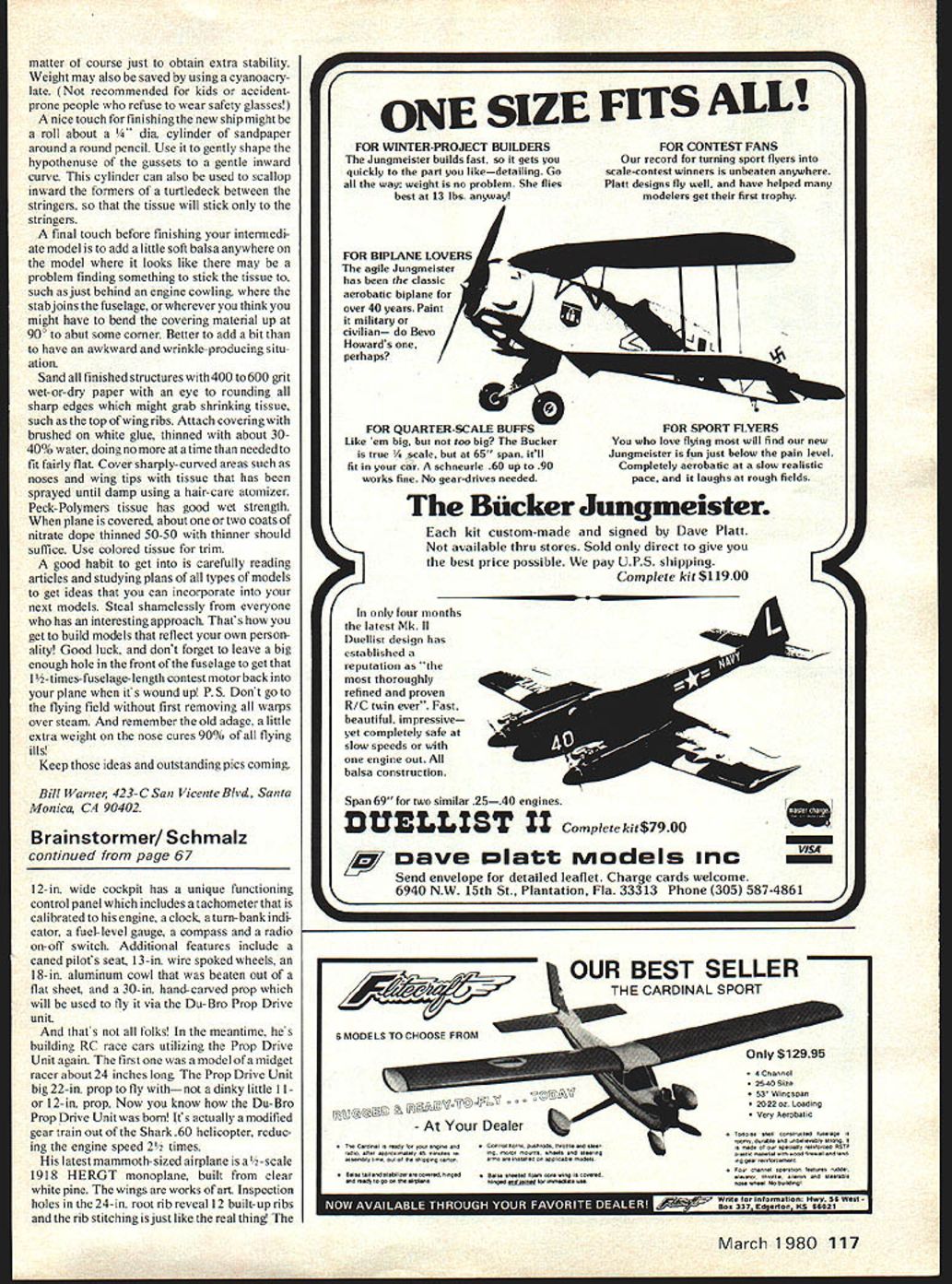
This month's T.W.A. (Thermal-Worthy Aircraft) Award goes to Abe Gallas of Los Angeles for his 18-minute flight at the Flightmasters Stahl vs. Lindberg contest last summer. A duplicate award goes to Andy Faykun, who flew the twin brother to Andy's Interstate Cadet O.O.S. the same day. Abe's ship was built almost exactly to plan (available from John Pond Old Time Plan Service, P.O. Box 3215, San Jose, CA 95156 — plan #18-E-5 Interstate O-63 Cadet, Earl Stahl, 1/4 MAN for $2) except that it required a tremendous amount of down-thrust (about a 1/4" shim).
We have learned that the 1980 Flying Aces Nats are to be held at Wright Field in Dayton, back-to-back with the AMA Nats. This has to be the Mecca for FF scalers this year! Expect about 11 action-packed events, all outdoor, all the way from AMA and FAC scale events to Embryo. Frank Scott is the C.D.; phone (513) 890-5989.
Who this column is for
Experts and beginners may stop here. The rest of the column deals with that much-neglected area of modeldom: the "intermediate" scale model. This is for the person who has built a couple of rubber ships (probably Peanuts), has been bitten by the bug, and would like to "step up" to rubber scale. The suggestions offered are by no means exhaustive, but they are intended to help someone who has no close contact with other scale modelers.
Choosing a first intermediate scale model
Let's shoot for a 30-inch-span rubber job — a high-wing monoplane is best — and let's try a simple scratch-built ship from a plan, rather than a kit. Some kits have good intentions, but what gets put in the box generally produces doorstops rather than fliers. The Interstate Cadet mentioned earlier, or a similar model, is a good starting point.
Obtain as much scale data as you can before starting. Good sources include:
- Local airports and museums
- Club newsletters
- Libraries and aviation photo services
- The regular model press for photos and 3-view drawings
If you can narrow your subject down to a particular registration and a color scheme proven by photos, you are worlds ahead for contest work.
Planning and strengthening the structure
Sit down with your construction plan and scale data and start penciling in changes to make your plane more scale or just better-built. Consider the following improvements:
- Add the scale number of ribs to the wing if it looks starved (use light 1/32" sheet rather than 1/16" if you go this route).
- Add gussets in all outside corners (wing tips, root ribs, etc.) to prevent tissue wrinkles. Look at your last plane and add a gusset wherever you got tissue "pull-in" wrinkles.
- Add gussets around landing gear attachment points to prevent ripping up the fuselage on impact.
- Prevent strut damage: design a small balsa pad on the underside of the rib for the strut to glue to, or use a tube for a strut-fixing wire to plug into.
- If wings have ripped off the fuselage in past crashes, add balsa-sheet reinforcement around wing-attachment areas and consider mounting the wing on 1/32" music-wire stubs plugging into aluminum tubes to make repairs easier and storage simpler.
Movable control surfaces
Although a bit more time-consuming to build, movable control surfaces make trimming and flying much easier:
- Use a double line of 1/16" light sheet along the aileron, rudder, and elevator separation lines, with ribs cut to fit on either side. This can even be added after the structure is built by cutting out the rib parts where it crosses.
- Use 1/32" scrap to keep a little space between parts for clearance; remove the scrap later.
- For hinges, use thin beer-can aluminum at least 1/4" wide. Thin, weak wire or narrow aluminum strips are easily knocked out of adjustment and will cause more trouble than help.
Balsa selection and structural advice
Shopping for balsa can keep strength where it belongs without adding unnecessary weight:
- Use sturdy, medium balsa for main fuselage members (longerons) that take the load of the wound motor; leading and trailing edges should not be too weak.
- Wing spars should be medium-hard, stringy balsa that doesn't snap cleanly (this helps prevent warping and may give lift through a turbulence effect).
- If the model has no spar or only flimsy ribs, try adding a couple of 1/16" square strips to keep the wing from warping upward when tissue is shrunk.
- Use light balsa for fuselage struts or uprights to save weight except near wing attachments and the front end, where strength is important.
- For tail surfaces, use one medium main spar (horizontal stabilizer) and one for the vertical tail, with the rest of the tail made of the lightest balsa you can find. Make tail surfaces at least 1/8" thick if possible and sand to an airfoil section if it can be done without getting too heavy, especially if the stabilizer is less than 20% of wing area.
- Some designers enlarge tail areas about 10–15% over scale as a matter of course to obtain extra stability. Keep the tail moment arm as long as possible.
- Cut down the width of the vertical tail if you get too much weathercocking. For small models, use a moderate amount of side area; too much side area can cause spiraling tendencies.
- Weight may also be saved by using cyanoacrylate (not recommended for kids or accident-prone people who refuse to wear safety glasses).
Finishing details and covering
A few finishing touches improve appearance and help the covering stick properly:
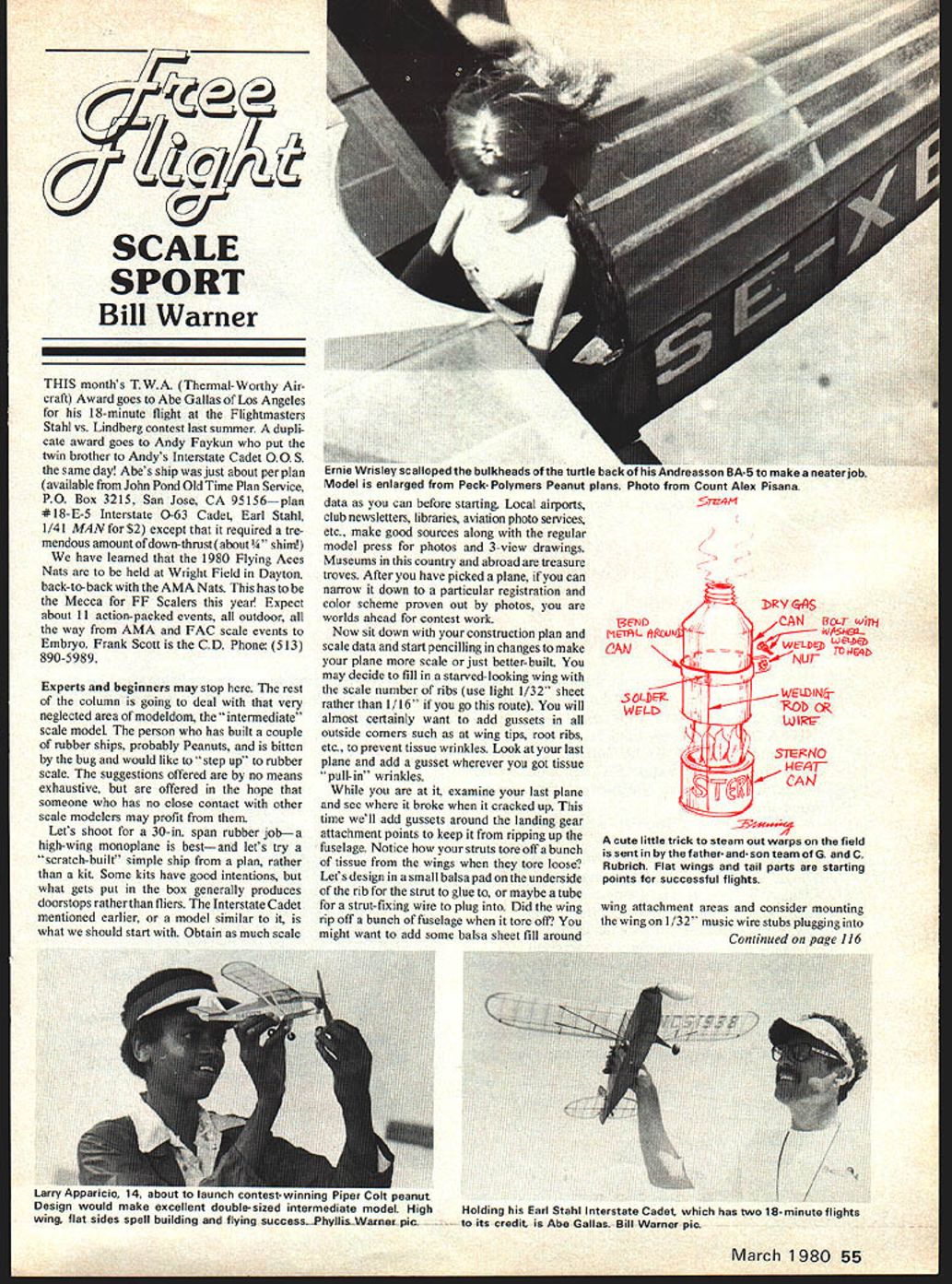
- Shape gussets and formers: roll a 1/4" diameter cylinder of sandpaper around a round pencil and use it to gently shape the hypotenuse of gussets to a gentle inward curve. This cylinder can also scallop inward the formers of a turtledeck between stringers so the tissue will stick only to the stringers.
- Add a little soft balsa wherever you anticipate difficulty getting tissue to stick, such as behind an engine cowling or where the stabilizer joins the fuselage. Better to add a bit than to have awkward wrinkles.
- Sand all finished structures with 400–600 grit wet-or-dry paper, rounding sharp edges that might grab shrinking tissue (tops of wing ribs, etc.).
- Attach covering with brushed-on white glue thinned about 30–40% with water, doing only as much at a time as needed to fit fairly flat. For sharply curved areas (noses, wing tips), use tissue sprayed until damp with a hair-care atomizer.
- Peck-Polymers tissue has good wet strength. When covered, about one or two coats of nitrate dope thinned 50–50 with thinner should suffice. Use colored tissue for trim.
Habits and final tips
- Read articles and study plans of all types of models to gather ideas you can incorporate into your next models. Steal shamelessly from everyone with an interesting approach — that's how you develop models that reflect your personality.
- Leave a big enough hole in the front of the fuselage to get that 1-1/2-times-fuselage-length contest motor back into your plane when it's wound up.
- P.S. Don't go to the flying field without first removing all wraps.
- Remember the old adage: a little extra weight on the nose cures 90% of all flying ills!
Keep those ideas and outstanding pictures coming.
Bill Warner 423-C San Vicente Blvd., Santa Monica, CA 90402.
Transcribed from original scans by AI. Minor OCR errors may remain.

