
Free Flight: Scale Sport
Bill Warner
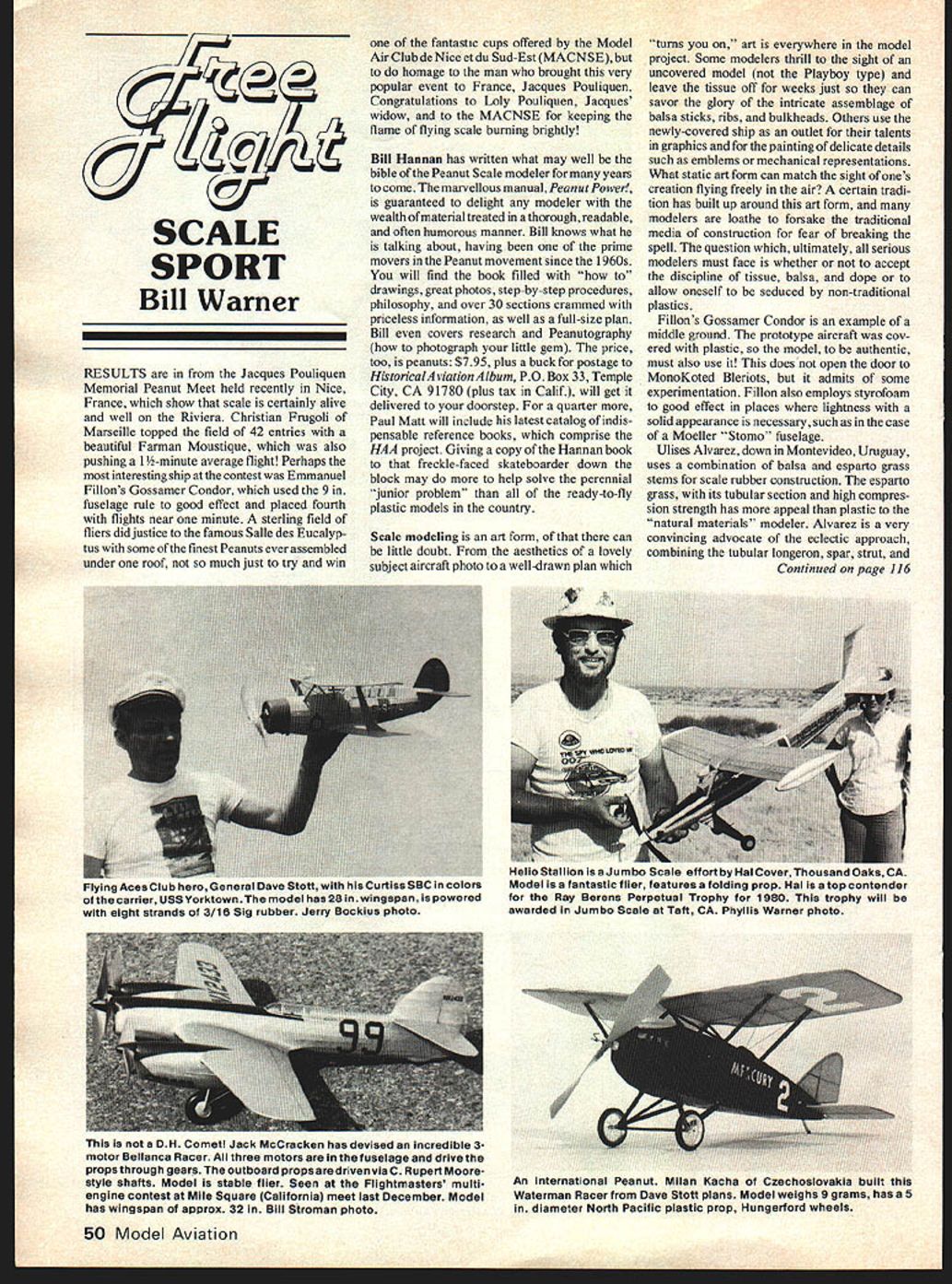
Results are in from the Jacques Pouliquen Memorial Peanut Meet held recently in Nice, France, which show that scale is certainly alive and well on the Riviera. Christian Frugoli of Marseille topped the field of 42 entries with a beautiful Farman Moustique, which was also pushing a 1½-minute average flight. Perhaps the most interesting ship at the contest was Emmanuel Fillon's Gossamer Condor, which used the 9 in. fuselage rule to good effect and placed fourth with flights near one minute. A sterling field of fliers did justice to the famous Salle des Eucalyptus, with some of the finest Peanuts ever assembled under one roof — not so much to try to win one of the fantastic cups offered by the Model Air Club de Nice et du Sud-Est (MACNSE), but to do homage to the man who brought this very popular event to France, Jacques Pouliquen. Congratulations to Loly Pouliquen, Jacques' widow, and to the MACNSE for keeping the flame of flying scale burning brightly!
Bill Hannan has written what may well be the bible of the Peanut Scale modeler for many years to come. The marvelous manual, Peanut Power, is guaranteed to delight any modeler with the wealth of material treated in a thorough, readable, and often humorous manner. Bill knows what he is talking about, having been one of the prime movers in the Peanut movement since the 1960s. You will find the book filled with how-to drawings, great photos, step-by-step procedures, philosophy, and over 30 sections crammed with priceless information, as well as a full-size plan. Bill even covers research and Peanutography (how to photograph your little gem). The price, too, is peanuts: $7.95, plus $1.00 for postage. Send orders to Historical Aviation Album, P.O. Box 33, Temple City, CA 91780 (plus tax in California). For a quarter more, Paul Matt will include his latest catalog of indispensable reference books, which comprise the HAA project. Giving a copy of the Hannan book to that freckle-faced skateboarder down the block may do more to help solve the perennial "junior problem" than all of the ready-to-fly plastic models in the country.
Scale modeling is an art form, of that there can be little doubt. From the aesthetics of a lovely subject aircraft photo to a well-drawn plan that "turns you on," art is everywhere in the model project. Some modelers thrill to the sight of an uncovered model (not the Playboy type) and leave the tissue off for weeks just so they can savor the glory of the intricate assemblage of balsa sticks, ribs, and bulkheads. Others use the newly covered ship as an outlet for their talents in graphics and for the painting of delicate details such as emblems or mechanical representations. What static art form can match the sight of one's creation flying freely in the air?
A certain tradition has built up around this art form, and many modelers are loath to forsake the traditional media of construction for fear of breaking the spell. The question which, ultimately, all serious modelers must face is whether to accept the discipline of tissue, balsa, and dope or to allow oneself to be seduced by non-traditional plastics.
Fillon's Gossamer Condor is an example of a middle ground. The prototype aircraft was covered with plastic, so the model, to be authentic, must also use it. This does not open the door to MonoKoted Bleriots, but it admits of some experimentation. Fillon also employs styrofoam to good effect in places where lightness with a solid appearance is necessary, such as in the case of a Moeller "Stomo" fuselage.
Ulises Alvarez, down in Montevideo, Uruguay, uses a combination of balsa and esparto grass stems for scale rubber construction. The esparto grass, with its tubular section and high compression strength, has more appeal than plastic does to the "natural materials" modeler. Alvarez is a very convincing advocate of the eclectic approach, combining tubular longeron, spar, strut, and flying-surface outlines with balsa ribs and bulkheads. The use of plastics in the form of nylon monofilament fuselage and wing rigging and a styrofoam pilot do not detract in the least from the elegance of his creations.
Maybe you might consider whether plastic wheels and props detract from or enhance the scale mystique of your next model.
Transcribed from original scans by AI. Minor OCR errors may remain.

