
Free Flight: SCALE SPORT
Bill Warner
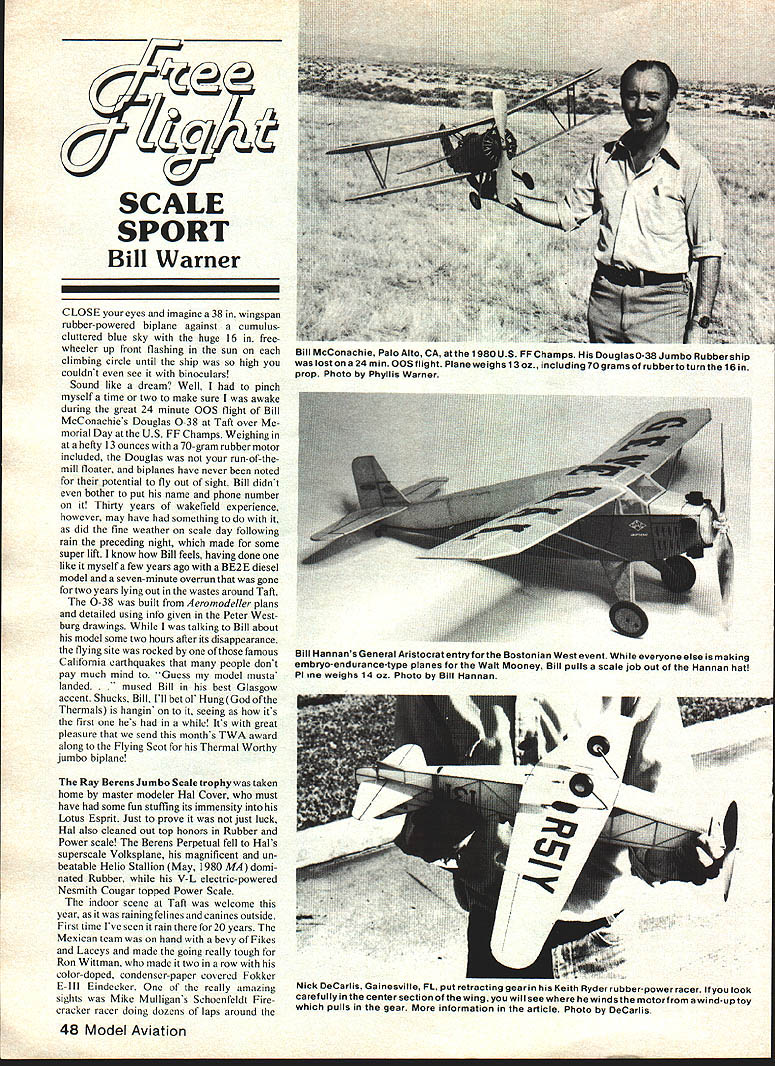
Close your eyes and imagine a 38 in. wingspan rubber-powered biplane against a cumulus‑cluttered blue sky, a huge 16 in. free‑wheeler up front flashing in the sun on each climbing circle until the ship was so high you couldn't even see it with binoculars. Sound like a dream? I had to pinch myself a time or two to make sure I was awake during the great 24‑minute out‑of‑sight flight of Bill McConachie's Douglas O‑38 at Taft over Memorial Day at the U.S. Free Flight Championships. Weighing a hefty 13 ounces with a 70‑gram rubber motor included, the Douglas was not your run‑of‑the‑mill floater, and biplanes have never been noted for their potential to fly out of sight. Bill hadn't bothered to put his name or phone number on it, but thirty years' Wakefield experience may have had something to do with the result.
The model was built from Aeromodeller plans and detailed using information from Peter Westburg drawings. Fine weather on scale day following rain the preceding night produced some superb lift. While I was talking to Bill about his model some two hours after its disappearance, the flying site was rocked by one of those famous California earthquakes that many people barely pay attention to. "Guess my model musta landed," mused Bill in his best Glasgow accent. "Shucks, ol' Hung (God of the Thermals) is hangin' on to it, seein' as how it's the first one he's had in a while." It's with great pleasure that we send this month's TWA award along to the Flying Scot for his Thermal‑Worthy jumbo biplane.
Awards and notable results
- Ray Berens Jumbo Scale trophy: Hal Cover.
- Hal also swept top honors in Rubber and Power scale.
- Berens Perpetual: Hal's superscale Volksplane.
- Rubber: Hal's magnificent Helio Stallion (May 1980 Model Aviation).
- Power Scale: Nesmith Cougar.
- Outdoor Peanut: Vital Elorza (Mexico City). His Fike floated out of sight early but was found, and that turned out to be enough to take first.
Indoor and outdoor highlights
The indoor flying scene at Taft was a welcome refuge this year as it was raining cats and dogs outside—the first time I've seen it rain there in twenty years. The Mexican team was on hand with a bevy of Fikes and Laceys and made the going really tough. Ron Wittman turned in notable flights with his color‑doped, condenser‑paper‑covered Fokker E‑III Eindecker. One of the truly amazing sights was Mike Mulligan's Schoenfeldt Firecracker racer doing dozens of laps around the gym as realistically as could be imagined—Fikes may stay up forever, but scale impression was that of a 75 mph headwind!
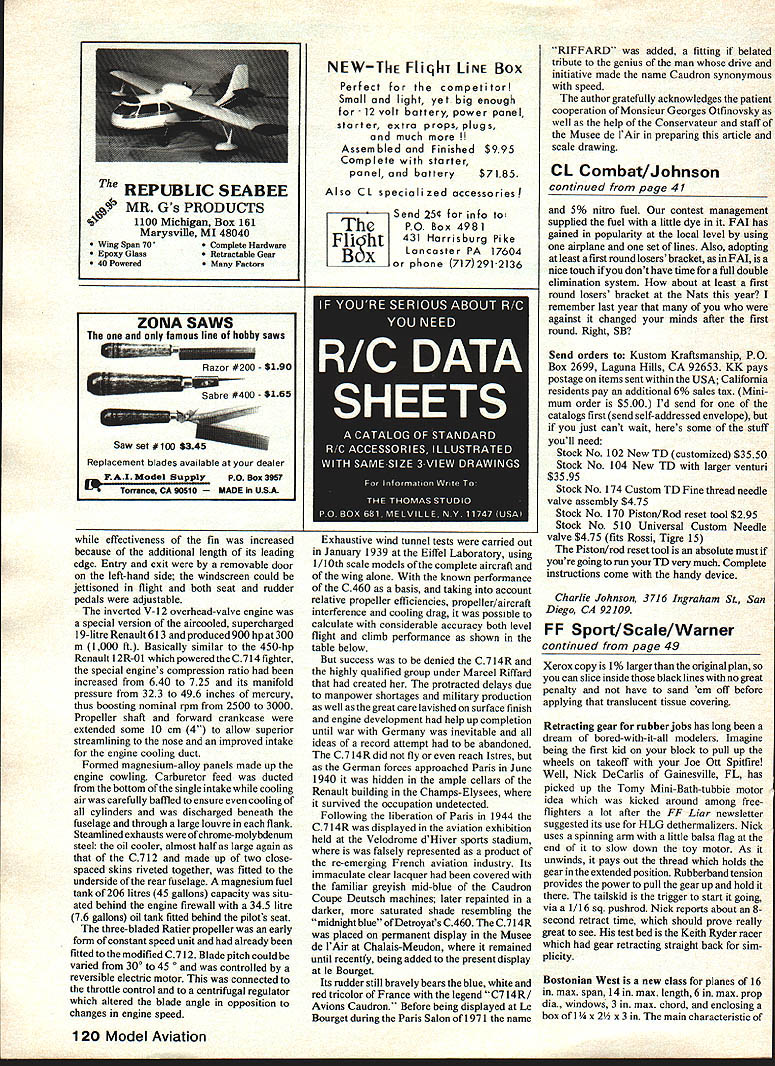
Among the more notable ships at Taft were Loren Williams' outstanding Gordon Israel Racer, a jumbo with 226 sq. in. area and a 36 in. span on a superlight wing; Ferrell Papic's Astro .02 Bleriot 7 electric, fresh from a win at the Scale Staffel Annual, which turned in a fine thermal performance and, as always, flew as if it were on rails; and my old Lee‑Richards annular, which flew well being an inherently stable design with plenty of adjustment leeway.
Ralph Cooke's gas‑powered Corsair had no transition problems and made very realistic low‑level strafing runs—nice to see someone who still knows how to start one of these. Mik Mikkelson's Peanut Chambermaid was a work of art at 6 grams and continually threatened to lose itself on outdoor flights. One of the bravest souls there was Carlo Godel, who took a trophy home with his 1913 Nieuport Schneider Cup racer—he must have known it was going to rain!
Participation in free‑flight scale events is growing at the FF Champs, and after its tenth running it looks set to become one of the biggest. Bill Stroman of Flightmasters is to be congratulated for the great job he has done keeping the event going and growing.
Equipment notes and tips
- Battery behavior: On my Astro .02 electric, the quarter‑inch Ni‑Cads in the battery pack have begun to discharge at slightly different rates, each cell showing its own personality. The result is a gradual reduction in power—full to about three‑quarters at ~20 seconds, to about half at ~30 seconds, then down further—so the airplane makes a smooth powered landing on about one cell. After years of tolerating glow engines that give a burst of power just as they quit (leaving a scale model in a stall attitude and costing flight points), this gradual decline is a real joy.
- Cutting surfaces: Walt Mooney reports a new use for old Sears catalogs and phone books—cutting surfaces. Slice out the tissue letters, indoor ribs or whatever, then rip off the hacked up sheets and you are left with a fine, smooth surface. And it's always entertaining to read the ads for power mowers and long underwear.
- Homemade printwood: Homemade printwood by Xerox, mentioned previously, was well covered by Ed Van Wagner in the June 1979 RCM. For those who want to try this method, Ed (a Xerox employee for 24 years) suggests using the Xerox 1860 copier for best results. Use drafting tape to hold the Xerox copy of your parts in the correct position, and then use long strokes with a hot iron, applying pressure to mimic the plastic black lines into your wood—be careful not to press too hard on thin, soft sheets.
Transcribed from original scans by AI. Minor OCR errors may remain.

