
Free Flight: Scale-Sport
Ralph D. Kuenz
I MENTIONED in the last installment that further use of masks and appliques (look it up in the dictionary) would be discussed this time around.
Sprayed-on finishes need a mask of some type to obtain a color separation line. Masks for lettering, registration numbers, company logos, etc. can be drawn on plain paper several times until you are satisfied with the results.
Several attempts at making a mask of some difficult design can only mean your desire to do it right is growing with the rest of your modeling ability. And remember, all the times you have done it over you haven't yet touched the model.
The masks must have an adhesive backing applied to make them stick to the surface of the model. You have in this instance two choices: 1) cut out the mask, then apply the adhesive. (I use 3M mild "Sprayment") or, 2) apply rubber cement tape first, then cut out the mask. (Note: a very nice letter from Rich Powers, editor of the San Francisco Vultures newsletter, informs me that what I have been calling rubber cement tape is properly known in office supply stores as Adhesive Transfer Tape #465. Thanks, Rich.)
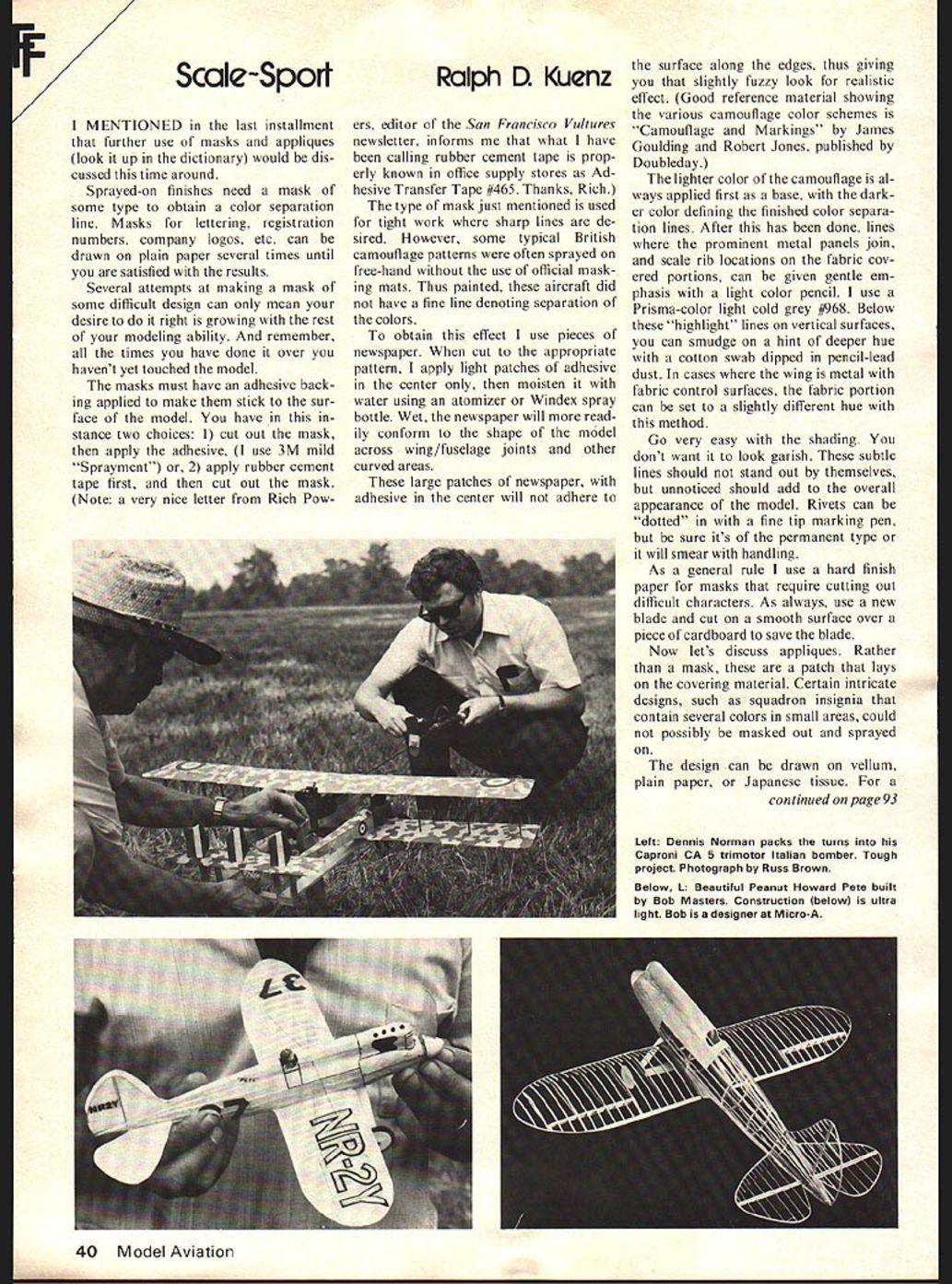
The type of mask just mentioned is used for tight work where sharp lines are desired. However, some typical British camouflage patterns were often sprayed on free-hand without the use of official masking mats. Thus painted, these aircraft did not have a fine line denoting separation of the colors.
To obtain this effect I use pieces of newspaper. When cut to the appropriate pattern, I apply light patches of adhesive in the center only, then moisten it with water using an atomizer or Windex spray bottle. Wet, the newspaper will more readily conform to the shape of the model across wing/fuselage joints and other curved areas.
These large patches of newspaper, with adhesive in the center will not adhere to the surface along the edges, thus giving you that slightly fuzzy look for realistic effect. (Good reference material showing the various camouflage color schemes is "Camouflage and Markings" by James Goulding and Robert Jones, published by Doubleday.)
The lighter color of the camouflage is always applied first as a base, with the darker color defining the finished color separation lines. After this has been done, lines where the prominent metal panels join, and scale rib locations on the fabric covered portions, can be given gentle emphasis with a light color pencil. I use a Prisma-color light cold grey #968. Below these "highlight" lines on vertical surfaces, you can smudge on a hint of deeper hue with a cotton swab dipped in pencil-lead dust. In cases where the wing is metal with fabric control surfaces, the fabric portion can be set to a slightly different hue with this method.
Go very easy with the shading. You don't want it to look garish. These subtle lines should not stand out by themselves, but unnoticed should add to the overall appearance of the model. Rivets can be "dotted" in with a fine tip marking pen, but be sure it's of the permanent type or it will smear with handling.
As a general rule I use a hard finish paper for masks that require cutting out difficult characters. As always, use a new blade and cut on a smooth surface over a piece of cardboard to save the blade.
Now let's discuss appliques. Rather than a mask, these are a patch that lays on the covering material. Certain intricate designs, such as squadron insignia that contain several colors in small areas, could not possibly be masked out and sprayed on.
The design can be drawn on vellum, plain paper, or Japanese tissue. For a
Free Flight: Scale-Sport
model with a sprayed-on color doped finish I prefer to have a brownline run off the original vellum. In this manner I keep the original and all the copies are, of course, the same. Thus, even if my drawing of the insignia is a little off scale in some dimensions, they will at least be uniform. The brownline is first backed with adhesive transfer tape, then colored with a felt-tip pen. (Except for white, where I use latex or white-out.) After the colors are successfully done, cut out the patch, peel off the tape backing, and you have an applique.
If your model has a colored Japanese tissue finish, the applique can be made using Japanese tissue to keep the "feel" of the model constant. This would be more in keeping with the see-through look of a lightly constructed model.
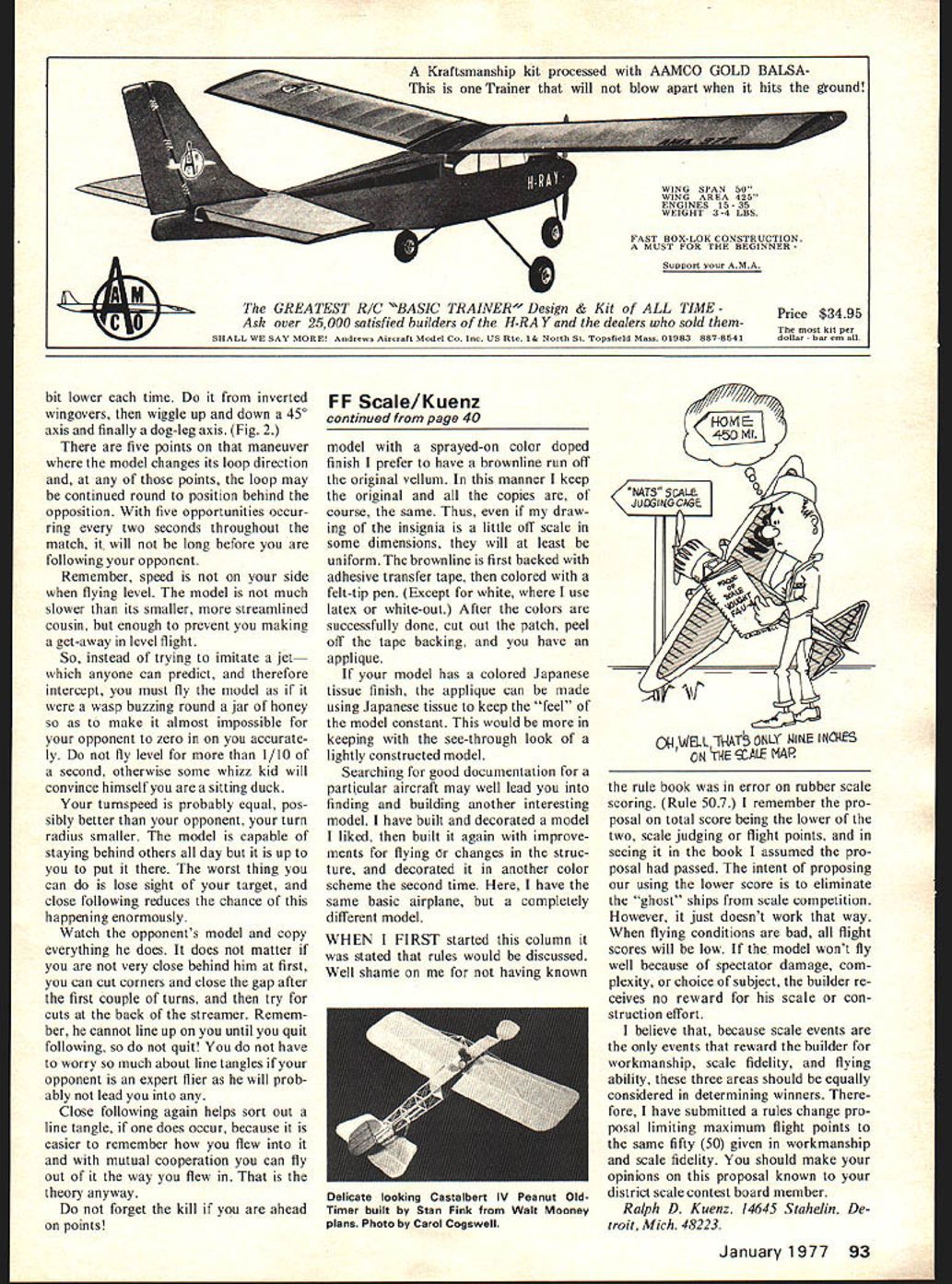
Searching for good documentation for a particular aircraft may well lead you into finding and building another interesting model. I have built and decorated a model I liked, then built it again with improvements for flying or changes in the structure, and decorated it in another color scheme the second time. Here, I have the same basic airplane, but a completely different model.
WHEN I FIRST started this column it was stated that rules would be discussed. Well shame on me for not having known the rule book was in error on rubber scale scoring. (Rule 50.7). I remember the proposal on total score being the lower of the two, scale judging or flight points, and in seeing it in the book I assumed the proposal had passed. The intent of proposing our using the lower score is to eliminate the "ghost" ships from scale competition. However, it just doesn't work that way. When flying conditions are bad, all flight scores will be low. If the model won't fly well because of spectator damage, complexity, or choice of subject, the builder receives no reward for his scale or construction effort.
I believe that, because scale events are the only events that reward the builder for workmanship, scale fidelity, and flying ability, these three areas should be equally considered in determining winners. Therefore, I have submitted a rules change proposal limiting maximum flight points to the same fifty (50) given in workmanship and scale fidelity. You should make your opinions on this proposal known to your district scale contest board member.
Ralph D. Kuenz, 14645 Stahelin, Detroit, Mich. 48223.
Transcribed from original scans by AI. Minor OCR errors may remain.

