
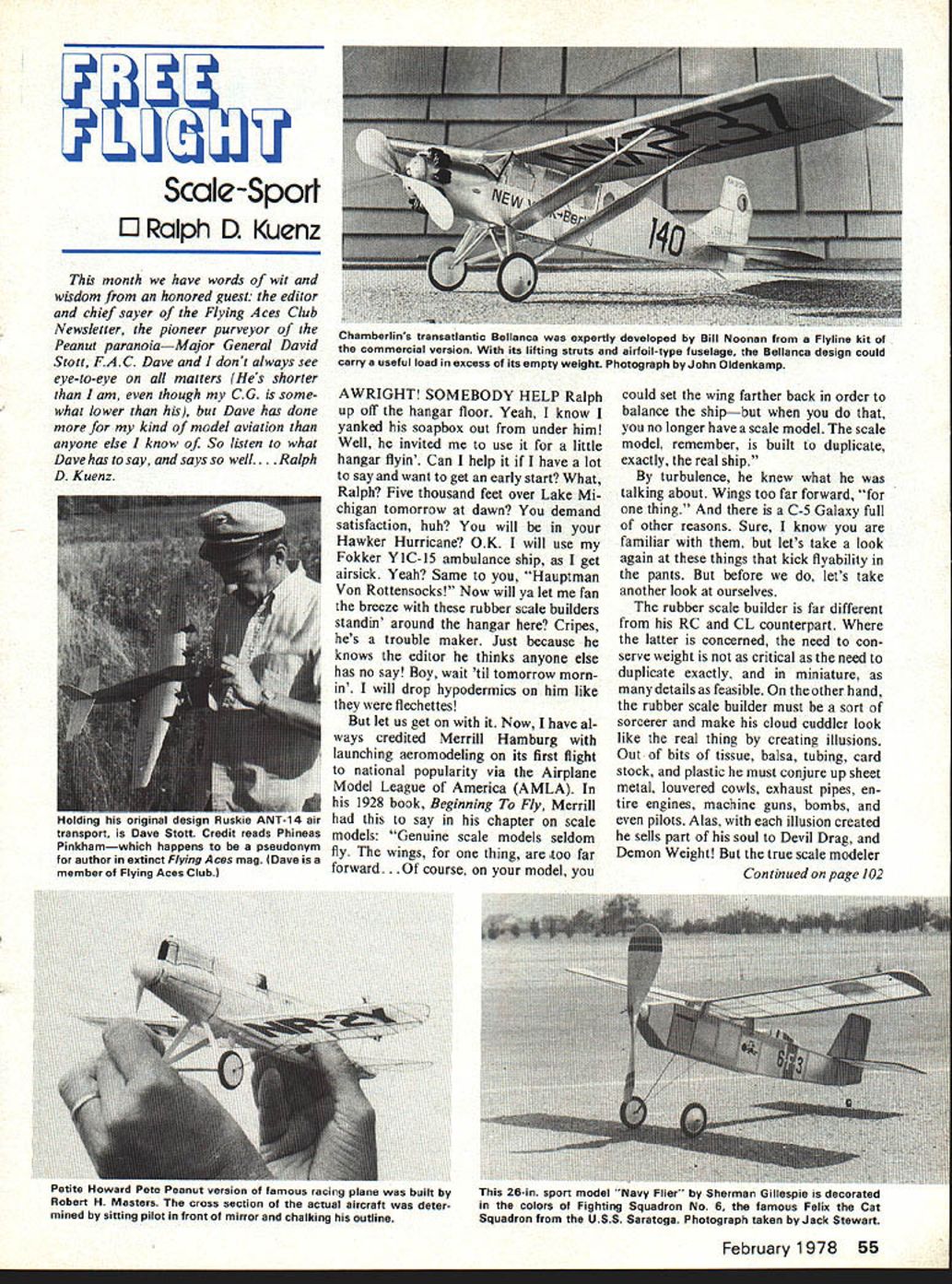
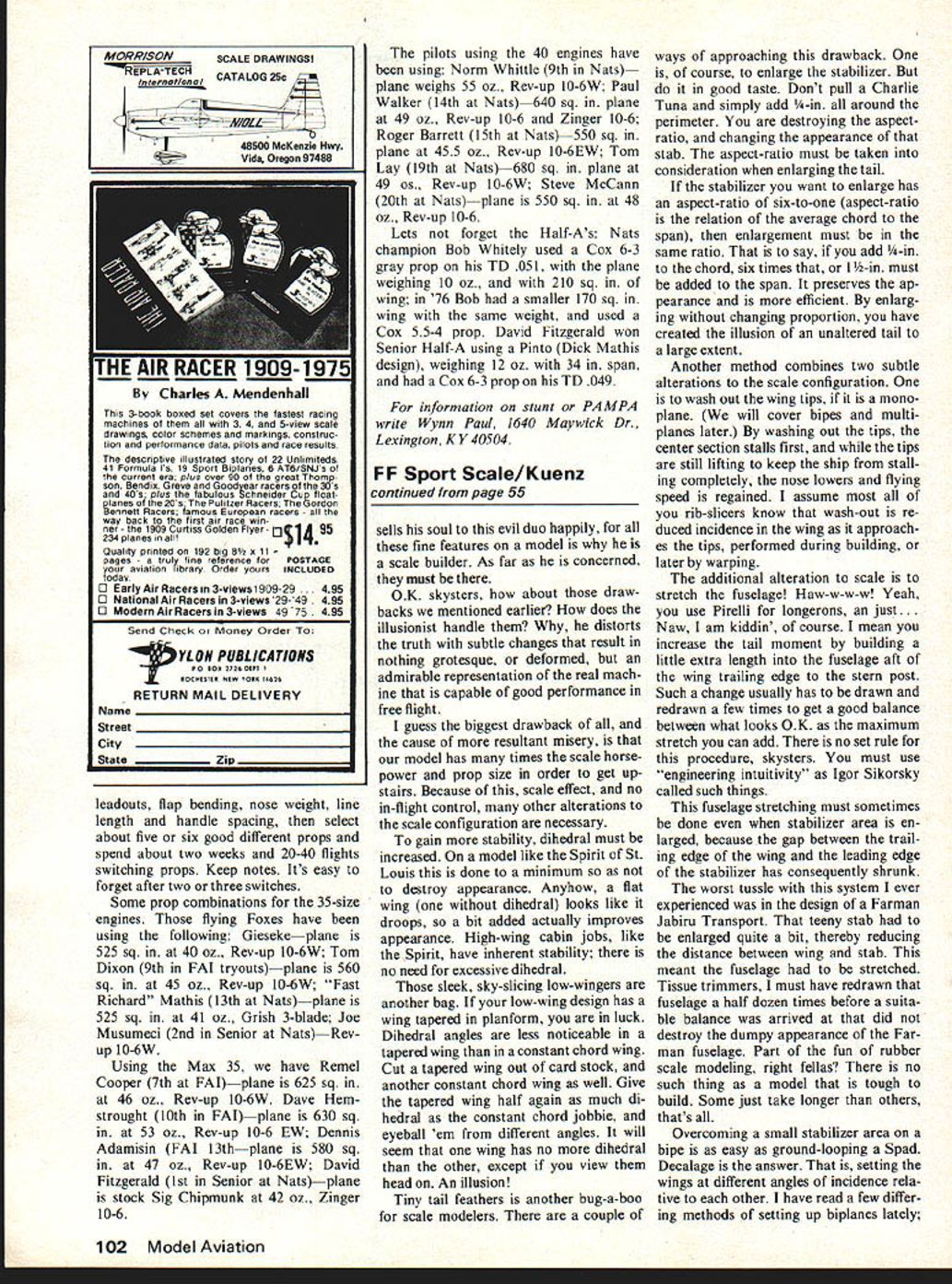
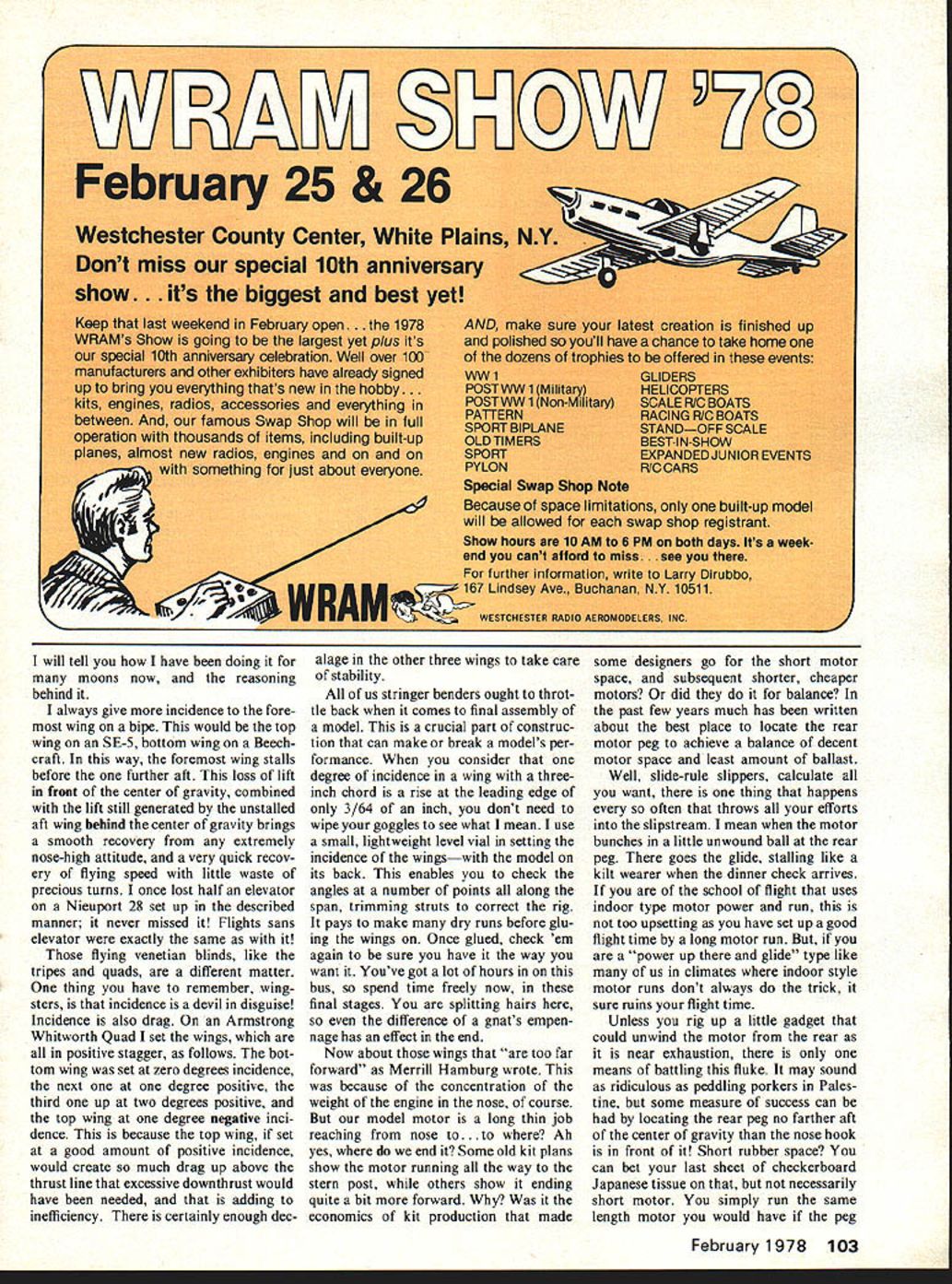

Free Flight: Scale-Sport
Ralph D. Kuenz
This month we have words of wit and wisdom from an honored guest: the editor and chief sayer of the Flying Aces Club Newsletter, the pioneer purveyor of the Peanut paranoia—Major General David Stott, F.A.C. Dave and I don't always see eye-to-eye on all matters (He's shorter than I am, even though my C.G. is somewhat lower than his), but Dave has done more for my kind of model aviation than anyone else I know of. So listen to what Dave has to say, and says so well... Ralph D. Kuenz.
AWRIGHT! SOMEBODY HELP Ralph up off the hangar floor. Yeah, I know I yanked his soapbox out from under him! Well, he invited me to use it for a little hangar flyin'. Can I help it if I have a lot to say and want to get an early start? What, Ralph? Five thousand feet over Lake Michigan tomorrow at dawn? You demand satisfaction, huh? You will be in your Hawker Hurricane? O.K. I will use my Fokker Y1C-15 ambulance ship, as I get airsick. Yeah? Same to you, "Hauptman Von Rottensocks!" Now will ya let me fan the breeze with these rubber scale builders standin' around the hangar here? Cripes, he's a trouble maker. Just because he knows the editor he thinks anyone else has no say! Boy, wait 'til tomorrow mornin'. I will drop hypodermics on him like they were flechettes!
But let us get on with it. Now, I have always credited Merrill Hamburg with launching aeromodelling on its first flight to national popularity via the Airplane Model League of America (AMLA). In his 1928 book, Beginning To Fly, Merrill had this to say in his chapter on scale models: "Genuine scale models seldom fly. The wings, for one thing, are too far forward... Of course, on your model, you could set the wing farther back in order to balance the ship—but when you do that, you no longer have a scale model. The scale model, remember, is built to duplicate, exactly, the real ship."
By turbulence, he knew what he was talking about. Wings too far forward, "for one thing." And there is a C-5 Galaxy full of other reasons. Sure, I know you are familiar with them, but let's take a look again at these things that kick flyability in the pants. But before we do, let's take another look at ourselves.
The rubber scale builder is far different from his RC and CL counterpart. Where the latter is concerned, the need to conserve weight is not as critical as the need to duplicate exactly, and in miniature, as many details as feasible. On the other hand, the rubber scale builder must be a sort of sorcerer and make his cloud cuddler look like the real thing by creating illusions. Out of bits of tissue, balsa, tubing, card stock, and plastic he must conjure up sheet metal, louvered cowls, exhaust pipes, entire engines, machine guns, bombs, and even pilots. Alas, with each illusion created he sells part of his soul to Devil Drag, and Demon Weight! But the true scale modeler sells his soul to this evil duo happily, for all these fine features on a model is why he is a scale builder. As far as he is concerned, they must be there.
O.K. skysters, how about those drawbacks we mentioned earlier? How does the illusionist handle them? Why, he distorts the truth with subtle changes that result in nothing grotesque, or deformed, but an admirable representation of the real machine that is capable of good performance in free flight.
I guess the biggest drawback of all, and the cause of more resultant misery, is that our model has many times the scale horsepower and prop size in order to get upstairs. Because of this, scale effect, and no in-flight control, many other alterations to the scale configuration are necessary.
To gain more stability, dihedral must be increased. On a model like the Spirit of St. Louis this is done to a minimum so as not to destroy appearance. Anyhow, a flat wing (one without dihedral) looks like it droops, so a bit added actually improves appearance. High-wing cabin jobs, like the Spirit, have inherent stability; there is no need for excessive dihedral.
Those sleek, sky-slicing low-wingers are another bag. If your low-wing design has a wing tapered in planform, you are in luck. Dihedral angles are less noticeable in a tapered wing than in a constant chord wing. Cut a tapered wing out of card stock, and another constant chord wing as well. Give the tapered wing half again as much dihedral as the constant chord jobbie, and eyeball ’em from different angles. It will seem that one wing has no more dihedral than the other, except if you view them head on. An illusion!
Tiny tail feathers is another bug-a-boo for scale modelers. There are a couple of ways of approaching this drawback. One is, of course, to enlarge the stabilizer. But do it in good taste. Don’t pull a Charlie Tuna and simply add 1/4-in. all around the perimeter. You are destroying the aspect-ratio, and changing the appearance of that stab. The aspect-ratio must be taken into consideration when enlarging the tail.
If the stabilizer you want to enlarge has an aspect-ratio of six-to-one (aspect-ratio is the relation of the average chord to the span), then enlargement must be in the same ratio. That is to say, if you add 1/4-in. to the chord, six times that, or 1-1/2-in. must be added to the span. It preserves the appearance and is more efficient. By enlarging without changing proportion, you have created the illusion of an unaltered tail to a large extent.
Another method combines two subtle alterations to the scale configuration. One is to wash out the wing tips, if it is a monoplane. (We will cover bipes and multiplanes later.) By washing out the center section stalls first, and while the tips are still lifting to keep the ship from stalling completely, the nose lowers and flying speed is regained. I assume most all of you rib-slicers know that wash-out is reduced incidence in the wing as it approaches the tips, performed during building, and later by warping.
As the additional alteration to scale is to stretch the fuselage! Haw-w-w! Yeah, you use Pirelli for longerons, an’ just... Naw, I am kiddin’, of course. I mean you increase the tail moment by building a little extra length into the fuselage aft of the wing trailing edge to the stern post. Such a change usually has to be drawn and redrawn a few times to get a good balance between what looks O.K. as the maximum stretch you can add. There is no set rule for this procedure, okysters. You must use “engineering intuitivity” as Igor Sikorsky called such things.
This fuselage stretching must sometimes be done even when stabilizer area is enlarged, because the gap between the trailing edge of the wing and the leading edge of the stabilizer has consequently shrunk.
The worst tussle with this system I ever experienced was in the design of a Farman Jabiru Transport. That teeny stab had to be enlarged quite a bit, thereby reducing the distance between wing and stab. This meant the fuselage had to be stretched. Tissue trimmers, I must have redrawn that fuselage a half dozen times before a suitable balance was arrived at that did not destroy the dummy appearance of the Farman fuselage. Part of the fun of rubber scale modeling, right fellas? There is no such thing as a model that is tough to build. Some just take longer than others, that’s all.
Overcoming a small stabilizer area on a biplane is as easy as ground-looping a Spad. Decalage is the answer. That is, setting the wings at different angles of incidence relative to each other. I have read a few differing methods of setting up biplanes lately;
leadouts, flap bending, nose weight, line length and handle spacing, then select about five or six good different props and spend about two weeks and 20–40 flights switching props. Keep notes. It’s easy to forget after two or three switches.
Some prop combinations for the 35-size engines. Those flying Foxes have been using the following: Gieseke—plane is 525 sq. in. at 40 oz., Rev-up 10-6W; Tom Dixon (9th in FAI tryouts)—plane is 560 sq. in. at 45 oz., Rev-up 10-6W; “Fast Richard” Mathis (13th at Nats)—plane is 525 sq. in. at 41 oz., Grish 3-blade; Joe Mussumeci (2nd in Senior at Nats)—Rev-up 10-6W.
Using the Max 35, we have Remel Cooper (7th at FAI)—plane is 625 sq. in. at 46 oz., Rev-up 10-6W; Dave Hemstrought (10th in FAI)—plane is 630 sq. in. at 53 oz., Rev-up 10-6 EW; Dennis Adamisin (FAI 13th)—plane is 580 sq. in. at 47 oz., Rev-up 10-6EW; David Fitzgerald (1st in Senior at Nats)—plane is stock Sig Chipmunk at 42 oz., Zinger 10-6.
The pilots using the 40 engines have been using: Norm Whittle (9th in Nats)—plane weighs 55 oz., Rev-up 10-6W; Paul Walker (14th at Nats)—640 sq. in. plane at 49 oz., Rev-up 10-6 and Zinger 10-6; Roger Barrett (15th at Nats)—550 sq. in. plane at 45.5 oz., Rev-up 10-6EW; Tom Lay (19th at Nats)—680 sq. in. plane at 49 oz., Rev-up 10-6W; Steve McCann (20th at Nats)—plane is 550 sq. in. at 48 oz., Rev-up 10-6.
Let’s not forget the Half-A’s: Nats champion Bob Whitely used a Cox 6-3 gray prop on his TD .051, with the plane weighing 10 oz., and with 210 sq. in. of wing; in ’76 Bob had a smaller 170 sq. in. wing with the same weight, and used a Cox 5.5-4 prop. David Fitzgerald won Senior Half-A using a Pinto (Dick Mathis design), weighing 12 oz. with 34 in. span, and had a Cox 6-3 prop on his TD .049. I will tell you how I have been doing it for many moons now, and the reasoning behind it.
I always give more incidence to the foremost wing on a bipe. This would be the top wing on an SE-5, bottom wing on a Beechcraft. In this way, the foremost wing stalls before the one further aft. This loss of lift in front of the center of gravity, combined with the lift still generated by the unstalled aft wing behind the center of gravity brings a smooth recovery from any extremely nose-high attitude, and a very quick recovery of flying speed with little waste of precious turns. I once lost half an elevator on a Nieuport 28 set up in the described manner; it never missed it! Flights sans elevator were exactly the same as with it!
Those flying venetian blinds, like the triplanes and quads, are a different matter. One thing you have to remember, wingsters, is that incidence is a devil in disguise! Incidence is also drag. On an Armstrong Whitworth Quad I set the wings, which are all in positive stagger, as follows. The bottom wing was set at zero degrees incidence, the next one at one degree positive, the third one up at two degrees positive, and the top wing at one degree negative incidence. This is because the top wing, if set at a good amount of positive incidence, would create so much drag up above the thrust line that excessive downthrust would have been needed, and that is adding to inefficiency. There is certainly enough decalage in the other three wings to take care of stability.
All of us stringer benders ought to throttle back when it comes to final assembly of a model. This is a crucial part of construction that can make or break a model's performance. When you consider that one degree of incidence in a wing with a three-inch chord is a rise at the leading edge of only 3/64 of an inch, you don't need to wipe your goggles to see what I mean. I use a small, lightweight level vial in setting the incidence of the wings — with the model on its back. This enables you to check the angles at a number of points all along the span, trimming struts to correct the rig. It pays to make many dry runs before gluing the wings on. Once glued, check 'em again to be sure you have it the way you want it. You've got a lot of hours in on this box, so spend time freely now, in these final stages. You are splitting hairs here, so even the difference of a gnat's empennage has an effect in the end.
Now about those wings that "are too far forward" as Merrill Hamburg wrote. This was because of the concentration of the weight of the engine in the nose, of course. But our model motor is a long thin job reaching from nose to... to where? Ah yes, where do we end it? Some old kit plans show the motor running all the way to the stern post, while others show it ending quite a bit more forward. Why? Was it the economics of kit production that made some designers go for the short motor space, and subsequent shorter, cheaper motors? Or did they do it for balance? In the past few years much has been written about the best place to locate the rear motor peg to achieve a balance of decent motor space and least amount of ballast.
Well, slide-rule slippers, calculate all you want, there is one thing that happens every so often that throws all your efforts into the slipstream. I mean when the motor bunches in a little unwound ball at the rear peg. There goes the glide, stalling like a kite wherever the dinner check arrives. If you are of the school of flight that uses indoor type motor power and run, this is not too upsetting as you have set up a good flight time by a long motor run. But, if you are a "power up there and glide" type like many of us in climates where indoor style motor runs don't always do the trick, it sure ruins your flight time.
Unless you rig up a little gadget that could unwind the motor from the rear as it is near exhaustion, there is only one means of battling this fluke. It may sound as ridiculous as peddling porkers in Palestine, but some measure of success can be had by locating the rear peg no farther aft of the center of gravity than the nose hook is in front of it! Short rubber space? You bet your last sheet of checkerboard Japanese tissue on that, but not necessarily short motor. You simply run the same length motor you would have if the peg were located in its usual more aft position. When it bunches, which seems to happen less due to less restricting fuselage dimensions further forward, it has less effect on balance. Also, due to clumps of unwound motor gathering forward, there is a tendency to counter-balance any bunching.
The one drawback is a slapping of the fuselage sides in jobs that are more slender. This is overcome by the addition of light 1/32-in. "slapper boards" glued to the inside of the uprights of the fuselage in the motor compartment. Even the 1/64-in. sheet is strong enough in smaller models. In Peanuts, where motors are not very powerful, no slapper board is needed.
Now, stringer benders. I want to... what is that you say? You caught Ralph pourin' acid on the control cables of my Fokker Ambulance! I bet he is related to Erich Von Stroheim! Well, I will get some bicarbonate of soda out of the medicine chest and daub it on, as it is an antacid, huh? Boy, I thought the good guys flew the Hurricanes! I'll bet he wears a black helmet and square goggles, too.
Well, so long fellas as I have to get ready for Lake Michigan in the mornin'. It has been swell jawin' with you. And if you take any of the advice given here and you wrap up that new crate, you can blame someone else for it this time, haw-w-w-w!
Ralph Kuenz, 14645 Stahelin, Detroit, MI 48223.
Transcribed from original scans by AI. Minor OCR errors may remain.

