
Free Flight: Scale-Sport
Bill Warner
HI GANG! How come you're reading this here column when you could be in building? So, you just got home, found that the latest Playboy and Model Aviation had arrived, and after a quick peek at the Playmate of the Month, turned immediately to M.A., anticipating Ralph Kuenz's highly-esteemed column. Surprise! Ralph has surrendered to his 100-hr. a week job with Ma Bell and the desire to have the time to again build one of his spectacular models!
Ralph will be a hard act to follow, and I'm relying on all of you who have great things to share to send 'em in! The penalty for non-contribution will be putting up with my personal views and antiquated hints and tips!
All flying things are neat, but let's face it, free-flight scale is the "ne plus ultra" of the sport. Something which looks like an airplane, which does not cost an arm and a leg to build and fly, and which offers a maximum of fun for the time expended, is where it's at. A lot of the fun is in the research and building. At one end of the spectrum is the rubber-powered Peanut model which has a life expectancy of several hours in the air, and at the other, is the Nats-quality gas-scale job which will probably be dragged out once a year for the "biggie." Whichever form of FF scale you prefer, the possibilities for creativity and satisfaction are limitless. If there is anything which has made FF scale more fun for you, don't be bashful about writing to share it.
In Memoriam: A few weeks ago, a superb FF scale modeler and good friend, Jacques Pouliquen, passed away. Remembered as an ex-champion of France in Coupe d'Hiver, as well as an accomplished architect's model builder, Jacques worked tirelessly to revive the scale art long dormant.
The country has had a tremendous resurgence of activity, especially Peanut scale, which can be traced to efforts in bringing plans, kits, articles and scale meets to the attention of French modelers. Respected and loved, Jacques is survived by his wife Loly, who shared his enthusiasm for the peanuts.
Multi-Engine Madness: Interesting scale subjects of the world are those equipped with two powerplants. Two motors may double the fun. Now the less adventurous type may search out CLT (center-line thrust) designs such as Bratu and the Cessna push-pull. Sometimes it works. I've seen Tom Stark's Dornier Pfeil rubber scaler traverse the length. of the El Toro Blimp Hangar in Santa Ana, California, flying as straight as an arrow. Others, including a similar speed job of mine, have been less successful. Probably a judicious sorting out of prop suitability and thrust adjustments fore and aft would make this a fairly ideal set-up. Many of the available twins, tri-motors, and four-engined planes, however, involve the possibility of asymmetrical thrust with one side pulling harder than the other. Years ago, Irwin Ohlsson had a neat twin with both ignition engines running off the same set of points. Even with both engines turning in the same direction, the model was tractable and the speed of each engine was perfectly in tune with the other. Rubber-powered ships, such as the P-38, seem to work well, even though the nacelles of those installations are too short to store much rubber. Controlling a tendency of one side or the other to pull more than the other is simply a matter of keeping track of the number of winds stuffed in each side, and upping the weak side a few turns.
When the CO2 craze hit us a few years ago with the reintroduction of inexpensive, light, and fairly reliable Brown Junior units, the first thing Walt Mooney did was to install a pair in a rubber-type Canadair model, running them both off one tank. The thought was that they would both run out of gas simultaneously, negating the hair-raising prospect of one mill stopping dead while the other purred merrily away. To make a long story short, the problem of getting the two engines to run at the same speed was incredibly difficult, one always wanting to "freeze down" a little and throw the whole thrust pattern out of whack.
Let's not get into the hassle of trying to synchronize two glow engines! Jack McCracken worked out a sliding motor-mount set up for his Curtiss Condor and two Cox Pee Wees. Beautifully machined, the rig was held in forward position by engine thrust. When one quit, a spring pulled it back, and simultaneously chopped the other engine. Great idea, if you're a master machinist, and if you can work out the bugs.
Despite the weight problem, I'm of the opinion that electric is the only way to go multi. Flipping a switch is certainly easier than flipping props. Sync is no big deal (unless you get some Hot Stuff into a motor bearing as I did on my Airspeed) with the rpm being pretty repeatable on each motor right after flight. With a common battery source, they all sag down together, keeping the thrust pattern as constant as you're likely to get it.
One problem is the lack of experience with electric, which may get one into hot water. Wiring the motors "in series" or "in parallel" makes a difference. Don't go from motor to motor with your wiring, but run each motor's power straight out to it from the battery and switch. More power, too. The plane needs to be kept as light as a rubber ship. If you want to run contra-rotating props, just reverse the leads! (And get a reverse-pitch prop.) More later on electric.
At the December 1977 Flightmasters Jumbo-Peanut Scale meet, a number of entrants were prompted by the addition of a multi-engine class to let their imaginations run free. Some of the more unusual models have appeared in the mags. The Turkey appeared in the November 1977 issue of MAN (Plan No. 301, $1.50), and the Hotbox in the July 1977 issue of MB (Plan No. 7773, $1.00). I mentioned the fine P-30 kit manufactured by Blue Ridge Models in the January issue. Blue Ridge Models, manufacturer of the Square Eagle P-30, and Coupe de Ville kits and suppliers of other free flight specialty items, has a new address: P.O. Box 429, Skyland, North Carolina 28776.
If the hassle of obtaining Jetex fuel has been too much to cope with, maybe the wing and stab of your Jetex model would serve for a P-30 model. Maybe he didn't plan it that way, but it seems to me that Wally Simmers designed a pretty good P-30 back about 1940. He called it the Gollywok.
For more information on P-30, write to Harry Steinmetz, 4425 Samoset Ave., San Diego, CA 92117.
Manhattan Mail-In: Box up your favorite Manhattan Formula indoor cabin model for the First Annual M.I.A.M.A. Manhattan Contest. First prize is expected to be, hopefully, a trip for two to Miami, including blimp rides, deep sea fishing, and a guest-of-honor appearance at the M.I.A.M.A. annual banquet. Models must arrive in Miami no later than April 14, 1977, so you had better hustle. For further information, write to Dr. John Martin, 3227 Darwin St., Miami, FL 33133.
Briefly, the rules are: Wing, 20" max projected span, 4" chord; stab, 8 x 3½" max; length not including prop, 20"; weight less motor, 4 gm min; fuselage-type models only, fuse must enclose "box" 2 x 2 x 4 in.; windshield 2 sq. in., and side windows 1 sq. in. each; two 1"-diam. wheels; covering tissue or condenser paper; wood prop.
Bob Meuser, 4200 Gregory St., Oakland, CA 94619. entries included Tom Laurie's Douglas XB-42 "Mixmaster," Fernando Ramos' Franco-Prussian Bloch powered troop glider, Warren Shipp's Uppercu-Burnelli UB 14B, Chuck West's Westland Whirlwind, Walt Mooney's Canadair, George James' Dornier Pfiel, and Bill Stroman's Zeppelin "Staaken."
Preferred power included twin geared motors for the contra-rotating XB-42, CO2 for the Bloch, Cox .020's on the Whirlwind, electric on the Staaken and Airspeed Ferry, and rubber on the Pfiel, Burnelli, and Canadair. Although most of the entries were plagued by minor problems, and failed to make the required 15-second qualification flight, such courage should be applauded! The event was won by the tri-motored Airspeed biplane, which had the advantage of being tested over the year and a half preceding the contest. Second went to the ol' perfesser from San Diego, Walt Mooney, and the Canadair (rubber contained in the nacelles gave just enough run), and a rousing third to Stroman's Herculean effort, the Zep, which had to be R.O.G.'d due to pendulum stability controls; it needed just a tad more in the battery department. The four Astro .02's seemed to have more than enough potential to fly the eight-foot behemoth, which took off after about a 50-foot run.
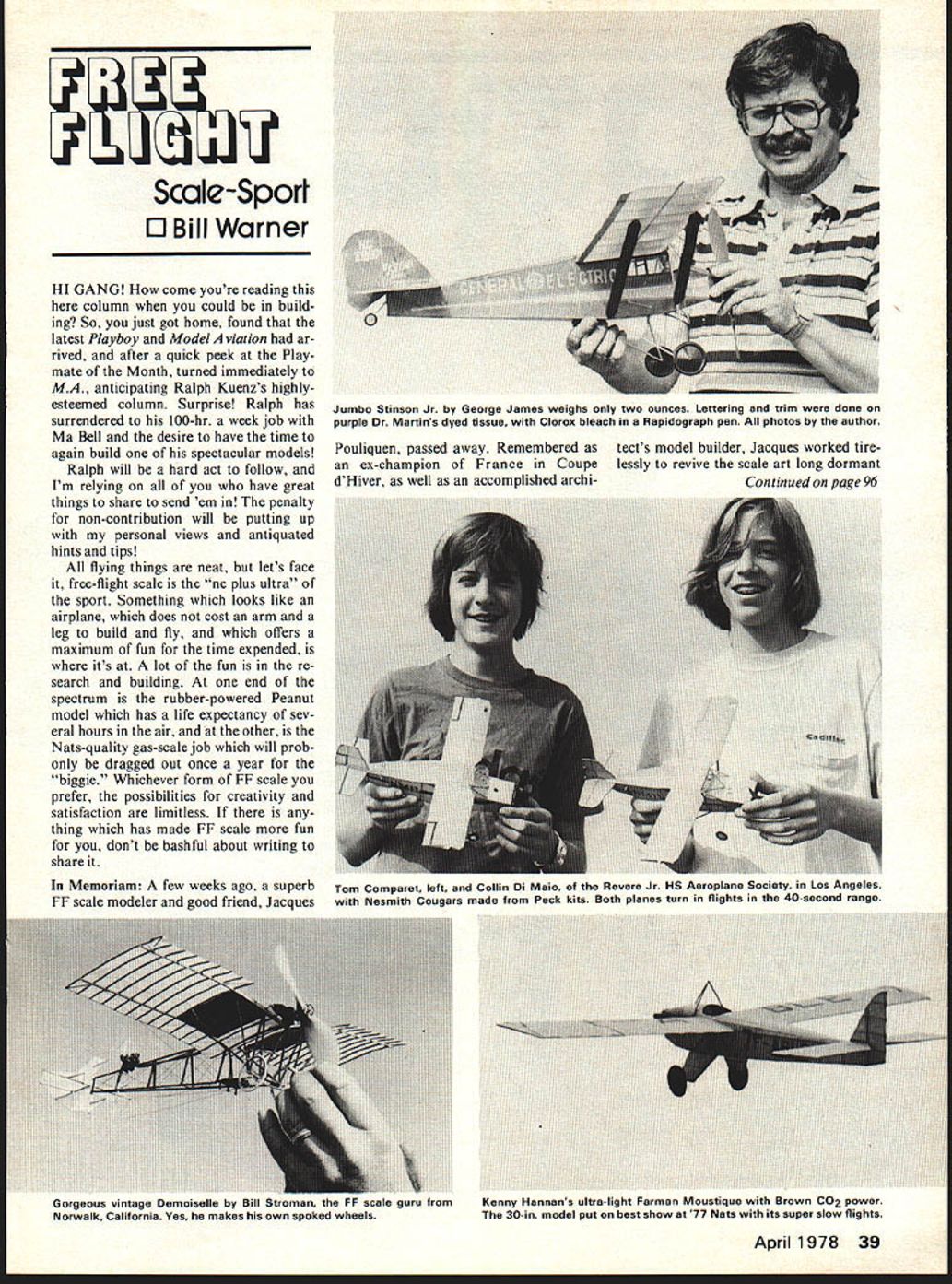
Bleaching Dr. Martin: A nifty new way to get light letters and trim on a dark background comes from George James. George uses Dr. Martin's dye on white tissue (purple), and then, with a small brush and Clorox bleach, bleaches out the unwanted areas. A Rapidograph pen is handy to do small letters and make the edges of the trim and large letters sharp. Try it next time you want an ultra-light job! I generally use the Press Bruning method of sticking on opaque letters from color-doped tissue, using spray rubber cement, but that does add a bit of heavy to some models.
Until next time, thermals! Send ideas, pix, etc. We pay for those used.
Bill Warner, 423-C San Vicente Blvd., Santa Monica, CA 90402.
Transcribed from original scans by AI. Minor OCR errors may remain.

