
Free Flight: Scale-Sport
Bill Warner
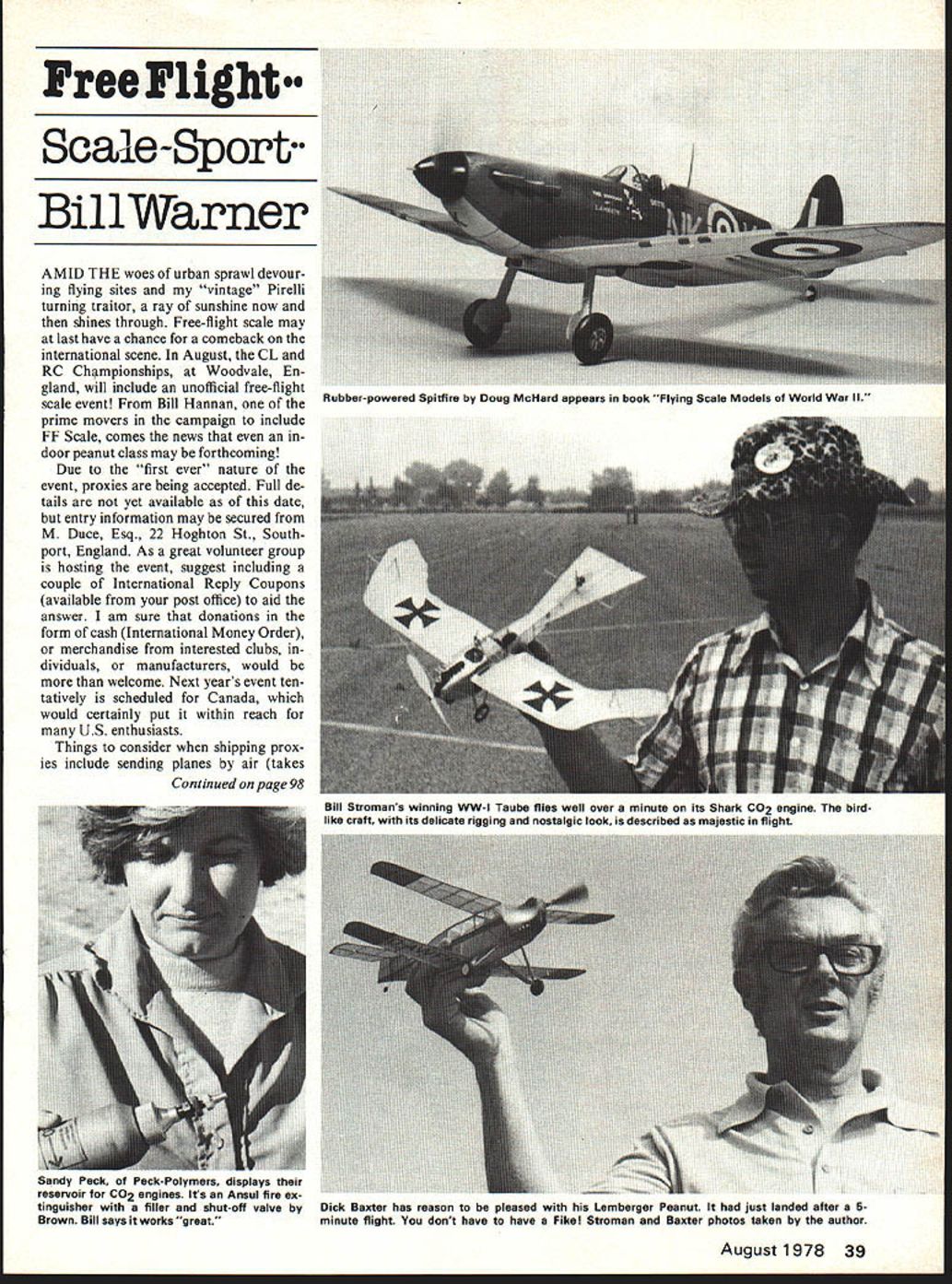
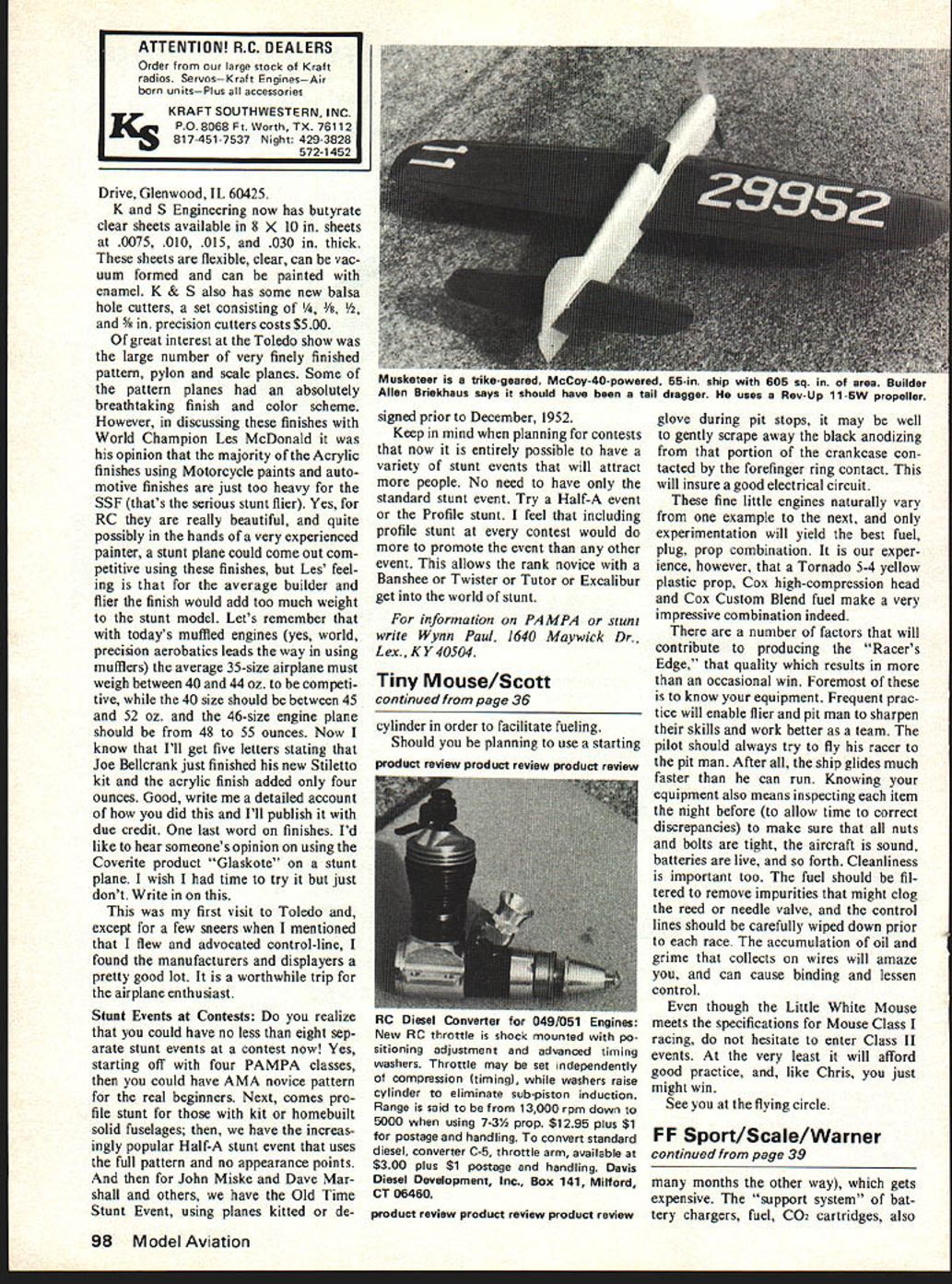
AMID THE woes of urban sprawl devouring flying sites and my "vintage" Pirelli turning traitor, a ray of sunshine now and then shines through. Free-flight scale may at last have a chance for a comeback on the international scene. In August, the CL and RC Championships, at Woodvale, England, will include an unofficial free-flight scale event! From Bill Hannan, one of the prime movers in the campaign to include FF Scale, comes the news that even an indoor peanut class may be forthcoming!
Due to the "first ever" nature of the event, proxies are being accepted. Full details are not yet available as of this date, but entry information may be secured from M. Duce, Esq., 22 Hoghton St., Southport, England. As a great volunteer group is hosting the event, suggest including a couple of International Reply Coupons (available from your post office) to aid the answer. I am sure that donations in the form of cash (International Money Order), or merchandise from interested clubs, individuals, or manufacturers, would be more than welcome. Next year's event tentatively is scheduled for Canada, which would certainly put it within reach for many U.S. enthusiasts.
Things to consider when shipping proxies include sending planes by air (takes Drive, Glenwood, IL. 60425.
K & S Engineering now has butyrate clear sheets available in 8 X 10 in. sheets at .0075, .010, .015, and .030 in. thick. These sheets are flexible, clear, can be vacuum formed and can be painted with enamel. K & S also has some new balsa hole cutters, a set consisting of 1/4, 3/8, 1/2, and 5/8 in. precision cutters; costs $5.00.
Of great interest at the Toledo show was the large number of very finely finished pattern, pylon and scale planes. Some of the pattern planes had an absolutely breathtaking finish and color scheme. However, in discussing these finishes with World Champion Les McDonald it was his opinion that the majority of the Acrylic finishes using Motorcycle paints and automotive finishes are just too heavy for the SSF (that's the serious stunt flier). Yes, for RC they are really beautiful, and quite possibly in the hands of a very experienced painter, a stunt plane could come out competitive using these finishes, but Les' feeling is that for the average builder and flier the finish would add too much weight to the stunt model. Let's remember that with today's muffled engines (yes, world precision aerobatics leads the way in using mufflers) the average 35-size airplane must weigh between 40 and 44 oz. to be competitive, while the 40 size should be between 45 and 52 oz., and the 46-size engine plane should be from 48 to 55 ounces. Now I know that I'll get five letters stating that Joe Bellcrank just finished his new Stiletto kit and the acrylic finish added only four ounces. Good, write me a detailed account of how you did this and I'll publish it with due credit. One last word on finishes. I'd like to hear someone's opinion on using the Coverite product "Glaskote" on a stunt plane. I wish I had time to try it but just don't. Write in on this.
This was my first visit to Toledo and, except for a few sneers when I mentioned that I flew and advocated control-line, I found the manufacturers and displayers a pretty good lot. It is a worthwhile trip for the airplane enthusiast.
Stunt Events at Contests:
Do you realize that you could have no less than eight separate stunt events at a contest now! Yes, starting off with four PAMPA classes, then you could have AMA novice pattern for the real beginners. Next, comes profile stunt for those with kit or homebuilt solid fuselages; then we have the increasingly popular Half-A stunt event that uses the full pattern and no appearance points. And then for John Miske and Dave Marshall and others, we have the Old Time Stunt Event, using planes kitted or designed prior to December, 1952.
Keep in mind when planning for contests that now it is entirely possible to have a variety of stunt events that will attract more people. No need to have only the standard stunt event. Try a Half-A event or the Profile stunt. I feel that including profile stunt at every contest would do more to promote the event than any other event. This allows the rank novice with a Banshee or Twister or Tutor or Excalibur get into the world of stunt.
For information on PAMPA or stunt write Wynn Paul, 1640 Maywick Dr., Lex., KY 40504. needs to go, preferably not in the same box as the model!
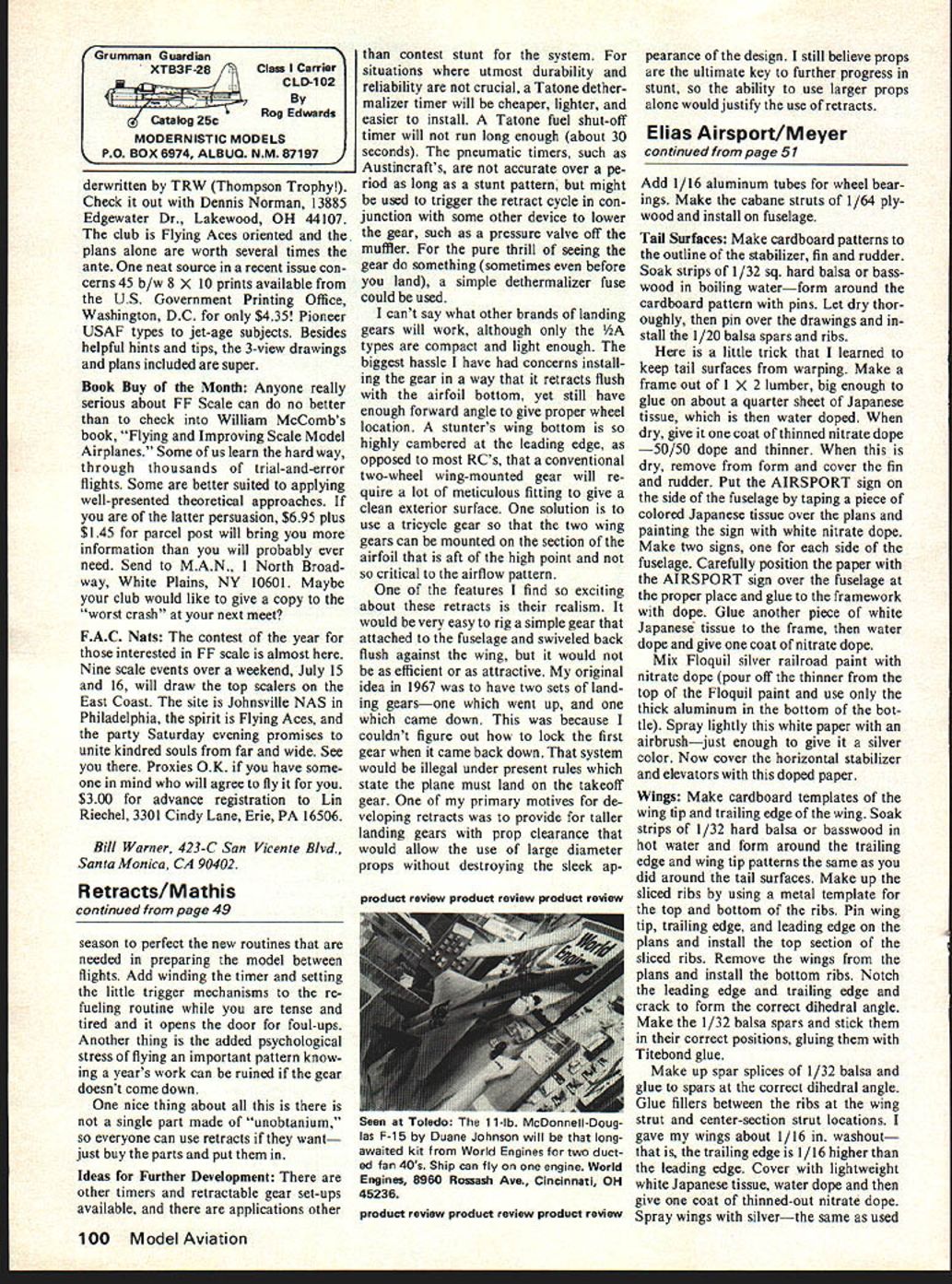
A good choice would be something on the order of a 12" span Gee Sport powered by one of the British CO2 motors. It is compact, well-documented, a good flier, easily-repaired, simple enough to build "stick-for-stick" in a small size, capable of R.O.G.'s, and with a British power-plant should prove easy for a proxy flier to handle. Hannan prefers a rubber peanut scale ship for the proxy route. Bill figures that there might even be an unused corner in one of those big RC model boxes into which a peanut could fit.
Wings Over Mexico: A recent issue of the Los Angeles Times carried an item which made me sit up and take notice. A gang of marijuana traders was ambushed by the Mexican police about 75 miles southwest of Ciudad Juarez in a pre-dawn raid. Leaving a half-ton of cargo behind, the villains fled in a camouflaged World War II B-29! That was the story the agents gave their superiors. If you were chief would you believe it?
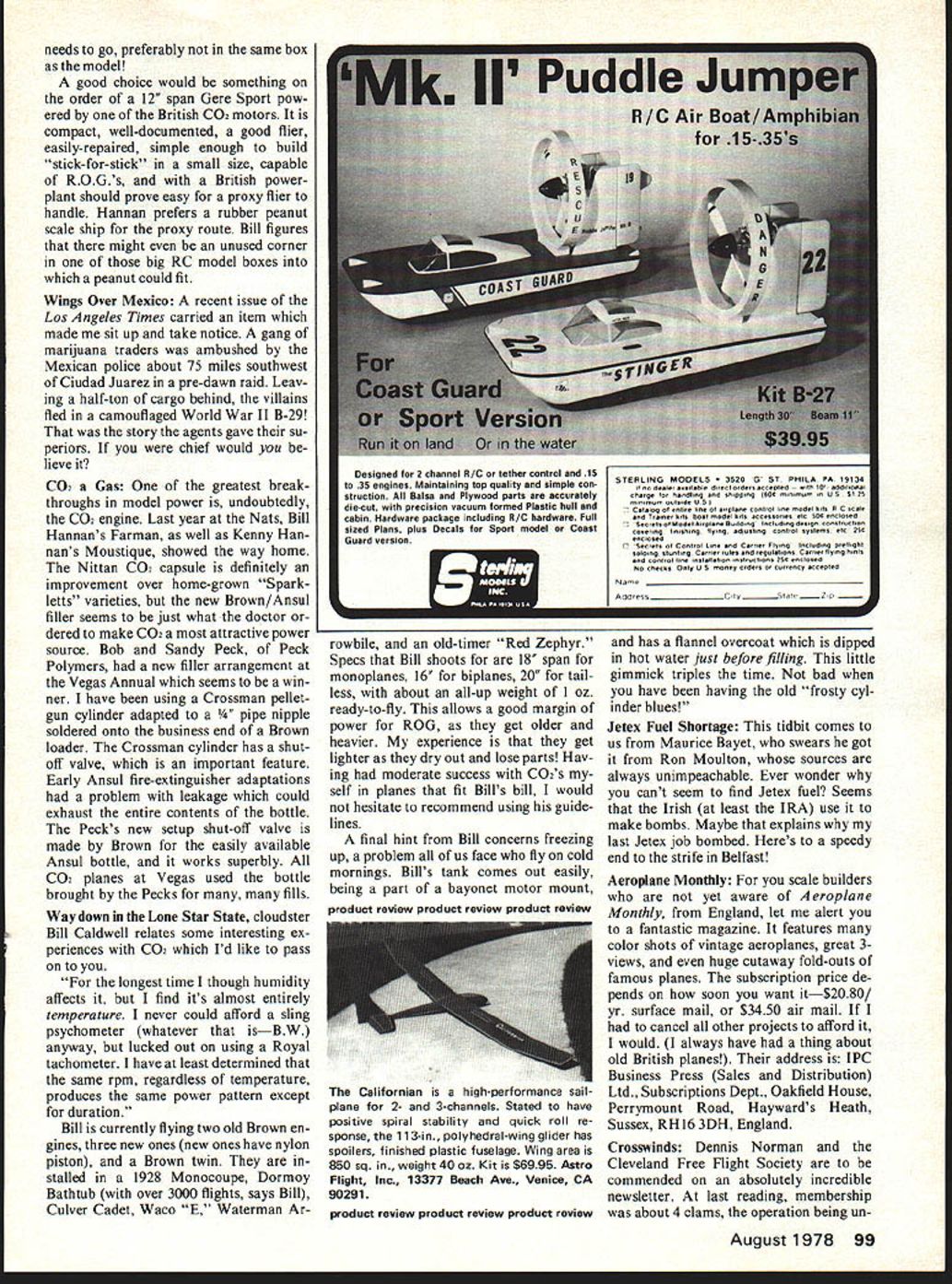
CO2 a Gas: One of the greatest breakthroughs in model power is, undoubtedly, the CO2 engine. Last year at the Nats, Bill Hannan's Farman, as well as Kenny Hannan's Moustique, showed the way home. The Nittan CO2 capsule is definitely an improvement over home-grown "Sparkletts" varieties, but the new Brown/Ansul filler seems to be just what the doctor ordered to make CO2 a most attractive power source. Bob and Sandy Peck, of Peck Polymers, had a new filler arrangement at the Vegas Annual which seems to be a winner. I have been using a Crossman pellet-gun cylinder adapted to a 1/4" pipe nipple soldered onto the business end of a Brown loader. The Crossman cylinder has a shut-off valve, which is an important feature. Early Ansul fire-extinguisher adaptions had a problem with leakage which could exhaust the entire contents of the bottle. The Peck's new setup shut-off valve is made by Brown for the easily available Ansul bottle, and it works superbly. All CO2 planes at Vegas used the bottle brought by the Pecks for many, many fills.
Way down in the Lone Star State, cloudbuster Bill Caldwell relates some interesting experiences with CO2 which I'd like to pass on to you.
"For the longest time I though humidity affects it, but I find it's almost entirely temperature. I never could afford a sling psychrometer (whatever that is—B.W.), anyway, but lucked out on using a Royal tachometer. I have at least determined that the same rpm, regardless of temperature, produces the same power pattern except for duration."
Bill is currently flying two old Brown engines, three new ones (new ones have nylon piston), and a Brown twin. They are installed in a 1928 Monocoupe, Dormoy Bathtub (with over 3000 flights, says Bill), Culver Cadet, Waco "E", Waterman Airrowbile, and an old-timer "Red Zephyr." Specs that Bill shoots for are 18" span for monoplanes, 16" for biplanes, 20" for tailless, with about an all-up weight of 1 oz. ready-to-fly. This allows a good margin of power for ROG, as they get older and heavier. My experience is that they get lighter as they dry out and lose parts! Having had moderate success with CO2's myself in planes that fit Bill's bill, I would not hesitate to recommend using his guidelines.
A final hint from Bill concerns freezing up, a problem all of us face who fly on cold mornings. Bill's tank comes out easily, being a part of a bayonet motor mount; and has a flannel overcoat which is dipped in hot water just before filling. This little gimmick triples the time. Not bad when you have been having the old "frosty cylinder blues"!
Jetex Fuel Shortage: This tidbit comes to us from Maurice Bayet, who swears he got it from Ron Moulton, whose sources are always unimpeachable. Ever wonder why you can't seem to find Jetex fuel? Seems that the Irish (at least the IRA) use it to make bombs. Maybe that explains why my last Jetex job bombed. Here's to a speedy end to the strife in Belfast!
Aeroplane Monthly: For you scale builders who are not yet aware of Aeroplane Monthly, from England, let me alert you to a fantastic magazine. It features many color shots of vintage aeroplanes, great 3-views, and even huge cutaway fold-outs of famous planes. The subscription price depends on how soon you want it—$20.80/yr. surface mail, or $34.50 air mail. If I had to cancel all other projects to afford it, I would. (I always have had a thing about old British planes!). Their address is IPC Business Press (Sales and Distribution) Ltd., Subscriptions Dept., Oakfield House, Perrymount Road, Hayward's Heath, Sussex, RH16 3DH, England.
Crosswinds: Dennis Norman and the Cleveland Free Flight Society are to be commended on an absolutely incredible newsletter. At last reading, membership was about 4 clams, the operation being un- Underwritten by TRW (Thompson Trophy!). Check it out with Dennis Norman, 13885 Edgewater Dr., Lakewood, OH 44107. The club is Flying Aces oriented and the plans alone are worth several times the ante. One neat source in a recent issue concerns 45 b/w 8 x 10 prints available from the U.S. Government Printing Office, Washington, D.C. for only $4.35! Pioneer USAF types to jet-age subjects. Besides helpful hints and tips, the 3-view drawings and plans included are super.
Book Buy of the Month: Anyone really serious about FF Scale can do no better than to check into William McComb's book, "Flying and Improving Scale Model Airplanes." Some of us learn the hard way, through thousands of trial-and-error flights. Some are better suited to applying well-presented theoretical approaches. If you are of the latter persuasion, $6.95 plus $1.45 for parcel post will bring you more information than you will probably ever need. Send to M.A.N., 1 North Broadway, White Plains, NY 10601. Maybe your club would like to give a copy to the "worst crash" at your next meet?
F.A.C. Nats: The contest of the year for those interested in FF scale is almost here. Nine scale events over a weekend, July 15 and 16, will draw the top scalers on the East Coast. The site is Johnsville NAS in Philadelphia, the spirit is Flying Aces, and the party Saturday evening promises to unite kindred souls from far and wide. See you there. Proxies O.K. If you have someone in mind who will agree to fly it for you. $3.00 for advance registration to Lin Riechel, 3301 Cindy Lane, Erie, PA 16506.
Bill Warner, 423-C San Vicente Blvd., Santa Monica, CA 90402.
Transcribed from original scans by AI. Minor OCR errors may remain.

