
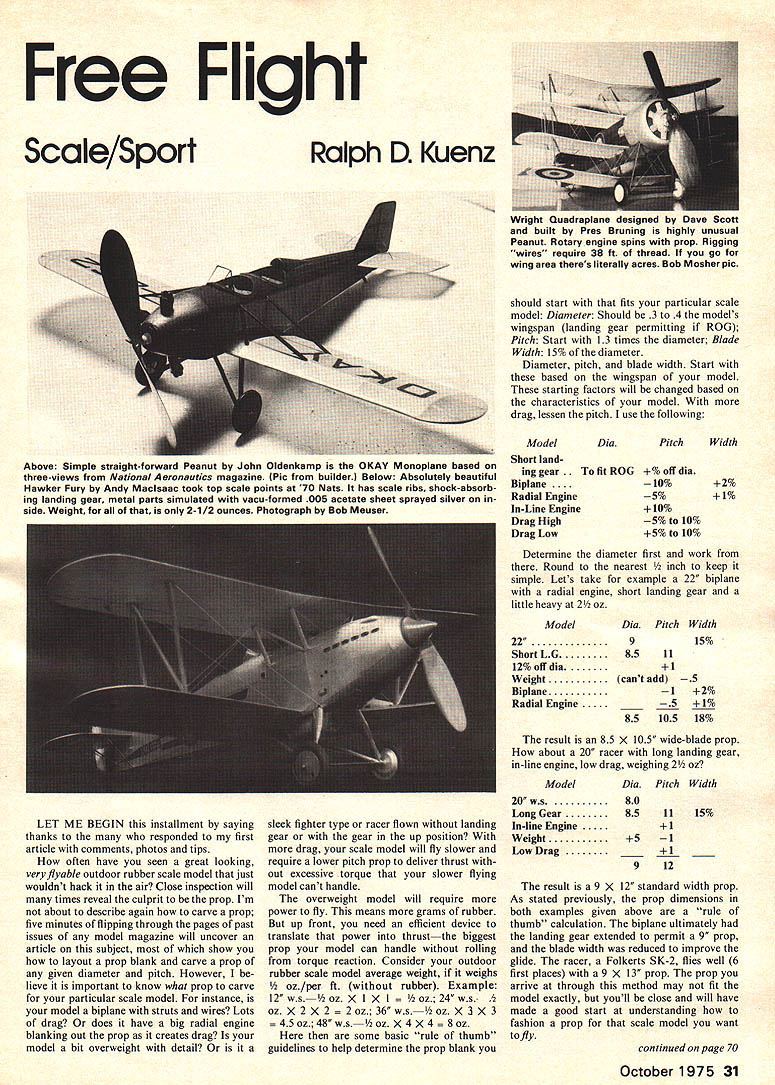
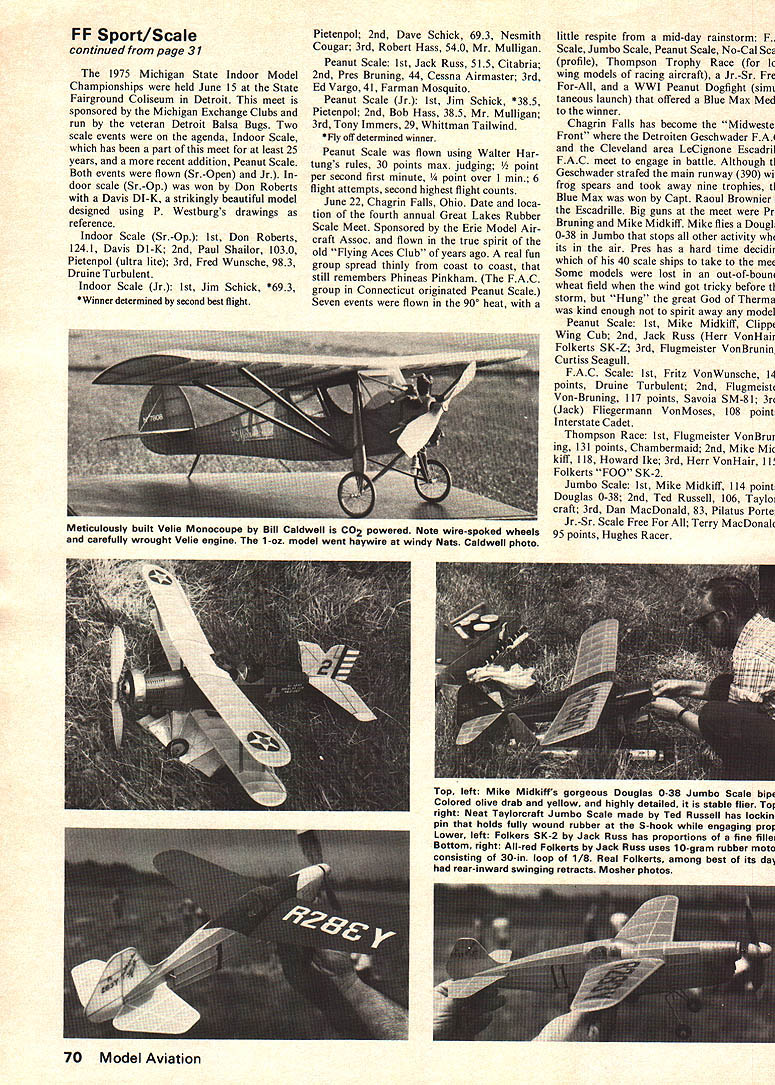
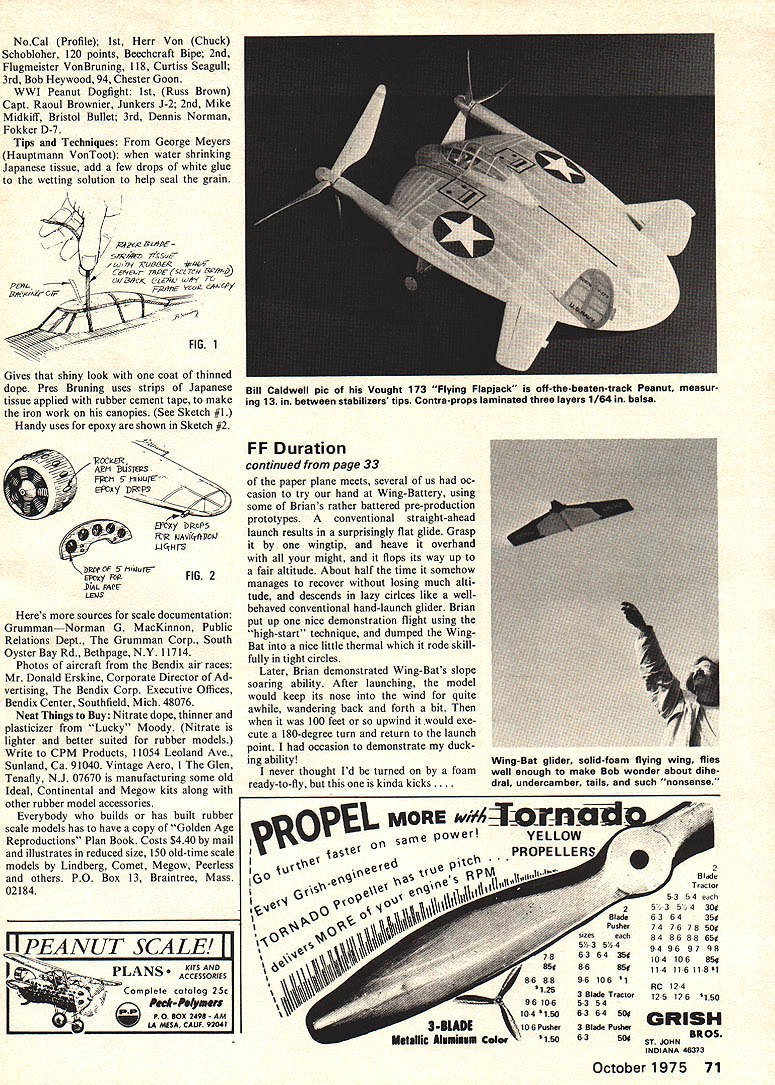
Free Flight
Scale/Sport
Ralph D. Kuenz
LET ME BEGIN this installment by saying thanks to the many who responded to my first article with comments, photos and tips.
How often have you seen a great looking, very flyable outdoor rubber scale model that just wouldn’t hack it in the air? Close inspection will many times reveal the culprit to be the prop. I’m not about to describe again how to carve a prop; five minutes of flipping through the pages of past issues of any model magazine will uncover an article on this subject, most of which show how to layout a prop blank and carve a prop of any given diameter and pitch. However I believe it is important to know what prop to carve for your particular scale model. For instance, is your model a biplane with struts and wires? Lots of drag? Or does it have a big radial engine blanking out the prop as it creates drag? Is the model a bit overweight with detail? Or is it a sleek fighter type or racer flown without landing gear or with the gear in the up position? With more drag, your scale model will fly slower and require a lower pitch prop to deliver thrust without excessive torque that your slower flying model can’t handle.
The overweight model will require more power to fly. This means more grams of rubber. But up front, you need an efficient device to translate that power into thrust—the biggest prop your model can handle without rolling from torque reaction. Consider your outdoor rubber scale model average weight when figuring prop size.
You should start with that which fits your particular scale model:
- Diameter: Should be .3 to .4 the model’s wingspan (landing gear permitting if ROG);
- Pitch: Start with 1.3 times the diameter;
- Blade Width: 15% of the diameter.
Diameter, pitch, and blade width. Start with these based on the wingspan of your model. These starting factors will be changed based on the characteristics of your model. With more drag, lessen the pitch. I use the following:
Model Dia. Pitch Width Short landing gear . . . To fit ROG (adjust diameter downward to fit) Biplane -10% (reduce pitch) +2% (width) Radial Engine -5% (reduce pitch) +1% (width) In-line Engine +10% (increase pitch) +1% (width) Drag High (reduce pitch 5% to 10%) Drag Low (increase pitch 5% to 10%)
Determine the diameter first and work from there. Round to the nearest 1/2 inch to keep it simple. Let’s take for example a 22" biplane with a radial engine, short landing gear and a little heavy at 2½ oz.
Model Dia. Pitch Width 22" 9 11 15% Short L.G. 8.5 10.5 18% 12% off dia. Weight (can’t add) -5 Biplane -1 +2% Radial Engine -5 +1%
The result is an 8.5 × 10.5" wide-blade prop.
How about a 20" racer with long landing gear, in-line engine, low drag, weighing 2 oz?
Model Dia. Pitch Width 20" 8.0 8.5 11 15% Long Gear 8.5 11 15% In-line Engine +5 +1 Weight +5 -1 Low Drag +1 +2
The result is a 9 × 12" standard width prop.
As stated previously, the prop dimensions in both examples given above are a “rule of thumb” calculation. The biplane ultimately had the landing gear extended to permit a 9" prop, and the blade width was reduced to improve the glide. The racer, a Folkerts SK-2, flies well (6 first places) with a 9 × 13" prop. The prop you arrive at through this method may not fit the model exactly, but you’ll be close and will have made a good start at understanding how to fashion a prop for that scale model you want to fly. The 1975 Michigan State Indoor Model Championships were held June 15 at the State Fairground Coliseum in Detroit. This meet is sponsored by the Michigan Exchange Clubs and run by the veteran Detroit Balsa Bugs. Two scale events were on the agenda, Indoor Scale, which has been a part of this meet for at least 25 years, and a more recent addition, Peanut Scale. Both events were flown (Sr.-Op.). Indoor Scale (Sr.-Op.) was won by Don Roberts, with a Davis DI-K, a strikingly beautiful model designed using P. Westburg's drawings as reference.
Indoor Scale (Sr.-Op.): 1st Don Roberts 124.1, Davis DI-K; 2nd Paul Shailor 103.0, Pietenpol (ultra lite); 3rd Fred Wunsche 98.3, Druine Turbulent.
Indoor Scale (Jr.): 1st Jim Schick *69.3. *Winner determined by second best flight. Pietenpol. 2nd Dave Schick 69.3, Nesmith Cougar. 3rd Robert Hass 54.0, Mr. Mulligan.
Peanut Scale (Sr.): 1st Jack Russ 51.5, Citabria; 2nd Pres Bruning 44, Cessna Airmaster; 3rd Ed Vargo 41, Farman Mosquito.
Peanut Scale (Jr.): 1st Jim Schick *385, Pietenpol.
Peanut Scale was flown using Walter Hartung's rules, 30 points max. judging; 1/2 point per second first minute, 1/4 point over 1 minute; 6 flight attempts, second highest flight counts.
June 22, Chagrin Falls, Ohio. Date and location of the fourth annual Great Lakes Rubber Scale Meet. Sponsored by the Erie Model Aircraft Assoc. and flown in the true spirit of the old "Flying Clubs" of years ago. A real fun group spread thinly from coast to coast, that covers several members Phineas Pinkham. (The F.A.C. group in Connecticut originated Peanut Scale.) Seven events were flown in the 90° heat, with a little respite from a mid-day rainstorm: F.A.C. Scale, Jumbo Scale, Peanut Scale, No-Cal Scale (profile), Thompson Trophy Race (for free flight models of racing aircraft), Jr.-Sr. Free-For-All, and a WWI Peanut Dogfight (six teams) that offered a Blue Max Medal to the winner.
Free Flight: Scale/Sport
LET ME BEGIN this installment by saying thanks to those who responded to the first article with comments, photos and tips. I have often seen a great-looking, very flyable outdoor rubber scale model that just wouldn't hack the air. Close inspection will at times reveal the culprit to be the prop. I'm about to describe again how to carve a prop in five minutes.
Flipping through pages of past issues of Model Aviation magazine will uncover articles whose subject shows the layout of the prop blank and how to carve a prop given diameter, pitch and blade width. However, it's important to know what prop to carve for a particular scale model. In many instances — model biplane, struts, wires — lots of drag, or a big radial engine blanking out the prop, creates drag. A model a bit overweight in detail (Ralph D. Kuenz's sleek fighter-type racer, for example, was flown with the landing gear in the gear-up position) will fly slower and require a lower-pitch prop to deliver thrust without excessive torque. A slower-flying model can't handle much rolling torque. An overweight model will require more power to fly, which means more grams of rubber up front and an efficient device to translate power into thrust — the biggest prop the model can handle is limited by rolling torque reaction.
Consider an outdoor rubber scale model average weight in ounces per foot of wingspan. Example:
- 12" ws = 2 oz
- 24" ws = 4 oz
- 36" ws = 6 oz
- 48" ws = 8 oz
Some basic rule-of-thumb guidelines help determine the prop blank.
Diameter: Should be 3/4 of the model's wingspan (landing gear permitting - ROG). Pitch: Start 13 times the diameter. Blade width: 15% of diameter.
Start based on wingspan; model starting factors will change based on characteristics such as drag. To lessen pitch, use the following adjustments:
- Short landing gear: -10% off diameter
- Biplane: -5% off diameter
- Radial engine: -5% off diameter
- In-line engine: +10% to diameter
- High drag: -5% to pitch
- Low drag: +10% to pitch
Determine diameter first and then round to the nearest simple size.
Let's take an example: a 22" wingspan biplane with a radial engine and short landing gear, a little heavy — say 2 oz.
Model: 22" ws — Short LG — 12% off dia — Weight: 2 oz — Biplane — Radial Engine Dia: 8.5" Pitch: 10.5" Width: 1.8" Result: 8.5 × 10.5 wide‑blade prop (about)
Another example: a 20" wingspan racer with long landing gear, in-line engine, low drag, weighing 2 oz.
Model: 20" ws — Long Gear — In-line Engine — Weight: 2 oz — Low Drag Dia: 9" Pitch: 12" Width: standard Result: 9 × 12 standard width prop
As stated previously, prop dimensions in both examples were given by rule-of-thumb calculation. On a biplane, if landing gear extended permits, a 9" prop blade width may be reduced to improve glide. The Folkerts SK-2 racer flies well and won first places with a 9 × 13 prop. The props arrived through this method may not fit your model exactly, but you'll be close and will have made a good start in understanding how to fashion a prop a scale model will want to fly.
Transcribed from original scans by AI. Minor OCR errors may remain.

