
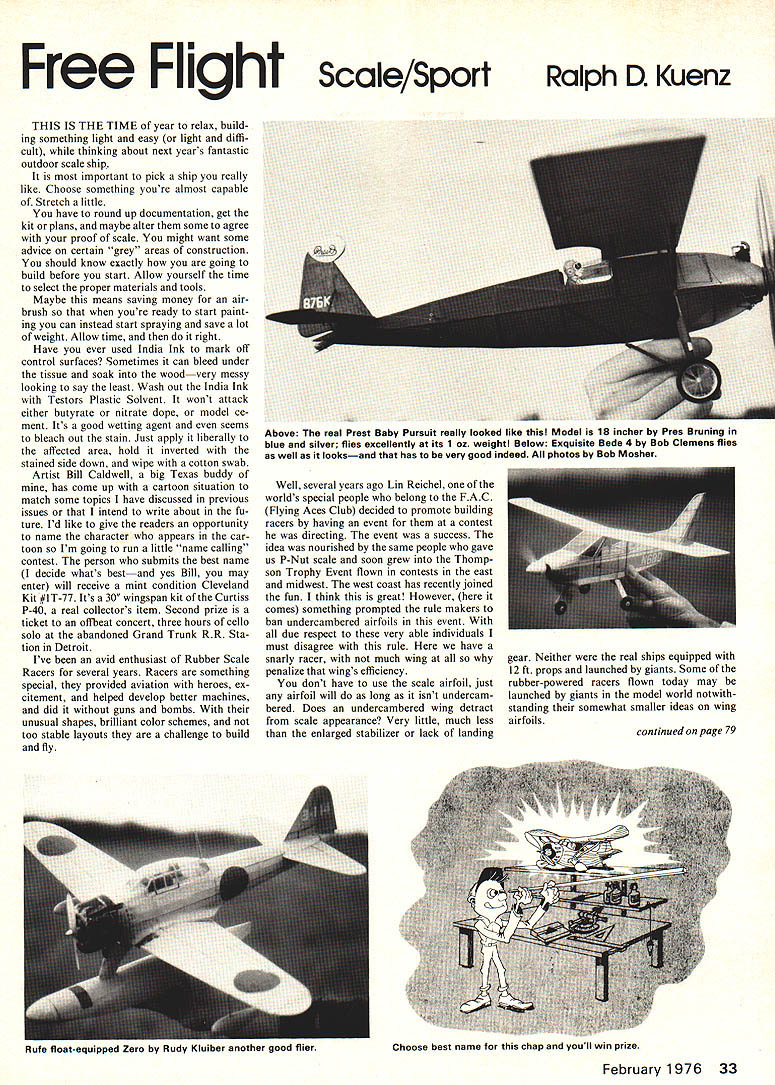
Free Flight: Scale/Sport
Ralph D. Kuenz
THIS IS THE TIME of year to relax, building something light and easy (or light and difficult), while thinking about next year's fantastic outdoor scale ship.
It is most important to pick a ship you really like. Choose something you're almost capable of. Stretch a little.
You have to round up documentation, get the kit or plans, and maybe alter them some to agree with your proof of scale. You might want some advice on certain "grey" areas of construction. You should know exactly how you are going to build before you start. Allow yourself the time to select the proper materials and tools.
Maybe this means saving money for an airbrush so that when you're ready to start painting you can instead start spraying and save a lot of weight. Allow time, and then do it right.
Have you ever used India Ink to mark off control surfaces? Sometimes it can bleed under the tissue and soak into the wood—very messy looking to say the least. Wash out the India Ink with Testors Plastic Solvent. It won't attack either butyrate or nitrate dope, or model cement. It's a good wetting agent and even seems to bleach out the stain. Just apply it liberally to the affected area, hold it inverted with the stained side down, and wipe with a cotton swab.
Artist Bill Caldwell, a big Texas buddy of mine, has come up with a cartoon situation to match some topics I have discussed in previous issues or that I intend to write about in the future. I'd like to give the readers an opportunity to name the character who appears in the cartoon. I'm going to run a little "name calling" contest. The person who submits the best name (I decide what's best—and yes Bill, you may enter) will receive a mint condition Cleveland Kit #IT-77. It's a 30" wingspan kit of the Curtiss P-40, a real collector's item. Second prize is a ticket to an offbeat concert, three hours of cello solo at the abandoned Grand Trunk R.R. Station in Detroit.
I've been an avid enthusiast of Rubber Scale Racers for several years. Racers are something special; they provided aviation with heroes, excitement, and helped develop better machines, and did it without guns and bombs. With their unusual shapes, brilliant color schemes, and not too stable layouts they are a challenge to build and fly.
Well, several years ago Lin Reichel, one of the world's special people who belong to the F.A.C. (Flying Aces Club) decided to promote building racers by having an event for them at a contest he was directing. The event was a success. The idea was nourished by the same people who gave us P-Nut scale and soon grew into the Thompson Trophy Event flown in contests in the east and midwest. The west coast has recently joined the fun. I think this is great! However, (here it comes) something prompted the rule makers to ban undercambered airfoils in this event. With all due respect to these very able individuals I must disagree with this rule. Here we have a snarly racer, with not much wing at all so why penalize that wing's efficiency.
You don't have to use the scale airfoil, just any airfoil will do as long as it isn't undercambered. Does an undercambered wing detract from scale appearance? Very little, much less than the enlarged stabilizer or lack of landing gear. Neither were the real ships equipped with 12 ft. props and launched by giants. Some of the rubber-powered racers flown today may be launched by giants in the model world notwithstanding their somewhat smaller ideas on wing airfoils.
Free Flight: Scale/Sport
A recent issue of Air Classics magazine contained an article by Peter Westburg on the Air Transport Meteor. Complete with superb drawings, Mr. Westburg noted that the Meteor was an excellent model subject, an example of which built by Walt Eggert won the National Model Championships three times.
This introduces Walt Eggert who offers a tip on trimming free flight biplanes. "Always rig your model with more incidence in the lower wing than in the upper wing, regardless of the stagger." Generally, it is the practice in full-size aircraft to carry more incidence in the forward wing (usually the upper wing) so that when the aircraft approaches a stall, the forward wing stalls first, shifting the center of lift rearward, and the nose drops stopping the stall.
In a model, however, this would mean you are suddenly flying a low-wing monoplane with a lot of structure drag above the C.G. — a very unstable configuration. If, however, you cause the lower wing to stall first, you are then flying a high-wing parasol, a very stable type. Seems to make good sense.
My address is: 14645 Stahelin, Detroit, Mich. 48223.
Transcribed from original scans by AI. Minor OCR errors may remain.

