
Free Flight: Scale/Sport
Ralph D. Kuenz
EVER WONDER how many hundred square feet of type have been used up in the controversy over Peanut Scale rules? The issue ranges from the avid scale type that wants another full-scale event for smaller models to the strictly fun flier that wants a mild form of relaxing competition. Standing off to the side are others, one the four-gram model builder surrounded by trophies. Is he a culprit? Can you build a four-gram "scale" ship? It's really quite an accomplishment in the eyes of an indoor or door builder. Another guy found on the sidelines is the seven-year-old. He doesn't understand the complex rules fashioned by the warring eagles that build and fly these tiny models. Let's not crowd him out of the arena. I want to see him in the middle of the field or gym floor beaming with pride, flying his model.
Let's keep the spirit of the event in mind. I have run this event at perhaps 25 meets and several Nationals. I've seen the super competitive type fly it, I've seen the kids live every second of each flight. Kim Mather standing still for the very first time in his life, thumb stuck in his side as if to pin himself right there as his tiny red model circles above. A very young-at-heart Rolfe Gregory strutting out on the floor to retrieve his beautiful blue and silver Travelair biplane. Barry Pailet releases his Pilatus and runs to his dad's side to share with Jean this moment.
When we're all through thrashing around with the Peanut Scale rules, I believe these things will still happen because tiny little Peanut Scale is much bigger than all of us.
Received a request from Dr. John Martin, 3227 Darwin St., Miami, Fla. 33133 for old AMA rule books. Doc is planning on doing an article on how Scale rules have progressed through the years. Indoor Scale rules that is. Doc is editor of the Hanger Pilot, bugle for the M.I.A.M.A. indoor club in Dade County, Fla. This group ran Peanut Scale at last year's Nats, and Doc, too, makes a lot of strange noises over present rules in this event.
In the last column some words were devoted to Rubber Scale racers; here are some more. Lin Reichel informs me that he intends to run a Thompson Trophy race as an unofficial event at this year's Nationals, provided that (1) the Nats are held at Dayton, Ohio, and (2) he gets the OK to do it. Open to pre-WW II racers, miniature replicas of the Thompson Trophy will be awarded. Lin has prepared a data sheet with rules, ships that qualify, and sources for plans and documentation. A self-addressed stamped envelope to either Lin Reichel, 3301 Cindy Lane, Erie, Pa., or myself will get you one.
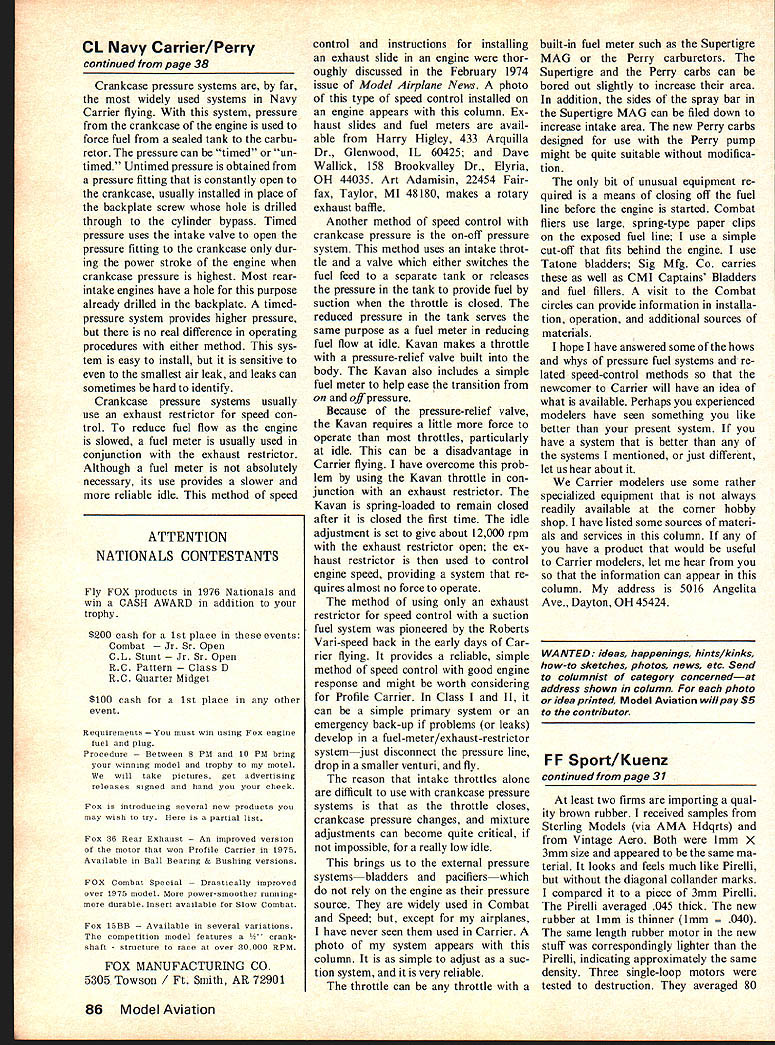
I've received a box full of mail responding to the "name calling" contest for the cartoon character. It seems that scale modelers are just naturally gifted with a great imagination for names. It will be hard to pick the winner. The winner will be announced in my next column. The month's cartoon relates to my article on props from a while back. Is balsa wood really on it's way out? I know the price has gone up terribly in the recent past, but I wasn't aware of it's "impending scarcity and eventual demise" as stated in a letter from Envoy Corp. This concern is polling modelers on their probable acceptance of a replacement for balsa wood, which they say can be made. Apparently, the initial cost is high, but if expected sales warrant developing the stuff, it will sell at about half the cost of balsa. I'll have to see a sample first. I repeat, I didn't know that good old balsa wood was on it's way out.
Tips and Techniques
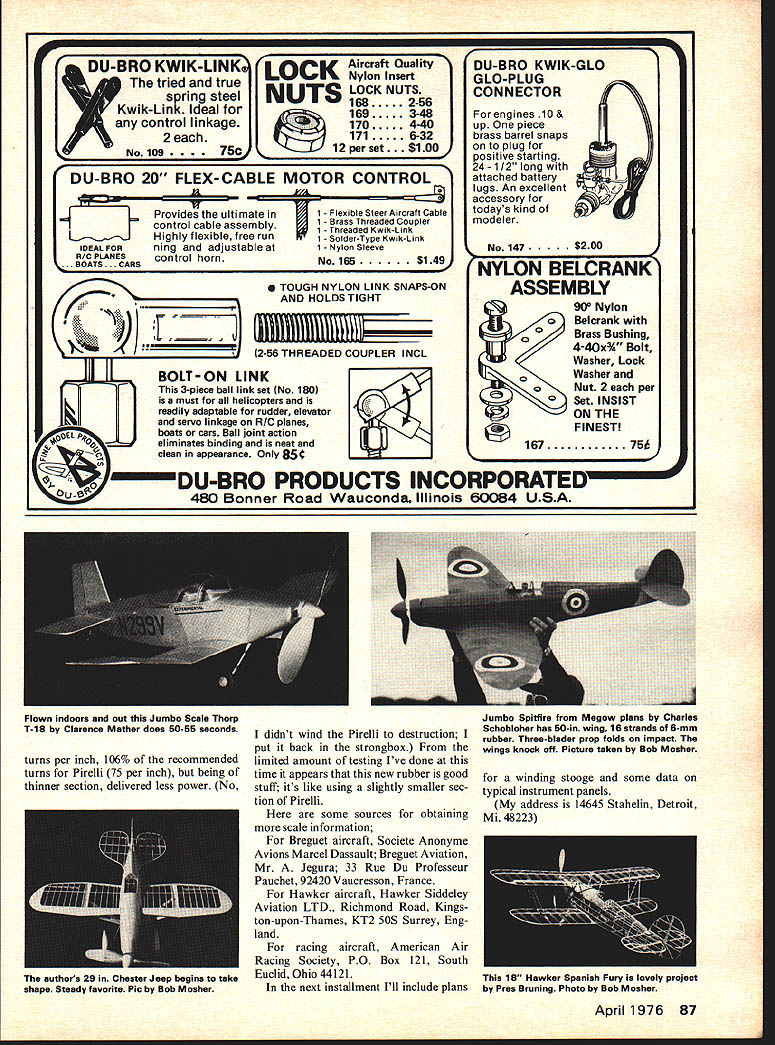
Here are some illustrations depicting the construction of realistic, functional landing gear. Sketch #1 shows a method for simulating working shock absorbers. This technique can be used on all models with similar gear such as the Curtiss Robin, Fairchild 24 and Davis Di-W. Sketch #2 is representative of the single-strut type. The bond-paper fillet, open in the rear, covers the gap in the landing gear leg/fuselage joint, and enables the landing gear leg to deflect rearward.
SKETCH #1
The type of gear shown in Sketch #3 could be used on a Ryan STM, Aeroneer, Miles Mohawk, or a typical fixed-gear-spatted Japanese carrier plane. This method allows the wheel some controlled springing movement inside the wheel pant, and the wheel pant can also flex on the strut. Pres Bruning uses this method on his jumbo scale Aeroneer.
SKETCH #2
SKETCH #3
Sketch #4 shows a method of providing thrust adjustment for both down- and side-thrust. Use either a dowel insert or a hard- wood block at the rear of the nose block to take the wood screw. Remember to mark a vertical and horizontal reference line because, when you loosen the screw, you start from ground zero.
SKETCH #4
From Dave Stott comes the recommendation to use lacquer for applying Japanese tissue. Because lacquer shrinks very little, it doesn't pull the tissue down into the structure if you get a blob of it at a corner or at a former/stringer junction. Dave also says he does not agree with Walt Eggert on the use of more incidence on the lower wing of a biplane. (See my last column—to stall the lower wing first.) Dave always puts more incidence in the forward wing, so that as it stalls first, the center of lift is shifted rearward, aiding recovery to normal flying attitude. I've always done it as Dave does; guess I'll have to try Walt's method on a biplane to see for myself if it works better. Ever wonder why the whole Peanut Scale controversy has used up so much ink? The issue ranges from the avid scale type who wants another full-scale event to the smaller-models-only, strictly fun-flier who wants a mild, relaxing competition. Standing off to one side are the four-gram model builders, surrounded by trophies — the culprit? "Can build a four-gram scale ship." It's really quite an accomplishment.
Another fellow found himself on the sidelines as a seven-year-old who doesn't understand complex rules fashioned warring eagles to build and fly tiny models. Let's not crowd him out of the arena — we want to see him in the middle of the gym floor, beaming with pride as his flying model performs. Let's keep the spirit of the event in mind.
I've run Peanut Scale events perhaps 25 times and at several Nationals. I've seen the super-competitive type fly; I've seen kids live for a second flight. Kim Mather stood very still the first time in his life, thumb stuck to his side pin, as his tiny red model circled above. Very young-at-heart Rolfe Gregory strutted out on the floor to retrieve a beautiful blue-silver Travel-Aire biplane. Barry Pailet releases a Pilatus, runs at Dad's side to share the moment. Through all the thrashing around over Peanut Scale rules, I believe things will still happen because tiny little Peanut Scale is much bigger to us.
I received a request from Dr. John Martin, 3227 Darwin St., Miami, Fla. 33133, for old AMA rule books. Doc is planning on doing an article on how Scale rules have progressed through the years. Indoor Scale rules — Doc, editor of the Hanger Pilot bugle, MIAMA indoor club, Dade County, Fla. — his group ran Peanut Scale at last year's Nats. Doc, too, makes a lot of strange noises over the present rules for the event.
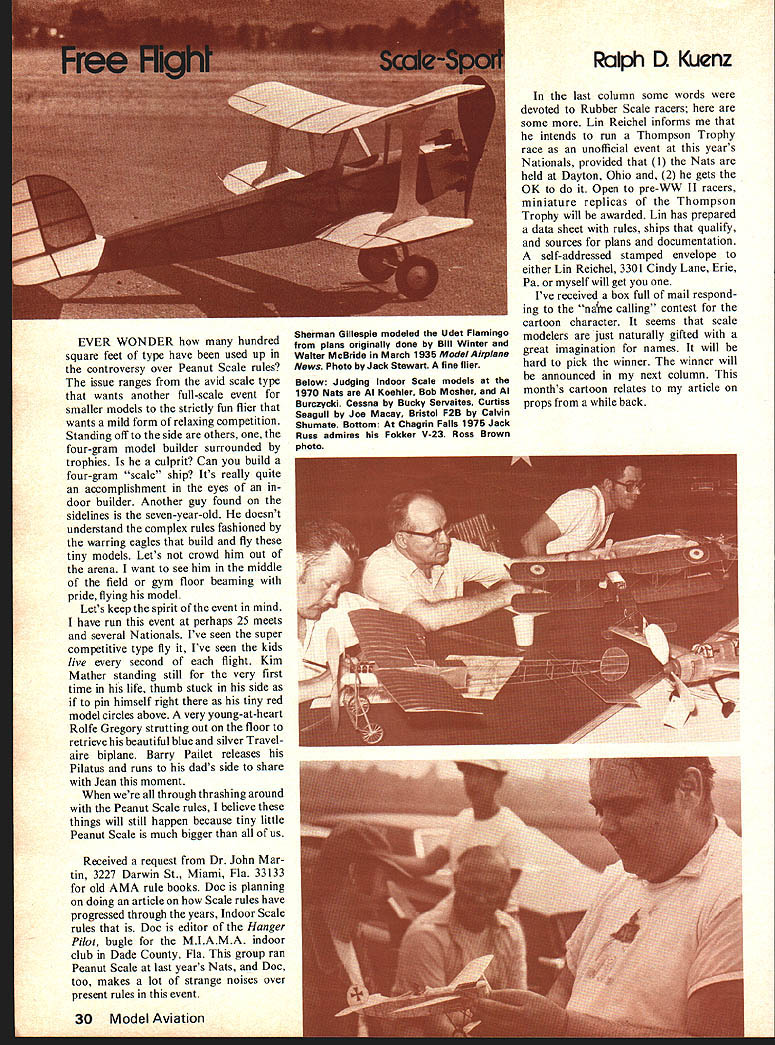
Sherman Gillespie modeled a Udet Flamingo from plans originally done by Bill Winter and Walter McBride, March 1935 Model Airplane News. Photo: Jack Stewart, fine flier.
Some words devoted to Rubber Scale racers: Lin Reichel informs me he intends to run the Thompson Trophy race as an unofficial event at this year's Nationals provided the Nats are held in Dayton, Ohio. He gets the OK for open pre-WW II racers — miniature replicas of the Thompson Trophy ships will be eligible. The Thompson Trophy will be awarded. Lin has prepared a data sheet and rules; ships qualify with sources of plans documentation. Send a self-addressed stamped envelope to Lin Reichel, 3301 Cindy Lane, Erie, Pa., and I will get a copy. I've received a box full of mail responding.
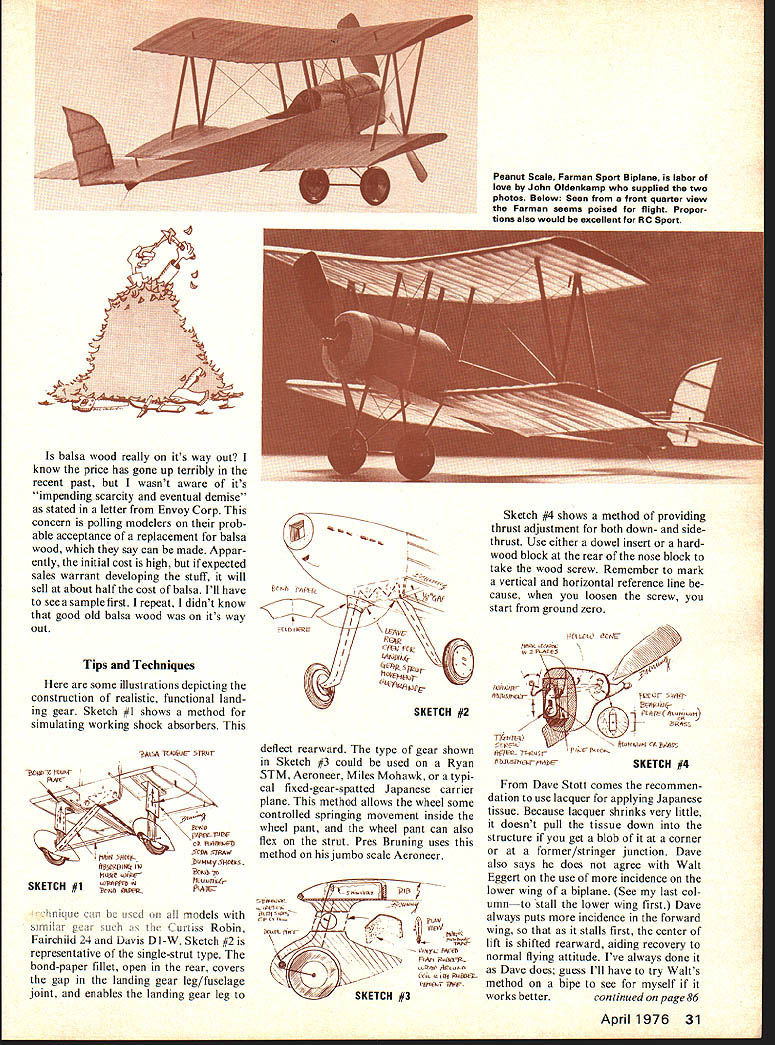
A cartoon character seems to scale modelers just naturally gifted with great imaginations. Names will be hard to pick — the winner will be announced next column. For months the cartoon relates to this article: props back Peanut Scale Farman Sport Biplane — labor of love. John Oldenkamp supplied two photos. Seen in front-quarter view, the Farman seems poised for flight. Proportions also would make an excellent RC sport ship.
A wood really is way out — I know price has gone up terribly in the recent past. I wasn't aware of its impending scarcity or eventual demise, stated a letter from Envoy Corp. Concerned with polling modelers' probable acceptance of a replacement for balsa wood, they say it can be made. Apparently initial cost is high; expected sales would have to warrant developing material that will sell at about half the cost of balsa. I'll have to see a sample first. Again, I didn't know our good old balsa wood was on its way out.
Tips & Techniques: Some illustrations depict construction of realistic, functional landing gear. Sketch #1 shows a method simulating working shock absorbers for models similar to such as the Curtiss Robin, Fairchild 24, Davis D1-W. Sketch #2 is representative of the single-strut type; bond-paper fillet opens rear covers gap at the landing-gear leg/fuselage joint and enables landing-gear leg movement. Sketch #3 could be used on Ryan, SIM, Aeroneer, Miles Mohawk — typical fixed-gear-spatted Japanese carrier-plane method allows wheel splay. Sketch #4 shows the method providing thrust adjustment for both down- and side-thrust. Use either a dowel insert or a hardwood block at the rear of the nose block to take the wood screw. Remember to mark a vertical and horizontal reference line because, when you loosen the screw, you start from ground zero.
From Dave Stott comes the recommendation to use lacquer for applying Japanese tissue. Because lacquer shrinks very little, it doesn't pull the tissue down into the structure if you get a blob of it at a corner or at a former/stringer junction. Dave also says he does not agree with Walt Eggert on the use of more incidence on the lower wing of a biplane (see my last column — to stall the lower wing first). Dave always puts more incidence in the forward wing, so that as it stalls first, the center of lift is shifted rearward, aiding recovery to normal flying attitude. I've always done it as Dave does; guess I'll have to try Walt's method on a biplane to see for myself if it works better. I didn't wind the Pirelli to destruction; I put it back in the strongbox. From the limited amount of testing I've done at this time it appears that this new rubber is good stuff; it's like using a slightly smaller section of Pirelli.
Here are some sources for obtaining more scale information:
- For Breguet aircraft, Societe Anonyme Avions Marcel Dassault; Breguet Aviation, Mr. A. Jegura; 33 Rue Du Professeur Pauchet, 92420 Vaucresson, France.
- For Hawker aircraft, Hawker Siddeley Aviation LTD., Richmond Road, Kingston-upon-Thames, KT2 5DS Surrey, England.
- For racing aircraft, American Air Racing Society, P.O. Box 121, South Euclid, Ohio 44121.
In the next installment I'll include plans for a winding stooge and some data on typical instrument panels.
(My address is 14645 Stahelin, Detroit, Mi. 48223)
Transcribed from original scans by AI. Minor OCR errors may remain.

