

Free Flight: Scale/Sport
Bill Warner
DeCarlis retract system
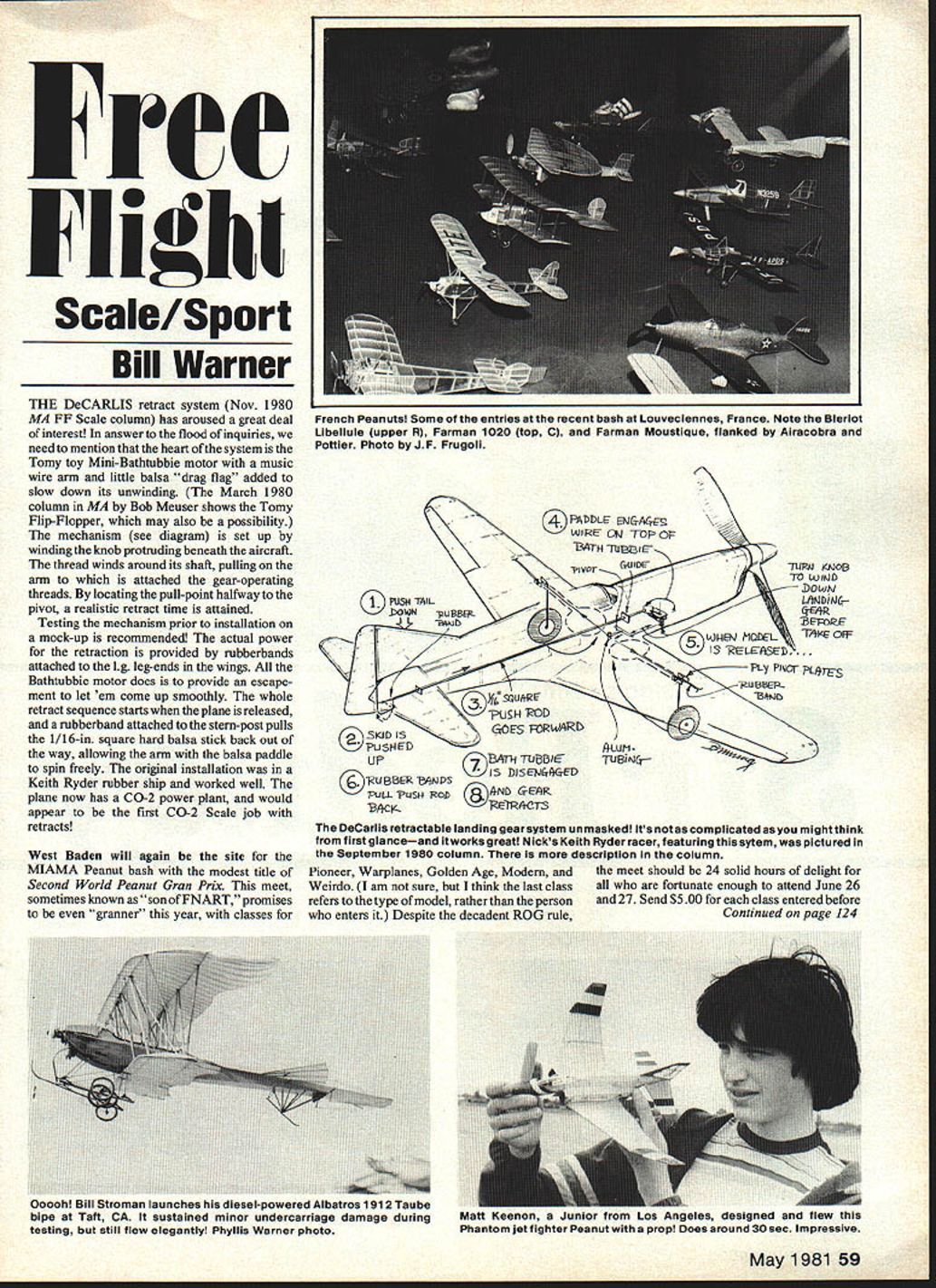
The DeCarlis retract system (Nov. 1980 MA FF Scale column) has aroused a great deal of interest. In answer to the flood of inquiries, the heart of the system is the Tomy toy Mini-Bathtubbie motor with a music-wire arm and a little balsa "drag flag" added to slow down its unwinding. (The March 1980 column in MA by Bob Meuser shows the Tomy Flip‑Flopper, which may also be a possibility.)
The mechanism is set up by winding the knob protruding beneath the aircraft. The thread winds around its shaft, pulling on the arm to which the gear-operating threads are attached. By locating the pull point halfway to the pivot, a realistic retract time is attained. Testing the mechanism prior to installation on a mock-up is recommended. The actual power for the retraction is provided by rubber bands attached to the leg ends in the wings; the Bathtubbie motor provides an escapement to let them come up smoothly.
The whole retract sequence starts when the plane is released and a rubber band attached to the stern post pulls the 1/16-in. square hard balsa stick back out of the way, allowing the arm with the balsa paddle to spin freely. The original installation was in a Keith Ryder rubber ship and worked well. The plane now has a CO2 power plant and would appear to be the first CO2 Scale job with retracts.
MIAMA Peanut bash — Second World Peanut Grand Prix
West Baden will again be the site for the MIAMA Peanut bash, modestly titled the Second World Peanut Grand Prix. This meet, sometimes known as "son of FNART," promises to be even grander this year, with classes for:
- Pioneer
- Warplanes
- Golden Age
- Modern
- Weirdo
(I'm not sure, but I think the last class refers to the type of model, rather than the person who enters it.) Despite the decadent ROG rule, the meet should be 24 solid hours of delight for all who are fortunate enough to attend June 26 and 27.
Send $5.00 for each class entered before May 15 to: Mike Arak, 10900 S.W. 61 Ct., Miami, FL 33156. Add $1 for each extra plane in any one class. You'll receive a complete information packet, including instructions on how to send your model for a proxy flyer to enjoy. In case your model isn't finished, they'll refund your entry fee.
Frank Zaic yearbook reissue
Just when you thought your collection of Frank Zaic's famous yearbooks was complete, out comes a "new" one. Frank is not taking retirement seriously and has compiled a wonderful tome called simply the 1934 Junior Aeronautics Year Book. It is more than a simple yearbook and includes several fantastic Jasco catalogs from the Thirties, as well as issues number one and two of Model Aviation (did you know Frank founded this magazine?). A 1937 issue of Model Aeronautics and an interesting autobiographical history of the yearbooks make this a must for any modeler. Some models and technical information may seem superseded and quaint now, but you'll be amazed at how far advanced the art was in those days.
Send $5.50 to M.A.P., Box 135, Northridge, CA 91324.
Jacques Pouliquen Memorial contest
The Jacques Pouliquen Memorial contest held in Nice, France was won this year by E. Fillon (winner of the 1937 Wakefield), flying a Gossamer Condor under the 9‑in. length rules they are using. Second was Christian Frugoli with a MacReady Mojave, ancestor of the Condor. It seems that the days of indoor Scale models that are not of the super-light "man-powered" variety are numbered unless that type of plane is given its own separate class, or we return to the "Peanut means 13‑in. span, and that's that!" way of doing business.
Electric Scale news
On the electric front, there is some good news and some bad news. The bad news is that there were very few entries in the 1981 Astro‑Flight Annual Electric Champs at Mile Square in the FF Scale category. The reason is not readily apparent, though the lousy January weather at the past two years' meets may have had something to do with it.
Ferrell Papic's Bleriot tandem (a No. 7, I think) flew in its usual fantastic fashion at its one‑pound weight. For those who think a heavy electric ship is a turkey, seeing this beauty fly is an education. My new Paulhan‑Tatin Aero‑Torpille, at 9½ oz. and about 250 sq. in. of wing, flew well, the Astro‑02 being an ideal power plant for a shaft‑driven prop mounted aft. Art Herbon's Berkeley Fairchild 24 looked great in the air, too.
There are a number of outstanding electric Scale ships which did not have a perfect day's flying, and to all of you who have yet to try electric Scale, all I can say is that you are really missing out. You'll soon come to believe that the initial cost for motor, Ni‑Cads, and charger will be worth the savings in frayed nerves caused by balky piston engines and snapping rubber motors. Besides that, the flights are smoother, with no big transition difficulties.
New Astro‑Flite power pack
Bob Boucher (pronounced "boo‑shay") at Astro‑Flite has just come out with a house‑current‑operated power pack which fits the popular cigarette‑lighter, plug‑in 12V charger most everyone is using. It enables you to break in your electric motor on the bench (an hour or two helps it) and saves you the run out to the driveway every time you want to test something on a plane you're building. You can do without it, but it's a nice present for the "man who has everything."
By the way, the Astro‑02 is about the most reliable and most powerful setup for an under‑a‑pound model of generous proportions (250–300 sq. in.) available today. It weighs about 4 oz., minus prop.
Thanks for the letters, cards, and pix. Keep 'em flying!
Bill Warner 423‑C San Vicente Blvd., Santa Monica, CA 90402.
Transcribed from original scans by AI. Minor OCR errors may remain.

