
Free Flight: Scale/Sport
Bill Warner
Volunteers needed — John Preston wants you
Volunteers with some Scale savvy will be in great demand this year, with the Nats split between Seguin, TX and West Baden, IN. If you will be at either event (or know someone who will), consider joining the "Good Guy Squadron" to help with judging, timing, or general officiating. It's a great chance to get hands-on with those little beauties — almost like holding a tape measure at a Miss America Pageant.
Another idea: a single club could take on running one Scale event. Don't wait — call John Preston:
- Evenings: (703) 532-2417
- Daytime: (301) 492-6604
The National Association of Scale Aeromodelers is doing a bang-up job and deserves our support in promoting Scale.
TWA (Thermal Worthy Aircraft) of the month
The TWA award goes to Mike Keville, who managed to thermal and lose a Peanut F6F Hellcat (built from a Gene DuBois kit) near Riyadh, Saudi Arabia. Rumor has it the plane was mistaken for a hostile intruder and shot down over the Persian Gulf. After a 12-minute OOS, Mike visited Gene DuBois' factory in Acushnet, MA; Gene gave him a free replacement kit (and the Victoria Cross, figuratively speaking).
Electric power — try something different
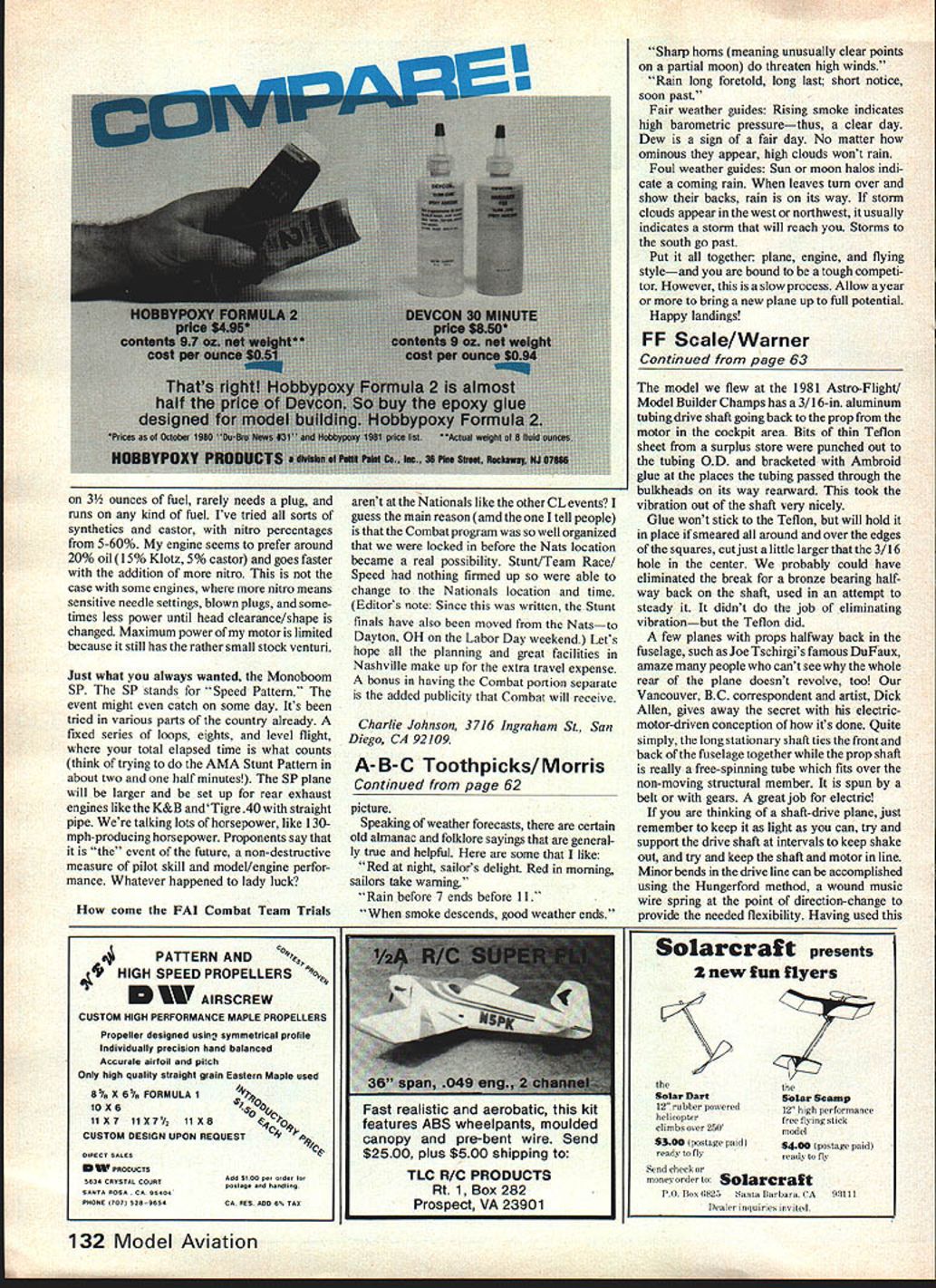
Free yourself from the conventional planes you've been building and give electric power a chance. Without worrying about flipping a prop, rubber-motor weight distribution, or synchronizing multiple motors, new configurations make sense — driving through a shaft becomes natural and pushers like the Paulhan-Tatin 1911 suddenly look practical.
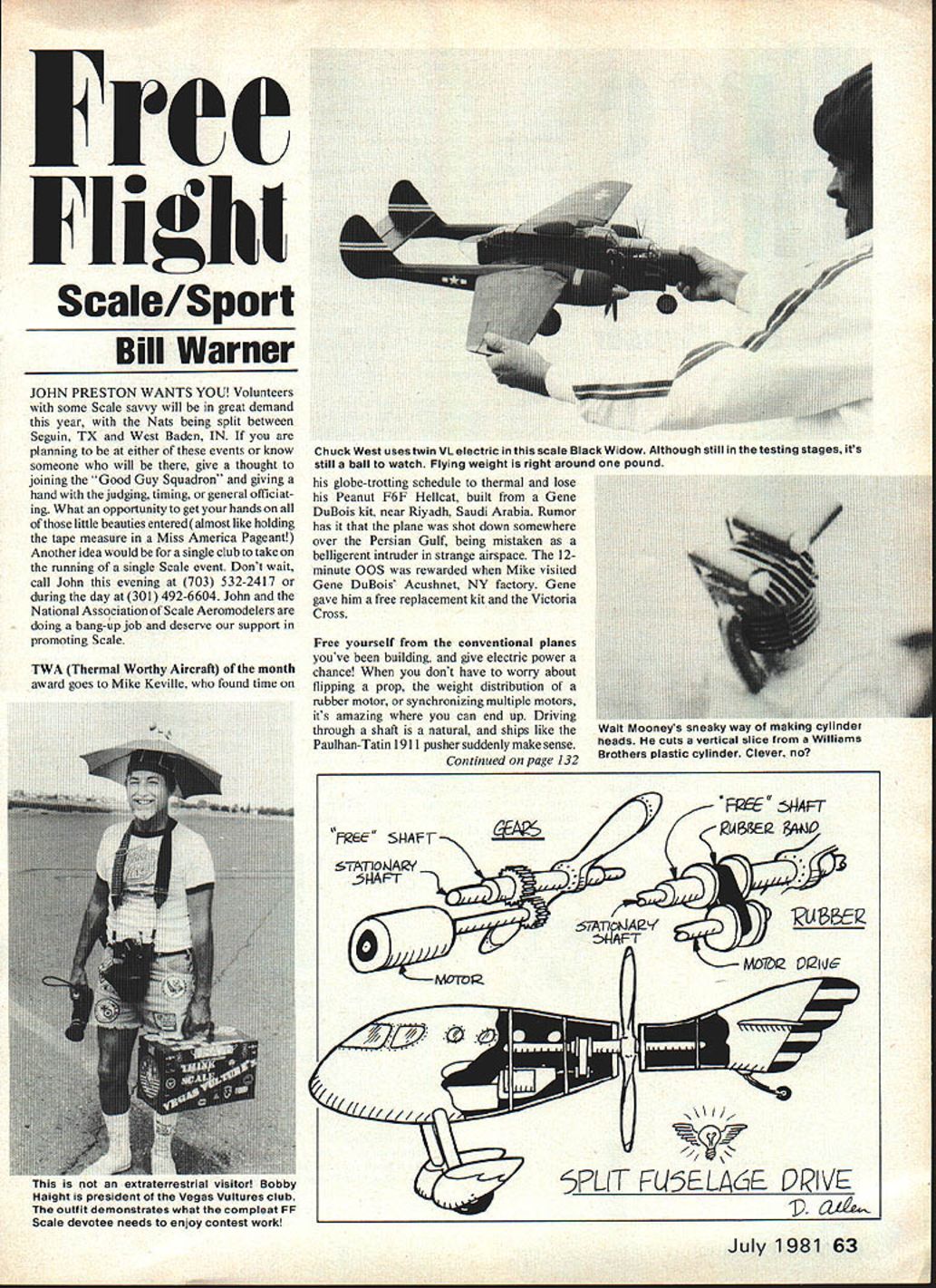
Chuck West has been flying a twin-V electric scale Black Widow (still in testing). Flying weight is roughly one pound and it's a lot of fun to watch.
Engine fuels and tuning notes
Many small engines will run well on a variety of fuels. Notes from contest experience:
- Typical run: about 3–3½ ounces of fuel, often without plug problems.
- Fuels tried: various synthetics and castor blends, nitro from 5% to 60%.
- A commonly preferred mix: roughly 20% oil total (for example, 15% Klotz synthetic + 5% castor).
- More nitro often increases speed, but on some engines higher nitro makes needle settings more sensitive, causes blown plugs, or reduces power until head clearance/shape is changed.
- Maximum power can be limited by a small stock venturi on many motors.
Monoboom SP (Speed Pattern)
Just what you always wanted: the Monoboom SP. SP stands for "Speed Pattern." The event has been tried in various parts of the country. Format: a fixed series of loops, eights, and level flight where total elapsed time counts (think of doing the AMA Stunt Pattern in about 2½ minutes). SP planes will be larger and set up for rear-exhaust engines (K&B, Tigre .40) with straight pipes — lots of horsepower and high speed (130-mph-producing power quoted). Proponents say it's a non-destructive measure of pilot skill and model/engine performance.
FAI Combat Team Trials and the Nats
Why aren't the FAI Combat Team Trials at the Nationals like other CL events? The Combat program was well organized and locked in before the Nats location became firm, so it stayed separate. Stunt, Team Race, and Speed were not yet settled and were moved to match the Nationals. (Editor's note: since this was written, the Stunt finals have also been moved from the Nats — to Dayton, OH on Labor Day weekend.)
A benefit of holding Combat separately is added publicity for the event. Mail Combat entries or inquiries to:
- Charlie Johnson, 3716 Ingraham St., San Diego, CA 92109
Shaft-drive and construction tips
If you're considering a shaft-drive plane, keep it light, support the drive shaft to prevent vibration, and try to keep the shaft and motor aligned. Useful techniques and examples:
- Teflon bushings
- At the 1981 Astro-Flight/Model Builder Champs we used 3/16" aluminum tubing for the prop shaft. Thin Teflon sheet punched to the tubing O.D. and glued (Ambroid) to the bulkhead holes eliminated most vibration where the tubing passed through bulkheads. Glue doesn't stick to Teflon, but a smear around the edges holds the squares in place.
- A mid-shaft bronze bearing had been tried but did not eliminate vibration as well as the Teflon pads.
- Nesting tubing "U-joint"
- To allow minor misalignments on the Paulhan-Tatin shaft, nesting aluminum tubing was used to build up the motor-shaft attachment. After grinding a flat on the steel motor shaft, short tubing pieces were stacked, crimped, and Hot-Stuffed. A hole large enough for a straight pin was drilled through the tubing; a pin through the assembly (bent over to secure) provided a simple, slightly flexible joint. Wiggling the tubing a bit opened it enough to allow true running under slight misalignment.
- Hungerford method for minor bends
- Use a wound music-wire spring at the point of direction change to give flexibility. This can provide about a 10° change and worked well with a fairly weak electric motor. Support the shaft just before and after the flexible section to prevent whipping.
- Rubber-band drives — caveats
- Driving through rubber bands can work, but expect weakening and eventual breakage; starting torque often snaps them.
- General advice
- Support the drive shaft near direction changes and bearings.
- Keep the system as light and straight as practical.
Miscellaneous building tips
- Insertable semi-bulkhead (George "Von Toot" Meyer)
- For circular-section fuselages, thread a thin strip of model-railroad basswood around inside the stringers midway between bulkheads. Expand and glue it to the stringers to create a lightweight hoop that prevents after-covering sag. Tested with Hinoki-wood strips and highly recommended. Caution: don't over-expand the hoop or you may swap one problem for another.
- E-Z Bill bulkhead (Walt Mooney)
- Wrap a dowel with masking tape until you reach just under the diameter of the largest bulkhead needed. Wrap thin basswood strips around the taped dowel and tack with Hot Stuff top and bottom to form a laminated hoop. Remove the hoop, place it over the plan, pinch to fit any ovaloid shape, and finish with Hot Stuff. Unwrap a few tape layers and repeat to make progressively smaller bulkheads. This yields pre-stressed, laminated former plugs quickly and easily.
Final notes
Support Scale events and volunteer when you can — people like John Preston and the National Association of Scale Aeromodelers need help to keep these contests running well. If you experiment with electric or shaft-drive designs, share your results — the community learns fast from practical field experience.
Transcribed from original scans by AI. Minor OCR errors may remain.

